3 Apr 2014 | Denmark, News, Politics and Society, Turkey
Kurdish broadcaster Roj TV has lost another battle in its long and controversial fight to stay on air. Denmark’s Supreme Court last month ruled to uphold the ban on the Kurdish-language broadcaster, which had been transmitting programs from Denmark to Europe and the Middle East since 2004. Roj TV’s former director, Imdat Yilmaz has announced plans to take the case to the European Court of Human Rights (ECHR).
The broadcaster had long been a sore spot in relations between Denmark and Turkey, with the latter viewing the broadcaster as a mouthpiece for the Kurdistan Worker’s Party (PKK) – which is considered a terrorist organisation by the US and EU. However Kurds – a minority group making up between 10 and 23 per cent of the Turkish population – have long felt the heavy hand of the Turkish state on their language and culture.
Since the station’s launch, Turkey’s radio and TV authority – the ominously named Radio and Television Supreme Council – made a number of formal complaints to Denmark against the broadcaster. These had, until 2010, been dismissed by Denmark’s Radio and Television Board on the basis that “contested clips do not contain, in the opinion of the Board, incitement to hatred due to race, nationality, etc. In more than one clip, democracy, democratic solutions, democratic revolution and the like are even mentioned.”
But in 2010, Danish authorities did bring criminal charges against Roj TV – on the grounds that it was promoting terrorism. Roj TV was then convicted in 2012 by the Copenhagen City Court.
But controversially, Denmark’s decision to prosecute Roj TV on these charges was detailed in a leaked official document. The diplomatic document appearing to describe a deal struck between Turkish authorities and the then Danish Prime Minister – offering the closure of Roj TV in exchange for Turkey supporting the appointment of the then Prime Minister Anders Fogh Rasmussen to NATO secretary general in 2009.
The document refers to the Danish Radio and Television Board’s failure to find incitement to hatred or violence in Roj TV’s content, and so urges for Danish authorities to “think creatively about ways to disrupt or close the station, should criminal prosecution prove unachievable in the short term.”
Also mentioned is the need for “…some new evidence or approach that can shield them against charges of trading principle for the former prime minister’s career.”
Rasmussen, who is now NATO secretary general, has denied agreeing to shut the station.
The Wikileak document can be read in full here.
Roj TV have admitted maintaining contacts with to the PKK, but deny they are a mouthpiece for the organisation, or that they received funding from it. The station’s former general manager, Manouchehr Tahsili Zonoozi, has previously commented: “We are an independent Kurdish broadcaster. Our job is to be journalists.”
Last month’s decision by Denmark’s Supreme Court marks a line of increasingly punitive rulings against the broadcaster. The legal battle started with just a fine in the Copenhagen City Court in 2012 – the court found no legal basis to follow the prosecution’s recommendation that the station’s broadcasting license be revoked.
The appeal to the Eastern High Court in 2013 saw its broadcasting rights confiscated indefinitely and the existing fine increased, causing Roj TV and its parent company to file for bankruptcy.
Now that the ruling has been upheld by Denmark’s Supreme Court, the station plans to take the case to the ECHR, with Roj TV’s former director Imdat Yilmaz telling Danish newspaper Arbejderen that he hopes “instead of connecting Roj TV to ‘terrorism,’ the court may relate it to ‘freedom of speech”.
Kurdish-language programmes were banned in Turkey until 2002 and, until 2008, Kurdish-language programs were restricted to 45 minutes per day. TRT 6, Turkey’s first Kurdish-language station and part of the Turkish Radio and Television Corporation, was launched in 2008 and broadcasts Kurdish programmes that promote the Turkish state and counter PKK.
This article was posted on April 3, 2014 at indexoncensorship.org
31 Mar 2014 | News, Russia
Punitive psychiatric treatment is returning to Russia. This is a throw back to Soviet times, with opposition activists condemned by a kangaroo court to bogus psychiatric treatment courses, with no chance of release until a doctor says so.
Mikhail Kosenko, 39, last week became the highest profile case when he lost his appeal case against enforced psychiatric treatment. As such he will be interned immediately at a state-owned medical facility in Moscow. At worst, his sentence could be for life, with no chance of parole, as his release depends on vaguely described criteria. His assessment will also be made by doctors whose political neutrality is not guaranteed.
In 2012, Kosenko was arrested by Moscow police after taking part in a peaceful protest against Putin in Bolotnoya Square. Charged with rioting, he spent much of the next twenty two months behind bars. When his sentence was read out in court last October, his sister Kseniya, told the BBC : “I have an awful feeling. There are really frightening stories about what goes on in these places.”
Kseniya describes her brother as “a very quiet, homely type of guy.” She confirms various inspecting doctors reporting that he’s very shy – “shunning any kind of violence.”
Kosenko did have a pre-existing psychiatric condition when he was arrested – slow on-set schizophrenia diagnosed in 2001. But after medication and good advice, the condition was very much under control. Kosenko had never shown any tendency to be violent, according to his doctors.
Tanya Lokshina, Russia Program Director and Senior Researcher at Human Rights Watch, opposes the ruling.
“Mikhail’s case simply reminds me of the Soviet Union,” Lokshina warns. She tells how punitive psychiatry was a tool that was rarely used, but always with devastating effect. “Back then the medications used were really heavy, they were designed to slow down movements and just keep you out of the way.”
It’s impossible know exactly what treatments are now in store for Kosenko. But whatever is to come, it will only end if Kosenko dies, renounces his politics, or wins a final case of appeal at the Supreme Court. This is his last chance, but it could be some time. Lokshina remembers that when Pussy Riot took an appeal case to the Supreme Court, they had to wait a year before their case was heard. In the meantime, Kosenko’s treatment will continue.
The only medical evaluation the court heard was conducted by the Serbsky Institute in Moscow. Their crebility was disputed by medical experts, including the head of Russia’s Independent Psychiatric Association, when they noted that the assessment had completely omitted any reference to Kosenko’s successful ten years of self-medication, with no history of violence. Serbsky Insitute is also owned and operated by the state. The judge threw out a petition to have a second medical assessment.
Lokshina tells me there have been a few cases recently – but this is by far the worst. Amnesty International call it “an abhorrent return to Soviet-era practices.” The weeping sister of Kosenko told the BBC she felt “physically sick” when she heard that her brother had been found guilty.
Putin is turning to medieval, desperate measures as he balances himself on a rattling economy, a tonne of debt and a country that is too big to govern. Those with the bitterest memories, like Ukraine, Poland and the Baltic states, fear a renewed bid to expand borders permanently, especially looking at adventures into Crimea.
But Putin is smarter. He must distract the population from a certain amount of oligarch asset-stripping and poor management, which has become epidemic under his reign. But he also must not overstretch or overspend. Enter the Roman strategy of “bread and circuses,” minus the bread.
Putin’s inaugural circus took place during the Georgia invasion in 2008, and according to Mark Adomanis remembering the war in Forbes magazine “bathed Russia in a warm patriotic glow.” Putin’s ratings took a generous bump as a result.
But Admonanis predicted, just two months ago, that Putin’s ratings would have dipped by the end of this year. The economy was weak and Sochi had been a slightly uncomfortable experience for anyone even remotely Russian.
Sadly Adomanis, nor anyone outside Putin’s inner circle, could not reasonably have predicted Putin’s subsequent gamble in Crimea.
The incursion has seen approval ratings leap from sixty five to eighty percent almost over-night. That is an extraordinary success.
Yet while Crimea has been a successful though highly irritating move, Putin’s political future is still at risk. The balance of world media commentary has been unapproving. The lies he is telling about dangerous neo-Nazi gangs have been proved as untruths, journalists have exposed the role of vicious nationalist thugs (on the Russian side), and Putin’s cheeky disregard for international law condemned. His domestic woes also go on regardless – senior officials within the Kremlin admit that the capital outflows and fall in the stockmarket are far greater than they had forecast. There certainly isn’t any capacity for “bread.”
Facing criticism at home and abroad – Putin turns to censorship and propaganda to secure himself domestically and reap political reward out of Crimea. Any oppositionist media has been bloodily censored. Reports of self-censorship are leaking out from the remaining clutch of titles.
There are three varieties of public criticism which particularly irk Putin. First, a human rights group can get hold of and successfully publicise a story (Kosenko). Second, a one-off event focuses the world on Russia (Sochi). The third is that Russian activists go out onto the streets (again Kosenko’s case, see also Pussy Riot).
In each scenario, Putin potentially loses. But he’s developed mitigation strategies. The first is to denounce foreign criticism as biased and baseless. The second is to claim it’s-a-great-big-Western-plot-we’re-the-victims-don’t-worry-Putin-here-will-rescue-you. The third is to allow some freedom of speech, but only as an opposition release valve. The fourth is to treat protesters like animals.
Street-marches are targeted by violent thugs, who act with suspicious impunity. But it’s the judiciary, and their shoddy self-discipline, who play the more important role. There were serious judicial errors in Kosenko’s case. Other victims have seen key witnesses prevented from giving testimony. Or biased “expert opinions.” Or paid goons threatening the families of the accused.
Putin’s actions abroad might bring back memories of Communist Russia, but Putin probably doesn’t see it this way. Putin needs the circuses of Georgia and Crimea, even if he can’t afford bread back home. He has also applied a blanket of censorship on the media.
Now Putin is turning to psychiatric institutions in a bid to remain in power.
This article was published on March 31, 2014 at indexoncensorship.org
20 Feb 2014 | Europe and Central Asia, News, United Kingdom
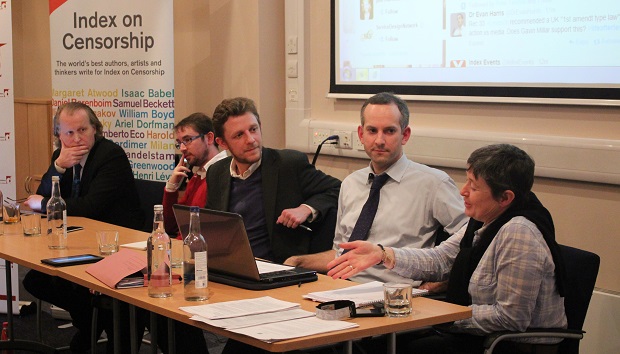
The panel from left to right: Gavin Millar QC, Tom Phillips, Padraig Reidy, Jonathan Heawood and Gill Phillips (Image: Georgia Hussey)
A new press regulator, with or without statutory underpinnings, would not stop another scandal like phone hacking from happening, an Index on Censorship panel said yesterday. The panel, consisting of Gill Phillips (Legal Director, Guardian Media Group), Gavin Millar QC (Doughty Street Chambers), Jonathan Heawood (Director of the Impress Project), and Tom Phillips (Senior Writer, Buzzfeed UK), chaired by Padraig Reidy, spoke at a Doughty Street Chambers and Index on Censorship debate on press freedom in the UK after the Leveson inquiry.
“In terms of the institutions that failed over phone hacking, the Press Complaints Commission doesn’t even make it onto the podium,” said Tom Phillips. “So the idea that any kind of regulation was ever intended to be the solution to this is missing a whole bigger picture.”
If you set up a system to stop something “human ingenuity and imagination” will find a way to get around it, said Gavin Millar QC. He added that the best regulation “has to come from the heart”, and was worried about the complicated rules surrounding regulation taking the responsibility away from those “who are putting the stuff out.”
Jonathan Heawood argued that we can make press abuses “less likely” though a “good, intelligent, intelligently applied regulator” and “sufficiently enforced, sufficiently clear sanctions”. He added that regulation is “part of the solution” to improve conditions allowing public interest journalism to flourish.
Press regulation took centre stage at the event, but wider issues of press freedom were also discussed. Gavin Millar pointed out how the UK’s debate on press freedom and press regulation may be perceived in authoritarian countries, while Tom Phillips warned that ignoring the evolving social norms of the internet age bad is for press freedom. Gill Phillips argued that while the UK isn’t as bad on press freedom as some other countries, “where we’re going” and “the threat of criminalisation that effects every day journalism” is worrying.
The event took place ahead of the release of Index on Censorship’s policy paper Life after Leveson: British media freedom in 2014. The paper acknowledges that the recent change in libel law was good for this country’s press freedom, “the record of successive governments have been far from perfect” and “there are still several areas where this government can act to safeguard the free press and free speech more broadly in the coming year.”
It was a timely discussion, as yesterday the High Court dismissed David Miranda’s challenge to his detention at Heathrow under the Terrorism Act in August. It was also the day former News of the World editor Rebekah Brooks took the stand in the ongoing hacking trial.
“The [Miranda] judgement has some wide ranging views downgrading journalism in the 20th century that I find personally bizarre,” said Philips. Millar said the judgement shows how the “remaining tendency of government using the possibility of court proceedings against newspapers to stifle the publication of state secrets” has a “chilling effect” on press freedom.
The sold-out event encouraged audience interaction, which made for a lively and at times heated, debate. One comment from the floor argued the panel had missed the point — that the debate was about press abuses, and a regulator was the minimum step that had to be taken. Another audience member questioned the press calling for regulation of other industries, but not wanting to be regulated themselves. The Guardian’s Roy Greenslade argued that we need to separate those issues of press abuse that can be tackled through the law and those that must be tackled by self-restraint on the part of the media. Observer columnist Peter Preston said the Royal Charter regulator would be part of a “conspiracy of chaps”.
The discussion also took place on Twitter, under the hashtag #LifeAfterLeveson
This article was published on 20 February 2014 at indexoncensorship.org
15 Jan 2014 | Europe and Central Asia, European Union, Index Reports, News, Politics and Society
This article is part of a series based on our report, Time to Step Up: The EU and freedom of expression
Beyond its near neighbourhood, the EU works to promote freedom of expression in the wider world. To promote freedom of expression and other human rights, the EU has 30 ongoing human rights dialogues with supranational bodies, but also large economic powers such as China.
The EU and freedom of expression in China
The focus of the EU’s relationship with China has been primarily on economic development and trade cooperation. Within China some commentators believe that the tough public noises made by the institutions of the EU to the Chinese government raising concerns over human rights violations are a cynical ploy so that EU nations can continue to put financial interests first as they invest and develop trade with the country. It is certainly the case that the member states place different levels of importance on human rights in their bilateral relationships with China than they do in their relations with Italy, Portugal, Romania and Latvia. With China, member states are often slow to push the importance of human rights in their dialogue with the country. The institutions of the European Union, on the other hand, have formalised a human rights dialogue with China, albeit with little in the way of tangible results.
The EU has a Strategic Partnership with China. This partnership includes a political dialogue on human rights and freedom of the media on a reciprocal basis.[1] It is difficult to see how effective this dialogue is and whether in its present form it should continue. The EU-China human rights dialogue, now 14 years old, has delivered no tangible results.The EU-China Country Strategic Paper (CSP) 2007-2013 on the European Commission’s strategy, budget and priorities for spending aid in China only refers broadly to “human rights”. Neither human rights nor access to freedom of expression are EU priorities in the latest Multiannual Indicative Programme and no money is allocated to programmes to promote freedom of expression in China. The CSP also contains concerning statements such as the following:
“Despite these restrictions [to human rights], most people in China now enjoy greater freedom than at any other time in the past century, and their opportunities in society have increased in many ways.”[2]
Even though the dialogues have not been effective, the institutions of the EU have become more vocal on human rights violations in China in recent years. For instance, it included human rights defenders, including Ai Weiwei, at the EU Nobel Prize event in Beijing. The Chinese foreign ministry responded by throwing an early New Year’s banquet the same evening to reduce the number of attendees to the EU event. When Ai Weiwei was arrested in 2011, the High Representative for Foreign Affairs Catherine Ashton issued a statement in which she expressed her concerns at the deterioration of the human rights situation in China and called for the unconditional release of all political prisoners detained for exercising their right to freedom of expression.[3] The European Parliament has also recently been vocal in supporting human rights in China. In December 2012, it adopted a resolution in which MEPs denounced the repression of “the exercise of the rights to freedom of expression, association and assembly, press freedom and the right to join a trade union” in China. They criticised new laws that facilitate “the control and censorship of the internet by Chinese authorities”, concluding that “there is therefore no longer any real limit on censorship or persecution”. Broadly, within human rights groups there are concerns that the situation regarding human rights in China is less on the agenda at international bodies such as the Human Rights Council[4] than it should be for a country with nearly 20% of the world’s population, feeding a perception that China seems “untouchable”. In a report on China and the International Human Rights System, Chatham House quotes a senior European diplomat in Geneva, who argues “no one would dare” table a resolution on China at the HRC with another diplomat, adding the Chinese government has “managed to dissuade states from action – now people don’t even raise it”. A small number of diplomats have expressed the view that more should be done to increase the focus on China in the Council, especially given the perceived ineffectiveness of the bilateral human rights dialogues. While EU member states have shied away from direct condemnation of China, they have raised freedom of expression abuses during HRC General Debates.
The Common Foreign and Security Policy and human rights dialogues
The EU’s Common Foreign and Security Policy (CFSP) is the agreed foreign policy of the European Union. The Maastricht Treaty of 1993 allowed the EU to develop this policy, which is mandated through Article 21 of the Treaty of the European Union to protect the security of the EU, promote peace, international security and co-operation and to consolidate democracy, the rule of law and respect for human rights and fundamental freedom. Unlike most EU policies, the CFSP is subject to unanimous consensus, with majority voting only applying to the implementation of policies already agreed by all member states. As member states still value their own independent foreign policies, the CFSP remains relatively weak, and so a policy that effectively and unanimously protects and promotes rights is at best still a work in progress. The policies that are agreed as part of the Common Foreign and Security Policy therefore be useful in protecting and defending human rights if implemented with support. There are two key parts of the CFSP strategy to promote freedom of expression, the External Action Service guidelines on freedom of expression and the human rights dialogues. The latter has been of variable effectiveness, and so civil society has higher hopes for the effectiveness of the former.
The External Action Service freedom of expression guidelines
As part of its 2012 Action Plan on Human Rights and Democracy, the EU is working on new guidelines for online and offline freedom of expression, due by the end of 2013. These guidelines could provide the basis for more active external policies and perhaps encourage a more strategic approach to the promotion of human rights in light of the criticism made of the human rights dialogues.
The guidelines will be of particular use when the EU makes human rights impact assessments of third countries and in determining conditionality on trade and aid with non-EU states. A draft of the guidelines has been published, but as these guidelines will be a Common Foreign and Security Policy document, there will be no full and open consultation for civil society to comment on the draft. This is unfortunate and somewhat ironic given the guidelines’ focus on free expression. The Council should open this process to wider debate and discussion.
The draft guidelines place too much emphasis on the rights of the media and not enough emphasis on the role of ordinary citizens and their ability to exercise the right to free speech. It is important the guidelines deal with a number of pressing international threats to freedom of expression, including state surveillance, the impact of criminal defamation, restrictions on the registration of associations and public protest and impunity against human right defenders. Although externally facing, the freedom of expression guidelines may also be useful in indirectly establishing benchmarks for internal EU policies. It would clearly undermine the impact of the guidelines on third parties if the domestic policies of EU member states contradict the EU’s external guidelines.
Human rights dialogues
Another one of the key processes for the EU to raise concerns over states’ infringement of the right to freedom of expression as part of the CFSP are the human rights dialogues. The guidelines on the dialogues make explicit reference to the promotion of freedom of expression. The EU runs 30 human rights dialogues across the globe, with the key dialogues taking place in China (as above), Kazakhstan, Kyrgyzstan, Tajikistan, Turkmenistan, Uzbekistan, Georgia and Belarus. It also has a dialogues with the African Union, all enlargement candidate countries (Croatia, the former Yugoslav republic of Macedonia and Turkey), as well as consultations with Canada, Japan, New Zealand, the United States and Russia. The dialogue with Iran was suspended in 2006. Beyond this, there are also “local dialogues” at a lower level, with the Heads of EU missions, with Cambodia, Bangladesh, Egypt, India, Israel, Jordan, Laos, Lebanon, Morocco, Pakistan, the Palestinian Authority, Sri Lanka, Tunisia and Vietnam. In November 2008, the Council decided to initiate and enhance the EU human rights dialogues with a number of Latin American countries.
It is argued that because too many of the dialogues are held behind closed doors, with little civil society participation with only low-level EU officials, it has allowed the dialogues to lose their importance as a tool. Others contend that the dialogues allow the leaders of EU member states and Commissioners to silo human rights solely into the dialogues, giving them the opportunity to engage with authoritarian regimes on trade without raising specific human rights objections.
While in China and Central Asia the EU’s human rights dialogues have had little impact, elsewhere the dialogues are more welcome. The EU and Brazil established a Strategic Partnership in 2007. Within this framework, a Joint Action Plan (JAP) covering the period 2012-2014 was endorsed by the EU and Brazil, in which they both committed to “promoting human rights and democracy and upholding international justice”. To this end, Brazil and the EU hold regular human rights consultations that assess the main challenges concerning respect for human rights, democratic principles and the rule of law; advance human rights and democracy policy priorities and identify and coordinate policy positions on relevant issues in international fora. While at present, freedom of expression has not been prioritised as a key human rights challenge in this dialogue, the dialogues are seen by both partners as of mutual benefit. It is notable that in the EU-Brazil dialogue both partners come to the dialogues with different human rights concerns, but as democracies. With criticism of the effectiveness and openness of the dialogues, the EU should look again at how the dialogues fit into the overall strategy of the Union and its member states in the promotion of human rights with third countries and assess whether the dialogues can be improved.
[1] It covers both press freedom for the Chinese media in Europe and also press freedom for European media in China.
[2] China Strategy Paper 2007-2013, Annexes, ‘the political situation’, p. 11
[3] “I urge China to release all of those who have been detained for exercising their universally recognised right to freedom of expression.”
[4] Interview with European diplomat, February 2013.