26 Jul 2021 | News, United Kingdom, Volume 50.02 Summer 2021, Volume 50.02 Summer 2021 Extras
[vc_row][vc_column][vc_single_image image=”117131″ img_size=”full” add_caption=”yes”][vc_column_text]
Picture the scene.
I’m driving a pick-up truck. I’m dressed in a high-vis jacket and white overalls and in the back is a tonne of manure. On the side of the pick-up is the logo “BS Industries UK”. We drive up to and block the front entrance to the Houses of Parliament, immediately drawing a bevy of armed police officers (or, as I like to call them, “supporting artists”) towards us.
“You can’t park here!”
I explain that this is “Grade A bullshit” and that “the MPs ran out of bullshit so they need a fresh batch to feed to the public”.
The prank, filmed in 2013 as part of the promotional campaign for the second series of our Bafta-winning BBC show The Revolution Will Be Televised, was an expression of that quintessentially British tradition of using satire as a tool of protest. Creative direct action dressed up as a comedy sketch, if you will.
For me there is nothing more British than using satire that laughs at the powerful, and that in a very minor way holds the powerful to account. But under clause 59 of the Police, Crime, Sentencing and Courts Bill which is going through the UK parliament now public nuisance is being criminalised and I could get 10 years in jail for such a prank! Ten. Years. In. Jail. I know that’s not the funniest joke but come on…!
History teaches us that things don’t change if the status quo is not disrupted and the intention appears to be to create an environment where you can make a lot of noise, as long as you stay in your lane, but where any movement deemed effective at changing hearts and minds and making a real difference is criminalised.
The passing of the PCSB in Parliament signals an active attack on this cornerstone of British democracy. Perhaps the significance of it is that freedom to speak truth to power without the fear of recrimination or criminal sanction is a British value as well as being a fundamental tenet of freedom of speech!
What does it feel like when the democracy you grew up in starts a gradual slide towards authoritarianism? Perhaps patriotism and flag-waving replace public debate. Perhaps the very fabric of public life starts to warp and change so that rational argument about policy is replaced by questions about how many national flags were printed on said policy paper. Perhaps the worse the state of the nation becomes, the more national greatness is invoked.
But what of those who question this new status quo? In societies where the ruling class wallows in corruption and enjoys total impunity, its enemies are a free press, and those who protest are criminalised. I’m not saying we are suddenly Myanmar. I’m not saying we are even Hungary. But maybe we are becoming Hungary-lite.
In a letter to the government in March co-ordinated by Liberty and Friends of the Earth, 245 organisations said the government’s proposals were cause for “profound concern”. The organisations highlighted numerous threats to our rights, including “draconian” police powers to restrict protests. The signatories represented a wide range of interests from Amnesty International to the Ramblers.
Hundreds of mainstream charities as well as groups such as Sisters Uncut, All Black Lives UK and Reclaim the Streets have committed to building a mass movement to resist the bill. But its protest and public order provisions could result in this very movement having its actions disproportionately criminalised for participating in peaceful activity. Even former prime minister Theresa May has voiced concerns over the proposed bill, insisting that the government has to walk a fine line between being “popular and populist”, and telling lawmakers that “our freedoms depend on it”.
It seems pertinent to ask if any amount of protest will be enough to stop the bill passing into law? The proposed law is indicative of a slide towards authoritarianism deeply at odds with the founding principles and traditions of the ruling Conservative party in the UK, and the democratic principles that many of us in the oldest democracy in the world hold so dear.
[/vc_column_text][three_column_post title=”You may also want to read” category_id=”8890″][/vc_column][/vc_row]
2 Sep 2020 | News
[vc_row][vc_column][vc_single_image image=”114690″ img_size=”full” add_caption=”yes”][/vc_column][/vc_row][vc_row][vc_column][vc_column_text]“The Hungarian public’s access to sources of balanced news and information is in greater danger than ever before.” This was the stark warning that Index on Censorship, alongside 15 other organisations, delivered to Executive Vice-President of the European Commission Margrethe Vestager today.
After a decade of Prime Minister Viktor Orban’s rule, Hungary’s media landscape is in turmoil. Last month, 70 of the approximately 90 journalists working at Index.hu – which had been considered one of the last major independent news outlets in Hungary – resigned after the editor-in-chief was fired by the company’s CEO.
“For years, we’ve been saying that there are two conditions for the independent operation of Index: that there be no external influence on the content we publish or the structure and composition of our staff. Firing Szabolcs Dull has violated our second condition. His dismissal is a clear interference in the composition of our staff, and we cannot regard it any other way but as an overt attempt to apply pressure on Index.hu,” the departing journalists wrote in an open letter.
“Index was the most widely read news website in Hungary,” explained András Pethő in an interview with Index on Censorship. Pethő is co-founder and senior editor at Direkt36, a small investigative journalism outlet that focuses on reporting abuses of power. “It was one of the few remaining independent news websites in Hungary. It was a kind of hub on the Hungarian internet: a lot of people started their day by checking Index.”
“The organisation, the outlet itself is still here. The whole staff resigned but they hired new people. There’s a new leadership and we’ll see what that looks like, how they will cover news, and how independent they will be,” said Pethő. “What happened is bad for basically everyone who is interested in independent journalism in Hungary.”
Before founding Direkt36, Pethő had been a reporter and editor at Origo.hu, one of the largest online news outlets alongside Index. But in 2014, Origo.hu’s editor-in-chief was abruptly replaced after an investigation was published about lavish expenses claimed by Orban’s chief of staff. “Basically we went through a pretty similar story [to Index],” said Pethő. “The whole project – Direckt36 – was born as a response to the negative environment.”
What happened at Index and Origo are just two examples of the Hungarian government’s efforts to undermine independent media in the country. Index on Censorship has reported regularly on Orban’s attacks on the media and has been particularly concerned by events of the last six months fearing that the Covid-19 crisis is being used as a distraction to further curtail media freedom. In this period, we have received reports of journalists being barred from press conferences, alongside other attacks that we have documented on our map.
But despite the government’s ongoing and strategic efforts to punish critical media and reward government mouthpieces, the EU has yet to meaningfully intervene. As highlighted by the signatories of today’s letter to Vestager, such efforts have included the misuse of state aid, which has resulted in two complaints being logged with the European Commission in 2016 and 2018 respectively. The first complaint relates to Hungary’s public service broadcaster which, despite having long ceased to meet international standards due to its clear pro-government bias, continues to receive state funding. The second relates to the distribution of state advertising to media outlets in Hungary.
Although it was a market leader, Index.hu had received virtually no state advertising in the years prior to the mass resignations. At the same time, its main competitor – the now pro-government Origo.hu, benefitted heavily. As stated in today’s letter, “the goal of these efforts is clear: to financially weaken independent media and hamper the production and dissemination of critical news.”
Pethő says that Direkt36 are among the organisations feeling the squeeze. “When we launched it in 2015 and when we had a bigger story, those stories were often picked up by several online news outlets, a couple of TV channels, radio stations… so it could travel quite widely in the Hungarian media,” he said.
“That space has been shrinking gradually more and more and now when we publish a bigger piece maybe it’s picked up by a couple of news websites, maybe there is a radio interview, maybe one TV channel. But it’s much less than what we had three, four or five years ago.”[/vc_column_text][/vc_column][/vc_row]
8 Apr 2020 | Hungary, News
[vc_row][vc_column][vc_column_text]
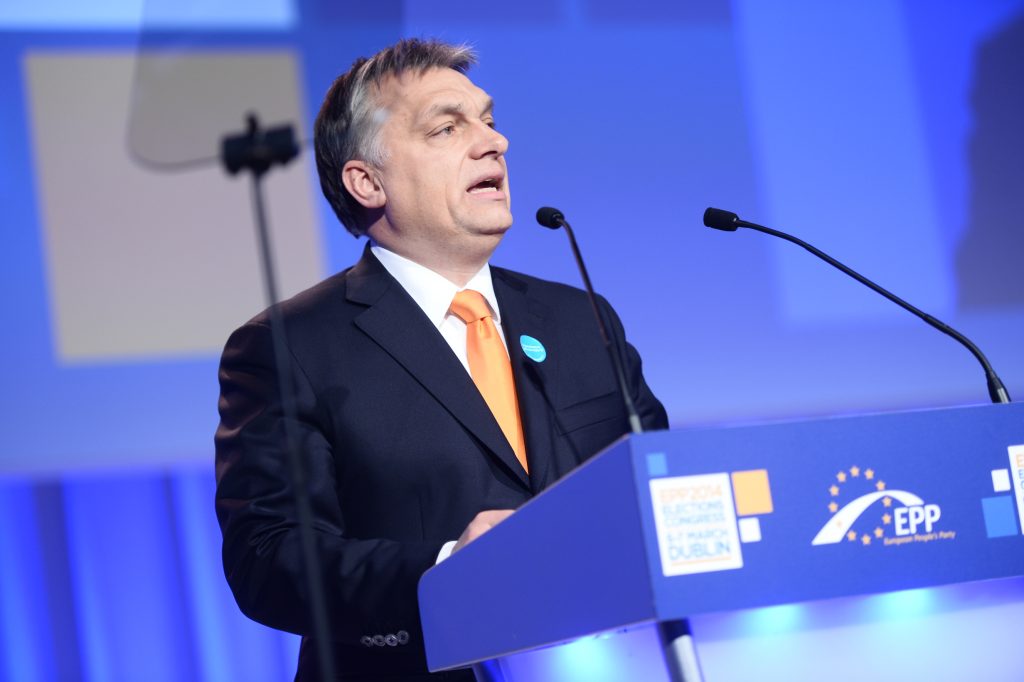
Viktor Orbán Credit: European People’s Party/Flickr
[/vc_column_text][vc_column_text]Hungary’s prime minister Viktor Orbán, leader of right-wing nationalist party Fidesz, has responded to the coronavirus crisis by pushing through sweeping emergency laws that have no time limit and have enormous potential to limit media freedom.
These laws essentially allow Orbán to rule by decree, which presents a huge threat to democracy and freedom of expression. While Index acknowledges that extraordinary measures need to be taken to protect lives, the passing of emergency laws of this nature for an indefinite time period was described in an Index statement as “an abuse of power”.
Under the emergency laws, journalists can be imprisoned for up to five years for publishing what the authorities consider to be falsehoods about the outbreak or measures taken to control it. But what exactly constitutes falsehoods is open to interpretation.
As Index notes, Hungary already has “one of the worst free speech records in Europe”. This further blow to journalists’ ability to report freely and objectively on the actions taken by the government is crippling for press freedom. It follows a pattern of state authorities infringing on press freedom under the guise of quashing “fake news” that Index has recorded happening globally in the wake of the crisis.
Transparency about the official numbers of those infected and those who have died from Covid-19 is critical for public safety. The scale of the outbreak will inform public behaviour and support for health services. Authoritarian regimes around the world such as North Korea and Turkmenistan have reported zero cases, the implausibility of which suggests censorship of the real figures by these countries’ despotic leaders.
Orbán is on the road to joining these leaders as, under the emergency laws, journalists are unable to hold the government to account over the accuracy of the data. Orbán has singular control of the public knowledge of the number of confirmed coronavirus cases, which, according to a government website, is 817 to date. See more here about this on the Index map tracking attacks on media freedom in Hungary.
Hungary’s neighbour Austria, which has a smaller population and recorded its first cases just 8 days before Hungary, has to date recorded 12,206 cases.[/vc_column_text][/vc_column][/vc_row][vc_row][vc_column][vc_basic_grid post_type=”post” max_items=”3″ grid_id=”vc_gid:1586344862424-03642fb1-d46b-2″ taxonomies=”4157″][/vc_column][/vc_row]
7 Aug 2018 | Campaigns -- Featured, Hungary, Statements
[vc_row][vc_column][vc_single_image image=”102023″ img_size=”full”][vc_column_text]Frans Timmermans, First Vice-President, European Commission
Mariya Gabriel, Commissioner, European Commission
Tibor Navracsics, Commissioner, European Commission
Antonio Tajani, President, European Parliament
7 August 2018
OPEN LETTER – Media freedom in Hungary and the case of Hir TV
The undersigned media freedom organisations are writing to draw your attention to the deteriorating situation of press and media freedom in Hungary, in particular the recent case of Hir TV.
Hir TV was the last domestically-owned independent TV company in Hungary. On 1 August 2018 a sudden change in ownership resulted in dismissals of outspoken leading journalists and an abrupt change of editorial policy. Programmes that had previously reflected independent views were cancelled and replaced with government-friendly programmes. One cancelled talk show was replaced with a broadcast of a speech that Viktor Orbán had made some days earlier.
The case of Hir TV has been reported to Index on Censorship’s platform Mapping Media Freedom, which monitors threats, limitations and violations related to media freedom in Europe.
The loss of independence of the last remaining domestically owned TV company in Hungary is deeply discouraging. It demonstrates a fundamental lack of respect for media freedom and shows how far Hungary has distanced itself from European values.
We ask you to condemn these developments in the strongest possible terms.
We strongly urge the European Union to strengthen the link between eligibility for funding under the next Multiannual Financial Framework and respect for media freedom.
European Centre for Press and Media Freedom (ECPMF)
Index on Censorship
International Press Institute (IPI)
South East Europe Media Organisation (SEEMO)[/vc_column_text][vc_separator][vc_column_text]
Hungarian media freedom violations reported to and verified by Mapping Media Freedom since May 2014.
[/vc_column_text][vc_raw_html]JTNDaWZyYW1lJTIwd2lkdGglM0QlMjI3MDAlMjIlMjBoZWlnaHQlM0QlMjIzMTUlMjIlMjBzcmMlM0QlMjJodHRwcyUzQSUyRiUyRm1hcHBpbmdtZWRpYWZyZWVkb20udXNoYWhpZGkuaW8lMkZzYXZlZHNlYXJjaGVzJTJGODUlMkZtYXAlMjIlMjBmcmFtZWJvcmRlciUzRCUyMjAlMjIlMjBhbGxvd2Z1bGxzY3JlZW4lM0UlM0MlMkZpZnJhbWUlM0U=[/vc_raw_html][/vc_column][/vc_row][vc_row][vc_column][vc_basic_grid post_type=”post” max_items=”12″ style=”load-more” items_per_page=”4″ element_width=”6″ grid_id=”vc_gid:1533629513035-b3d8ca8c-d3a9-4″ taxonomies=”6534″][/vc_column][/vc_row]
