18 Aug 2015
A version of this article originally appeared in The Guardian
Police involvement in the cancellation this week of a National Youth Theatre production highlights again the difficult legal challenges for arts organisations putting on contentious work. Can a new set of guidelines help?
By Julia Farrington
7 August 2015
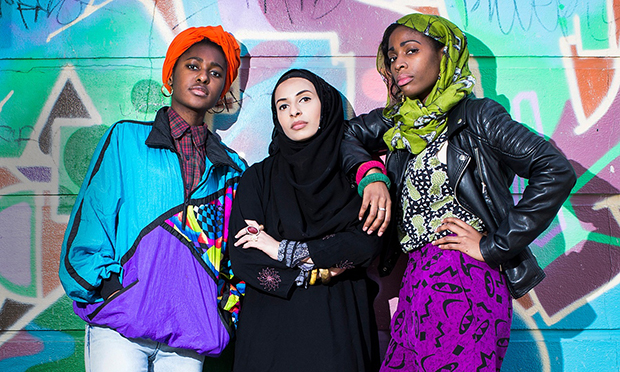
The 112 young cast members were two weeks into rehearsal when the production was cancelled. (Photo: Helen Maybanks / National Youth Theatre)
In September last year, the arts world was blindsided by the closure of white South African artist Brett Bailey’s Exhibit B exhibition at the Barbican. Bailey’s controversial work featured live actors in tableaux mimicking the anthropological exhibits of the 19th century, when real people were exhibited as curiosities for the amusement of Europeans – people such as Saartjie Baartman, the “Hottentot Venus”.
Bailey presents his show as antiracist and anticolonial. This newspaper agreed, giving it five stars during its Edinburgh run, and praising Bailey’s “fearlessly uncompromising” approach. Others took a diametrically opposed view. Sara Myers, a journalist in Birmingham, started Boycott the Human Zoo, an online petition, supported by a broad coalition of campaigners, artists and arts organisations, condemning the work and calling for it to be cancelled. On the opening night in London, protesters gathered to picket the show. Accounts differ as to what happened next, but the evening ended with police advising that Exhibit B be shut down, and not reopened. The Barbican felt they had no alternative but to follow the advice.
The Exhibit B closure may have been unexpected, but it was not unprecedented. Last year in Edinburgh, pro-Palestinian and pro-Israel supporters protested outside The City – a hip-hop musical by Israeli company Incubator that received funding from the Israeli government. There, again, the police advised the venue to cancel the show. And as far back as 2004, the West Midlands police similarly advised Birmingham Rep to cancel Gurpreet Kaur Bhatti’s play Behzti about abuse and corruption in a Gurdwara (Sikh temple), when protesters from the Sikh community, who had demonstrated outside the theatre for several days, tried to break into it. It was Bhatti’s subsequent play, Behud, an imaginative response to the experience of having Behtzi cancelled, that provided the point of departure for an ongoing programme of work looking at constraints on freedom of expression in UK that I started at Index on Censorship.
At the start of that programme, I wrote a case study of the premiere production of Behud at the Belgrade theatre in Coventry called Beyond Belief – theatre, freedom of expression and public order. Given the controversy surrounding Behzti, Behud was treated as a potential public order issue from day one. Importantly, it revealed that there was, and there remains, no specific guidance for policing of artistic freedoms. It also spawned a series of roundtable discussions and a couple of conferences on the status of artistic freedom, the second of which, Taking the offensive at the Southbank Centre in 2013, looked at how lack of clarity around policing roles and the law contributed to growing self-censorship in the cultural sector. Coming out of this conference was a picture of self-censorship as pervasive, complex and troubling, and there was a clear call for guidance to navigate an increasingly volatile cultural landscape. Specifically, many arts professionals who attended the conference were unclear about the role of the police and largely ignorant of the laws that impact on what is sayable in the arts.
This is no surprise – for several reasons. There is no training for arts professionals in art and the law as part of tertiary education. There is also very little in the way of legal precedent to guide arts organisations. And, of course, freedom of expression is innately complex. The right to it includes the right to shock, disgust and offend. But it is also not perceived as an absolute right, as demonstrated in the long list of qualifications in Article 10 of the European convention on human rights where freedom of expression is qualified by concerns including national security, the prevention of disorder and the “protection of health or morals”. It is therefore unsurprising that arts organisations can be unsure about how best to defend their right to free expression.
Tamsin Allen, senior partner at law firm Bindmans, and I decided to do something to help and have produced a series of information packs for arts organisations that introduce the law in a way that is relevant and tailored to their needs. The guides contextualise and explain qualifications to free expression, how they are represented in our legislation and what they mean for artists and arts bodies.
Choosing five areas of law that address these protected areas – legislation covering child protection, counter terrorism, public order, obscenity and race and religion – the lawyers explain the offences, and the roles and responsibilities of police and prosecuting services, as well as those of artists and arts bodies. However, it is the pack on public order that is probably most relevant to the arts sector, because it is far more likely that a public order problem arises because of the reactions of third parties to the work of art. This reflects how the art we see is much more subject to social rather than legal controls, and that is where the police come in, to arbitrate over the public space where some deep-seated social conflicts are acted out.
The packs explain that the police have a duty to support freedom of expression and to protect other rights, to prevent crime and to keep the peace. They summarise relevant legislation, explaining the qualified nature of the right to freedom of expression due to the offences in each area of law, and give guidance how best to prepare if you think the work could be contested. The guidance encourages arts organisations to be prepared to defend work they believe in, advises them on when and how to involve the police and on how to anticipate potential problems, guided as much by good practice and common sense as a detailed understanding of the law, most of which most organisations and artists will be doing anyway.
The packs are not a substitute for legal advice and provide links to law firms willing to give advice on this area. It includes a series of case studies that consider recent examples of police and/or lawyers having been involved in an artistic event, which look at things that worked well for freedom of expression and things that didn’t.
However, we have a problem. The heckler’s veto is working. When faced with a noisy demonstration, the police have shown that they will all too often take the path of least resistance and advise closure of whatever is provoking the protest. Arts organisations may have prepared well, and yet still find themselves facing the closure of a piece of work. This sends out a disturbing message to artists and arts bodies – that the right to protest is trumping the right to freedom of artistic expression. As things stand, in the trigger-happy age of social media where calls for work that offends to be shut down are easily made and quickly amplified, the arts cannot count on police protection to manage both the right to protest and to artistic expression. The police did a risk assessment on Behud and asked for £10,000 a night to provide adequate protection. Hamish Glen, artistic director of the Belgrade, explained that this was a fiscal impossibility – so the police offered to halve it, eventually waiving the fee altogether once Glen pointed out that even half was prohibitive and represented de facto censorship. But it exposed the fact that there is no guidance around the policing of artistic expression as a core duty, leaving it vulnerable. The fees were calculated based on how the police charge for attending football matches and music festivals. I have not heard of an arts venue being asked to pay for policing before.
In an ideal world we would have access to both the artwork and the protest it provokes. This is when art really works for society, when it encourages debate, inspires counterspeech; art coming from all perspectives and all voices in society, in particular those who are currently shamingly mis- or underrepresented in contemporary culture.
If we are to create the space where artists are free to take on the more complex issues in society, that may be disturbing, divisive, shocking or offensive, then we need to look again at the role of the police in helping to manage the public space in which different views meet. These may in fact be the same issues that the police are called on to manage through community relations policing, and this only adds to the complexity of their role – they probably would prefer it if artists didn’t rock the boat. And they can point to being resource-strapped and under pressure to fight crime.
The situation raises a series of difficult and important questions about policing, art and offence and requires high-level discussion, involving the police of course, about how best to defend the right to free expression. That work needs to start now.
• Julia Farrington is associate arts producer for Index on Censorship, a Vivarta associate and head of campaigns for Belarus Free theatre.
A version of this article originally appeared in The Guardian on 7 August 2015
The arts, the law and freedom of speech
7 Aug 2015 | Art and the Law Commentary, Artistic Freedom Commentary and Reports
The 112 young cast members were two weeks into rehearsal when the production was cancelled. (Photo: Helen Maybanks / National Youth Theatre)
Reports this week that the National Youth Theatre had pulled the plug on Homegrown, a new play about radicalisation, contained some discomfiting details. The production had been moved from a venue in Bethnal Green, east London, amid concerns it was “insensitive”. Police had apparently requested a final draft of the script, and there had been talk of plain-clothes police attending performances. The play is the latest victim of an encroaching nervousness among authorities and arts organisations.
In September last year, the arts world was blindsided by the closure of white South African artist Brett Bailey’s Exhibit B exhibition at the Barbican. Bailey’s controversial work featured live actors in tableaux mimicking the anthropological exhibits of the 19th century, when real people were exhibited as curiosities for the amusement of Europeans – people such as Saartjie Baartman, the “Hottentot Venus”.
Bailey presents his show as antiracist and anticolonial. This newspaper agreed, giving it five stars during its Edinburgh run, and praising Bailey’s “fearlessly uncompromising” approach. Others took a diametrically opposed view. Sara Myers, a journalist in Birmingham, started Boycott the Human Zoo, an online petition, supported by a broad coalition of campaigners, artists and arts organisations, condemning the work and calling for it to be cancelled. On the opening night in London, protesters gathered to picket the show. Accounts differ as to what happened next, but the evening ended with police advising that Exhibit B be shut down, and not reopened. The Barbican felt they had no alternative but to follow the advice.
The Exhibit B closure may have been unexpected, but it was not unprecedented. Last year in Edinburgh, pro-Palestinian and pro-Israel supporters protested outside The City – a hip-hop musical by Israeli company Incubator that received funding from the Israeli government. There, again, the police advised the venue to cancel the show. And as far back as 2004, the West Midlands police similarly advised Birmingham Rep to cancel Gurpreet Kaur Bhatti’s play Behzti about abuse and corruption in a Gurdwara (Sikh temple), when protesters from the Sikh community, who had demonstrated outside the theatre for several days, tried to break into it. It was Bhatti’s subsequent play, Behud, an imaginative response to the experience of having Behtzi cancelled, that provided the point of departure for an ongoing programme of work looking at constraints on freedom of expression in UK that I started at Index on Censorship.
At the start of that programme, I wrote a case study of the premiere production of Behud at the Belgrade theatre in Coventry called Beyond Belief – theatre, freedom of expression and public order. Given the controversy surrounding Behzti, Behud was treated as a potential public order issue from day one. Importantly, it revealed that there was, and there remains, no specific guidance for policing of artistic freedoms. It also spawned a series of roundtable discussions and a couple of conferences on the status of artistic freedom, the second of which, Taking the offensive at the Southbank Centre in 2013, looked at how lack of clarity around policing roles and the law contributed to growing self-censorship in the cultural sector. Coming out of this conference was a picture of self-censorship as pervasive, complex and troubling, and there was a clear call for guidance to navigate an increasingly volatile cultural landscape. Specifically, many arts professionals who attended the conference were unclear about the role of the police and largely ignorant of the laws that impact on what is sayable in the arts.
This is no surprise – for several reasons. There is no training for arts professionals in art and the law as part of tertiary education. There is also very little in the way of legal precedent to guide arts organisations. And, of course, freedom of expression is innately complex. The right to it includes the right to shock, disgust and offend. But it is also not perceived as an absolute right, as demonstrated in the long list of qualifications in Article 10 of the European convention on human rights where freedom of expression is qualified by concerns including national security, the prevention of disorder and the “protection of health or morals”. It is therefore unsurprising that arts organisations can be unsure about how best to defend their right to free expression.
Tamsin Allen, senior partner at law firm Bindmans, and I decided to do something to help and have produced a series of information packs for arts organisations that introduce the law in a way that is relevant and tailored to their needs. The guides contextualise and explain qualifications to free expression, how they are represented in our legislation and what they mean for artists and arts bodies.
Choosing five areas of law that address these protected areas – legislation covering child protection, counter terrorism, public order, obscenity and race and religion – the lawyers explain the offences, and the roles and responsibilities of police and prosecuting services, as well as those of artists and arts bodies. However, it is the pack on public order that is probably most relevant to the arts sector, because it is far more likely that a public order problem arises because of the reactions of third parties to the work of art. This reflects how the art we see is much more subject to social rather than legal controls, and that is where the police come in, to arbitrate over the public space where some deep-seated social conflicts are acted out.
The packs explain that the police have a duty to support freedom of expression and to protect other rights, to prevent crime and to keep the peace. They summarise relevant legislation, explaining the qualified nature of the right to freedom of expression due to the offences in each area of law, and give guidance how best to prepare if you think the work could be contested. The guidance encourages arts organisations to be prepared to defend work they believe in, advises them on when and how to involve the police and on how to anticipate potential problems, guided as much by good practice and common sense as a detailed understanding of the law, most of which most organisations and artists will be doing anyway.
The packs are not a substitute for legal advice and provide links to law firms willing to give advice on this area. It includes a series of case studies that consider recent examples of police and/or lawyers having been involved in an artistic event, which look at things that worked well for freedom of expression and things that didn’t.
However, we have a problem. The heckler’s veto is working. When faced with a noisy demonstration, the police have shown that they will all too often take the path of least resistance and advise closure of whatever is provoking the protest. Arts organisations may have prepared well, and yet still find themselves facing the closure of a piece of work. This sends out a disturbing message to artists and arts bodies – that the right to protest is trumping the right to freedom of artistic expression. As things stand, in the trigger-happy age of social media where calls for work that offends to be shut down are easily made and quickly amplified, the arts cannot count on police protection to manage both the right to protest and to artistic expression. The police did a risk assessment on Behud and asked for £10,000 a night to provide adequate protection. Hamish Glen, artistic director of the Belgrade, explained that this was a fiscal impossibility – so the police offered to halve it, eventually waiving the fee altogether once Glen pointed out that even half was prohibitive and represented de facto censorship. But it exposed the fact that there is no guidance around the policing of artistic expression as a core duty, leaving it vulnerable. The fees were calculated based on how the police charge for attending football matches and music festivals. I have not heard of an arts venue being asked to pay for policing before.
In an ideal world we would have access to both the artwork and the protest it provokes. This is when art really works for society, when it encourages debate, inspires counterspeech; art coming from all perspectives and all voices in society, in particular those who are currently shamingly mis- or underrepresented in contemporary culture.
If we are to create the space where artists are free to take on the more complex issues in society, that may be disturbing, divisive, shocking or offensive, then we need to look again at the role of the police in helping to manage the public space in which different views meet. These may in fact be the same issues that the police are called on to manage through community relations policing, and this only adds to the complexity of their role – they probably would prefer it if artists didn’t rock the boat. And they can point to being resource-strapped and under pressure to fight crime.
The situation raises a series of difficult and important questions about policing, art and offence and requires high-level discussion, involving the police of course, about how best to defend the right to free expression. That work needs to start now.
A version of this article originally appeared in The Guardian on 7 August 2015
Open letter to the King of Morocco in support of Ali Lmrabet
27 Jul 2015 | Campaigns, mobile, Morocco, Statements
To Your Majesty Mohammed VI,
At a time when Morocco is advocating openness, democratisation and full respect for human rights as instruments for confronting the future, we receive the news of the hunger strike begun by the journalist Ali Lmrabet. For this reason, we wish to pass on to you our deep concern for the situation of this journalist, who has received dozens of international awards and who is deprived of his national identity documents coinciding with the end of a 10-year ban on exercising the profession of journalist in Morocco and also with his announcement that he wishes to return to professional activity.
Freedom of expression and criticism are fundamental elements for the consolidation of a democratic state that is active against regression and intolerance. Any attempt to restrict freedom of expression degrades the image of Morocco and the credibility of its commitment to the rule of law.
Precisely because, from here, we wish to lend our full support to any effort to transform Morocco developed at different levels of the political world and civil society in the country, we are writing to you to express our serious concern at the current situation of Ali Lmrabet, whose life is in danger.
For all these reasons, we would ask you to reflect on this to give instructions to the administration in your country, and its diplomatic staff in Switzerland in particular, to renew all Ali Lmrabet’s Moroccan citizenship documents.
Without a residence certificate, passport and other documents related to journalistic work, Ali Lmrabet would become the first Moroccan deprived of his civil and political rights.
We do not need to give you, Your Majesty, lessons in the fact that the deprivation of these rights is contrary to all liberties, including fundamental freedoms, freedom of expression and, in the case of Ali, the internationally recognised and acclaimed right to freely exercise the profession of journalist. The only thing we would ask you, Your Majesty, in your capacity as Head of State, is to strictly apply the provisions of the Moroccan Constitution, giving the right to all citizens to fully and freely exercise their profession, in this case as journalist and editor of publications in Morocco.
We look forward to your considered response.
Yours sincerely,
Letter signed by the following:
Míriam Acebillo Baqué, President of Lafede.cat, Organisations for Global Justice
Mariano Aguirre, Director of Norwegian Peacebuilding Resource Centre (Norway)
Cinta Arasa, Coordinator of the Persecuted Writers Committee
Carmen Arenas, President of Catalan PEN
Homero Aridjis, Emeritus President of International PEN
Jordi Armadans, Director of FundiPau (Peace Foundation)
Sion Assidon, former Secretary General of Transparency-Morocco
Margaret Atwood, Vice-President of Canada International PEN, Prince of Asturias Award
Danielle Auroi, MP of the National Assembly of France
Juan Tomás Ávila Laurel, Writer, HM Award International Odón Betanzos Palacios of the New York Circle of Ibero-American writers and poets (Equatorial Guinea)
Malén Aznárez, President of Reporters without Borders (RSF- Spanish section)
Elisabeth Badinter, Philosopher
Ekbal Baraka, Chair of PEN International Women Writers Committee, former president of Egyptian PEN
Isaías Barreñada Bajo, University Professor and Human Rights activist
Ana Barrero Tiscar, Peace Culture Foundation
Mark Barwick, Policy Adviser at Human Rights Without Frontiers International (Switzerland)
David Bassa i Cabanas, Journalist, president of the Barnils Group of Journalists
Lluís Bassets, Deputy director of El Pais (Spain)
Anouar Bassi, Transparency 25 President (Tunisia)
Abdejelil Bedoui, Economist and member of the FTDES Steering committee
Sélim Ben Abdesselem, Former member of the Tunisian National Constituent Assembly
Abdelkader Benali, Writer and journalist, Libris Prize (Netherlands)
Thijs Berman, Former Dutch MP of the European Parliament
Mylène Botbol–Baum, Writer, University professor of philosophy and bioethics
Marian Botsford Fraser, Writer and journalist, Chair of Writers in Prison Committee, PEN International Canada
Jean-Marcel Bouguereau, Journalist Le Nouvel Observateur and former chief editor of Libération
Sfia Bouarfa, Belgian honorary MP and former senator
Jim Boumelha, President of the International Federation of Journalists (IFJ)
François Burgat, Political scientist, Research Director of CNRS
Teresa Cadete, Portuguese writer, board member of PEN International
Lindsay Callaghan, President of PEN South Africa
Maria Cañadas, President of Catalonia Amnesty International (AIC)
Gemma Calvet, MP of Parliament of Catalonia (Spain)
Carles Campuzano, MP of Congreso de los Diputados (Spain)
Marius Carol, Editor of La Vanguardia
Ignacio Cembrero, Journalist, former correspondent of El País in Maghreb
Nadia Chaabane, Former deputy of Tunisian National Constituent Assembly
Alain Chabod, International Consultant, former journalist of France Television
Luc Chartrand, Journalist, Radio-Canada
Larbi Chouikha, University professor; Institut de Presse et des Sciences de l’Information (IPSI) (Tunisia)
John Maxwell Coetzee, Writer, Nobel Prize in Literature 2003, Vicepresident of PEN International
Robert Coover, Writer, William Faulkner Foundation Award, American Academy of Arts and Letters, and National Endowment of the Arts (USA)
Olivier Corten, Professor; Centre of international law of ULB; Brussels
Joan Coscubiela, Deputy of Congreso de los Diputados (Spain)
Olivier Da Lage, Journalist, Vice-president of IFJ, RFI and SNJ
Luc Dardenne, Filmmaker
Eric David, Emeritus professor of International Law; Chairman of The International Law Centre of the ULB
Ascensión de las Heras, MP of Congreso de los Diputados (Spain)
Antonio Della Rocca, President of the Trieste PEN Center, Member of the Board of PEN International (Italy)
Christophe Deloire, Secretary General of Reporters Without Borders
Nicolas Dot Pouillard, Resercher of MAEE
Christos Doulkeridis, President of ECOLO group in the Parliament of the Wallonie-Bruxelles Federation (Belgium)
André du Bus, Deputy of Wallonie-Bruxelles Federation
Josy Dubié, Honorary senator (Belgium), former journalist and ONU official
François Dubuisson, Professor, International Law Centre of ULB (Brussels)
Patrick Dupriez, Co-chair of Ecolo party
Isabelle Durant, Brussels MP (Belgium)
Mohamed El Battiui, President of the Amazigh World Assembly
Najat El Hamchi, Writer, Ramon Llull Prize
Ahmed El Khannous, MP, Brussels Parliament
Mahmoud El May, MP and Member of the National Constituent Assembly (Tunisia)
Isabelle Emmery, Brussels Member of Parliament
Mathias Enard, Writer, Gouncourt Prize 2012
Charles Enderlin, Journalist, former France2 correspondent in Israel
Moris Farhi, MBE Vice-President, PEN International
Halim Feddal, Secretary General of the National Association for the Fights against corruption (Algeria)
Soledad Gallego-Díaz, Journalist of El País
Vicent Garcés, Former Member of the European Parliament
María Caridad García Álvarez, MP of Congreso de los Diputados (Spain)
Lise Garon, Professor, Laval University
Zoé Genot, Ecolo MP, Brussels Regional Parliament
François Gèze, President and chief editor of Éditions La Découverte (France)
Jodie Ginsberg, Chief Executive Officer of Index on Censorship
Henri Goldman, Editor of Politique, revue de débats and MICmag (Belgium)
Eric Goldstein, human rights activist (United States)
Elsa González, FAPE President (Spanish Press Associations Federation)
Juan Goytisolo, Writer, National Prize of Spanish Letters and Miguel de Cervantes Prize
Rafael Grasa Hernández, President of Institut Català Internacional per a la Pau
Ricardo Gutiérrez, Secretary general of European Federation of Journalists (EFJ)
Maher Hanin, Member of steering committee of FTDES
Abderrahmane Hedhili, President of Tunisian Forum for Economic and Social Rights (FTDES)
Seymour M. Hersh, American journalist
Francis Hickel, Coordinator Pâquis Solidarity Space, Geneva
Jesús Iglesias Fernández, Senator (Spain)
Jon Iñárritu García, MP of Congreso de los Diputados (Spain)
Véronique Jamoulle, MP, Brussels Parliament
Jean-Jacques Jespers, University Professor, Université libre de Bruxelles
Oriol Junqueres i Vies, Chairman of the party “Esquerra Republicana de Catalunya” (ERC) and opposition leader in Parliament of Catalonia
Lucina Kathmann, Writer, Vice-president of PEN International (United States)
Salam Kawakibi, Arab Reform Initiative, president of the Initiative for a New Syria
Melek Kefif, Doctor and member of the Steering committee of FTDES
Charefeddine Kellil, Lawyer for the families of martyrs and wounded (Tunisia)
Zakia Khattabi, Co-chair of Ecolo Party (Green Belgian)
Kamel Labidi, Tunisian journalist, former director of Amnesty International in Tunisia and former president of the National Authority to Reform Information and Communication (INRIC)
Luis Las Heras, Editor (Spain)
Gilwon Lee, Poète, Poet, Sang-Byeong Cheon Prize and Dong-Ju Yoon Literary Prize, Board Member, PEN International South Korea
Joanne Leedom-Ackerman, vice-president of PEN International (USA)
Jean-Claude Lefort, Former MP at the French Parliament
Emmanuel Lemieux, Essayist, and investigation journalist (France)
Stefano Liberti, journalist and writer, Luchetta Award to the best journalist and Anello Debole Prize
Jonathan Littell, Writer, Goncourt Award and Grand Prix du Roman of the French Academy
Robert Littell, Writer and journalist, Los Angeles Times Book Prize (USA)
Juan López de Uralde, Executive Commission Equo party, former Greenpeace-Spain Director
Bernabé López García, Professor, former member of Averroes Committee Spain-Morocco
Mehdi Mabrouk, Former Culture Minister (Tunisia)
Noël Mamère, MP of the National Assembly and Mayor of Bègles (France)
Sherif Mansour, MENA Program Coordinator, Committee to Protect Journalists (CPJ)
Christophe Marchand, Lawyer, Brussels (Belgium)
Jean-Paul Marthoz, journalist, correspondent of the Committe to Protect Journalists (CPJ) in the European Union
Sandrine Martins Espinoza, Lawyer and international consultant for elections (Argentine)
Daniel Patrick Maunier, University Professor, New York University
Fernando Maura Barandarián, Spanish MP, European Parliament
Federico Mayor Zaragoza, President of Foundation for a culture of peace, former Director of UNESCO
Daniel Menschaert, Diplomatic, Honorary Officer of the Federation Wallonia-Brussels in Morocco
Manuela Mesa Peinado, CEIPAZ Director, Peace Culture Foundation
Rosa Montero, Writer and journalist, Grinzane Cavour award and National Journalism Award (Spain)
Quim Monzó, Writer, National Literature award (Catalonia)
Alexandre Niyungeko, President of the Burundi Journalists Union (UBJ)
Elisabeth Nordgren, Chair of the Search Committee, PEN International (Finland)
Vida Ognjenovic, Vicepresident, PEN International (Serbia)
Margie Orford, Board Member, PEN International (South Africa)
Mario Orrù, Observer Coordinator at Democracy International
Bechir Ouarda, Journalist, Former Coordinator of the civil coalition in defence of freedom of expression in Tunisia
Rémy Pagani, Administrative Councillor for the city of Geneva
Andrés Perelló, Former Member of the European Parliament, Spain
Rosana Pérez Fernández, MP of the Congreso de los Diputados (Spain)
Tone Peršak, Chair of Writers for Peace Committee, Pen International (Slovenia)
Thomas Pierret, University professor, University of Edinburgh
John Ralston Saul, Writer, president of PEN International
Pedro J. Ramírez, Editor of El Español, former editor of El Mundo
Raul Rivero, Cuban writer, UNESCO / Guillermo Cano Press Freedom Prize
Raül Romeva Rueda, Former Spanish MP, European Parliament
Jean Louis Roumegas, MP of the French Parliament
Elena Ruiz Ruiz, University professor (Spain)
Hélène Ryckmans, Member of the Walloon Parliament and the Parliament of the Federation Wallonia-Brussels, Senator
Messaoud Romdhani, Member of the Executive Committee of the Euro-Mediterranean Network of Human Rights (EMHRN), and vice president of the Tunisian League of Human Rights (LTDH)
Amor Safraoui, Chairman of the Independent National Coordination for Transitional Justice (Tunisia)
Mohamed Salah Kherigi, Trade unionist, Vice-president of the Tunisian League of Human Rights (LTDH)
Raffaella Salierno, General Secretary of PEN Català, Director of the GuestWriter programme
Victoria Salvy, Artist and writer (France)
Gervasio Sánchez Fernández, Journalist, National Photography Award, and Ortega y Gasset Journalism Award (Spain)
Mhamed Seghier, Journalist of Liberté (Algeria)
Màrius Serra, Writer, Ramon Llul and Sant Jordi Awards (Catalonia)
Amira Aleya Sghaier, Tunisian historian and university professor
Mohamed Sheriff, President of PEN Sierra Leona
Ricardo Sixto Iglesias, MP at Congreso de los Diputados (Spain)
Simona Skrabec, Chair of Translation and Linguistic Rights Committee, PEN International
Mohamed Smaïn, Activist in charge of human rights, Algerian League for the Defence of Human Rights (LADDH)
Carles Solà, Journalist, TV3 program Director (Catalonia, Spain)
Carlo Sommaruga, Lawyer, MP of the Swiss parliament
Karima Souid, Former MP of the Tunisians from abroad, member of National Constituent Assembly of Tunisis
Simone Susskind, MP of Brussels – Capital Region
Abdellah Taïa, Moroccan Writer, Flore Award
Alaa Talbi, President of Alternatives, Tunisian Section
Joan Tardà, MP of Congreso de los Diputados (Spain)
Sami Tlili, Tunisian Filmmaker, Cinema and Human Rights Award of Amnesty International and Best documentary of the Arab world Award
Jarkko Tontti, Treasurer of PEN International (Finland)
Manuel Tornare, Swiss MP, former Mayor of Geneva
Carles Torner, Executive Director of PEN International
Estefania Torres, Spanish MP of the European Parliament
Mathew Tree, Writer, Octubre – Andròmina Award
Jane Unrue, Director of the Harvard Scholars at Risk (SAR) Program and Freedom to Write Committee board for PEN, New England (United States)
Miguel Urban, Spanish MP of the European Parliament)
Dominique Vidal, Journalist
Santiago Vidal i Marsal, Judge of Provincial Audience Chamber of Barcelona, Judges for Democracy
Per Wästberg, Writer, President of Nobel Committee for Literature, former President of PEN International
Lawrence Weschler, écrivain, George Polk et Lannan Literary Award (United States)
The Siege
21 Jul 2015 | Art and the Law Case Studies, Artistic Freedom Case Studies
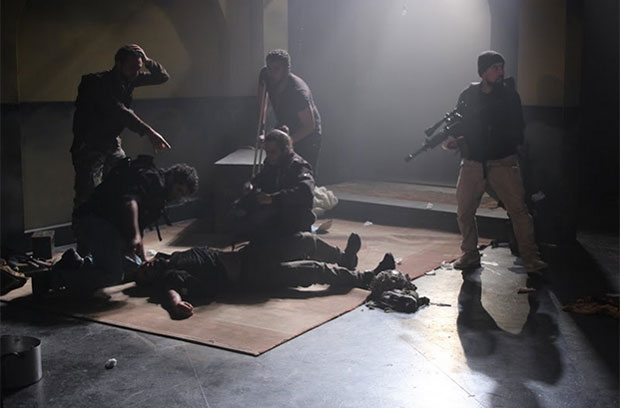
A scene from The Freedom Theatre’s UK tour of The Siege. Image courtesy of The Freedom Theatre
Throughout Index on Censorship’s Art and the Law information packs, the lawyers who wrote them stress that the packs offer guidance only and are not a substitute for legal advice. Knowing about the law helps an artist or an organisation identify when there could be a legal issue arising from an artwork. But each artwork is case specific so the advice is to contact a lawyer, if you are in doubt about whether or not you may be in breach of the law.
This short case study of the Palestinian Theatre Company’s first UK tour illustrates how the legality of The Siege was challenged in the media and how the touring venues responded to meet the challenge.
Background
The Freedom Theatre’s first UK tour, 13 May-20 June 2015, took the premiere production of The Siege to 10 UK venues: The Lowry, Manchester; Lakeside Theatre, Colchester; Battersea Arts Centre, London; The Hub, Leeds; St Mary in the Castle, Hastings; The Merlin, Frome; Birmingham Rep, Birmingham; The Cut, Halesworth; The Tron, Glasgow.
The show tells the story of the 2002 siege of the Church of the Nativity in Bethlehem, which was an international news story. The production illustrated the siege from the perspective of the Palestinian fighters who spent 39 days inside the church. The company researched the show by interviewing some of the fighters who are now living in exile in different countries.
In programming The Siege, Battersea Arts Centre (BAC) had anticipated that it and other participating venues might receive some critical feedback connected with the tour. Indeed, the 3 May 2015 Mail on Sunday contained an article with the headline: UK taxpayers fund ‘pro-terrorist’ play – £15,000 of public money given to show based on the words of Hamas killers. The Times of Israel also reported on the production with the strapline – “2002’s hostage standoff at Bethlehem’s Church of the Nativity gets historically questionable treatment in play set to tour England”
The BAC responded to the media reports. This is an excerpt from the briefing document:
- Battersea Arts Centre has agreed to help the Freedom Theatre in their liaison with the press in the UK and to act as a go-between between the company and the other 9 venues on the tour
- We are seeking legal advice from freedom of speech lawyers to reassure ourselves that nothing in the show is in contravention of UK counter-terrorism legislation
- We are looking carefully at the curation of discussions alongside the show which give the opportunity for points of view opposed to the Freedom Theatre point of view to be aired
- We are talking to our Board, funders and others to brief them on the current situation, to share information and to take their advice
- In the light of recent articles we are updating an internal document of Q&As to help us answer any questions likely to be levelled at us or other venues from the press/others. The key principle espoused in these answers is that Battersea Arts Centre (as is true of most if not all of the other venues on the tour we imagine) are providing a platform to this theatre company in the interests of freedom of expression, but BAC is not subscribing to any one particular point of view. We have previously given a platform to a theatre company that presented a piece from an Israeli perspective on the conflict in Israel/Palestine”
This last point, by referring to freedom of expression, cites the venues’ right to freedom of expression as laid out in Article 10 of the European Convention on Human Rights.
Seeking legal advice
In the Q&A mentioned above, one question raised a legal issue: Does this play glorify terrorism? It was also echoed in the media that alleged the play was “pro terrorist”.
Glorification of terrorism is a crime with serious consequences if convicted. While the guidance in our pack goes into some detail of defences for artists and arts organisation, it also stresses that the pack is not a substitute for legal advice. If you are unsure about your responsibilities under the law at any time, you must obtain independent specialist legal advice.
In order to be as confident as possible of the content in The Siege, BAC sought independent legal advice from three different sources: a Trustee contact; an Arts Council contact; Liberty. The Lowry also sought independent legal advice.
This was a sensible belt and braces approach because lawyers’ advice often varies according to interpretations of the law. Lawyers can only advise after all, so it was sensible to go three ways. All three gave advice pro-bono.
BAC created a summary statement from this advice and shared it with the other nine venues. They included a disclaimer that other venues used it at their own risk. It was advice, rather than a watertight guarantee that there couldn’t be other interpretations placed on the script. But it succeeded in its main purpose, which was to reassure the touring venues of their legal position, and enabled them to stand up to hostile press if necessary.
The statement helpfully demonstrates how freedom of expression is qualified by other considerations. In other words, once the lawyers were satisfied that the play didn’t breach legislation, then the right to freedom of expression can be upheld. Here is the summary:
The Siege does not infringe Section 1 of the Terrorism Act 2006, which prohibits the encouragement or glorification of terrorism. The play focuses on the personal struggles of the Palestinian fighters on a human level in attempting to survive the siege. It does not encourage audience members to emulate their conduct. Although the play is likely to be interpreted as sympathetic to the fighters, the sympathy is based on their struggle to survive as people and not on any violent acts or participation in terrorist groups. Violence is at no point encouraged in the play.
The presentation of The Siege, which depicts real-life events expressly from the point of view of the Palestinian fighters, is covered by Article 10 of the Human Rights Act: the right to freedom of expression, including artistic expression. Since The Siege does not commit an offence under the Terrorism Act 2006, and therefore poses no reason for this freedom of expression to be curtailed, prohibiting the play would likely be a breach of Article 10.”
David Jubb, artistic director of Battersea Arts Centre, reflected on the tour:
It was interesting to see the way that language was used in some of the reporting of The Siege. As well as raising the general temperature around the tour and adding to a sense of controversy, the use of legalistic language also introduced questions about the legal status of the show.
We felt that seeking legal advice would be useful to us in a number of ways: to inform our Q&As so that we could confidently answer any question that posed a direct legal challenge to the work; and to settle any anxiety that any staff or Trustees might understandably feel, to demonstrate that the artists and the organisation were on a solid legal footing.
This latter point was especially useful for Trustees who are one-step removed from the day-to-day and for good governance in these matters must be reassured that all risks have been assessed. Perhaps the most productive decision was made by all participating venues together: that we would support each other in the run-up to and during the tour, and work closely with the company at all times.
I know that we at Battersea Arts Centre learnt a lot from the great work of the Lowry and others. Providing each other with a support network ensured that we felt less isolated during stressful moments.”
A short survey was sent around to the venues on the tour asking if there were protests and about their contact with the police. The feedback was that the police were supportive and responsive and acted as useful liaisons between the venue and the protesters. Most venues informed the police of the forthcoming production about one week in advance. One venue approached the police a month in advance, but it seemed to “get lost in the system”. There were protests at many of the venues, but all were peaceful and took place without incident.