15 Oct 2014 | Press Releases, Uncategorized
- Awards honour journalists, campaigners and artists fighting censorship globally
- Judges include journalist Mariane Pearl and human rights lawyer Sir Keir Starmer
- Nominate at www.indexoncensorship.org/nominations
Beginning today, nominations for the annual Index on Censorship Freedom of Expression Awards 2015 are open. Now in their 15th year, the awards have honoured some of the world’s most remarkable free expression heroes – from Israeli conductor Daniel Barenboim to Syrian cartoonist Ali Farzat to education activist Malala Yousafzai.
The awards shine a spotlight on individuals fighting to speak out in the most dangerous and difficult of conditions. As Idrak Abbasov, 2012 award winner, said: “In Azerbaijan, telling the truth can cost a journalist their life… For the sake of this right we accept that our lives are in danger, as are the lives of our families. But the goal is worth it, since the right to truth is worth more than a life without truth.” Pakistani internet rights campaigner Shahzad Ahmad, a 2014 award winner, said the awards “illustrate to our government and our fellow citizens that the world is watching”.
Index invites the public, NGOs, and media organisations to nominate anyone they believe deserves to be part of this impressive peer group: a hall of fame of those who are at the forefront of tackling censorship. There are four categories of award: Campaigner (sponsored by Doughty Street Chambers); Digital Activism (sponsored by Google); Journalism (sponsored by The Guardian), and the Arts. Nominations can be made online via http://www.indexoncensorship.org/nominations
Winners will be flown to London for the ceremony, which takes place at The Barbican on March 18 2015. In addition, to mark the 15th anniversary of the Freedom of Expression awards, Index is inaugurating an Awards Fellowship to extend the benefits of the award. The fellowship will be open to all winners and will offer training and support to amplify their work for free expression. Fellows will become part of a world-class network of campaigners, activists and artists sharing best practice on tackling censorship threats internationally.
Jodie Ginsberg, CEO of Index, said: “The Index Freedom of Expression Awards is a chance for those whom others try to silence to have their voices heard. I encourage everyone, no matter where they are in the world, to nominate a free expression hero.”
The 2015 awards shortlist will be announced on January 27th 2015. Judges include journalist Mariane Pearl and human rights lawyer Sir Keir Starmer. The public will be asked to participate in selecting the winner of the Google Digital Activism award through a public vote beginning January 27th 2015. Sir Keir said: “Freedom of expression is part of the bedrock of civilised, democratic society. The Index on Censorship Awards have a material influence on promoting such freedom and both celebrating and protecting those who fight against censorship worldwide. That’s why Doughty Street Chambers chooses Index as its principal charity.”
For more information please contact David Heinemann: [email protected]
_______________________________________________________________________
NOTES FOR EDITORS
About Index on Censorship:
Index on Censorship is an international organisation that promotes and defends the right to freedom of expression. The inspiration of poet Stephen Spender, Index was founded in 1972 to publish the untold stories of dissidents behind the Iron Curtain and beyond. Today, we fight for free speech around the world, challenging censorship whenever and wherever it occurs. Index believes that free expression is the foundation of a free society and endorses Article 19 of the Universal Declaration of Human Rights, which states: “Everyone has the right to freedom of opinion and expression.”
About The Index on Censorship Freedom of Expression Awards:
The Index Freedom of Expression Awards recognise those deemed to be making the greatest impact in tackling censorship in their chosen area.
Awards categories:
Journalism – for impactful, original, unwavering journalism across all media (sponsored by The Guardian).
Campaigner – for campaigners and activists who have fought censorship and who challenge political repression (sponsored by Doughty St Chambers).
Digital Activism – for innovative uses of new technology to circumvent censorship and foster debate (sponsored by Google).
Arts – for artists and producers whose work asserts artistic freedom and battles repression and injustice.
Previous award winners include:
Journalism: Azadliq (Azerbaijan), Kostas Vaxevanis (Greece), Idrak Abbasov (Azerbaijan), Ibrahim Eissa (Egypt), Radio La Voz (Peru), Sunday Leader (Sri Lanka), Arat Dink (Turkey), Kareen Amer (Egypt), Sihem Bensedrine (Tunisia), Sumi Khan (Bangladesh), Fergal Keane (Ireland), Anna Politkovskaya (Russia), Mashallah Shamsolvaezin (Iran)
Digital/New Media: Bassel Khartabil (Palestine/Syria), Freedom Fone (Zimbabwe), Nawaat (Tunisia), Twitter (USA), Psiphon (Canada), Centre4ConstitutionalRights (US), Wikileaks
Advocacy: Malala Yousafzai (Pakistan), Nabeel Rajab (Bahrain), Gao Zhisheng (China), Heather Brooke (UK), Malik Imtiaz Sarwar (Malaysia), U.Gambira (Burma), Siphiwe Hlope (Swaziland), Beatrice Mtetwa (Zimbabwe), Hashem Aghajari (Iran)
Arts: Zanele Muholi (South Africa), Ali Farzat (Syria), MF Husain (India), Yael Lerer/Andalus Publishing House (Israel), Sanar Yurdatapan (Turkey)
You have received this email because email address ‘[email protected]’ is subscribed to ‘AWARDS 2015 Call For Nominations’.
2 Oct 2014 | Europe and Central Asia, News, United Kingdom
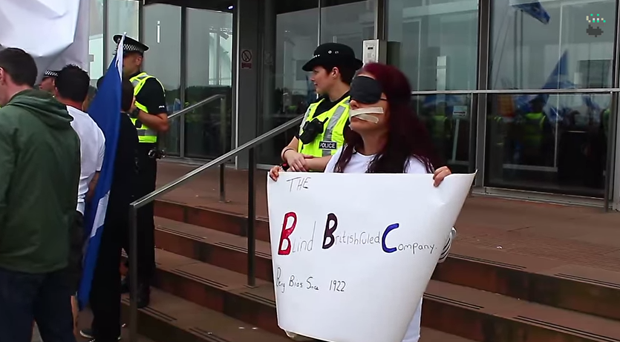
Supporters of Scottish independence protested against alleged BBC bias ahead of the referendum on 18 September (Image: Mishka Burr/YouTube/Creative Commons)
Benito Mussolini wrote romantic fiction. Of course he did. Maudlin sentimentality is at the very heart of fascism, which is why we should be keeping a closer eye on Mrs Brown’s Boys.
The Cardinal’s Mistress (or to give it its typically grandiose full title: Claudia Particella, Lamante del Cardinale, Grande Romanzo dei Tempi del Cardinale Emanuel Madruzzo) was written in the first decade of the 20th century, when the future dictator was still playing with socialism before he came up with his big idea. It was originally published as a serial in La Vita Trentina, the weekly supplement of socialist newspaper Il Popolo.
Reviewing an English translation of the work in 1928, Dorothy Parker, who admits to er, struggling with the book, dreamed of a scene “in which I tell Mussolini ‘And what’s more, you can’t even write a book that anyone could read. You old Duce you,’” before deadpanning, “You can see for yourself how flat that would leave him.”
It’s unclear whether or not Mussolini was left flat, or even read Parker’s New Yorker magazine review. But it’s possible to imagine that the negative review haunted him to the very end, that Il Duce spent his last days still pondering whether to write an angry letter to the New Yorker, pointing out that since Parker had admitted that she HADN’T EVEN FINISHED THE BOOK, it was a SERIOUS LAPSE of journalistic and critical standards to even run the review, and a sign of how a ONCE GREAT publication had been given over to cheap jibes and sarcasm instead of proper discussion of literary works [and so on, ad lamppostium].
One can imagine his supporters on Twitter, furiously @-ing the poor Parker: “Call yourself a journalist? #NewYorkerBias”, “MSM once again Misreprasents #IlDuce. #NoSurprise (@medialens)”, “So apparently this ‘Parker’ woman is actually a ROTHSCHILD? #BoycottNewYorker”, and so on and on and on and on and wearily on.
You know the kind of thing, because we see it every week now. The dull, thudding obsession with the idea that the media, or a section of the media is involved in some enormous conspiracy against you and your views, and subsequently the belief that that is the only reason not everyone shares your views.
The Scottish independence referendum was a case in point. Yes supporters became curiously obsessed with the BBC’s Nick Robinson and his apparent conservative sympathies. Now, Robinson, like many BBC hacks before him, (Andrew Marr? Socialist Organiser; Paul Mason? Workers’ Power; Jennie Bond? Class War), was politically active in his youth, rising to be president of the equal parts hilarious and horrendous Oxford University Conservative Association. This, plus a terse exchange between Robinson and Scottish Nationalist leader Alex Salmond over a media conference question Robinson felt Salmond had not answered properly, led to hundreds of nationalists converging on BBC Scotland’s headquarters claiming the BBC was biased against them and demanding, well, something.
This was bad enough, but they were egged on by Salmond himself, who said he thought there was “real public concern in terms of some of the nature and balance of the coverage”.
Calls for “balance” are almost always, in fact, calls for more-of-my-side and less-of-the-opposition. This was beautifully demonstrated by the number of complaints logged against the BBC in August about the most recent Israel-Palestine conflict. That month, 938 people complained that the BBC’s coverage was too favourable to the Palestinians, while 813 felt it the corporation was too favourable to the Israeli side. (Incidentally, in the same month over 350 people complained that the BBC had been too pro-independence in its broadcast of a Scottish referendum debate.)
The most embarrassing spectacle of the entire referendum came the days after the vote, when the nationalists had lost. The SNP sulkily decided they would bar right-wing, pro-union newspapers from the morning media conference. Salmond allegedly then tried to handpick which reporter from The Guardian would be allowed attend. The Guardian, doubly affronted by the ban on their press pack colleagues and Salmond’s demands upon it, rightly told Salmond they would skip the conference altogether.
The SNP are far from the only people to think they can demand good coverage and prevent dissent. Mark Ferguson, of the left-wing, trade-union-supported website Labour List, was recently informed that he would not be given a press pass for the Conservative party conference in Birmingham. It was only after other journalists raised their objections via Twitter that the Conservative party relented. It’s probably true to say that the Labour blogger’s coverage would not be the most pro-Tory, but that’s really not the point.
Meanwhile, in the wide world of sport, Newcastle United’s controversial owner owner Mike Ashley has decided that the Daily Telegraph’s Luke Edwards (and anyone else from the Telegraph, for that matter) will not be allowed near the club’s ground again, after Edwards reported rumours that Ashley may be seeking to sell the club.
There is an argument that Ashley generates enough bad publicity for himself without the assistance of apparently hostile journalists (Ashley recently caused confusion after telling a reporter with The i newspaper that club manager Alan Pardew would be “finished” and “dead” if Newcastle lost their next game), but that doesn’t make the move any less thin-skinned and censorious.
Football has form on this. Sir Alex Ferguson may have been the greatest manager of the modern era, but he was also so petty as to refuse to talk to the BBC for seven years after he objected to a documentary about his son aired by the national broadcaster.
Perhaps this tetchiness is what’s needed to get ahead, but it feels increasingly like a retreat from argument, and a retreat from the idea of open debate and a robust public sphere. We won’t accept arguments counter to our own, and if those arguments prove more popular than ours, it is not because ours may need rethinking. No, it is because the world is biased against us. We’re either being silenced by the metropolitan liberals, or censored by the public school Tory elites. Our public conversation is in danger of becoming a public whinge.
Correction 15:40, 2 October: An earlier version of this article stated that Paul Mason was in Workers’ Hammer.
This article was published on Thursday 2 October at indexoncensorship.org
19 Sep 2014 | Academic Freedom, News, Politics and Society, Religion and Culture, United States
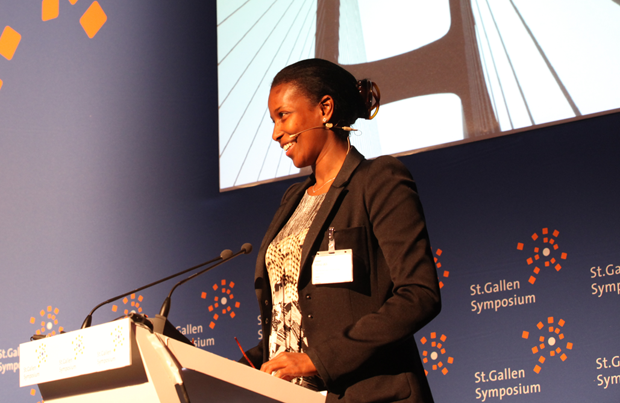
Ayaan Hirsi Ali at the University of St. Gallen in 2011 (Photo: International Students’ Committee/Wikimedia Commons)
Earlier this month, Yale President Peter Salovey used his address at the university’s freshman assembly to call for students to protect unfettered freedom of expression, labelling it “essential on a university campus”. Specifically, his speech dealt with the policing of university speakers by protesting student groups. He urged students not to participate in the types of activities that have forced prominent public figures out of speaking roles at other universities.
This address came in anticipation of Yale’s William F Buckley Jr. Program — a group dedicated to promoting intellectual diversity on campus — hosting Ayaan Hirsi Ali. The Dutch activist and writer has been accused of holding strong anti-Islamic views, and her work has been a source of controversy throughout her career.
The president’s advice was not heeded. The announcement of Ali’s inclusion in the speaker series was met with complaints by over 30 student organisations. Spearheaded by Yale’s Muslim Students Association, who wrote a letter and started a petition condemning the speech, groups of all makes attempted to get Ali removed from the docket or to get other speakers added to the event. Despite this, Yale’s faculty stood by the president’s message, and the event went ahead on 16 September.
This follows the case of a reverend at the university being forced to step down after he wrote a three sentence op-ed criticising an article in the New York Times. He argued that a piece on the rise of anti-semitism in Europe ignored the link between this and the Gaza conflict.
But these are not the only recent examples of free expression being limited on American campuses. Here are nine other universities that have faced free speech controversies in the past year.
CAL Berkeley
University of California Berkley chancellor, Nicholas Dirks, sent an email to students on 5 September entitled “Civility and Free Speech”. The email came at the start of the school year marking the 50th anniversary of the Free Speech Movement, a protest that helped lift the ban on political activities on campus and increased students’ free speech rights at universities around the world. The email, however, turned into a platform for Dirks to place qualifiers on students’ free speech, saying it should only be practiced “insofar as we feel safe and respected in doing so”. Dirks called for civility in free speech, which many, including some faculty members at the university, felt inhibited academic freedom.
Arkansas State University
Arkansas State University attempted to force football players to remove or modify crosses from their helmets, used to commemorate two former teammates who were killed in the last year. The symbol memorialising the former teammates was challenged by a group of outspoken atheists known as the Freedom from Religion Foundation who called the symbol inappropriate. The team has since changed it into a bar baring the initials of the fallen. One player, however, is suing the school, saying that he feels the university has censored the team.
University of Illinois at Urbana-Champaign
The University of Illinois at Urbana-Champaign revoked the hiring of Steven Salaita, an American-Indian studies and Israeli-Arab Relations professor, after he wrote anti-Israeli tweets in response to Israeli violence on the Gaza Strip. Tweets like, “When will the attacks on #Gaza end? What is left for #Israel to prove? Who is left for Israel to kill? This is the logic of genocide.” were posted on the first and second of August. The university claimed that current employees of the university would not be fired on the same grounds, but since Salata was merely promised a position and had yet to start working, the same rules did not apply.
University of Georgia
A group of students at the University of Georgia, represented by the Alliance Defending Freedom (ADF), have filed a lawsuit against the school after it adopted a policy that limits free speech to certain zones. These areas make up less than 1 percent of the campus and are open from 8am-9pm Monday through Friday for protest and other political demonstration. Protests on other parts of campus must be cleared 48 hours in advance by an administrator. ADF’s Travis Barham said in a press release, “Public universities are supposed to be the marketplace of ideas, and so they should promote and celebrate free speech, not quarantine it.”
Rutgers University
Former US Secretary of State Condoleezza Rice withdrew from her speaking opportunity at Rutgers University’s graduation commencement following student protests. Students were in uproar about the former politician’s involvement in the Iraq war, namely her signing off on the torture of Iraqi citizens. This was not the first time Rice faced protest as a commencement speaker. In 2006 students and faculty alike held up signs during graduation, voicing their displeasure over her inclusion.
Boise State University
Boise State’s chapter of the Young Americans for Student Liberty, a national organisation for education of libertarian values and the constitution invited gun law activist Dick Heller to be a keynote speaker at one of their campus events. The group, seemingly due to the controversial nature of the speaker’s opinions, was charged an additional sum of money as a security fee 24 hours before the event which had been scheduled for six weeks. This came just one week after the university forced a pro-life organisation to put up warning signs at two of their on campus events. Both of these cases were subjects of lawsuits citing the First Amendment right to freedom of expression as being violated.
Citrus College
A student at Citrus College in Glendora, California was threatened with removal from campus after he was caught petitioning against the spying of the National Security Agency outside of the school’s designated free speech zone. These areas make up just over one percent of university premises, with every other part of a campus labelled a “non-public forum”. The student sued, making it the second time in just over a decade the college faced legal action over a free speech issue. California has two laws that that protect free speech on campuses.
University of Massachusetts Amherst
In the autumn of 2013, the University of Massachusetts banned electronic dance music events following the death of one of their students due to an MDMA overdose. The death came at the end of a string of overdoses on campus and in the Massachusetts area and the ban was an attempt to curb this illegal drug use. Students responded with a peaceful protest which featured picketing, petitioning and flash mobs.
Iowa State University
Iowa State University banned t-shirts made by the school’s branch of the National Organisation for the Reform of Marijuana Laws. The school claimed the use of their mascot on the shirts was a trademark violation. The school filed a lawsuit against NORML after the image was published in a local newspaper, following pressure by state officials who did not want the school to be seen as pro marijuana reform. NORML asked for the case to be dismissed claiming ISU failed “to allege sufficient facts to establish any constitutional right in the use of ISU’s trademarks”.
This article was posted on Thursday 19 Sept 2014 at indexoncensorship.org
12 Aug 2014 | Israel, News, Palestine, Politics and Society
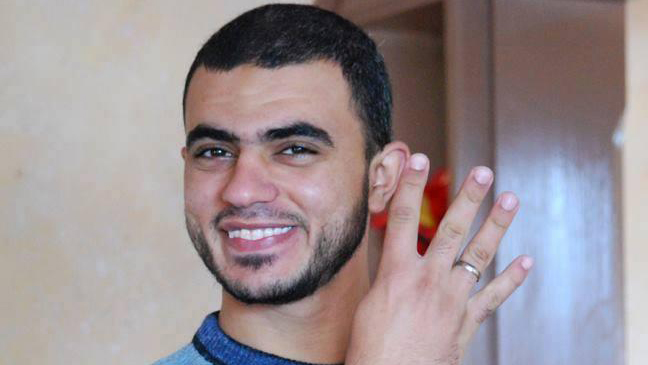
Khaled Hamad was killed while reporting on the Gaza conflict.
News coverage of the ongoing Gaza conflict would be infinitely poorer without local journalists, but it’s clear that international media needs to show their commitment by providing Palestinian reporters and fixers with extra support.
Images of bloodied press vests have become a dark motif of the latest Gaza war. One of the most striking came from 22-year-old photographer Rami Rayan, killed during the shelling of a market in the Shujayah district on the 30 July. The same attack also killed journalist Sameh al-Aryan, aged 26. Before this came the pictures of Khaled Hamed, pulled from the rubble of Shujayah with his broken video camera at his side on the 20 July. In total, 13 Palestinian journalists have been killed in over a month of fighting, according to the International Federation of Journalists.
An earlier statement by the IFJ also listed the names of seven journalists who had been injured when they were struck by shrapnel, with six of these injuries occurring while the journalists were in the field. The seventh was injured when her house was destroyed by an Israeli bombardment.
A journalist’s bullet-proof vest does more than just physically protect the wearer – the “PRESS” marking it is designed to show that they are never a legitimate target. This should stand apart from even the high civilian death toll of this war. Marking oneself as a journalist is to appeal to the so-called “rules of engagement”, that attacking journalists or anywhere where there may be journalists, is a breach of a code that has, until now, lasted since journalists first took to the battlefields to report.
In Gaza, this code has sadly long since worn thin. Hamid Shehab was killed when his parked car was struck by a rocket outside his house on the 9 July. According to the IFJ, his car was “clearly marked as a press vehicle”.
There is no doubt that covering this war has taken its toll on every journalist that has operated in Gaza since fighting began on the 8 July. But sadly, the body count suggests that the dangers for Palestinian media workers covering their homeland in a time of crisis, and those for international journalists who enter to cover the war, are distinctly different. Palestinian media workers include those working for international or local outlets, as well as those working as fixers for international media. The role of a fixer is one that is often overlooked – especially in terms of safety.
In a statement on the 6 August, the Israeli Government Press Office (GPO) stated that they had issued accreditation to 705 journalists from over 42 countries. This is not necessarily the number of journalists who entered Gaza to cover the war, but a GPO card is needed to do so. If even half of this number succeeded to enter and leave Gaza without coming to any harm, they still compare favourably to the numbers of Palestinian media workers who have been harmed.
The Israeli Defense Force (IDF) have taken a certain amount of care to protect international journalists operating on the ground in Gaza, at one point relocating them to two hotels in the strip in order to provide a level of protection during a period of particularly heavy shelling. Although fixers or other Palestinian media workers were free to shelter alongside the international press in the lobby of these hotels, the journey alone may have proved lethal. Add to this that Gazan journalists are unlikely to choose to leave their families at home to suffer heavy shelling while they themselves enjoy this nominal protection.
Even with the IDF awareness of media workers the offices of Al Aqsa TV and Radio, Wattan Radio and the National Media agency were destroyed, and workers at Al Jazeera’s office in Gaza city were forced to evacuate following “warning shots” fired at the building. This occurred days after Al Jazeera was threatened by Israeli Foreign Minister Avigdor Lieberman, who stated at a press conference on 21 July that the foreign ministry was taking steps to investigate the network, with “the intent of not allowing it to broadcast anymore from Israel”.
A tentative ceasefire is currently allowing some respite on the ground in Gaza. But many of the journalists who have left the strip have said that this is not the last war they expect to cover there. Sadly, this is also not the first time that attacks on media outlets have been part of wider attacks on Gaza.
The deaths of Palestinian journalists was also a feature of the 2012 war, when three journalists were killed. One of the most hotly-debated points of this latest bout of destruction has been what constitutes a “legitimate target”. There is one lesson that must stand apart from this discussion: no journalist should ever be included in that category.
The following are statements from fixers and journalists who have been involved in covering Gaza.
In the case of Gaza, nobody is safe. As a fixer I am more exposed to dangers because of continuous movement to the “hot zones”. Last Friday, during the ceasefire, I was 100m away from the front line with the Israeli army in Beit Hanoun. I don’t have equipment for protecting myself like a flak jacket or helmet – my movement from my house to the hotels [where journalists stay] adds more risk. We depend on marking our car with words like TV, hoping that the Israelis will avoid us. What normally privileges foreign journalists over local ones is their financial capabilities.”
— Amjed Tantish is from Beit Lahia, in the north Gaza strip.
Moving around under constant shelling, I wasn’t sure if I would make it back home. I couldn’t get a bulletproof vest, as they are so expensive and I’m a freelancer – I can’t afford it. But also, there is no one who would volunteer to bring one into Gaza from Jerusalem for me. Working without it is risky though. Another danger to Palestinians is that they can be accused of being pro-Israeli. Internationals can come and go, but Palestinians will point fingers at me if I write something they don’t like. I wish that there was an organization that was protecting Palestinian journalists – but as a freelancer, I am responsible for my life. International outlets should take into account that the dangers faced by the local journalists they hire may be quite different – but that should apply to all conflict zones, not just Gaza.”
— Abeer Ayyoub, freelance journalist, Gaza City.
I am usually lucky to find an available flak jacket. Usually I don’t wear protective gear- I would like to buy some, but they are expensive and hard to get during wartime. Instead, I try and assess whether the situation is safe enough to be in, and if it seems too dangerous, I leave. I call ahead to people in the area to see if it’s safe, to find out what the safest route is and to coordinate with people on the ground. For sure, I could get killed. I feel like I could lose everything sometimes. But it’s my work, it’s what I do to get the message out to the world. Some of the people I work with appreciate the work and the risk, but 80 percent don’t care about the risks we take. Most people don’t know about what we do for them. They don’t think about us dying for a picture they sell for $50.”
— Mohammed Rajab, a fixer based in Gaza City.
Danger in this war is everywhere- nowhere is safe. You could survive the hardest hit places, and die in places you think are the safest. I thought that heading to church to do story on displaced families is safe. The next day, it was bombed. Palestinian journalists face different dangers to international journalists – there is a form of discrimination among Gaza-based news agencies. Local staff don’t dare to speak out on this, but if there is a bulletproof car, then international staff have priority to drive it. International journalists are protected by insurance and an affiliation to international and national journalists unions. This gives them protection and insurances if something goes wrong. In Gaza, if a journalist is killed, media outlets cannot care less about their families. Some news agencies know Palestinian journalists well enough in crises, but after the war ends, they dump them. It’s hard for journalists to make themselves indispensible. The outlets I have freelanced for do understand the limitations – but I’ve heard of others that seem to think you could get close enough to danger to hold a rocket in your hands, i.e. get exclusive shots. A friend of mine was injured and his outlet dumped him to find someone new, exactly like you do with car spare parts.”
— Mohammed Omer, a freelance journalist based in Rafah
Israeli forces will open fire on Palestinians, but not internationals. Internationals are just less likely to be shot at – I make sure I wear a bulletproof vest and a helmet, and make sure that I’m clearly marked as press. We need this protective gear. The vest and helmet cost me $1000- and there is no compensation for hazards, even when I work for international media outlets. If you are a Palestinian national that means no insurance either. Foreign journalists at least have the chance of getting their media outlets to cover their life insurance or provide compensation.”
— Yousef Al-Helou, a journalist who covered the two previous wars in Gaza, currently in London
This article was published on August 12, 2014 at indexoncensorship.org
