12 Jul 2013 | Digital Freedom
Whatever happens to the NSA whistleblower, the repercussions of his actions will endure
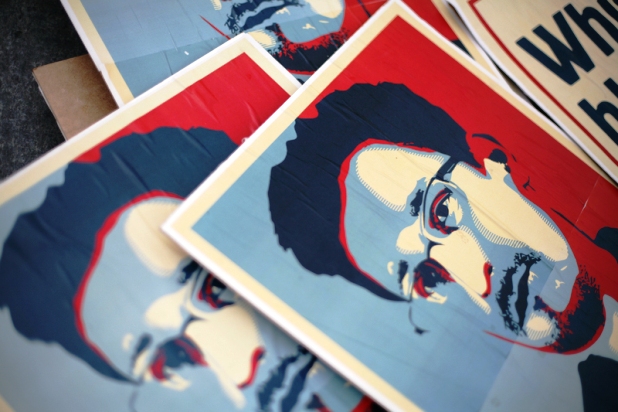
Edward Snowden placards at a protest in Berlin (David von Blohn/Demotix)
This is a guest post by Daniel Keane
Edward Snowden’s leaks have exposed an ideological chasm between the partisans of free information and liberty and the guardians of state security. They have also asked demanding questions of the public at large: when does intelligence gathering become an unwarranted intrusion into private lives? Is the first responsibility of an intelligence agent to the country he serves or to a — self defined — greater good? Can we have a free society without people who do dirty work like spying on our emails?
Public reaction in the polls remains mixed, with a Huffington Post/YouGov’s poll this week finding that 38 per cent of Americans believe Snowden did the wrong thing, while 33 per cent believing the contrary. However a survey released by Quinnipiac showed that 55 per cent of Americans believed Snowden was a whistle blower rather than a traitor.
Snowden also denied in interviews published that he gave any information to the Russian or Chinese governments while in transit there. Allegations of leaking information to these authorities arose from the New York Times, which claimed China had ‘drained the contents of Snowden’s laptops’. Snowden claimed he “never gave any information to either government.”
Snowden also declared in an interview given before he left his home in Hawaii with German newspaper ‘Der Spiegel’ that the NSA is “in bed together with the Germans the same as with most other Western countries” and that the USA and Israel co-wrote Stuxnet, the malicious computer virus utilised against an Iranian nuclear site.
These revelations made by Snowden come as a shock to the public consciousness and this is certainly reflected in the activities of pressure groups in the US and the UK. The Electronic Privacy Information Center, based in Washington DC, has filed an emergency petition to the US Supreme Court in order to halt the NSA’s logging of the nation’s telephone records.
Meanwhile in the UK, human rights group Liberty has filed a claim to the Investigatory Powers Tribunal against the British Intelligence Services for their role in the PRISM or Tempora surveillance programmes. It remains to be seen, however, whether both of these attempts to halt or impair mass surveillance will be successful: the US Supreme Court is unlikely to do away with a programme seen as vital to domestic security, while the IPT makes its decisions in private leaving any reform in Britain largely improbable.
If he reaches asylum, possibly in Nicaragua, Venezuela or Bolivia, Snowden could continue to leak crucial information regarding the NSA. The Obama administration finds itself in a crisis should he evade extradition: the inevitable slew of secrets weakening their international credentials.
Furthermore as Snowden reveals more regarding the collaboration of the US with Western European states, countries like Britain and France face a public dilemma as we learn more about the undermining of our personal liberties. These governments risk being whisked into undesirable public debate regarding the legitimacy of organisations such as GCHQ.
Even if Snowden returned to America to face trial the issue would not disappear. People will want to hear what he will say in court.
Many governments probably wish Edward Snowden was condemned to perpetual Limbo in Sheremetyevo Airport. But whatever happens, the repercussions of his actions are sure to endure for a long time as the debate between liberty and security rages ever on.
9 Jul 2013 | In the News
INDEX EVENTS
18 July New World (Dis)Order: What do Turkey, Russia and Brazil tell us about freedom and rights?
Index, in partnership with the European Council on Foreign Relations, is holding a timely debate on the shifting world order and its impact on rights and freedoms. The event will also launch the latest issue of Index on Censorship magazine, including a special report on the multipolar world.
(More information)
FROM INDEX ON CENSORSHIP MAGAZINE
Global view: Who has freedom of expression?
Freedom of expression is a universal, fundamental human right. But who actually has access to free expression? Index CEO Kirsty Hughes looks at the evidence.
(Index on Censorship)
Global view: Who has freedom of expression?
Freedom of expression is a universal, fundamental human right. But who actually has access to free expression? Index CEO Kirsty Hughes looks at the evidence.
(Index on Censorship)
The multipolar challenge to free expression
As emerging markets command influence on the international stage, Saul Estrin and Kirsty Hughes look at the impact on economics, politics and human rights.
(Index on Censorship)
News in monochrome: Journalism in India
The media’s infatuation with a single narrative is drowning out the country’s diversity, giving way to sensationalist reporting and “paid for” news. But, says Bharat Bhushan, moves towards regulation could have a chilling effect too
(Index on Censorship)
Censorship: The problem child of Burma’s dictatorship
Writer and artist Htoo Lyin Myo gives his personal account of working under government censorship in Burma
(Index on Censorship)
BURMA
Burma’s Press Council Threatens Resignation Over Media Rules
Members of Burma’s interim Press Council say they will resign if the newly minted Printing and Publishing Enterprise Bill is passed into law in its current guise.
(The Irrawaddy)
CHINA
State of the artist in China
“What can they do to me?” asks Ai Weiwei. “Who is afraid of Ai Weiwei?” sprays a young woman on city buildings in Hong Kong. You can hate him or love him but you can’t ignore Ai Weiwei.
(The Hindu)
GLOBAL
All the ways Google is asked to censor the web, in one handy chart
Google recently released statistics on all the legal requests it gets to censor the Web via its many services, from Search to YouTube. Now Sebastian Sadowski has created some handy visualizations of all the ways information is being censored — perhaps without you even realizing it.
(io9)
INDIA
To free the press or not to: the Indira govt debate?
The Indira Gandhi government feared Emergency and its various aspects, including the controversial family planning programme, would see the government “severely criticised” if press censorship was lifted in the run-up to the March 1977 Lok Sabha elections.
(Indian Express)
‘India has a strong culture for cinema’
Cinema is a movement that lets you enter the personal space of subjects without disturbing them and the art lies in then knitting a story around them, acclaimed French filmmaker Claire Denis said on Monday while addressing a news conference at the Film and Television Institute of India (FTII).
(Times of India)
IRAN
Iran’s Rouhani Set to Revamp Censorship?
Iranian President-elect Hassan Rouhani may be set to revamp the country’s censorship, according to a speech he delivered in Tehran.
(Israel National News)
MOROCCO
Free speech sidelined in Morocco
Despite promising reform and introducing a new constitution in 2011, Morocco’s treatment of dissidents indicates the changes were just window dressing, Samia Errazzouki writes
(Index on Censorship)
NEW ZEALAND
Critic claims censorship on Collins Wiki
Justice Minister Judith Collins’ office has become embroiled in a Wikipedia war with ministry critic Roger Brooking. Brooking is an outspoken critic of Collins and the Justice Ministry and was a prolific Wikipedia editor – now banned – under the username Offender9000.
(Southland Times)
RUSSIA
Guest Post: International solidarity with Russian civil society is crucial
Global action is needed to counter Putin’s crackdown on civil society, says Yuri Dzhibladze, president of the Center for the Development of Democracy and Human Rights
(Index on Censorship)
Russia to Develop ‘Code of Ethics’ for Film Industry
Veteran Russian directors Karen Shakhnazarov and Marlen Khutsiyev have been included in a working group charged with developing a code of ethics for the Russian film industry, an idea originally suggested by President Vladimir Putin.
(The Hollywood Reporter)
SINGAPORE
US ‘deeply concerned’ by Singapore Internet rules
The United States said Monday it was “deeply concerned” by what it called a “new restrictive” law in Singapore for licensing online news websites.
(Inquirer)
TUNISIA
Hollande’s Tunisia Visit Upsets
Some Civil Society Advocates
While many observers expected the visit of French President Francois Hollande to Tunisia to be postponed, others believed that its timing was counterproductive in the sense that it signaled indirect support for the ruling troika.
(Al Monitor)
UNITED STATES
Top Attorney Floyd Abrams Has Defended Free Speech For Over 40 Years
Floyd Abrams is an ardent defender of free speech and a passionate proponent of the First Amendment. Except for the time that his 12-year-old daughter, now a federal judge, told her dad that she and some friends were going to an R-rated movie.
(NY1)
Coalition calls for veto of NJ media violence ‘disinformation bill’
The National Coalition Against Censorship, American Booksellers Foundation for Free Expression and the Center for Democracy and Technology sent a letter to New Jersey Governor Chris Christie today asking him to veto Senate Bill 2715, which would require the state’s Department of Education “to prepare and distribute informational pamphlets on how parents can limit a child’s exposure to media violence,” which includes video games, according to the text of the bill.
(Polygon)
Previous Free Expression in the News posts
July 8 | July 5 | July 4 | July 3 | July 2 | July 1 | June 28 | June 27 | June 26 | June 25
27 Jun 2013 | In the News
INDEX POLICY PAPER
Is the EU heading in the right direction on digital freedom?
While in principle the EU supports freedom of expression, it has often put more emphasis on digital competitiveness and has been slow to prioritise and protect digital freedom, Brian Pellot, digital policy advisor at Index on Censorship writes in this policy paper
(Index on Censorship)
AUSTRALIA
Australia doubles down on censorship, refuses R18+ classification to State of Decay
Australia, coming off the back of refusing classification to Saints Row IV yesterday, apparently wasn’t satisfied with just one act of censorship. Today Undead Labs announced that their game too had been refused classification, so for the foreseeable future Australia will not be seeing State of Decay. Again, the issue seems to be related to some sort of drug use. The team is currently exploring their options with Microsoft
(NeoSeeker)
BAHRAIN
Bahrain mulls clamp on Internet calls
Bahrain is considering introducing controls on calls made via the Internet, including those on Skype and Viber, said a top official.
(Trade Arabia)
BRAZIL
Brazil’s left and right struggle for ownership of protests
Rival groups split on the political direction of the protests, with claims two organisations back military rule
(The Guardian)
EGYPT
Egypt journalists to march for free expression on 30 June
Journalists criticise attacks on freedom of expression under President Mohamed Morsi
(Ahram Online)
EUROPEAN UNION
EU adopts guidelines to “protect and promote” LGBTI rights
Coming on the heels of Russia’s enactment of a “gay propaganda” law, the European Union’s decision to adopt guidelines to protect the rights of lebian, gay, bisexual, transgender and intersex persons in foreign relations on Monday is welcome. Sean Gallagher writes
(Index on Censorship)
FRANCE
Pro-Israeli activist found guilty of libel
A man has been convicted of defamation in France for his claims about a widely-publicised video which showed a 12-year-old Palestinian boy’s death in Gaza Strip.
(Al Jazeera)
ISRAEL
Knesset members seek libel protection for IDF soldiers
If passed, legislation will enable class-action suits against critics who make false claims about army operations
(The Times of Israel)
INDIA
Censor laws are extremely ambiguous: Anand Gandhi
Independent filmmaker Anand Gandhi was in the city recently to screen his film ‘Ship of Theseus’ for the students of Film and Television Institute of India. Anand spoke to TOI about being an independent filmmaker, film censorship and why serious engagement from the government for Indian films is the need of the hour.
(The Times of India)
JORDAN
Jordan Accused Of Targeting Online Dissent
Jordan’s King Abdullah vowed to make the desert kingdom a “free Internet” country as he began his rule more than a decade ago. On June 2, when local Internet providers were ordered to block hundreds of news websites across the kingdom, Web publishers protested the broken promise and international media watchdog organizations charged censorship.
(NPR)
RUSSIA
Blockage of Major News Websites Raises Censorship Fears
A ruling by a court in the central Russian town of Ulyanovsk ordering a state-run Internet provider to block access to 15 websites, including those of two prominent national newspapers, has sparked fears of a broader campaign of Internet censorship in the country.
(The Moscow Times)
SOUTH AFRICA
South African groups seek arrest warrants for Obama
Two South African groups were trying to obtain arrest warrants for US President Barack Obama, who will visit the country later this week.
(Times Live)
TURKEY
Turkey seeks to tighten grip on Twitter after protests
Turkey said on Wednesday it had asked Twitter to set up a representative office inside the country, which could give it a tighter rein over the microblogging site it has accused of helping stir weeks of anti-government protests.
(Reuters)
UNITED KINGDOM
Banning of Geller and Spencer from UK will only build grievance
Britain’s ban on anti-Muslim activists could do more harm than good, says Padraig Reidy
(Index on Censorship)
Change in libel laws ‘not required in Northern Ireland’
A Stormont committee has been told there is no need to reform antiquated Northern Ireland’s libel laws by a high-profile libel lawyer.
(Belfast Telegraph)
Daily Mail in £110k libel payout over Syrian chemical weapons story
The Daily Mail has been forced to pay more than £100,000 in damages and apologise for a story linking a UK defence company with the use of chemical weapons in Syria.
(Press Gazette)
UNITED STATES
Jeff Olson Faces 13 Years In Jail For Writing Anti-Bank Messages In Chalk
Jeff Olson, a man who is being prosecuted for writing anti-bank messages on sidewalks in water-soluble chalk last year, is facing a 13-year jail sentence.
(Opposing Views)
Companies win U.S. free speech shield over scientific articles
Authors and publishers of controversial scientific articles, and the companies sponsoring those articles, won broad free speech protection from a U.S. appeals court on Wednesday.
(Reuters)
Sexual predator cries censorship over Jaycee Dugard memoir
Eight years ago, a New York journalist named Peter Braunstein, then 41, forced his way into the apartment of a 34-year-old Manhattan woman by pretending to be a firefighter. He proceeded to drug the woman, a former colleague, and sexually assault her for more than 12 hours.
(Los Angeles Times)
VIETNAM
In Vietnam, “Depraved” Blogging Could Get You Locked Up for a Decade
Vietnam is not a good place to be a blogger. At least, it’s not a good place to be a blogger if you actually want to write what’s on your mind.
(Motherboard)
Previous Free Expression in the News posts
June 26 | June 25 | June 24 | June 21 | June 20 | June 19 | June 18 | June 17
26 Jun 2013 | In the News
INDEX POLICY PAPER
Is the EU heading in the right direction on digital freedom?
While in principle the EU supports freedom of expression, it has often put more emphasis on digital competitiveness and has been slow to prioritise and protect digital freedom, Brian Pellot, digital policy advisor at Index on Censorship writes in this policy paper
(Index on Censorship)
AZERBAIJAN
Tensions between two natural allies
Protesters face an extra three months in prison without trial. Padraig Reidy reports. Members of Azerbaijan’s N!DA Civic movement have been held since the end of March this year. It was confirmed this week that their pre-trial detention is to continue for another three months.
(Index on Censorship)
EUROPEAN UNION
Free expression guidelines a crucial opportunity for EU
As the European Commission opens a consultation on its planned freedom of expression guidelines, Index on Censorship is publishing a public note setting out what it sees as the key principles that must underpin such guidelines.
(Index on Censorship)
INDIA
Tensions between two natural allies
The doctrine of prior restraint and the more potent contempt of court provisions have the potential to disturb the relationship between the judiciary and media
(The Hindu)
ISRAEL
Bill making libel against IDF a crime ‘highly problematic’
The Knesset’s Constitution, Law and Justice Committee on Monday debated the so-called “Jenin-Jenin bill,” which suggests making libelous statements or accusations against the Israel Defense Forces in the media would become a criminal offense.
(Israel Hayom)
LIBYA
Libyan political party officials could face death penalty over election posters
Libyan judicial authorities should immediately drop all criminal charges that violate freedom of speech over election poster cartoons against two Libyan National Party officials, Human Rights Watch said today. Under the laws being applied in this case, the men could face the death penalty over posters their party displayed during the 2012 election campaign for the General National Congress.
(IFEX)
PAKISTAN
‘Solid’ culture policy can help defeat terrorism
The Culture Journalists Forum (CJF) on Monday demanded of the PTI-led Khyber Pakhtunkhwa government to announce a ‘solid and clear’ culture policy, allocate funds for the promotion of art and culture in the province and set up a transparent censorship board to check production of substandard and vulgar Pashto CDs.
(Dawn)
NORWAY
Freedom of Expression Grant to Far-Right Blogger Stirs Debate in Norway
Culture Minister Hadia Tajik supports Freedom of Expression grant for the controversial blogger Peder Nøstvold Jensen, best known by the nickname Fjordman.
(The Nordic Page)
SPAIN
Spain’s Google privacy case “an interference with the freedom of expression”
Should search engines be forced to block results that link to newspaper articles? No, the Advocate General of the European Court of Justice said earlier today, deciding Google need not block “legal and legitimate information that has entered the public domain”. Brian Pellot writes
(Index on Censorship)
TAIWAN
Taiwan: Internet Policy Reforms Spark Fears of Censorship
This spring, the Taiwanese government has proposed multiple amendments to existing laws that could impact free expression online, sparking concern among Taiwanese netizens. While many are comparing the amendments to Chinese-style speech control, others have noted the influence of the United States on the legislation.
(Global Voices Online)
TURKEY
Turkey protests restrict Erdogan’s foreign activism
Expert: Ankara still may act in key regions, including Gaza; twenty arrested in latest raid in Turkey.
(The Jerusalem Post)
EU agrees to reopen Turkey membership talks
The EU agreed to reopen long-stalled talks on Turkey’s EU membership on Tuesday, but not until a later date due to concerns from Germany that it could send the wrong message to Ankara after its tough crackdown on anti-government protests.
(France 24)
UKRAINE
Femen and Facebook in ‘Pornography’ Row over Topless Pictures
Radical feminist group Femen has had two of its Facebook pages blocked by the social networking site because of nudity. The Facebook censors went into action because of the large number of images of Femen activists taking part in topless demonstrations.
(International Business Times)
UNITED STATES
The chilling effects of surveillance
Revelations contained in documents recently leaked to the Guardian by whistleblower Edward Snowden have placed the United States front and centre in the ongoing global debate around mass surveillance.
(Al Jazeera)
Edward Snowden: history will be kind to him
Daniel Ellsberg, the leaker of the Pentagon Papers 40 years ago, was smeared and denounced at the time
(The Guardian)
Have you noticed growing assaults on free speech? Here? And here? And here?
Revelations contained in documents recently leaked to the Guardian by whistleblower Edward Snowden have placed the United States front and centre in the ongoing global debate around mass surveillance.
(Investor’s Business Daily/a>)
Abortion Opponents: ‘Buffer Zones’ At Abortion Clinics Violate Free Speech
The Supreme Court has said it will reconsider the constitutionality of protest zones
(US News and World Report)
Previous Free Expression in the News posts
June 25 | June 24 | June 21 | June 20 | June 19 | June 18 | June 17
