28 Mar 2022 | News, Russia, Ukraine
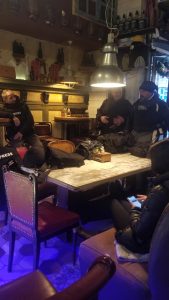
Photo: Reporters inside Kyiv’s Buena Vista Social Bar
There’s always a bar. In Kyiv, in 2022, it’s the Buena Vista Social bar, bang next to a Ukrainian police checkpoint which is both funny ha-ha and funny peculiar because there is a nationwide ban on the sale of alcohol. Sssh. It’s a joyful shebeen, Cuban-themed, run by Maks, and you never quite know what’s available to drink and who’s going to be there. All the women have a past; all the men have no future. You get the vibe.
Early on in the war, a fellow regular was a big bloke with a thick moustache and a mane of bubbly, curly hair, often seen with his fixer, a Ukrainian freelancer. I never spoke to him but I clocked him as someone who had presence, who was an interesting character, who I had probably seen in Sarajevo or somewhere like that. He was Pierre “Zak” Zakrzewski, she Sasha Kuvshynova, and they were both killed on 14 March 2022 when their vehicle came under fire in Bucha – pronounced Butcher – to the northwest of Kyiv. British journalist Ben Hall was wounded in the same attack. They were working for Fox News, something Zak, 55, who had been brought up in Ireland, had mixed feelings about. But he knew the risks of war too well and made a decision that working for a big corporate was better risk-management than being freelance. His co-workers at Fox loved him, giving him an award as “Unsung Hero” after he helped get Afghan freelancers out of Kabul.
Sasha was 24, bold and fiercely smart. After her death, her dad said that she learnt to read at the age of three and picked up English from reading restaurant menus while on family holidays. She was a fanatical photographer with five stills cameras, had founded a music festival for up-and-coming jazz musicians, worked as a DJ and wrote poetry. She wanted to make movies.
If you don’t like free expression in a democracy, you blow up the TV tower. The Kremlin’s first journalist victim was Yevhenii Sakun, 49, a camera operator for Ukraine’s LIVE station, on 1 March. The Russian army sent in four missiles in the evening, killing a worker in the TV tower complex and four civilians. The next morning I saw the people from the morgue take away the bodies of a middle-aged man and a mother and her child with my own eyes.
The most dangerous area of Kyiv is the northwest suburbs, where the Russian army’s offensive, driving down through Chernobyl, has come closest to the capital. Reporters seeking human stories, of refugees fleeing with their dogs on a lead or their cat in a box, went repeatedly to Irpin. Fearing further Russian advance, the Ukrainian army flooded the river plains near the suburb and blew up the most southerly bridge, leaving people to pick their way across the skeleton remains. Once beyond that crossing, there is a second bridge. That’s where US film maker Brent Renaud, 50, originally from Little Rock and formerly of the New York Times, found himself, filming refugees running for their lives. Brent knew what he was doing, having filmed and reported man’s cruelty to man in Iraq, Afghanistan, Libya: all the nice places.
At Irpin, at the second bridge, the Russian army shot him in the neck and he died of his wounds.
Oksana Baulina was one of those intensely brave Russians who were on Team Navalny before their champion was arrested on fake charges and the organisation broken up. Oksana, 43, was declared a “terrorist” by the Kremlin and had to flee Russia. She set up as a reporter and film maker in Poland and reported on the war. When Russian artillery smashed into a shopping centre in Podil, in the northwest of the city, she was killed.
To be honest with you I have done my best to avoid writing this piece for days now because it can only fill one with gloom to think of these brave truth-tellers sent early to their graves by the mobster in the Kremlin. But my pals and I in the Buena Vista are buoyed up the thought that we are in Ukraine exactly because Vladimir Putin does not want us to be here. And on that point, Mr Putin, do fuck off.
And the rum is good.
There is, also, the line from Tom Stoppard’s great play, Night And Day, which I quoted on Twitter while hurrying back from the bar just before – well, actually, just after curfew – had fallen. This, from memory, is how it goes, how the lover of the dead young journalist, played by Diana Rigg, killed on the frontline denounces the false romance of journalism, “it’s not worth the heart-break beauty queen or the crossword and it’s definitely not worth the leader.”
And the old hack, played by John Thaw, replies: “Yes, you’re right. But also the other thing. People do awful things to each other. But it’s worse in places where everybody is kept in the dark. Information is light. Information, in itself, about anything, is light.”
RIP Zak, Sasha, Yevhenii, Brent and Oksana.
8 Sep 2021 | News, United Kingdom
[vc_row][vc_column][vc_single_image image=”117423″ img_size=”full” add_caption=”yes”][vc_column_text]
It is now more than 20 years since The Guardian and The Observer fought off attempts by the UK government to force them to hand over documents in the case of MI5 whistleblower David Shayler. At a judicial review, Judge Igor Judge concluded that demands to hand over journalistic material “would have a devastating and stifling effect on the proper investigation of the … story”.
The case reinforced the special status of journalistic sources in law – even in official secrecy cases – and established the principle that the police should not use journalists as informers.
As the Observer journalist responsible for writing the stories about Shayler’s disclosures, which included allegations of the involvement of UK intelligence in a plot to topple Libya’s Muammar Gaddafi, I was particularly concerned to see the latest proposals for the reform of the Official Secrets Act.
These include enhanced search powers to give police access to just the sort of journalistic “special procedure material” (notes, emails and recorded interviews) we fought so hard to keep from the police two decades ago. The new OSA would thus enshrine in law the “devastating and stifling effect” on journalism that so concerned Judge.
Much has happened in the two decades since The Guardian and The Observer’s principled stand in the High Court. The growth of digital technology, the emergence of global Islamist terrorism and the increased national security threat to the UK from Russia and China have given the government good arguments for reform of legislation that was enacted when the world wide web was in its infancy.
But the new act is authoritarianism by stealth – a full-on assault on media freedom, carefully hidden behind an apparently reasonable desire for reform.
The National Union of Journalists has rightly sounded the alarm over plans to increase the maximum prison sentence for breaches of the OSA, which currently stands at two years. This will have significant chilling effect on journalists investigating government wrongdoing and their civil servant sources. More worrying still is the distinction now being made between espionage and so-called “unauthorised disclosure offences” (ie, leaks to journalists). As the consultation makes clear, this government believes “there are cases where an unauthorised disclosure may be as, or more, serious in terms of intent and/or damage”. The argument is that a large-scale digital disclosure could benefit a number of hostile actors, whereas espionage is usually carried out by a single state. The effect, in practice, is that a journalist in receipt of secret documents could face a longer sentence than a spy.
Where the government really lets its authoritarian slip show, however, is in a section of the consultation about the number of successful prosecutions under existing legislation. The truth is that the record here is woeful. The government argument is as follows: “This is primarily due to the sensitive nature of the evidence that would typically be required to be disclosed in order to bring prosecutions, but also because of the age of the legislation, which means many of the offences are not designed for the modern world. Prosecutions, as a result, are challenging and rare.”
This is patent nonsense. In most cases, Official Secrets prosecutions fail because they should not have been brought in the first place.
Since the Shayler case, I have been involved in two other high-profile Official Secrets cases, both of which eventually collapsed. The first concerned Katharine Gun, a GCHQ whistleblower, who leaked details to The Observer of a covert US/UK operation to fix the vote at the UN Security Council in advance of the Iraq War in 2003.
As the recent film of the case – Official Secrets – made clear, the problem was not disclosure of evidence of the crime (Gun confessed to the leak) but disclosure that would lead to ministerial embarrassment about the legality of the war.
The second case involved a Foreign Office official, Derek Pasquill, who leaked details of government policy on radical Islam in 2006. Here again, the trial did not collapse over evidential disclosure. In this case there were serious questions over whether any of his disclosures should have been covered by the OSA in the first place.
For those who care about free speech, civil liberties and democracy, the most serious concern should be the resistance of the government to a public interest defence in such cases. This is where the British state and the British people come into direct conflict.
In the cases of Gun and Pasquill, there is no doubt they acted in the public interest to reveal uncomfortable truths for the government. Their revelations served not just the public interest but the national interest. If the new legislation had been in place at the time, it is quite possible that Gun and Pasquill would both have been sent to prison.
Boris Johnson, the UK’s journalist prime minister, has said he doesn’t want to see a world where people are prosecuted for doing their public duty. I look forward to his column condemning his government’s own Official Secrets proposals, which will create just that nightmare world.
This piece first appeared in the British Journalism Review
[/vc_column_text][/vc_column][/vc_row]
20 Apr 2021 | News
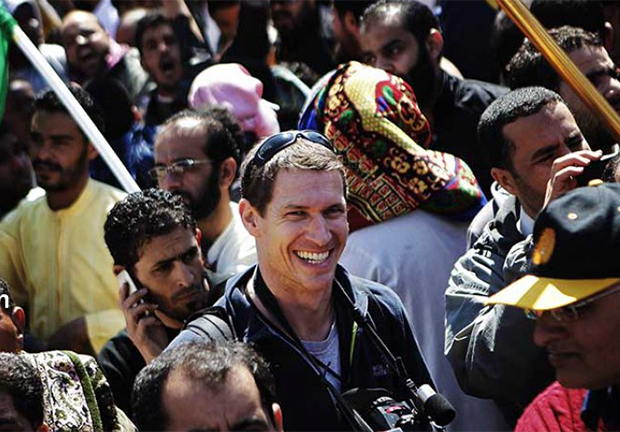
Tim Hetherington’s mission to create a better understanding of the world cast him in many roles: photojournalist, filmmaker, human rights advocate, artist and a leading thinker in media innovation. He was killed in Libya by a mortar in in April 2011.
On 20 April 2011, photojournalist Tim Hetherington was killed by shrapnel from a mortar blast in Misrata, Libya.
Born in Liverpool on 5 December 1970, Hetherington was a prominent photojournalist whose work was acclaimed by his peers. He was once described as one of ‘brightest photojournalists of his generation’ and his work included co-producing the Oscar-nominated Restrepo, a 2010 documentary film about US soldiers in the war in Afghanistan.
His passion for his work was rooted in developing a relationship between his audience and the events portrayed in his work. He once said: “I want to record world events, big history told in the form of a small history, the personal perspective that gives my life meaning and significance. My work is all about building bridges between myself and the audience.”
A clear passion for people is what led him to the Libyan civil war and to the front line between rebel forces and those of Muammar Gaddafi, where he met his death.
After a degree in photojournalism from Cardiff University in 1997, Hetherington pursued his photography career. His coverage was extensive and ranged from the aftermath of the 2004 Boxing Day tsunami, to the events during and after the Liberian civil war.
Director of the Tim Hetherington Trust, Stephen Mayes, shed a light on where his appetite for his work came from. He wrote: “His family talks about a child who was playful yet intense, perpetually curious and seeking new experiences, pushing the proper boundaries of an English adolescence, characteristics that later served him well as a journalist.”
“It was never enough to simply witness events, he had to experience the lives of his subjects”
After Hetherington’s death, Sebastian Jungar, the director of Restrepo and someone who worked closely with him released the film “Where is the Front Line from Here? The Life and Time of Tim Hetherington”, a documentary about his life and work.
Junger told Index of his work with Hetherington and his unique way of thinking.
“In my mind he was some ways a brother. We were in combat together and it builds a kind of experience of brotherhood that is hard to find anywhere else,” Junger recollected.
“When he was killed, I was devastated like I had never been devastated by anything. Among other things, I decided to stop combat reporting.”
“He really thought out of the box. He said to me ‘I only use a camera because that is the easiest way to tell a certain kind of story. If I could tell that story without a camera I would drop it in a second’.”
During the filming of the pair’s co-project, Restrepo, Junger recalls a moment that typified Hetherington’s approach to his work.
“There was a lot of combat, but when there wasn’t, the guys [US infantry] would basically sleep as much as they could.”
“One day everyone was asleep, but Tim was sort of creeping around and I asked him ‘What are you doing? It is like 100 degrees and everyone is asleep’.”
“He said ‘Don’t you get it? They look like children. This is how their mothers see them’.”
Tim Hetherington’s name lives on not only through his work but also through an eponymous fellowship with Index on Censorship, established in 2016 in conjunction with Liverpool John Moores University and the Tim Hetherington Trust. The fellowship sees a student from the university join Index for a year as editorial assistant on the magazine and website, gaining valuable journalistic experience.
Steve Harrison, journalism lecturer at LJMU’s Liverpool Screen School, who manages the fellowship, spoke of the how Hetherington’s work continues to be a good example to his students.
“His main media output was documentaries, so it is of particular interest to people looking to go into that. But it was his journalism roots that is relevant to all students and an example of a way in which journalism can be put to a very powerful use,” he said.
“It is not just journalism, it is art as well, the intersection of journalism and art. It is our view that Tim’s work was an inspiration for current and future journalists and one of the main reasons we thought naming [the fellowship] after him was so appropriate. An ideal fit.”
The fellowship has helped a number of former LJMU students gain a foothold in the industry. Last year’s recipient Orna Herr, now a communications officer for the British Science Association, said: “The Tim Hetherington fellowship gave me incomparable experience of working in journalism and the confidence to pitch and write my own stories. Being a member of the team at Index allowed me to be part of the process of editing and publishing articles from all over the world, working closely with the journalists themselves and the editorial team.
“I left Index with a portfolio of work I’m very proud of.”
Lewis Jennings, the 2018/19 fellow, said, “I learned a lot about the craft of journalism and also what it means to be an advocate for free expression. It opened my eyes to a lot of things that go on in the world in terms of threats to the media and free speech. It has enabled me to pursue a career in journalism, both in print and radio. It was an honour to carry on the legacy of Tim Hetherington through the fellowship. Tim’s work as a visual storyteller and human rights advocate continues to inspire ten years after his death.”
