
Maldives: Killing of Yameen Rasheed underscores urgent need for reform
[vc_row][vc_column][vc_column_text]
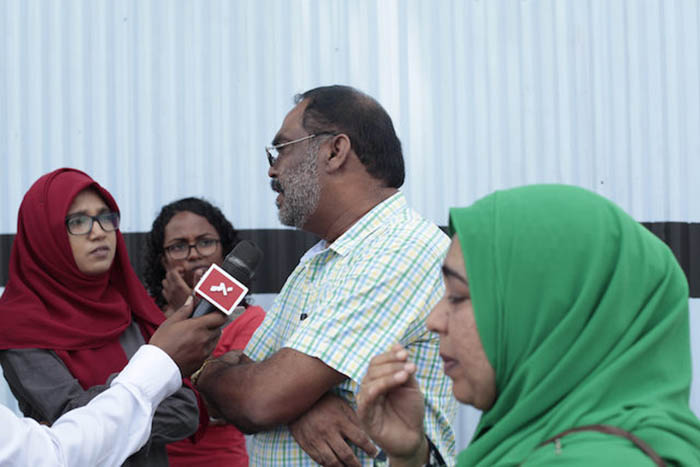
Yameen Rasheed’s family submit a petition to Maldives Police Services to investigate his murder.
Your Excellency,
The undersigned civil society organisations write to you to condemn in the strongest terms the murder of internationally recognised Maldivian blogger Yameen Rasheed. We call on the government to take all necessary measures to ensure that the perpetrators of this heinous crime are brought to justice and to end the cycle of impunity for attacks on journalists, bloggers, and human rights defenders that has taken root in the Maldives.
Yameen Rasheed was an impassioned critic who reported on issues related to corruption, radicalism, and impunity, mainly through his popular blog The Daily Panic. In 2015, IFEX helped to support Yameen to speak out on these issues at the UN Human Rights Council in Geneva. His witty and relentless condemnation of systemic injustice earned him praise but also drew the attention of religious extremists and government officials who felt threatened by his social and political commentary.
Yameen Rasheed had reported numerous death threats before his attack. The police refused to act on any of his complaints. Reports since his killing suggest that the crime scene had been tampered with before a thorough review of evidence could be carried out. Furthermore, the family of Yameen Rasheed has reported harassment by local police who sought to prevent them from making public calls for justice for the death of their son. Such troubling reports raise doubts about the authorities’ commitment to ensure that a proper investigation takes place.
Yameen’s case is emblematic of the growing intolerance for ideas and opinions that challenge the role of religion in society throughout South Asia. Similar to countries like Pakistan and Bangladesh, in the Maldives, harassment of individuals that promote moderate or secular views has been common, and is justified by both militant criminal groups and sympathetic politicians on the grounds that these ideas are “un-Islamic.”
Yameen is one of three recent high-profile cases of attacks on media personnel in the Maldives over the past five years. In 2012 Ismail Rasheed, a freelance journalist and human rights campaigner, barely survived after having his throat slit near his home in the Maldivian capital, Malé. In 2014, Ahmed Rilwan, journalist for Minivan News, was abducted from his office and remains missing to this day. Rilwan was a close friend of Yameen’s, and much of Yameen’s work was focused on finding justice for Rilwan’s abduction. In all cases there has been a lack of adequate police investigation and response.
There are further causes for concern in the broader Maldivian free expression environment. The country ranks 117th out of 180 countries in Reporters Without Borders’ 2017 Press Freedom Index, due in large part because of restrictive laws such as the 2016 “Protection of Reputation and Good Name and Freedom of Expression Bill”, which criminalises defamation based on an overly broad definition of the offence. Public threats have frequently been issued against independent media by politicians, criminal gangs and religious extremists and have helped to create a climate of hostility that has led to self-censorship. Imprisonment of journalists and activists is also a common tactic used to silence critical voices.
Yameen Rasheed’s death should serve as a strong indicator of the need for immediate steps to protect space for dissent and debate in the Maldives, space that is threatened by draconian laws and impunity for attacks committed against individuals expressing controversial or adversarial opinions. As such, we call on the government to take the following measures:
• Ensure that a timely, thorough, and transparent investigation into the killing of Yameen Rasheed takes place and all perpetrators of this crime against freedom of expression are brought to justice. Similar action should be taken in the cases of Ismail Rasheed and Ahmed Rilwan;
• Investigate and hold accountable all those who make threats or incite violence against journalists, bloggers, and human rights defenders, as well as against the family of Yameen Rasheed;
• Amend or repeal laws that create disproportionate and unnecessary limits to legitimate expression, according to standards specified in Article 19 of the International Covenant on Civil and Political Rights, ratified by the Maldives in 2006;
• Implement legislation and other measures to create a safe and enabling environment for journalists and human rights defenders, according to relevant recommendations accepted by the Maldives during its 2nd cycle Universal Periodic Review (UPR);
• Improve independence of the judiciary and build technical capacity of the police force through international assistance and other reforms, as agreed to by the Maldives during its 2nd cycle UPR.
Signed,
Bytes for All
Adil Soz – International Foundation for Protection of Freedom of Speech
Afghanistan Journalists Center
ARTICLE 19
Association for Media Development in South Sudan
Bahrain Center for Human Rights
Cambodian Center for Human Rights
Canadian Journalists for Free Expression
Center for Media Freedom and Responsibility
Committee to Protect Journalists
Foundation for Press Freedom – FLIP
Freedom Forum
Free Media Movement
Global Voices Advox
Globe International Center
Human Rights Network for Journalists – Uganda
Index on Censorship
Institute of Mass Information
International Federation of Journalists
International Press Centre
International Publishers Association
MARCH
Media, Entertainment and Arts Alliance
Media Institute of Southern Africa
Pakistan Press Foundation
Palestinian Center for Development and Media Freedoms – MADA
PEN American Center
PEN Canada
PEN International
Reporters Without Borders
Vigilance pour la Démocratie et l’État Civique
Asian Forum for Human Rights and Development
Awaz Foundation Pakistan, Centre for Development Services
Banglar Manabadhikar Suraksha Mancha
Bangladesh Manobadhikar Sangbadik Forum
Center for Social Activism
Center for Media Research – Nepal
Commonwealth Human Rights Initiative
FIDH, in the framework of the Observatory for the Protection of Human Rights Defenders
Front Line Defenders
Free Press Unlimited
Maldivian Democracy Network
Peoples’ Vigilance Committee on Human Rights
People’s Watch India
Pakistan NGOs Forum
Programme Against Custodial Torture and Impunity
South Asian Women in Media – Sri Lanka
South India Cell for Human Rights Education and Monitoring
World Organisation Against Torture (OMCT), in the framework of the Observatory for the Protection of Human Rights Defenders[/vc_column_text][/vc_column][/vc_row][vc_row][vc_column][vc_basic_grid post_type=”post” max_items=”4″ element_width=”6″ grid_id=”vc_gid:1494603115837-be75a009-7c8a-9″ taxonomies=”9143, 4002, 8875, 9028″][/vc_column][/vc_row]
 Beyond the Script, part of the