11 Jan 2018 | Campaigns -- Featured, Russia, Statements
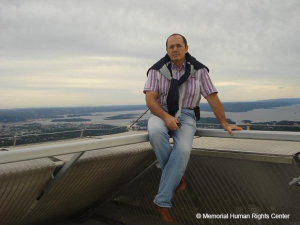
Oyub Titiev
We, members of the Civic Solidarity Platform (CSP), are deeply concerned at reports of the arrest of Oyub Titiev, head of Human Rights Center Memorial’s Grozny office in Chechnya on highly dubious narcotics charges. We call for his immediate and unconditional release and dropping of all charges.
Titiev is highly respected in the international human rights community, as well as in the North Caucasus, where he is part of a small group of brave human rights defenders still working to uncover and document grave ongoing human rights violations. Titiev has led Memorial’s work in Chechnya since the horrific murder of his colleague Natalia Estemirova in 2009. In recent years, he received numerous threats aimed at making him quit human rights work. Now, his life and safety are in jeopardy.
According to reports, Oyub Titiev was brought to the Kurchaloi district police department shortly after his car was stopped and searched near the Khymuk bridge around 10:30 am on Tuesday 9 January. Titiev’s lawyer has been informed that he is being charged with the illegal possession of drugs, reportedly a large amount (180 grams) of marijuana.
Similar trumped-up charges have previously led to several years’ imprisonment for activists and independent journalists in Chechnya. Framing people for drug crimes has become an increasingly frequent tactic used by Chechnya’s authorities to punish and discredit their critics in the eyes of Chechen society.
The Civic Solidarity Platform is a network of more than 90 human rights organizations working across the OSCE region. We consider the suggestion that a highly experienced human rights defender such as 60 year-old Oyub Titiev would travel around Chechnya with any amount of drugs in his car to be absurd, and to be evidence only of the tactics employed by Chechen authorities against principled and hard-working human rights defenders. We believe Chechen authorities are seeking to frame Titiev and close down the extremely important work of Human Rights Center Memorial in the region by means of threats and harassment.
Russia is under an obligation to respect and enable the work of human rights defenders. An important resolution in the UN General Assembly – adopted by consensus on 24 December 2017 – “Calls upon States to take concrete steps to prevent and put an end to arbitrary arrest and detention, including of human rights defenders, and in this regard strongly urges the release of persons detained or imprisoned, in violation of the obligations and commitments of States under international human rights law, for exercising their human rights and fundamental freedoms, such as the rights to freedom of expression, peaceful assembly and association, including in relation to cooperation with the United Nations or other international mechanisms in the area of human rights”.
The undersigned members of the Civic Solidarity Platform call on Chechen authorities as well as central Russian authorities to immediately release Oyub Titiev and stop his persecution as we believe that he is being punished solely in retaliation for his legitimate and peaceful human rights work. Furthermore, we call on authorities to ensure the safety of Memorial staff in Chechnya. Furthermore, we call on authorities not to hinder but to assist brave individuals such as Titiev in their work to uncover grave human rights violations in the North Caucasus region.
We call on international organizations and foreign governments to follow Titiev’s case closely and to bring our concerns to the attention of the authorities in the Russian Federation. Russia must abide by its international human rights obligations and OSCE commitments.
Signed:
- Advisory Centre on contemporary international practices and their implementation in law ”Human Constanta” (Belarus)
- Albanian Helsinki Committee (Albania)
- Article 19 (United Kingdom)
- Association UMPDL (Ukraine)
- Barys Zvozskau Belarusian Human Rights House (Lithuania)
- Belarusian Helsinki Committee (Belarus)
- Bir Duino (Kyrgyzstan)
- Bulgarian Helsinki Committee (Bulgaria)
- Center for Civil Liberties (Ukraine)
- Center for Participation and Development (Georgia)
- Center for the Development of Democracy and Human Rights (Russia)
- Centre de la Protection Internationale (France)
- Citizens’ Watch (Russia)
- Committee Against Torture (Russia)
- Crude Accountability (USA)
- Freedom Files (Poland/Russia)
- Georgian Centre for Psychosocial and Medical Rehabilitation of Torture Victims-GCRT (Georgia)
- German-Russian Exchange (Germany)
- Helsinki Association Armenia (Armenia)
- Helsinki Citizens’ Assembly-Vanadzor (Armenia)
- Helsinki Committee for Human Rights in Serbia (Serbia)
- Helsinki Committee of Armenia (Armenia)
- Helsinki Foundation for Human Rights (Poland)
- Human Rights Center of Azerbaijan (Azerbaijan)
- Human Rights Center “Viasna” (Belarus)
- Human Rights Club (Azerbaijan)
- Human Rights Matter (Germany)
- Human Rights Monitoring Institute (Lithuania)
- IDP Women Association Consent (Georgia)
- Index on Censorship (United Kingdom)
- Institute for Reporters’ Freedom and Safety (Azerbaijan)
- International Partnership for Human Rights (Belgium)
- International Protection Center (Russia)
- Kazakhstan International Bureau for Human Rights and Rule of Law (Kazakhstan)
- Kharkiv Regional Foundation Public Alternative (Ukraine)
- Legal Transformation Center (Belarus)
- Macedonian Helsinki Committee (Macedonia)
- Moscow Helsinki Group (Russia)
- Netherlands Helsinki Committee (Netherlands)
- Norwegian Helsinki Committee (Norway)
- Notabene (Tajikistan)
- OMCT – World Organisation Against Torture (Switzerland)
- Office of Civil Freedoms (Tajikistan)
- Promo LEX Association (Moldova)
- Protection of Rights Without Borders (Armenia)
- Public Association Dignity (Kazakhstan)
- Public Verdict (Russia)
- Regional Center for Strategic Studies (Azerbaijan/Georgia)
- Solidarus (Germany)
- Truth Hounds (Ukraine)
- Women of the Don (Russia)
22 Nov 2017 | Bahrain, Bahrain Statements, Campaigns -- Featured, Statements
[vc_row][vc_column][vc_column_text]
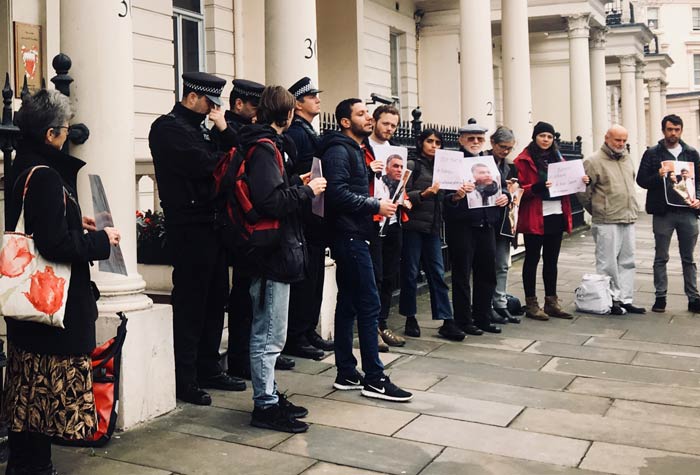
Protesters call for freedom for Nabeel Rajab outside the Bahraini embassy in London.
Nabeel Rajab’s sentence to two years in prison for speaking to journalists was upheld on 22 November 2017 by a Bahraini appeals court at the conclusion of a long-running, unfair trial.
Rajab will serve his sentence at notorious Jau Prison until December 2018, by which time he will have actually spent two and a half years in prison. He faces up to 15 years in prison in a second case related to his comments on Twitter, with the next hearing on 31 December. Index on Censorship and the Bahrain Institute for Rights and Democracy (BIRD) condemns Rajab’s imprisonment, which is a reprisal against his work as a human rights defender, and calls for his immediate and unconditional release.
Rajab was sentenced in absentia on 10 July 2017 on charges of “publishing and broadcasting fake news that undermines the prestige of the state” under article 134 of Bahrain’s Penal Code. This is in relation to statements he has made to media that:
-
International Journalists and researchers are barred from entering the country
-
The courts lack independence and controlled by the government. Use judiciary as a tool to crush dissidents.
-
Foreign mercenaries are employed in the security forces to repress citizens
-
Torture is systematic in Bahrain.
In the last appeal court hearing on 8 November, the judge refused to allow the defence’s evidence, which included testimonies of high-profile journalists and researchers who had been banned from entering Bahrain.
Sayed Ahmed Alwadaei, Director of Advocacy, BIRD: “This is a slap in the face of free expression and tragically proves Nabeel’s point that the justice system is corrupt. Bahrain’s rulers are fearful of the truth and have lashed out against it once again. This Bahraini repression has been enabled by their western allies in the US and UK.”
Jodie Ginsberg, CEO, Index on Censorship: “This is an outrageous decision. Nabeel has committed no crime. Bahrain needs to end this injustice and its harassment of Nabeel.”
The Bahraini courts have failed to provide Rajab, the president of the Bahrain Center for Human Rights (BCHR), a fair trial at every turn. He has been prosecuted for his expression, as protected under article 19 of the Universal Declaration of Human Rights and International Covenant on Civil and Political Rights. During his hospitalisation earlier this year, multiple court hearings were held in Rajab’s absence, including his sentencing in July.
Rajab had a separate hearing on 19 November 2017 in a concurrent case relating to his tweets about torture in Bahrain’s notorious Jau Prison and the Saudi-led coalition’s war in Yemen, for which he faces up to 15 additional years in prison. The court heard a prosecution witness, who had already appeared in a previous hearing last year, and who was not able to provide any evidence against Rajab. The trial was adjourned to 31 December 2017, when the security officer who confiscated Rajab’s electronic devices for another case will be brought as a prosecution witness. The next court hearing will be the eighteenth since the trial began.
Rajab also has been charged with “spreading false news” in relation to a letter he wrote to the New York Times in September 2016. A new set of charges were brought against Rajab in September 2017 in relation to social media posts made in January 2017, when he was already in detention and without internet access.
The human rights defender was transferred to Jau Prison on 25 October 2017, having been hospitalised the previous six months, since April, after a serious deterioration of his health resulting from the authorities’ denial of adequate medical care and unhygienic conditions of detention.
Rajab was subjected to humiliating treatment on arrival at the prison, when guards immediately searched him in a degrading manner and shaved his hair by force. Prison authorities have singled him out by confiscating his books, toiletries and clothes, and raiding his cell at night. Rajab is isolated from other prisoners convicted for speech-related crimes and is instead detained in a three-by-three meter cell with five inmates. Prison officers have threatened him with punishment if he speaks with other inmates, and he is not allowed out of his cell for more than one hour a day.
One of Rajab’s outstanding charges is that he spoke out about the degrading treatment in Jau Prison.The evidence he and BCHR gathered proving torture in the prison was exposed in a joint-NGO report, Inside Jau, in 2015. Human Rights Watch also reported on the same incidents of torture.
The upholding of the sentence means Rajab will be imprisoned at least until December 2018, by which time he will have spent 30 months in prison. This itself reflects the unfair court procedures: Rajab was first arrested in June 2016 and charged with spreading fake news in media interviews. However, the prosecution did not begin investigating his charges until six months into his detention, in December 2016.
International Positions
The UK Foreign and Commonwealth Office has avoided expressing concern over Nabeel Rajab’s sentencing in its answers to four parliamentary questions since July. In their latest statement, they stated: “We continue to closely monitor the case of Nabeel Rajab and have frequently raised it with the Bahraini Government at the highest levels.”
25 British MPs have condemned the sentence.
Following Rajab’s sentencing on 10 July, the United States, European Union and Norway all called for Rajab’s release. Germany deplored his sentence. The UN High Commissioner for Human Rights’ office called for his unconditional release.
In September 2017, the UN condemned the increasing number of Bahraini human rights defenders facing reprisals, naming nine affected individuals, Rajab among them. The UN Committee Against Torture has called for Rajab’s release.
Yesterday, fifteen international and local NGOs wrote to states including the UK, US, EU, Norway, Germany, France, Italy, Denmark, Sweden, Ireland and Canada urging them to call for Nabeel Rajab’s immediate and unconditional release. Their voices were joined by protesters in London. In Washington D.C., a petition signed by 15,000 people calling for Rajab’s release was delivered to the Bahrain embassy.
[/vc_column_text][/vc_column][/vc_row][vc_row][vc_column][vc_basic_grid post_type=”post” max_items=”12″ style=”load-more” items_per_page=”4″ element_width=”6″ grid_id=”vc_gid:1511346172721-094fe208-2d84-9″ taxonomies=”716, 3368″][/vc_column][/vc_row]
21 Nov 2017 | Bahrain, Bahrain Statements, Campaigns -- Featured, Statements
[vc_row][vc_column][vc_column_text]
Fifteen rights groups have written to 11 states and the European Union on 21 November 2017 calling for action ahead of the conclusion of Bahraini human rights defender Nabeel Rajab’s appeal against his two-year sentence for stating that Bahrain bars reporters and human rights workers from entry into the country.
In the letters, which are addressed to the United Kingdom, the United States and the European Union, as well as Germany, Ireland, France, Sweden, Italy, Denmark, Switzerland, Norway and Canada, the rights groups ask the states “to urgently raise, both publicly and privately, the case of Nabeel Rajab, one of the Gulf’s most prominent human rights defenders.” The letter further urges governments to support Rajab “by condemning his sentencing and calling for his immediate and unconditional release, and for all outstanding charges against him to be dropped.”
On 22 November 2017 Mr Rajab is expecting the conclusion of his appeal against a two-year prison sentence. Rajab was sentenced on 10 July 2017 on charges of “publishing and broadcasting fake news that undermines the prestige of the state” under article 134 of Bahrain’s Penal Code, in relation to his statement to journalists that the Bahraini government bars reporters and human rights workers from entering the country. In a previous appeal court hearing earlier this month, the judge refused to allow the defence’s evidence, including testimonies of journalists and researchers who had been banned from entering Bahrain.
The human rights defender, who is President of the Bahrain Center for Human Rights (BCHR), has been detained since his arrest on 13 June 2016. He was held largely in solitary confinement in the first nine months of his detention, violating the UN Standard Minimum Rules for Non-Custodial Measures (Tokyo Rules).
Rajab faces up to a further 15 years in prison on a second set of charges related to comments he made on Twitter criticising the Saudi-led war in Yemen and exposing torture in Bahrain. His 18th court hearing will be held on 31 December 2017. In September, the Public Prosecution brought new charges against related to social media posts made while he was already in detention; he has also been charged with “spreading false news” in relation to his letter from a Bahraini jail published in the New York Times.
[/vc_column_text][/vc_column][/vc_row][vc_row][vc_column width=”1/4″][vc_icon icon_fontawesome=”fa fa-times-circle” color=”black” size=”xl” align=”right”][/vc_column][vc_column width=”3/4″][vc_column_text]
“The ongoing judicial harassment of Nabeel Rajab is a gross injustice. Nabeel is a man of peace who seeks democratic reforms for his country. His persecution for expressing his opinions — something taken for granted in many nations — must not stand. We call on Bahrain to recognise international human rights norms by releasing Nabeel and ending its prosecution of him.” — Jodie Ginsberg, CEO, Index on Censorship
[/vc_column_text][/vc_column][/vc_row][vc_row][vc_column][vc_column_text]
Rajab was transferred to Jau Prison on 25 October 2017. He was subjected to humiliating treatment on arrival, when guards immediately searched him in a degrading manner and shaved his hair by force. Prison authorities have singled him out by confiscating his books, toiletries and clothes, and raiding his cell at night. Rajab is isolated from other prisoners convicted for speech-related crimes and is instead detained in a three-by-three metre cell with five inmates.
Campaigners today protested outside the Bahrain embassy in London to call on the Bahraini regime to release Nabeel Rajab and end reprisal attacks against the family of Sayed Ahmed Alwadaei, a prominent UK-based human rights campaigner living in exile from Bahrain, who is Director of Advocacy at the London-based Bahrain Institute for Rights and Democracy.
Sayed Ahmed Alwadaei, Director of Advocacy, Bahrain Institute for Rights and Democracy: “Nabeel Rajab has been imprisoned for exposing injustice in Bahrain. Three of my own family members have been imprisoned and tortured for my human rights campaigning. The Bahraini government pursues a pattern of revenge tactics against human rights defenders, but we will not rest until they are freed. If the UK government cares for the rights of Bahraini people, then it must tell its repressive ally that this violent campaign to silence us is unacceptable.”
The 15 rights groups are:
Americans for Democracy & Human Rights in Bahrain
Bahrain Center for Human Rights
Bahrain Institute for Rights and Democracy
English PEN
European Centre for Democracy and Human Rights
FIDH within the framework of the Observatory for the Protection of Human Rights Defenders
Front Line Defenders
Global Legal Action Network
Gulf Centre for Human Rights
IFEX
Index on Censorship
International Service for Human Rights
PEN International
Reporters Without Borders
World Organisation Against Torture within the framework of the Observatory for the Protection of Human Rights Defenders
[/vc_column_text][/vc_column][/vc_row][vc_row][vc_column width=”1/2″][vc_single_image image=”81222″ img_size=”full” onclick=”custom_link” link=”https://www.indexoncensorship.org/2017/11/letter-drop-all-charges-against-nabeel-rajab/”][/vc_column][vc_column width=”1/2″][vc_column_text]
[/vc_column_text][/vc_column][/vc_row]
26 Oct 2017 | Bahrain, Bahrain Letters, Campaigns -- Featured, Statements
[vc_row][vc_column][vc_single_image image=”95197″ img_size=”full” add_caption=”yes” alignment=”center”][vc_column_text]Joint NGO letter to: Canada, Denmark, European Union External Action (EEAS), France, Germany, Italy, Norway, Sweden, Switzerland, United Kingdom, United States
We write to ask you to urgently raise, both publicly and privately, the case of Sayed Nazar Alwadaei, Hajar Mansoor Hasan and Mahmood Marzooq Mansoor with the Government of Bahrain ahead of the verdict in their criminal trial on 30 October 2017. These three individuals are relatives of Sayed Ahmed Alwadaei, a Bahraini human rights defender based in the United Kingdom, and his wife Duaa Alwadaei. Mr Alwadaei has been targeted by the Bahrain authorities for his human rights activism on numerous occasions and has been granted refugee status in the UK. We believe that Mr Alwadaei’s relatives are being prosecuted solely as a reprisal against him and the trial forms part of a pattern of harassment against his family.
On 26 October 2016, Mr Sayed Ahmed Alwadaei took part in a protest in London against King Hamad of Bahrain’s visit to the UK Prime Minister. Hours later, on the same day, his wife, Duaa Alwadaei, was detained along with her two-year-old son at Bahrain International Airport by Bahraini security forces. She was interrogated over seven hours and she was told she would not be allowed to leave Bahrain. During the interrogations, government officers reportedly made threats against her, her family and Mr Alwadaei’s family and she was told to deliver the threats as “a message to her husband.” Following international pressure and the intervention of the US embassy, on 1 November 2016 Mrs Alwadaei was able to leave Bahrain.
However, in March 2017, while Mr Alwadaei was attending the 34th session of the UN Human Rights Council in Geneva, Mrs Alwadaei’s brother Sayed Nazar Alwadaei, her cousin Mahmoud Marzooq Mansoor and her mother Hajar Mansoor Hassan were arrested in Bahrain. They all claim that they were subjected to ill-treatment, torture and extensively interrogated, including in relation to Mr Alwadaei’s life and work in the United Kingdom, without the presence of their lawyers. Mrs Hassan reportedly required hospitalisation on the first day of her detention. They were forced to sign confessions and were charged under Bahrain’s anti-terrorism law. If found guilty on 30 October, they face upwards of three years in prison each.
The treatment of the Alwadaei family has been the subject of international criticism. Six UN human rights experts raised “grave concerns” over the family’s allegations of torture, ill-treatment, arbitrary arrest and the apparent aim of the Government of Bahrain to “intimidate and impair Mr Alwadaei’s human rights activities”, including his participation at the UN Human Rights Council.
We therefore urge your government to request Bahrain to immediately release Mr and Mrs Alwadaei’s relatives ahead of their 30 October trial and drop all charges against them, and undertake prompt, impartial, independent and effective investigations into their allegations of torture and other ill-treatment. The findings of the investigation must be made public and anyone suspected of criminal responsibility must be brought to justice in fair proceedings. As this case is a part of a pattern of abuse and harassment against human rights defenders and their families in Bahrain, we urge you to call on Bahrain to cease all harassment of human rights defenders and their families.
Yours Sincerely,
Americans for Democracy & Human Rights in Bahrain (ADHRB)
Amnesty International
Article 19
Bahrain Centre for Human Rights (BCHR)
Bahrain Institute for Rights and Democracy (BIRD)
CIVICUS
English PEN
European Center for Constitutional and Human Rights (ECCHR)
European Centre for Democracy and Human Rights (ECDHR)
Gulf Centre for Human Rights (GCHR)
Index on Censorship
PEN International
REDRESS
Reporters Without Borders (RSF)
REPRIEVE[/vc_column_text][/vc_column][/vc_row][vc_row][vc_column][vc_basic_grid post_type=”post” max_items=”12″ style=”load-more” items_per_page=”4″ element_width=”6″ grid_id=”vc_gid:1509023634414-c2e4eb0c-cfba-5″ taxonomies=”716″][/vc_column][/vc_row]
