6 Feb 2012 | Uncategorized
The UK parliament’s reasonably sensible report on radicalisation was released this morning, focusing on the perceived terror threats to Britain and Northern Ireland; far-right racist individuals and groups, Islamist terrorists and “dissident” republicans.
A quick glance at, for example, the Republican Sinn Féin website is enough to tell the reader that your average dissident is not the most web savvy person. “Radicalisation” in Northern Ireland is not taking place on the web, but in the same small, tightly bound communities where extremism has festered in Ireland since, well, a very long time.
What of the other two groups? The report points out that white power radicals tend to pop up in isolation — think of Anders Breivik in Norway, busy writing his manifesto in suburban Oslo before unleashing his horror. At the time, many on the liberal left took a perverse glee in finding Breivik’s “manifesto” quoted, among others, Jeremy Clarkson and Melanie Philips, as if they somehow carried responsibility for the slaughter. I argued against this, pointing out that while his thinking may have been influenced by them, they could not be held responsible for one man going on a shooting spree. The mainstream writers Breivik quoted did not incite violence. The attack was something Breivik did off his own bat.
While I don’t think Breivik fits into our 20th-century idea of “far right”, many of those on the radical right in the UK seem to be following a similar pattern — paranoid obsessives acting alone, convinced of the coming race war, but fuelled by reading and discussion on the web.
Radicalisation of young Muslim youth tends to take a different slant. When Roshanara Choudhry stabbed her MP Stephen Timms, much of the coverage suggested that the east London woman had been radicalised on the web, particularly by the sermons of the (now dead) preacher Anwar al-Awlaki. At the time I suggested that it was disingenuous to suggest Choudhry would never have encountered these ideas until she stumbled across “Sheikh Google” as the report calls online Islamist extremism, and I still believe that to be true.
The issue is agency. While we should be thankful that the parliamentary committee does not recommend additional censorship powers (indeed, it advocates more free speech in the form of helping civil society groups make counterarguments against extremist rhetoric), the effectiveness of any form of online censorship must continue to be questioned. it is ultimately unpredictable what language will have what effect on whom. Context mean a lot more than content.
25 Jan 2012 | Europe and Central Asia, News
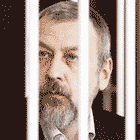 States urged to heighten sanctions against Europe’s last dictator as opposition leader tells of fears. Michael Harris reports
(more…)
17 Dec 2011 | Asia and Pacific
A crowd of 200 royalists staged a protest at the United States Embassy in Bangkok on 16 December, accusing it of interfering in domestic affairs.
Protesters criticised Ambassador Kristie Kennie for her comments on recent lese majeste prosecutions, including that of of Joe Gordon, a Thailand-born US citizen.
“We call on the US embassy and Ambassador Kristie Kenney to apologise to all Thai people for their improper action towards our beloved king,” protest leader Chaiwat Surawichai reportedly said to AFP.
Both US and UN officials had expressed concern about the sentencing of Joe Gordon, also known as Lerpong Wichaikhammat, on 8 December and Amphon Tangnoppakul on 23 November. Gordon, 55, faces two-and-a-half years in prison for translating parts of a banned biography of King Bhumibol Adulyadej and posting them online, while Amphon, 61, was sentenced to 20 years for sending four text messages insulting the monarchy.
Members of royalist group Siam Sammakkhi (United Siam) submitted letters to the United Nations headquarters and the Ambassador urging them not to comment on the lese majeste law. Some of them carried placards which read “Kristie Kenney Shut Up”, “We will protect Article 112 with our lives” and shouted for the Ambassador to “get out”.
At about 6:00pm local time, Kenney posted on her Twitter account that the “protest was peaceful, protestors included respectful conversation with Embassy staff to exchange views. Freedom of expression”. Earlier the US Embassy posted a statement on its website stating “the United States government has the utmost respect for the Thai monarchy, the royal family and Thai culture”, and they “respect Thai laws and do not take sides in Thailand’s internal affairs. We support freedom of expression around the world and consider it a fundamental human right.”
According a report from The Nation, angry commentators had this week lashed out at the Embassy on its Facebook page with postings containing abusive language and images. After its administrator posted a request urging for civility to no avail on 15 December, the messages have been apparently deleted. There was barrage of messages following Kenney’s remarks during a chat with Twitter users last week, including one that read she was “troubled by prosecutions inconsistent with international standard of freedom of expression”.
On 9 December, the UN Office of High Commissioner on Human Rights called for Thailand to amend its lese majeste law. During the Universal Periodic Review in October, countries with monarchs, such as the UK and Norway, urged Thailand to safeguard freedom of expression. Countries without that did not comment during the session included the US.
7 Sep 2011 | News
As a twelve-year-old, my life consisted of watching re-runs of What’s Happening, planning my wedding to Justin Timberlake, and playing unhealthy amounts of Grand Theft Auto and DOOM. Then came the tragic 1999 shootings at Columbine High; sparking a heated debate about the role of violent video games in the actions of Eric Harris and Dylan Klebold, both players of my favourite game, DOOM. My parents used it as an excuse to pull the plug on my pixelated carnage. The link between video games and violent shootings was raised again after the Virginia Tech massacre in 2007, and more recently, the Anders Breivik killing spree in Norway.
Germany, known for having a stringent videogame market, restricted the sale of DOOM and DOOM II to select adult video stores back in 1994. Both games were named on the official “List of Media Harmful to Young People.” Games on the list cannot be “sold, advertised, or displayed to minors in the country”, putting them in the same category as pornography.
After seventeen years of restrictions, the Federal Department for Media Harmful to Young Persons (Bundesprufstelle) has decided to lift restrictions on the videogame after an appeal from Bethesda Softworks, which owns DOOM. The change was made because of advances in the quality of graphics in videogames, rather than a concern about preserving free speech.
While it might seem silly to think that games like DOOM, with its hilariously bad graphics and hideous Martians on bad stereoids could actually stir a player’s dormant killer, some nations have taken measures based on the assumption that playing such games could lead to violent behaviour. The shootings in Norway led a major retailer to pull violent video games from their stores, viewing the murders as a negative effect of playing such games. Gore might be more realistic in today’s games, but much like graphic images in film or books, restricting the sale of such items would not change the outcome of such tragedies. What leads someone like Breivik to kill cannot be reduced to his hateful blogging or his love for Call of Duty: Modern Warfare 2.
If you are under sixteen and in Germany, purchasing either video game is still restricted. While the US Supreme Court ruled that a California law on the sale of violent video games to children violated the First Amendment, it does not appear that Germany will be taking the same measures any time soon. Luckily, the game can be easily found online, probably because we all passed it around on floppy disks in the 90s. Happy playing!

