19 Dec 2016 | Europe and Central Asia, Mapping Media Freedom, Netherlands, News
[vc_row][vc_column][vc_column_text]
Volkskrant columnist Harriet Duurvoort had received threats before. She often questioned the racist elements of Black Pete (Zwarte Piet) in her columns. Black Pete, a black-faced children’s character, is part of the annual Dutch feast of Saint Nicolas (Sinterklaas) celebrated every 5 December.
The threats usually came through social media. But this time it was different.
It was early December 2015. Her phone rang. There was a male voice on the other end of the line. Before she could ask who he was and how he got her number, the man started shouting at her. He called her a “bitch” and told her to keep her hands off of “our Black Pete”. His rant lasted less than a minute, Duurvoort recalled. “It was terrifying,” she said. “This wasn’t just Facebook or Twitter. This man got hold of my personal phone number, and made an effort to phone me up.”
Duurvoort’s weekly column runs in one of the biggest Dutch dailies, De Volkskrant. That week she had published a commentary for the New York Times – titled Why I changed my mind about Black Pete – in which she described how she experienced Black Pete as a child of Suriname descent. Duurvoort knew her article would stir tension and it was shared widely on social media. “It defines the climate surrounding the Black Pete debate in which we find ourselves,” she said.
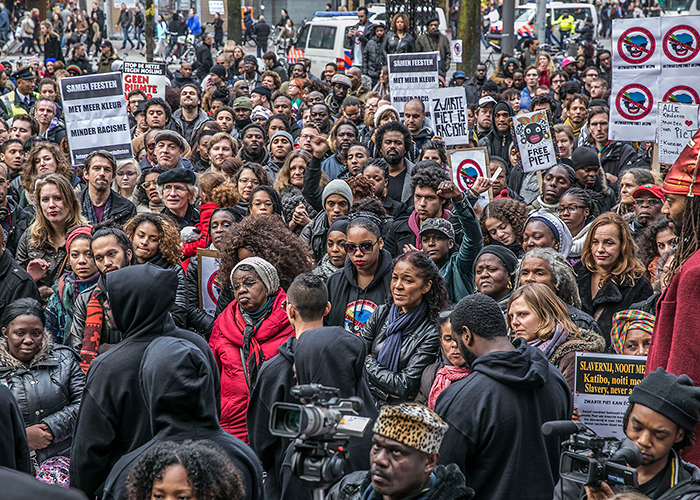
For years the character of Black Pete has been causing heated debates in The Netherlands. An activist group collectively using the slogan “Black Pete is racist” began campaigning in 2011. The group aims to change the Dutch perspective on the black-faced character with which Dutch kids had been growing up for decades. But the pledge to change the Black Pete tradition has met with much resistance. Many Dutch citizens consider Black Pete an essential part of their culture and childhood memories and they don’t want to see it changed.
The United Nations committee on the Elimination of Racial Discrimination urged The Netherlands in 2015 to get rid Black Pete because it has racist elements. “Black Pete is sometimes portrayed in a manner that reflects negative stereotypes of people of African descent and is experienced by many people of African descent as a vestige of slavery,” their report stated. The UN urged the Dutch authorities to work on the elimination of racial stereotyping.
A few Dutch cities, schools and TV broadcasters have already reinvented Black Pete by changing the character’s colour and removing it’s big red lips and golden earrings, calling it Pete instead of Black Pete. But the public debate remains fierce. Protest groups in favour of and against Black Pete have clashed on several occasions. People who speak out in the media about the racist elements of the character are increasingly facing threats from Black Pete supporters, mostly through social media.
The well known TV presenter and now politician Sylvana Simons has been subject to a storm of threats ever since she became publicly vocal about Black Pete and racism. A photo-montage of her face in a video showing lynched bodies was shared on social media earlier this year. A popular radio DJ played monkey sounds on his national radio show, saying that Simons should “be quiet,” which created a huge row in Dutch media.
In November this year, the Dutch special Children’s Ombudsman, Margrite Kalverboer, received dozens of death threats by email after she’d published a report on the matter, stating that the Dutch must change the Black Pete tradition because it contributes to bullying and discrimination of black children.
Journalists experience similar threats when writing or tweeting their opinions about Black Pete. Seada Nourhussen, a Dutch-Ethiopian journalist for daily Trouw, saw her Twitter timeline fill up with roughly a hundred hate tweets after she’d posted a photo of little black-faced marzipan pastries being sold at an Amsterdam bakery on 13 November 2016. “Adults who bake these, what kind of a life do they have?” she wrote below a picture she had received from a friend.
“I’m a columnist in a free country without censorship where tensions do sometimes rise high. It’s not easy sometimes”
“It was a nasty, violent, sexsist, racist and Islamophobic mayhem,” she told Mapping Media Freedom. “My whole timeline was filled with mostly angry white men who wished me dead and called me names.” Nourhussen spent hours on blocking and reporting accounts from people who’d threatened her to Twitter. “It lasted for about a week, every day, and then it stopped”, she said. She said she also reached out to Twitter and the police, but neither responded to her.
The hate storm against her started after right-wing politician Martin Bosma (PVV) had reposted a screenshot of her tweet to his thousands of followers. Nourhussen had by then already deleted the tweet. She didn’t want to derail the racism debate towards Dutch bakeries, she said. The popular right-wing weblog GeenStijl republished Bosman’s screenshot in a tendentious article about another bakery in Amsterdam which removed black-faced cakes after someone had sprayed ‘You are racist’ on it’s window, indirectly blaming Nourhussen for it.
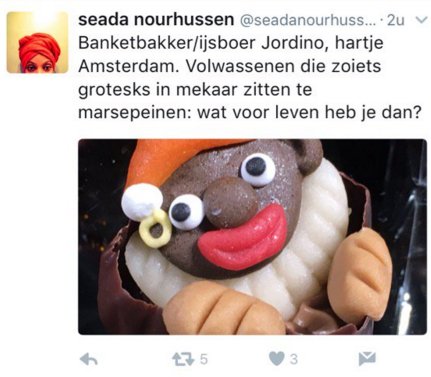
Nourhussen is an Africa-editor at Trouw’s foreign news desk. She does not write about the Black Pete controversy for the newspaper and her tweets represent her personal opinion. But she does think being a journalist might make her an easier target for people who are intended to send out hate tweets. “When you have my profession, and also belong to a minority group in a western country, and on top of that being a woman and having an Arabic sounding name, you’re aware that you’re not entitled to express your opinion without consequences”, she said.
It didn’t change the way she writes or tweets, she added. “I’m not afraid,” she said. “Angry is a better description of how I feel”. Nourhussen is disappointed in her colleague journalists at other newspapers and broadcasters who ran the story about her tweet only from the perspective of victimising bakeries that are selling Black Pete pastries, like daily Telegraaf and regional Amsterdam broadcaster AT5. “I’m ashamed to call those reporters my colleagues because they did a terrible job”.
Nourhussen and Duurvoort are not the only ones. The African-American documentary filmmaker Roger Williams who produced the documentary Blackface: Dutch holiday tradition or racism? for CNN in November 2015, also received death threats from Dutch citizens. “I clearly touched a nerve here,” he said in the Dutch TV talkshow RTL Late Night. Among other things he was called “black ape” in emails he’d received. He said that he was astonished by the reactions to his documentary about Black Pete and racism in The Netherlands. “The Dutch are clearly not aware that the black community in The Netherlands is not happy with Black Pete,” he said.
Several incidents with journalists have taken place during Black Pete street protests this year. On 12 November 2016 a reporter for the broadcaster PowNed, Dennis Schouten, was assaulted during a demonstration against organised by activist group Kick Out Zwarte Piet (Kick out Black Pete). Schouten was interviewing protesters when one of them, an anti-Black Pete protester, pushed him onto a moving car. He wasn’t injured and the perpetrator was arrested.
On 26 November Dutch-American journalist Kevin P Roberson was assaulted while reporting on another demonstration against Black Pete in the city of Utrecht. Roberson, owner of the online news portal The Roberson Report, was hit on the head by a Black Pete supporter while he was filming the protest. Roberson had been threatened before, and he’s told Mapping Media Freedom that he fears for his safety. He said that his home address and car license plate number is circulating on right-wing social media groups. “I don’t feel safe anymore,” he added. “I don’t know if I’d risk covering another Black Pete protest to be honest.”
The Dutch Union for Journalists condemned both attacks.
The day that Volkskrant columnist Duurvoort received that threatening phone call, she felt unsafe in her own house. At the time, she contacted the police, but they had told her there was not enough information to start an investigation. A year later she’d rather not think about it too much anymore. And it did not stop her from writing about the controversy surrounding Black Pete.
“I’m a columnist in a free country without censorship where tensions do sometimes rise high. It’s not easy sometimes,” she said. “But it is also part of my job.”
Click on the bubbles to view reports or double-click to zoom in on specific regions. The full site can be accessed at https://mappingmediafreedom.org/
[/vc_column_text][/vc_column][/vc_row][vc_row][vc_column][vc_basic_grid post_type=”post” max_items=”4″ element_width=”6″ grid_id=”vc_gid:1482144241975-569ee181-a8c8-3″ taxonomies=”6664″][/vc_column][/vc_row]
16 Dec 2016 | Magazine, Volume 45.04 Winter 2016
[vc_row full_width=”stretch_row” full_height=”yes” css=”.vc_custom_1481647350516{background-image: url(https://www.indexoncensorship.org/wp-content/uploads/2016/12/magazine-cover-subhead.jpg?id=82616) !important;background-position: center !important;background-repeat: no-repeat !important;background-size: contain !important;}”][vc_column][/vc_column][/vc_row][vc_row][vc_column][vc_custom_heading text=”Governments that introduce bans on clothing and other forms of expression are sending a signal about their own lack of confidence” google_fonts=”font_family:Libre%20Baskerville%3Aregular%2Citalic%2C700|font_style:400%20italic%3A400%3Aitalic”][/vc_column][/vc_row][vc_row][vc_column][vc_column_text]
IF YOU HAVE to introduce laws telling your citizens that they are banned from wearing purple, sporting red velvet, or showing their knees, then, frankly, you are in trouble.
But again and again, when times get tough or leaders think they should be, governments tell their people what to wear, or more often, what not to wear.
“Dare to wear this,” they say, “and we will be down on you like a ton of bricks.” Why any government thinks this is going to improve their power, the economy or put their country on a better footing is a mystery. History suggests you never strike up a more profitable relationship with your people by removing the freedom to wear specific types of clothing or, conversely, telling everyone that they have to wear the same thing. We are either consumed by rebellion, or by dullness.
The Romans tried it with purple (only allowed for the emperor and his special friends). The Puritans tried it with gold and silver (just for the magistrates and a few highfaluting types). Right now the governments of Saudi Arabia and Iran ban women from wearing anything but head-to-toe cover-ups along with a range of other limitations. In one frightening case in the past month there were calls via social media for a woman in Saudi Arabia to be killed because she went out shopping “uncovered” without a hijab or abaya. One tweet read: “Kill her and throw her corpse to the dogs.”
Banning any type of freedom of expression, often including free speech, or freedom of assembly, usually happens in times of national angst, economic downturn or crisis, when governments are not acting either in the interest of their people, or the national good. These are not healthy, confident nations, but nations that fear allowing their people to speak, act and think. And that fear can express itself in mandating or restricting types of expression. Generally, as with other restrictions on freedom found in the US First Amendment, enforcing such bans doesn’t sweep in a period of prosperity for countries that impose them.
At different points in world history governments have forced a small group of people to wear particular things, or tried to wipe out styles of clothing they did not approve of. In medieval Europe, for instance, non-Christians were, at certain periods, forced to wear badges such as stars or crescents as were Christians who refused to conform to a state religion, such as the Cathars. Forcing a particular badge or clothing to be worn sends a signal of exclusion. Those authorities are, by implication, saying to the majority that there is a difference in the status of the minority, and in doing so opening them up either to attack, or at least suspicion. Not much has changed between then and now. Historically groups that have been forced to wear some kind of badge or special outfit have then found themselves ostracised or physically attacked. The most obvious modern example is Jews being forced to wear yellow stars in Nazi Germany, but this is not the only time minorities have been legally forced to stand out from the crowd. In 2001 the Taliban ruled that Afghan Hindus had to wear a public label to signify they were non-Muslims. The intent of such actions are clear: to create tension.
The other side of this clothing coin is when clans, tribes or groups who choose to dress differently from the mainstream, for historical religious reasons, or even just because they follow a particular musical style, are persecuted because of that visual difference, because of what it stands for, or because they are seen as rebelling against authority. In some cases strict laws have been put in place to try and force change, in other cases certain people decide to take action. In 1746, for instance, the British government banned kilts and tartans (except for the military) under the Dress Act, a reaction said to be motivated by support for rebellions to return Catholic (Stuart) monarchs to the British throne. Those who ignored the order faced six months in prison for the first instance, and seven years deportation for the second. Those who wear distinctive, and traditional clothing, out of choice can face other disadvantages. For years, the Oromo people in Ethiopia, who wear distinctive clothing, have long faced discrimination, but in 2016 dozens of Oromo people were killed at a religious festival, after police fired bullets into the crowd. And in her article Eliza Vitri Handayani reports on how the punk movement in Indonesia has attracted animosity and in one case, Indonesian police seized 64 punks, shaved their heads and forced them to bathe in a river to “purify themselves”. Recently the Demak branch of Nadhlatul Ulama, Indonesia’s largest Islamic organisation, has banned reggae and punk concerts because they make young people “dress weird”.
Another cover for restrictions or bans stems from religions. As soon as the word “modesty” is bandied around as a reason for somebody to be prohibited from wearing something then you know you have to worry. Strangely, it is never the person who proclaims that there needs to be a bit more modesty who needs to change their ways. Of course not. It is other people who need to get a lot more modest. The inclusion of modesty standards tends to be used to get women to cover up more than they have done.
[/vc_column_text][/vc_column][/vc_row][vc_row][vc_column width=”1/4″][vc_icon icon_fontawesome=”fa fa-quote-left” color=”custom” align=”right” custom_color=”#dd3333″][/vc_column][vc_column width=”3/4″][vc_custom_heading text=”When freedom of expression is quashed, it usually finds a way of squeezing out just to show that the spirit is not vanquished” google_fonts=”font_family:Libre%20Baskerville%3Aregular%2Citalic%2C700|font_style:400%20italic%3A400%3Aitalic”][/vc_column][/vc_row][vc_row][vc_column][vc_column_text]
Then you get officious types who decide that they have the measure of morality, and start hitting women wearing short skirts (as is happening right now in South Africa and Uganda). For some Ugandan women it feels like a return to the 1970s under dictator Idi Amin “morality” laws.
Trans people can find themselves confronting laws, sometimes centuries old, that lay out what people shouldn’t be allowed to wear. In Guyana a case continues to edge through the court of appeal this year, it argues that a cross-dressing law from 1893 allows the police to arrest or harass trans people. A new collection, the Museum of Transology, which opens in London in January, uses a crowdsourced collection of objects and clothing to chart modern trans life and its conflicts with the mainstream, from a first bra to binders.
When freedom of expression is quashed, it usually finds a way of squeezing out just to show that the spirit is not vanquished. So during the tartan ban in the 18th century, there are tales of highlanders hiding a piece of tartan under other clothes to have it blessed at a Sunday service. And certainly tartan and plaids are plentiful in Scotland today. In the 1930s and 40s when British women and girls were not “expected” to wear trousers or shorts, some bright spark designed a split skirt that could be worn for playing sport. It looked like a short dress (therefore conforming to the accepted code), but they were split like shorts allowing girls to run around with some freedom.
While in Iran, where rules about “modest” dress are enforced viciously with beatings, sales of glitzy high heels go through the roof. No one can stop those women showing the world their personal style in any way they can. Iranian model and designer Tala Raassi, who grew up in Iran, has written about how vital those signs of style are to Iranian women. In a recent article, commenting on the recent burkini ban in France, Raassi wrote of her disappointment that a democratic country would force an individual to put on or take of a piece of clothing. She added: “Freedom is not about the amount of clothing you put on or take off, but about having the choice to do so.”
And that freedom is the clearest sign of a healthy country. We must support the freedom for individuals to make choices, even if we do not agree with them personally. The freedom to be different, if one chooses to be, must not be punished by some kind of lower status or ostracism. National leaders have to learn that taking away freedom of expression from their people is a sign of their failure. Countries with the most freedom are the ones that will historically be seen as the most successful politically, economically and culturally.
[/vc_column_text][/vc_column][/vc_row][vc_row][vc_column][vc_column_text]
Rachael Jolley is the editor of Index on Censorship magazine. She recently won the editor of the year (special interest) at British Society of Magazine Editors’ 2016 awards
[/vc_column_text][/vc_column][/vc_row][vc_row][vc_column][vc_custom_heading text=”From the Archives”][vc_row_inner][vc_column_inner width=”1/3″][vc_single_image image=”86201″ img_size=”213×289″ alignment=”center” onclick=”custom_link” link=”http://journals.sagepub.com/doi/pdf/10.1177/0306422016643039″][vc_custom_heading text=”T-shirted turmoil” font_container=”tag:p|font_size:24|text_align:left” link=”url:http%3A%2F%2Fjournals.sagepub.com%2Fdoi%2Fpdf%2F10.1177%2F0306422016643039|||”][vc_column_text]April 2016
Vicky Baker looks at why slogan shirts are more than a fashion statement and sometimes provoke fear within great state machines.[/vc_column_text][/vc_column_inner][vc_column_inner width=”1/3″][vc_single_image image=”89180″ img_size=”213×289″ alignment=”center” onclick=”custom_link” link=”http://journals.sagepub.com/doi/pdf/10.1080/03064220600624127″][vc_custom_heading text=”Miniskirts” font_container=”tag:p|font_size:24|text_align:left” link=”url:http%3A%2F%2Fjournals.sagepub.com%2Fdoi%2Fpdf%2F10.1080%2F03064220600624127|||”][vc_column_text]February 2006
Salil Tripathi believes the press should not pick and choose what to publish based on who will get offended. [/vc_column_text][/vc_column_inner][vc_column_inner width=”1/3″][vc_single_image image=”90622″ img_size=”213×289″ alignment=”center” onclick=”custom_link” link=”http://journals.sagepub.com/doi/pdf/10.1080/03064228908536934″][vc_custom_heading text=”List to the right ” font_container=”tag:p|font_size:24|text_align:left” link=”url:http%3A%2F%2Fjournals.sagepub.com%2Fdoi%2Fpdf%2F10.1080%2F03064228908536934|||”][vc_column_text]July 2001
UK’s Terrorism Act 2000 is further evidence of the government’s indifference to fundamental freedoms – clothing included.[/vc_column_text][/vc_column_inner][/vc_row_inner][vc_separator][/vc_column][/vc_row][vc_row][vc_column width=”1/3″][vc_custom_heading text=”Fashion Rules” font_container=”tag:p|font_size:24|text_align:left” link=”url:https%3A%2F%2Fwww.indexoncensorship.org%2F2016%2F12%2Ffashion-rules%2F|||”][vc_column_text]The winter 2016 issue of Index on Censorship magazine looks at fashion and how people both express freedom through what they wear.
In the issue: interviews with Lily Cole, Paulo Scott and Daphne Selfe, articles by novelists Linda Grant and Maggie Alderson plus Eliza Vitri Handayani on why punks are persecuted in Indonesia.[/vc_column_text][/vc_column][vc_column width=”1/3″][vc_single_image image=”82377″ img_size=”medium” alignment=”center” onclick=”custom_link” link=”https://www.indexoncensorship.org/2016/12/fashion-rules/”][/vc_column][vc_column width=”1/3″][vc_custom_heading text=”Subscribe” font_container=”tag:p|font_size:24|text_align:left” link=”url:https%3A%2F%2Fwww.indexoncensorship.org%2Fsubscribe%2F|||”][vc_column_text]In print, online. In your mailbox, on your iPad.
Subscription options from £18 or just £1.49 in the App Store for a digital issue.
Every subscriber helps support Index on Censorship’s projects around the world.
 SUBSCRIBE NOW[/vc_column_text][/vc_column][/vc_row]
16 Dec 2016 | Events, Magazine, Volume 45.04 Winter 2016 Extras
[vc_row][vc_column][vc_column_text]
Join Index on Censorship for a drinks reception and conversation to celebrate the launch of our latest award-winning magazine, Fashion Rules, Dressing to oppress: why dress codes and freedom clash. The evening will explore how fashion rules can be used to oppress and how responses can challenge and confront, in the glamorous surroundings of one of Google’s London offices .
We’ll hear from an expert panel, including Maggie Alderson, former editor of Elle magazine, Regina Jane Jere-Malanda, editor of New African Woman magazine, award-winning documentary maker Laura Silvia Battaglia and fashion historian Amber Butchart.
In the upcoming issue, models Lily Cole and Daphne Selfe discuss why changes in society are reflected in the clothes we (are allowed to) wear, while writers from around the world look at indigenous dress in Nigeria, oppression of Indonesian punks today as well as fashion and freedom of expression in Saudi Arabia. Plus, Donald Trump in a fur thong courtesy of cartoonist Martin Rowson, poetry from Paulo Scott and a never before seen English translation of a short story by legendary Argentine writer Haroldo Conti.
Order your high-quality print copy of our fashion special here, or take out a digital subscription from anywhere in the world via Exact Editions (just £18* for the year). Each magazine sale helps Index on Censorship fight for free expression worldwide.
*Will be charged at local exchange rate outside the UK.
Copies are also available at the BFI, the Serpentine Gallery, MagCulture, (London), News from Nowhere (Liverpool), Home (Manchester) and on Amazon. Each magazine sale helps Index on Censorship continue its fight for free expression worldwide.[/vc_column_text][/vc_column][/vc_row][vc_row][vc_column][vc_column_text]
[/vc_column_text][/vc_column][/vc_row][vc_row][vc_column width=”1/3″][vc_custom_heading text=”Fashion Rules” font_container=”tag:p|font_size:24|text_align:left”][vc_column_text]The winter 2016 issue of Index on Censorship magazine looks at fashion and how people both express freedom through what they wear.
Contributors include Lily Cole, Daphne Selfe, Linda Grant, Bibi Russell, Katy Werlin, Jang Jin-sung, Maggie Alderson and Eliza Vitri Handayani.[/vc_column_text][/vc_column][vc_column width=”1/3″][vc_single_image image=”82377″ img_size=”medium” style=”vc_box_shadow” onclick=”custom_link” link=”https://www.indexoncensorship.org/2016/12/fashion-rules/” css=”.vc_custom_1481889636739{background-image: url(https://www.indexoncensorship.org/wp-content/uploads/2016/12/volume-45-04-winter-2016-700×933.jpg?id=82377) !important;}”][/vc_column][vc_column width=”1/3″][vc_custom_heading text=”Fashion Rules” font_container=”tag:p|font_size:24|text_align:left”][vc_column_text]In print, online. In your mailbox, on your iPad.
Subscription options from £18.
Every subscriber helps support Index on Censorship’s projects around the world.
SUBSCRIBE NOW[/vc_column_text][/vc_column][/vc_row]