27 May 2016 | Europe and Central Asia, Mapping Media Freedom, mobile, News, Spain
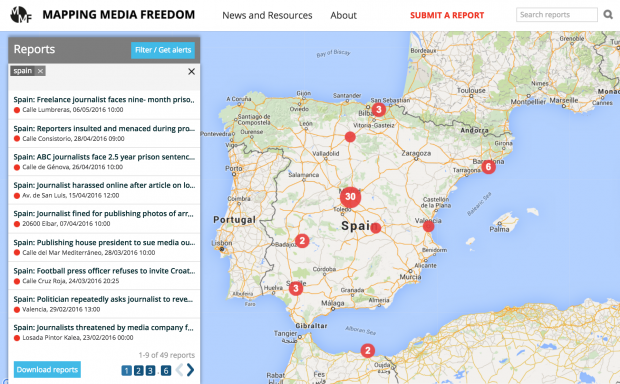
When Axier López, the 37-year-old reporter for the Basque-language magazine Argia, opened the mailbox at his home in Barakaldo early April, he discovered he’d become the first journalist in Spain to be punished under the Public Security Law.
He was ordered to pay €601 (£466) for photos of an arrest he published on Twitter without state permission on 7 March.
“It is a fine similar to a parking ticket,” López told Mapping Media Freedom. “Signed by a local government representative, it claims I committed a crime by putting on-duty police officers in danger.”
The photos in question were taken when López was in the city of Eibar covering the arrest of a woman who had previously refused to appear in court. In 2007 she had participated in a protest against the forced closure of a local youth organisation which the state and court linked to a Basque separatist terrorist group. The woman was accused of blocking a road.
The so-called “gag law” under which López was fined came into force on 1 June 2015. It bans coverage of on-duty police officers without prior police permission and prohibits the publication of any clue as to their identity. The Spanish centre-right government said the purpose of the law is to protect officer security.
“What is the problem if we track and inform the public about events involving police officers?” López asked. “Policemen are paid with public money, so I don’t see a problem if they appear in media content.”
“Almost every day you can see arrests of different people on TV, where police officers appear in front of the camera, but they punished only us,” he added.
Journalists in Spain have recently come under mounting legal pressures related to their work.
In April two journalists from the daily newspaper ABC, Pablo Muñoz and Cruz Morcillo, were facing two-and-a-half-year prison sentences for publishing a telephone conversation between members of the Italian mafia, who were talking about Luis Bárcenas, former treasurer of Partido Popular. After an avalanche of support for the journalists, the general attorney in Madrid dropped the charges in May.
The journalists had published their article in July 2014, a year after police investigators intercepted the phone conversation between two mafioso. The general attorney had claimed they revealed details of a secret police investigation.
“Charges, in this case, were really severe,” said Elsa González, president of the Spanish Federation of Journalist Associations (FAPE), the main journalist body in the country. “A journalist has to publish information if it’s in the public interest.”
González added that according to a poll by Madrid’s Association of Journalist (APM), last year only 23.2% of reporters with permanent contracts and 22.2% of freelancers said they never received pressure to modify information in their reports. APM said the pressure could come from multiple angles, including political and corporate powers, public institutions and advertisers.
A group of Spanish media companies has also recently been threatened with legal action after online newspapers El Confidencial and Eldiario.es, along with private TV channel La Sexta reported that Juan Luís Cebrián, president of the Prisa media group, publisher of the national newspaper El País and sports daily AS, appeared in the Panama Papers.
On 26 April Prisa issued a statement on its website stating that its president had taken legal action against the outlets for “clear defamatory intent” by linking Cebrián to the Panama Papers “in which he categorically does not appear”.
The centre-right daily newspaper El Mundo, a competitor of Prisa’s left-leaning daily El País, then reported that journalists who work for Prisa publishing house were prohibited from engaging with the three media outlets.
Nacho Cardero, director of El Confidencial, told Mapping Media Freedom that Cebrián has yet to take any formal action.
“At the moment there are no actions against any of the three media sources and furthermore, the intention to expel contributors of El Confidencial, La Sexta or Eldiario.es from his group, hasn’t occurred,” said Cardero. “However, Prisa has closed the door to Ignacio Escolar, director of Eldiario.es.”
López believes all these cases serve to spread fear among journalists. Meanwhile, his appeal against his fine has been refused. It could have been reduced to €300 (£232) if he had paid in 15 days. “However, we are not going to pay because we were doing our job,” he said.
“I don’t know where we can go in the legal process,” López added. “But it is important that the debate on this law is open and that we resist in order to prevent possible fear in other journalists.”
Mapping Media Freedom approached Cebrián for comment but received no response.
18 May 2016 | Bosnia, Europe and Central Asia, Mapping Media Freedom, mobile, News, Russia, Turkey, United Kingdom
Each week, Index on Censorship’s Mapping Media Freedom project verifies threats, violations and limitations faced by the media throughout the European Union and neighbouring countries. Here are five recent reports that give us cause for concern.
The Russian state media regulator Roskomnadzor began blocking Krym Realii, the Сrimean edition of Radio Free Europe / Radio Liberty on Saturday 14 May.
A representative of Roskomnadzor confirmed that the regulator had blocked a page, which contains an interview with a leader of the Tatar Mejlis, at the request of the general prosecutor office. “Currently, Roskomnadzor is implementing measures for blocking and closing this website,” criminal prosecutor Natalia Poklonskaya told Interfax.
Krym Realii was established following the annexation of Crimea to Russia. Materials on the site are published in Russian, Ukrainian and Crimean Tatar languages.
Several editors at RBC media holding lost their jobs on 13 May following a meeting between top management with journalists. They include RBC editor-in-chief Elizaveta Osetinskaya, editor-in-chief of the RBC business newspaper Maksim Solyus, and RBC deputy chief editor Roman Badanin.
In a press release, RBC underlined that the dismissals were finalised as a mutual agreement of both parties, but sources from TV-Dozhd and Reuters claim managers have bowed to political pressure from the Kremlin.
The pressure against RBC began following investigations that have reportedly “irked the Kremlin“, including one on the assets of Vladimir Putin’s alleged daughter, Ekaterina Tikhonova.
Petar Panjkota, a journalist for the Croatian commercial national broadcaster RTL, was physically assaulted after he had finished a segment from the Bosnian town Banja Luka on 14 May.
Panjkota was reporting on parallel rallies in Banja Luka, the administrative centre of Bosnia’s Serb-dominated of Republika Srpska. He was reporting on protests organised by the ruling and opposition parties of the Bosnian Serbs. When he went off air, Panjkota was punched in the head by an unidentified individual, leaving bruises.
RTL strongly condemned the attack, calling it another attack on media freedom. No information has surfaced on the identity of the assailant.
On 12 May, the long-awaited white paper on the future of the BBC was unveiled. The BBC Trust is to be abolished and replaced by a new governing board including ministerial appointees. The board will be comprised of 12 to 14 members: the chair, deputy chair and members for each of the four nations of the UK will be appointed by the government and the remaining seats will be appointed by the BBC.
“It is vital that this appointments process is clear, transparent and free from government interference to ensure that the body governing the BBC does not become simply a mouthpiece for the government,” Jodie Ginsberg, CEO of Index on Censorship, said.
“Independence from government is essential for the BBC and these proposals don’t quite offer that,” Richard Sambrook, director of the Centre for Journalism at Cardiff School of Journalism, Media and Cultural Studies and former BBC journalist, told Index on Censorship. “There is no reason the board can’t be appointed by an arms length, independent panel. Currently the plans are too close to a state broadcasting model.”
Two reporters working for Dicle News Agency (DİHA) reporters were detained in the eastern city of Van on 12 May. Nedim Türfent and Şermin Soydan were allegedly detained within the scope of an on-going investigation and taken to the anti-terror branch in the central Edremit district of Van.
Both were detained separately. According to Bestanews website, Nedim Türfent was detained when his car was stopped by state forces at the entrance of Van. Şermin Soydan was detained on her way to cover news in the city of Van.
13 May 2016 | Digital Freedom, Mapping Media Freedom, mobile, News, Ukraine
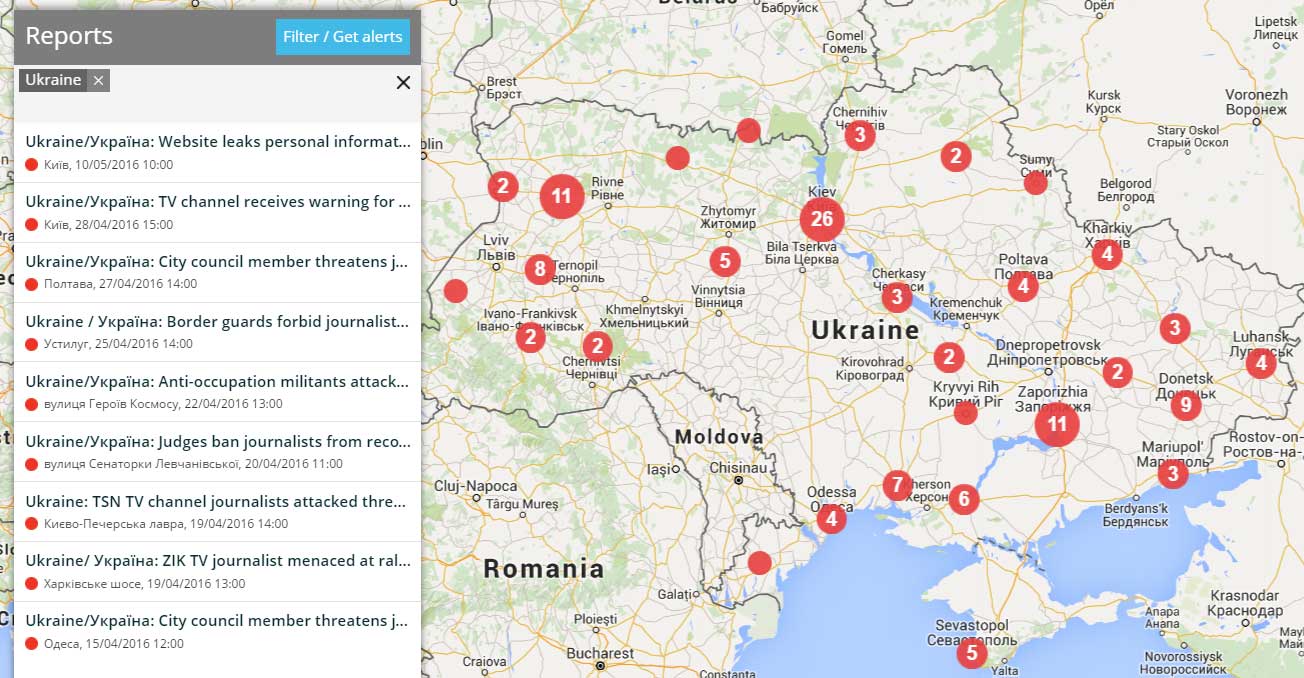
Ukraine is again at the center of an international scandal. On 10 May Ukrainian website Myrotvorets, which publishes personal data of alleged separatists, made public information about the journalists who have been accredited in the so-called Donetsk People’s Republic (DPR) — the part of Donbas area beyond Ukraine’s government control.
The website, which announced on Friday 13 May that it was shutting down, leaked personal data of more than 4,000 journalists, including those working for BBC, Reuters, AFP, The Independent, Ceska televize, CNN, Bloomberg, Aljazeera, AP, Liberation, ITAR-TASS and other media.
The site published the names of the journalists, the media outlets they work for, country of origin, cell phones, email and dates of stay in the DPR.
Myrotvorets, or Peacemaker, received the data from Ukrainian hackers who had attacked DPR sites. After the data was illegally disclosed, the hackers declared a boycott and suspended their activities.
The website also accuses the journalists of co-operating with “militants of the terrorist organisation” and claims that “journalists with Russian names work for many non-Russian media (CNN? BBC? AFP?).”
Myrotvorets has long been raising concerns and criticism of Ukrainian human rights activists. Launched in the spring of 2014, it publishes the personal data of people its writers see as supporting separatism in Ukraine.
In particular, it had published the personal data of former Ukrainian lawmaker Oleh Kalashnikov and journalist Oles Buzyna. Both were murdered near their apartments shortly after the release of their information.
Breaking legislation on personal data protection and the presumption of innocence, the site has been operating for two years without any prosecution for its activities.
In April 2015, the Ukrainian parliament’s Commissioner for Human Rights Valeria Lutkovska demanded that the security service and the interior ministry block the website and prosecute those behind it. Instead, she received only threats in response.
As a result, Anton Herashchenko, the MP from the People’s Front faction and the advisor to the Ukrainian Interior Minister, who previously announced his involvement in the creation of Myrotvorets, threatened Lutkovska with dismissal. He said that operation of the website was “extremely important for the national security of Ukraine and the one, who does not understand this or attempts to hinder its operation, is either a puppet in the wrong hands or works against the national security” and the information is collected “exclusively from such open sources as social networks, blogs, online directories, news feeds”.
Lutkovska’s office of ombudsman told Mapping Media Freedom that the police launched a criminal case last year, but there are no tangible results yet and the website continues its work. The sites servers are located outside Ukraine.
In the wake of the publication of journalists’ information, Lutkovska again appealed to the interior ministry and security service aksing for the site to be blocked.
Journalists, whose personal data was published, have already received threats. Ukrainian freelance journalist Roman Stepanovych has published a threat he received via e-mail.
Stepanovych, who currently works mainly for Vice News, told Mapping Media Freedom: “I filmed in Donbas like a stringer for different news agencies like NBC, DW, Reuters and sometimes worked as a fixer for Die Ziet, CCTV, Aftenposten and many more. I am a native of Donetsk, but have always worked for the western media.“
Stepanovych, who is working outside Ukraine, said that he was considering asking police to investigate the threats when he returns to the country.
On May 11, journalists working for Ukrainian and foreign media issued a joint statement with Ukrainian and international media organisations demanding that Myrotvorets immediately take down the personal data of journalists, who had been accredited in the DPR:
“The Ukrainian and foreign journalists, who risked their lives to cover the events impartially and told what was happening in the occupied territories in Ukrainian and international media, were exposed to attack. In particular, it is thanks to their work we found out about the Vostok battalion, crimes of militant known as Motorola and other militants, supply of Russian weapons and many other important facts. These journalists gave information for a qualitative investigation into downing of MH17 flight in the summer of 2014, and their materials about senior officials of the occupied territories formed the basis of many investigative and analytical articles. We especially emphasise that accreditation does not mean and has never meant cooperation of journalists with any party to the conflict. Accreditation is a form of protection and safety of journalists.”
According to the Ukrainian and international media organisations, nearly 80 journalists were taken captive in 2014, many of whom suffered torture. Accreditation is the only, although minor, mechanism for protection of journalists from torture or captivity.
Lutkovska and the journalists also appealed to Ukrainian authorities asking for a launch of criminal proceedings. On the same day, the address of the European Union’s ambassador to the Ukraine, Jan Tombinski, was released. Tombinski said that publication of the journalists’ leaked personal data violated the best international practices and Ukrainian legislation. He urged Ukrainian authorities “to help ensure that this content is no longer published“.
In response, Anton Herashchenko posted on his Facebook page: “Currently, Ukraine has no lawful methods to block harmful content and has no principles of defining which content is illegal and harmful and which is not. Ukraine has also no technical possibility to block any content on the internet.”
On May 11, the Kyiv prosecutor’s office opened criminal proceeding under Article 171 of the Criminal Code of Ukraine (Preclusion of legal professional activities of journalists).
6 May 2016 | Europe and Central Asia, Events, Hungary, mobile, Poland, Turkey, United Kingdom
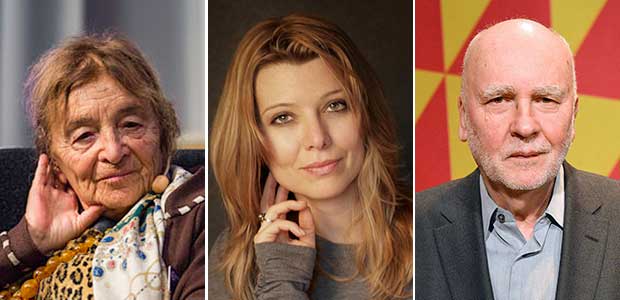
Join Agnes Heller, Elif Shafak and Adam Zagajewski for a discussion about Europe’s changing environment for freedom. (Photos: Agnes Heller, Elif Shafak: Wikipedia; Adam Zagajewski: Frankie Fouganthin via Wikipedia
“The point of the future is that anything can happen.” – Victor Orban, prime minister of Hungary
Europe was a bastion of hope for more than a million refugees last year. What brought them? A hunger for safety and security? Dreams of freedom? The draw of liberal democracy with its ideals of free expression, equal opportunity and persecution for none?
But look within our own continent and you will see the cracks. In Hungary, Victor Orban’s administration looks increasingly autocratic. Poland’s new conservative government is making changes to its public media that critics have said amount to a takeover. How can we support neighbours like Turkey in their fight to avoid authoritarianism if we can’t fly the banner for freedom at home?
On the eve of the EU referendum, three major cultural figures from Hungary, Poland and Turkey gather in London to compare their stories and ask: is Europe just a place, or a set of values that are rapidly unravelling?
Featuring:
When: Wednesday 15 June, 6.45pm
Where: Free Word Centre, 60 Farringdon Rd, London EC1R 3GA (Map)
Tickets: £5/£3 from Free Word website or 0207 324 8904
This event will be live streamed. Click here to tune in to the Free Word YouTube livestream, which will begin at 6.45pm (BST) on Wednesday 15 June 2016. Join in the conversation by tweeting @IndexCensorship using the hashtag #FWEurope.
Presented in partnership with:
More about the panelists:
Agnes Heller was born in 1929 and is one of the leading thinkers to come out of the tradition of critical theory. Her broad intellectual range and publications include ethics, philosophical anthropology, political philosophy and a theory of modernity and its culture. Hungarian by birth, she was one of the best-known dissident Marxists in central Europe in the 1960s and 1970s. She has held visiting lectureships all over the world and has been the Hannah Arendt Professor of Philosophy at the New School in New York. She now lives in Budapest and is one of the most popular and outspoken critics of the current regime.
Elif Shafak was born in Strasbourg, France, in 1971. She is an award-winning novelist and the most widely read woman writer in Turkey. Critics have named her as “one of the most distinctive voices in contemporary Turkish and world literature”. Her books have been published in more than 40 countries and she was awarded the honorary distinction of Chevalier of the Order of Arts and Letters. Elif has published thirteen books, nine of which are novels. She writes fiction in both Turkish and English. Elif blends Western and Eastern traditions of storytelling, bringing out the myriad stories of women, minorities, immigrants, subcultures, youth and global souls. Her work draws on diverse cultures and literary traditions, as well as a deep interest in history, philosophy, Sufism, oral culture, and cultural politics. Elif’s writing breaks down categories, clichés, and cultural ghettoes. She also has a keen eye for black humour.
Adam Zagajewski is an award-winning poet, novelist, translator and essayist. Born in Lwow in 1945, he first became well-known as one of the leading poets of the Generation of ‘68’ or the Polish New Wave (Nowa Fala). His poems and essays have been translated into many languages. Among his honors and awards are a fellowship from the Berliner Kunstlerprogramm, the Kurt Tucholsky Prize, a Prix de la Liberté, and a Guggenheim Fellowship. Since 1988, he has served as visiting associate professor of English in the Creative Writing Programme at the University of Houston. In 2010, he was nominated for the Nobel Prize in Literature. Adam is currently co-editor of Zeszyty Literackie (Literary Review). He lives in Krakow.
