I write to you in the hope of assisting you in a rather arduous task being assigned to you by the Pakistan Telecommunication Authority (PTA). If recent reports are to be believed, the Pakistan telecommunication authority has done the unthinkable; in a rare moment of clarity the PTA has requested the parliament to define ‘blasphemy’.
Yes, after the country’s governor was shot 27 times for seeking pardon for a blasphemy accused mother, his murderer garlanded by lawyers and defended by the ex-Chief Justice of the Lahore High Court, a 14-year-old young girl and her family driven out of the country, a 70-year-old mentally unstable woman sentenced to 14 years in jails, several hundred burnt houses and dozens of lynched dead bodies later, you’ve finally been approached to determine what exactly classifies as blasphemy.
If you ask me, it’s rather strange that none of the incidents – or call them random acts of insanity – I summarised were able to do what a B-grade filmmaker was able to achieve. But then again, priorities! We are a nation of strange people and reactions; we forgive the unforgivable and punish ourselves for the crimes of others.
Without wasting much time, I’d want to discuss the important issue at hand. Now that you’ve been given the responsibility of defining blasphemy for the nation, given how difficult it is to be specific, and government policies are by their nature vague, I’d say go with enlisting instances of blasphemy for clarity’s sake:
One commits blasphemy each time they harm another in the name of religion.
One commits blasphemy each time they incite hatred for another in the name of religion.
One commits blasphemy each time they justify murder in the name of religion.
One commits blasphemy each time they persecute another for their faith or lack of it.
One commits blasphemy each time they infringe the right to freedom of expression, opinion or movement of another, in the name of religion.
For the biggest form of blasphemy that we all almost always commit is to force another to live in fear for believing, speaking, thinking and sometimes even existing, as we justify it in the name of our faith or stand silent as we bear witness.
No videos, sketches or hate speeches have hurt Islam more than the reckless army of blood thirsty goons justifying vandalism in the name of religion.
There doesn’t exist a form of disrespect bigger than justifying cold-blooded murder and hate in God’s name. To instill fear and lawlessness in the society and to justify that as an act of faith. End the insanity now, tell the nation that we aren’t all potential blasphemers waiting to be lynched as and when the opportunity arises.
Trust me; it might do a lot more than just unblocking YouTube.
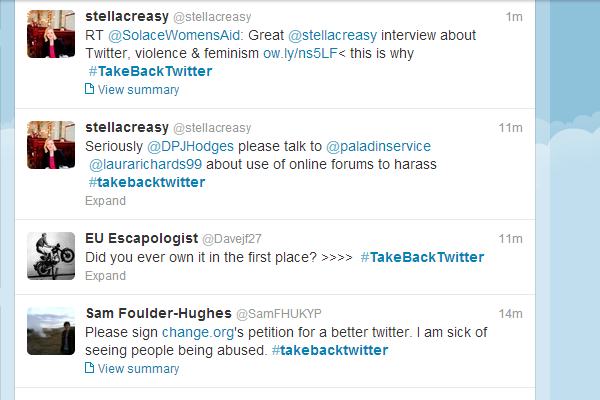
On a BBC Newsnight discussion last night, panelists were asked if they felt that a watershed moment had been reached in our attitude to misogynist abuse and threats on Twitter.
It certainly feels like a moment: The increasing pervasiveness of social media in UK public life, combined with a resurgent young feminist movement (aided by social media), has led to this tumult of voices. We all seem to agree that something should be done about threats of rape, such as the ones experienced by Labour MP Stella Creasey, but the question is what?
Twitter yesterday released a statement saying they would look into introducing a report abuse button under all tweets. This, the company pointed out, is in fact already available on the Twitter iphone app, and will soon be rolled out on Android and desktop.
But some see a danger in this: a report button, they suggest, could easily be abused. Celebrity users with a large amount of followers could, for example, get their fans to report critics.
Political opponents and human and civil rights activists could easily be marked as abusive by users. I can imagine, for example, that Index on Censorship’s account would repeatedly be reported as abusive by, say, highly co-ordinated pro-Bahraini government tweeters.
What are the alternatives? Writing for the Guardian, Index contributor Jane Fae says that the focus is too much on the potential solutions Twitter can provide and not enough on the existing laws in place. Earlier this year, the Crown Prosecution Service released guidelines on social media user prosecutions. Index greeted these as by and large sensible (interesting to note that these came about because of a feeling that there were too many prosecutions of social media users; though there is a distinction between generally offensive material and specific, direct, threats).
Jane suggests a mechanism for reporting threats to the police, rather than Twitter:
“By all means, let’s have a button – but one that delivers reports of online abuse directly to the local police force, a bit like a security alarm, and not just to Twitter.
This relatively simple solution doesn’t exist yet but I’m currently coding a mock-up of one for Everyday Victim Blaming (EVB), a not-for-profit organisation set up to help stop violence against women. Installed on your computer, the button would let you generate instant email reports, detailing online abuse and asking the police to investigate. It should also copy a report back to EVB or another campaign group. If the police really are swamped, that, in itself, is a thing – and may finally prompt politicians to ditch the soundbite and think a bit deeper on this issue.
Matt Flaherty, the prolific and interesting tweeter and blogger on free speech issues, brings the issue back to Twitter with his idea of a “panic mode” to help tweeters beleaguered by coordinated attacks:
“My solution to this problem would be for Twitter to introduce something like a panic button that would immediately but temporarily place one’s account into a state where all mentions are blocked except for those coming from the followers and following lists. Twitter could also allow the user to open a case and have mentions logged against that case to help Twitter to take action against those who violate the terms. Twitter could also perhaps warn users attempting to put the panicked account into a mention or reply. Perhaps they could ask for confirmation either within the stream or in an email. An alternative would be to actually disallow the creation of the mention or reply. A blocked account is currently not allowed to perform a reply but it can use a mention. The same rules might apply here. The mention would still not be seen.”
It’s an interesting idea, particularly for the kind of abuse Caroline Criado-Perez was subjected to: The campaigner was receiving 50 tweets an hour, suggesting a level of co-ordination. Flaherty’s proposal is a kind of advanced version of Don’t-Feed-The-Trolls, allowing a user to silence the angry mob directed at them.
The Daily Telegraph’s Marta Cooper (formerly of this parish), points out, however, that technological fixes are not the answer to societal problems:
“The offline world is still inhabited by some men who believe that women who voice an opinion must be put in their place. This is simply reflected and amplified online. Twitter did not create the misogynistic monsters that hurled grotesque tweets at Criado-Perez or send the same to other women on a regular basis; online platforms simply make it easier for these individuals to behave in appalling ways, and it is far harder to ignore published text than a hateful comment made by some Neanderthal in a pub.
“As with other societal problems, there is no quick fix – technological or otherwise – to something which has centuries’ worth of roots. It is far more valuable and worthwhile to expose hate for what it is and to debate why it occurs in the first place.”
So what do we do? MPs have called Twitter executives to testify at the House of Commons: there is no doubt Twitter could have handled this better – the action of their New York based manager of journalism Mark S Luckie, blocking critical but polite UK voices, has been particularly unfortunate. No doubt the Twitter representatives will face demands from MPs to do something, and fast.
But we should be careful of quick fix solutions: the police are investigating the threats against Criado-Perez and Creasy; it is likely there will be prosecutions. This may seem frustratingly slow for some, but that is the pace of these things. The instant nature of social media means we often expect instant remedies for problems that are, as Ben Goldacre puts it, a little bit more complicated than that. Collective effort and thought on this should take precedent over the kind of kneejerk thinking about the web that too often dominates (see David Cameron’s “ban all the bad things” speech last week). We want the web to be free and diverse, but we also want the web to be, as much as possible, a positive experience for people. This is the challenge we face, and our reactions over the issues raised in the past few weeks could have consequences for years to come. Together we can make the web better, but we should be wary of attempts to make it perfect.
If we want the web to be a positive place for young people, we need to start talking about the positive things that happen there
Texan teenager Justin Carter was released on bail on 11 July, after his $500,000 bail was paid anonymously. His family had been unable to raise that amount previously.
The young man had been in a Texan prison since February, charged with making “terroristic threats” on Facebook.
“I’m f—ed in the head alright. I think I’ma shoot up a kindergarten and watch the blood of the innocent rain down and eat the beating heart of one of them.”
Not pleasant, no. Not particularly funny. But is it an actual threat? I really don’t think so.
Carter’s lawyer insists that the teen posted “LOL” and “jk” (joke) immediately afterwards to clarify that he wasn’t serious. And yet he finds himself facing a terror-related charge, with a possible sentence of 10 years ahead of him.
Why?
Americans are often wrongly accused of not getting irony, but this is one of those awful cases where the letter of the law clashes with expression that is clearly not meant to be taken literally.
Britons will be all too aware that they cannot be too complacent about these cases. People such as Paul Chambers, Azhar Ahmed, Liam Stacey and Matthew Woods have all felt the full force of the law for inappropriate, ill-advised social media messages, under laws that have been clumsily applied and don’t really allow for context – the crucial component in all free speech cases (though the Crown Prosecution Service has at least attempted to offset this problem with its new recommendations).
It’s interesting that almost all these recent cases involve young men.
The only exception I can think of is 21 year-old British woman Deyka Ayan Hassan, who was recently sentenced to 250 hours community service for a tweet in the aftermath of the murder of Lee Rigby, in which she said anyone wearing a Help For Heroes t-shirt deserved to be beheaded.
A lot of social media at the moment is based on getting a reaction; our worth is based on how many likes or comments a post gets, or responses and retweets on Twitter. The most hardened editor will sit anxiously viewing how many times an article is tweeted.
This pushes content posted in certain directions: either mind-numbingly banal but well meaning to the point where people feel bad for not responding (RT IF YOU THINK CANCER IS BAD), or snarky and borderline – or just plain – offensive (CANCER IS LOLZ).
The latter type of comment is the one that’s getting young people in trouble.
A segment of the Olympic opening ceremony in London last summer made a great deal of the amazing power of communications technology in young people’s lives, with “founder of the web” Tim Berners Lee looking on benignly as a sweet love story played out between pretty teenagers wielding smartphones.
But the way we talk about the web now does not reflect that idealism. The current debate in the UK portrays the web overwhelmingly as the habitat of trolls, predators, bullies and pornmongers. And that, plus the police are watching too, ready to arrest you for saying the wrong thing.
I can’t help feeling that all this doom-mongering could be self fulfilling. If we keep thinking of the web as the badlands, that’s how it will be, like a child beset by endless criticism and low expectations. We need to talk more about the positive side of life online – the conversations, the friendhips, the opportunities – if we’re going to get the most out of it.
Index held an event last night with Doughty Street Chambers, where a panel of experts discussed whether or not democratic freedoms have been eroded by mass surveillance programmes.
The panel included the Guardian’s Technology Editor, Charles Arthur, Stephen Cragg, QC (Doughty Street Chambers), Index Chief Executive Kirsty Hughes, and Liberty’s Policy Director, Bella Sankey. The discussion was chaired by Kirsty Brimelow (Doughty Street Chambers, Chairwoman of Bar Human Rights Committee of England and Wales.)
Check out the conversation below, and be sure to follow @IndexEvents for updates on our future events:

 On a BBC Newsnight discussion last night, panelists were asked if they felt that a watershed moment had been reached in our attitude to misogynist abuse and threats on Twitter.