Past Event: 25th July: NSA, surveillance, free speech and privacy

DSC short logo

Venue Doughty Street Chambers,
54 Doughty Street
London, WC1N 2LS (map)
Time 6.30pm
Index_logo_for_email_signatures
RSVP [email protected]
Space is limited, so please reserve a place early

Edward Snowden’s leaks about the US’s international mass surveillance programmes has prompted perhaps the definitive debate of our age: How free are we online? Can we ever trust technology with our personal details?

Have democratic freedoms been subverted by surveillance programmes such as PRISM and Tempora, justified on the grounds of security?

Join Index on Censorship and Doughty Street Chambers on 25 July to discuss these issues and more.

Speakers include

Charles Arthur (Technology Editor, the Guardian)

Stephen Cragg, QC (Doughty Street Chambers)

Kirsty Hughes (Chief Executive, Index on Censorship)

Bella Sankey (Policy director, Liberty)


Chair: Kirsty Brimelow (Doughty Street Chambers, Chairwoman of Bar Human Rights Committee of England and Wales

READ: Snowden leaks open up the great question of our age

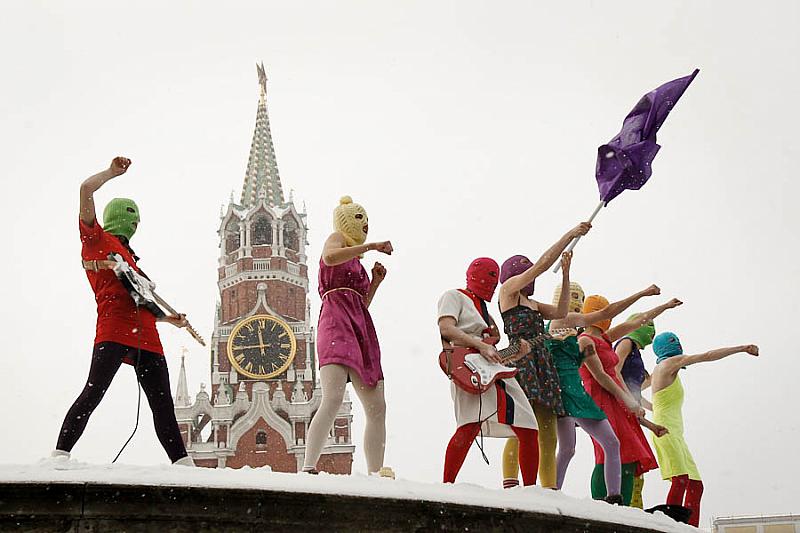
Religious youth group creates ‘Kill Pussy Riot’ game

A Russian Orthodox has launched a video game in which players attack members of punk feminist group Pussy Riot with a crucifix

According to Reuters, “Players use a mouse to move a cross over the screen and zap colorful cartoon representations of the women from Pussy Riot – each with a balaclava like those worn by the band members in their protest — as they try to enter a white church.”

Pussy Riot have declined to comment on the game.

Two of the punk group,  Maria Alyokhina and Nadezhda Tolokonnikova, are serving sentences in a penal colony after they staged a protest against Vladimir Putin at Moscow’s Christ The Saviour Cathedral in February 2012. A third, Yekaterina Samutsevich, was released on appeal.

Index on Censorship met two members of the eight-woman strong collective in London last month. You can read the interview here.

Update: Via RFE/RL, here’s the game

Free expression in the news

INDEX EVENTS
18 July New World (Dis)Order: What do Turkey, Russia and Brazil tell us about freedom and rights?
Index, in partnership with the European Council on Foreign Relations, is holding a timely debate on the shifting world order and its impact on rights and freedoms. The event will also launch the latest issue of Index on Censorship magazine, including a special report on the multipolar world.
(More information)

FROM INDEX ON CENSORSHIP MAGAZINE
Global view: Who has freedom of expression?
Freedom of expression is a universal, fundamental human right. But who actually has access to free expression? Index CEO Kirsty Hughes looks at the evidence.
(Index on Censorship)

Global view: Who has freedom of expression?
Freedom of expression is a universal, fundamental human right. But who actually has access to free expression? Index CEO Kirsty Hughes looks at the evidence.
(Index on Censorship)

The multipolar challenge to free expression
As emerging markets command influence on the international stage, Saul Estrin and Kirsty Hughes look at the impact on economics, politics and human rights.
(Index on Censorship)

News in monochrome: Journalism in India
The media’s infatuation with a single narrative is drowning out the country’s diversity, giving way to sensationalist reporting and “paid for” news. But, says Bharat Bhushan, moves towards regulation could have a chilling effect too
(Index on Censorship)

Censorship: The problem child of Burma’s dictatorship
Writer and artist Htoo Lyin Myo gives his personal account of working under government censorship in Burma
(Index on Censorship)

BURMA
Burma’s Press Council Threatens Resignation Over Media Rules
Members of Burma’s interim Press Council say they will resign if the newly minted Printing and Publishing Enterprise Bill is passed into law in its current guise.
(The Irrawaddy)

CHINA
State of the artist in China
“What can they do to me?” asks Ai Weiwei. “Who is afraid of Ai Weiwei?” sprays a young woman on city buildings in Hong Kong. You can hate him or love him but you can’t ignore Ai Weiwei.
(The Hindu)

GLOBAL
All the ways Google is asked to censor the web, in one handy chart
Google recently released statistics on all the legal requests it gets to censor the Web via its many services, from Search to YouTube. Now Sebastian Sadowski has created some handy visualizations of all the ways information is being censored — perhaps without you even realizing it.
(io9)

INDIA
To free the press or not to: the Indira govt debate?
The Indira Gandhi government feared Emergency and its various aspects, including the controversial family planning programme, would see the government “severely criticised” if press censorship was lifted in the run-up to the March 1977 Lok Sabha elections.
(Indian Express)

‘India has a strong culture for cinema’
Cinema is a movement that lets you enter the personal space of subjects without disturbing them and the art lies in then knitting a story around them, acclaimed French filmmaker Claire Denis said on Monday while addressing a news conference at the Film and Television Institute of India (FTII).
(Times of India)

IRAN
Iran’s Rouhani Set to Revamp Censorship?
Iranian President-elect Hassan Rouhani may be set to revamp the country’s censorship, according to a speech he delivered in Tehran.
(Israel National News)

MOROCCO
Free speech sidelined in Morocco
Despite promising reform and introducing a new constitution in 2011, Morocco’s treatment of dissidents indicates the changes were just window dressing, Samia Errazzouki writes
(Index on Censorship)

NEW ZEALAND
Critic claims censorship on Collins Wiki
Justice Minister Judith Collins’ office has become embroiled in a Wikipedia war with ministry critic Roger Brooking. Brooking is an outspoken critic of Collins and the Justice Ministry and was a prolific Wikipedia editor – now banned – under the username Offender9000.
(Southland Times)

RUSSIA
Guest Post: International solidarity with Russian civil society is crucial
Global action is needed to counter Putin’s crackdown on civil society, says Yuri Dzhibladze, president of the Center for the Development of Democracy and Human Rights
(Index on Censorship)

Russia to Develop ‘Code of Ethics’ for Film Industry
Veteran Russian directors Karen Shakhnazarov and Marlen Khutsiyev have been included in a working group charged with developing a code of ethics for the Russian film industry, an idea originally suggested by President Vladimir Putin.
(The Hollywood Reporter)

SINGAPORE
US ‘deeply concerned’ by Singapore Internet rules
The United States said Monday it was “deeply concerned” by what it called a “new restrictive” law in Singapore for licensing online news websites.
(Inquirer)

TUNISIA
Hollande’s Tunisia Visit Upsets
Some Civil Society Advocates

While many observers expected the visit of French President Francois Hollande to Tunisia to be postponed, others believed that its timing was counterproductive in the sense that it signaled indirect support for the ruling troika.
(Al Monitor)

UNITED STATES
Top Attorney Floyd Abrams Has Defended Free Speech For Over 40 Years
Floyd Abrams is an ardent defender of free speech and a passionate proponent of the First Amendment. Except for the time that his 12-year-old daughter, now a federal judge, told her dad that she and some friends were going to an R-rated movie.
(NY1)

Coalition calls for veto of NJ media violence ‘disinformation bill’
The National Coalition Against Censorship, American Booksellers Foundation for Free Expression and the Center for Democracy and Technology sent a letter to New Jersey Governor Chris Christie today asking him to veto Senate Bill 2715, which would require the state’s Department of Education “to prepare and distribute informational pamphlets on how parents can limit a child’s exposure to media violence,” which includes video games, according to the text of the bill.
(Polygon)


Previous Free Expression in the News posts
July 8 | July 5 | July 4 | July 3 | July 2 | July 1 | June 28 | June 27 | June 26 | June 25


Free speech sidelined in Morocco

Despite promising reform and introducing a new constitution in 2011, Morocco’s treatment of dissidents indicates the changes were just window dressing, Samia Errazzouki writes

Morocco’s King Mohammed VI announced a constitutional reform process during a 9 March 2011 speech, following popular protests organised by the 20 February Movement. Regime supporters and allies — France and the United States — hailed the move towards reform as “unprecedented.” Morocco was soon referred to as the “model for the region.”

But the government’s repression of freedom of expression has remained steadfast even after the new constitution.

Most recently, in March 2013 dissident rapperMouad Belghouat (alias El Haqed) was released from jail after he served his second, year-long prison sentence over his anti-regime lyrics, which were described as “undermining state authority.”

posztos | ShutterstockIn February 2012, 18-year old Walid Bahomane was charged with “defaming Morocco’s sacred values” after he posted a caricature of Mohammed VI on Facebook. Even though he did not create the illustration, Bahomane was convicted and sentenced to one year in prison for the act of sharing the image.

In the same month, Abdessamad Hidour, an activist with the 20 February Movement faced similar charges after a video of him criticising Mohammed VI was uploaded on Youtube. In the video, he likened Mohammed VI’s reign to colonialism and railed against his corrupt practices, landing him a three-year prison sentence.

These are only a few cases out of many that have drawn widespread attention over the nature of the charges as well as the expedited trials that landed all those charged in jail.

Morocco’s latest constitution supposedly grants the right to freedom of expression, but it still leaves room for repression.

The king stacked the constitutional reform deck by appointing the committee to undertake the work. The reforms introduced some liberalisation, but did not address demands for democratisation of the system. It’s an old trick dating to the 1960s when Morocco’s first constitution was drafted following its independence from France.

The latest version of the constitution incorporates human rights language and places greater attention on the legal protection of free speech, such as the following:

  • Article 10 grants the opposition the “freedom of opinion, expression, and of assembly.”
  • Article 25 states that “The freedoms of thought, of opinion and of expression under all their forms are guaranteed.”
  • Article 28 addresses the press, “The freedom of the press is guaranteed and may not be limited by any form of prior censure.”

Out of context, these articles stand as testaments for what regime supporters describe as “landmark reforms.” However in scrutiny and in practice, these articles have proved to be futile. In Article 28, for example, immediately after stipulating the guarantee of freedom of the press, there is a caveat that leaves this article open to interpretation: “All have the right to express and to disseminate freely and within the sole limits expressly provided by the law, information, ideas, and opinion.” Immediately, “freedom of the press” is limited to a legal framework dictated by the regime and this interpretation has come into play in various recent trials where freedom of speech and press has been threatened, especially in instances when the monarchy has been the target of criticism.

The regime’s response to free speech cases following constitutional reform is swift and relatively consistent, indicating no clear break from its past policies. Despite these violations of freedom of expression, Moroccans continue to express their dissent in multiple media, from online publications to protests on the streets, indicating that the regime’s alleged “path toward reforming” is long and winding.

Samia Errazzouki is a Moroccan-American writer and co-editor of Jadaliyya’s Maghreb Page.

SUPPORT INDEX'S WORK