14 Mar 2014 | Asia and Pacific, News, Pakistan
(Image: Aleksandar Mijatovic/Shutterstock)
The Council of Islamic Ideology (CII) have pronounced that laws prohibiting child marriage in Pakistan are un-Islamic. The move has been slammed by a coalition of over a hundred Islamabad-based civili society organisations, who have labelled it a violation of Pakistani women’s and girls’ fundamental human rights. The CII is a constitutional body but its advice is non-binding on both the government and the parliament.
The CII’s declaration on early marriage follows hot on the heels of another controversial proclamation by its chairman Maulana Mohammad Khan Sheerani, saying that the current law requiring a man to seek written permission from his wife before contracting a second marriage should be amended.
Experts see these the CII’s priorities skewed at a time when the country is already reeling from an extremist onslaught for which there has been little condemnation from the same quarters. Instead, it has found fit to pick on issues that had long been settled and accepted by the Pakistani society.
“We are not conspiracy theorists, but are forced to wonder why such deliberately anti-women/girls advice comes now, 53 years after the Muslim Family Law Ordinance, 1961, was promulgated?” asked a group of civil society organisations, including Women Action Forum and Pakistan Reproductive Health Network, in a joint press release. The CII’s advice, it stated, came at a “critical juncture”, when the government was holding talks with the Taliban.
“Does the government wish to further appease and placate the bloodthirsty killers of 60,000 Pakistanis with further Islamisation and shariatisation measures? If so, why does the so-called Islamisation begin and end only with a violation of Pakistani women’s and girls’ fundamental human rights, enshrined in the unanimously endorsed constitution, and even before that, inherent in our humanity?” the statement read.
“This shows a mindset that is regressive,” says rights activist and documentary film maker Samar Minallah, who has worked extensively on highlighting traditions like Vani (women and girls given in marriage to hostile families as compensation for a relative’s crime to end feuds) and child marriage.
“It shows how Islam continues to be misinterpreted and distorted for political reasons,” Minallah continued, adding: “The shocking part is that the parliamentarians reinforce this mindset by remaining silent. It is a deliberate effort to create confusion and degrade women.”
Rafia Zakria, a lawyer and regular Dawn columnist, fears this may well legalise child abuse. She argues CII’s edict is unacceptable because “there are many Islamic scholars who have issued rulings opposing child marriage, highlighting the contractual aspect of Islamic marriage and the fact that minors cannot give consent hence making such marriages prima facie unacceptable.”
Zakaria also points out that Pakistan has ratified and signed several international treaties underscoring the necessity of protecting children especially girls. “Cumulatively it will serve to substantiate stereotypes about Pakistan as a country that cannot respect the rights of women and children, and which is oriented backwards into ignorance as opposed to forward into enlightenment.”
“Health consequences of early marriage are grave and many,” explains Dr Farid Midhet who heads the Maternal and Child Health Integrated Program (MCHIP) in Pakistan for USAID.
The adolescent girl, he says, is incapable of fully understanding and bearing the burden of pregnancy and childbirth. “Probability of maternal death and neonatal death is significantly higher in the early ages (under 20 years).” Having worked in the field and with communities, Midhet says premature births and congenital abnormalities are higher among births to young mothers. In addition, he finds, there is an increased risk of malaria, sexually transmitted diseases and cervical cancer among women who marry early.
Apart from the physiological toll early marriage takes on a young girl, the social consequences are as grave. “Early marriage denies the girl child her right to education, bonding with her peers, personality development and mature thinking. Young girls are almost always married against their wishes, or they are unable to fully understand and give consent for the marriage,” he said.
And so Midhet feels it is important for public health experts to voice their concerns by “making a case against early marriage, listing the social, health, economic and religious factors, and then approach the CII (or other scholars/institutions) to request them to declare, or at least recommend, that girls must not be married while they are in puberty, and that delaying marriage is not against Islam.”
In their statement, the civil society coalition has urged the government to abolish CII and in the meantime replace chairman Maulana Mohammad Khan Sheerani with someone who is “educated, enlightened, progressive and a real Islamic scholar”. It also demanded that the government ensure at least 50 percent of CII members are female and 5 percent non-Muslims.
This article was posted on 14 March 2014 at indexoncensorship.org
10 Mar 2014 | News, Uncategorized
(Image: GEO TV)
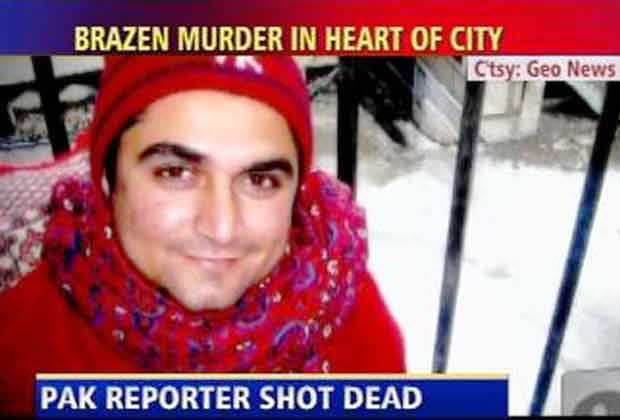
On 1 March an anti-terrorism court in Pakistan, found six men guilty of the murder of 28-year old journalist Wali Khan Babar. Four have been sentenced to life imprisonment, and two, in absentia, were sentenced to death.
The young reporter was shot dead on January 1, 2011, while working for GEO TV in the Liaquatabad area of Karachi. According to Committee to Protect Journalists, his was a work-related murder.
Convictions for attacks on journalists can be complicatd in Pakistan. Ahmed Omar Saeed Sheikh, who was convicted for the murder of US reporter, Daniel Pearl is the only previous journalist killer to have been sentenced to death. However, Pearl’s case remains in dispute and Sheikh has been incarcerated at the Hyderabad Central Jail for the last 12 years. His lawyers are appealing the conviction, saying he was framed. The confusion arose after Khalid Sheikh Mohmmad (currently being held in Guantanamo) confessed to the murder.
Therefore, Mazhar Abbas, former secretary general of the Pakistan Federal Union of Journalists (PFUJ) while terming this month’s conviction as an “important decision” remains sceptical that Babar’s family will get justice given the abysmally low conviction rate once the case goes to higher courts. “It may take years to get a decision if the case goes to the Sindh High Court for appeal,” he said pointing to deep-rooted “corruption” that prevailes in the judicial system.
But that is not the only reason for the delay in justice. Despite setting up anti-terrorist courts (ATCs) for speedy disposal of cases, the conviction rate has not made an appreciable difference. People like former prosecutor general of Sindh province, Shahadat Awan, links the high rate of acquittal (almost 73 percent), to weak investigation and witnesses retreating.
Since Babar’s trial began, six witnesses, a lawyer and two policemen linked to the investigation have been assassinated.
After these murders, and amid threats to the prosecutors and lawyers, the trial was shifted from Karachi to another city in Sindh, Shikarpur. “The case has been tried under extremely difficult circumstances and to that extent I am satisfied,” acknowledged Abbas.
However, not everyone is wholly satisfied.
According to Zohra Yusuf, chairperson of the independent Human Rights Commission of Pakistan (HRCP) “justice has not been fully served as two culprits are absconding and six witnesses and a prosecution lawyer were killed while the case was being heard.”
For Ambreen Agha, research assistant with New Delhi’s Institute for Conflict Management, the conviction was a welcome step but ensuring justice was equally important.
“It is a significant step in a place where a culture of impunity dominates” she said, citing the example of Malik Ishaq, a militant leader, who, despite his involvement in the massacre of minority Shias and his association with the defunct terrorist outfit, Lashkar e Jhangvi, “goes scot free”.
At the same time, a recent attack on the Islamabad courthouse showed how vulnerable those delivering justice were.
“Despite the threat that looms large on any functioning institution of Pakistan, the judiciary will have to stand strong and determined in bringing justice in this case. The onus lies on the judiciary despite the precarious times in Pakistan,” Agha emphasized.
Nevertheless, for the media community, the conviction of Babar’s killers is historic.
Media analyst, Adnan Rehmat, said the verdict was a “turning point in the battle for defence of beleaguered media practitioners” and Abbas termed it a “ray of hope” showing that Pakistan can improve its record on protecting journalists and pursuing their killers.
But Ambreen Agha warned that a sustained policy was required to “protect the media from the extreme intolerance of the militants and the political class”.
Further, she added: “The political lobby and its attempts to shrink spaces for freedom of expression by shutting down private TV channels, intimidating and blocking certain media outlets, has, in the past, emboldened the terrorists and opened the spaces for the perpetrators of violence.”
This article was posted on March 10, 2014 at indexoncensorship.org
22 Feb 2014 | Asia and Pacific, Pakistan
TARGET – Episode No.190 by aajnews
Pakistan’s media has become increasingly powerful in the decade and a half since then-president Pervez Musharraf eased restrictions on new TV channels. The move sparked a boom in channels that hasn’t slowed and has encouraged the pursuit of ratings and viewers.
The crowded broadcast media market has driven the networks to cover lavish weddings during their morning shows, or dissect domestic disputes between husbands, wives and mothers in law. But more importantly and tragically, the networks are filling with shows aimed at “policing” women in this conservative nation.
While in the families, fathers, brothers, uncles, husbands, and other male-figures make sure that women don’t do any jobs or say anything that affects family name, in the working places too, policing of women is common. From telling them how to dress to how to be soft-spoken and more feminine, the trend of considering women as some property is prevalent.
So too with the media. A recent episode the show Target, broadcast on Aaj TV made many liberals cringe.
Under the guise of protecting Muslim values, the show’s producers and host broke laws while behaving like a proxy police force.
The Aaj TV team swooped on an apartment where they had heard women were involved in prostitution, which is illegal in Pakistan. The video then shows the programme’s host making a fake call to get his team member inside the apartment. Later — after the police break the lock on the door without showing a warrant — the host berated the women inside. “I know women like you” he yells.
While the show’s host Syed Shahryar Asim does claims he could go ater all the powerful people who frequent the brothel, he never names them. Perhaps it is easier to intimidate helpless women than the influential men who actually back the brothels.
At the end of the programme, Superintendent Police (SP) Ali Asif advises people to call 15 to report illegal or illicit activity. While in a civilised country, that would be the way to report criminal activities, in Pakistan, apparently, investigations and trials are carried out by the media. Be it some case to be handled by police, parliament or Supreme Court, Pakistan’s eager media anchors have taken it on themselves to police, stalk and harass anyone in their way.
For women featured in these reports the consequences can be terribly serious.
– The video in Urdu can be watched from this link.
This article was posted on 25 February 2014 at indexoncensorship.org
4 Feb 2014 | News, Pakistan, Politics and Society
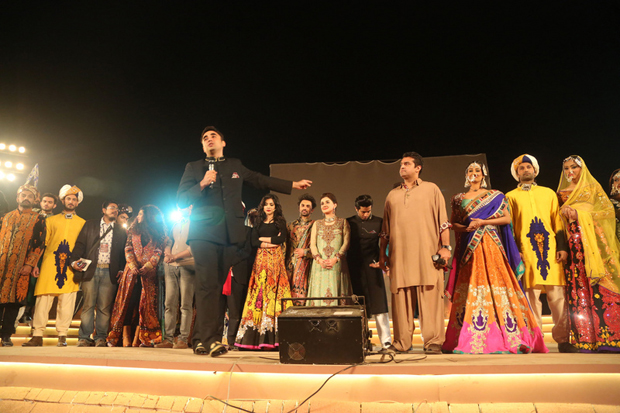
PPP Chairman Bilawal Bhutto Zardari addresses the opening ceremony of the Sindh Festival on 1 February (Photo: Jamal Dawoodpoto / Demotix)
Hoping to use culture to battle Pakistan’s slide into “Talibanisation”, the son of Benazir Bhutto kicked off a two-week-long arts festival on 1 February to offer an alternative to what is perceived here as dithering by prime minister Nawaz Sharif, who announced he was giving “peace another chance”.
After a spate of violent attacks in January, Pakistanis assumed Sharif would crack down on the Taliban with an iron fist. However, in a speech on 29 January, Sharif opted to promote talks instead. Critics immediately pointed out the repeated violations of peace accords signed by the Taliban.
Finding it a “characteristic feature” of Pakistani politics on matters of national security, Ambreen Agha, a research assistant with New Delhi’s Institute for Conflict Management said: “Mr Sharif finds it convenient to keep the nation busy with his idle pursuit of rhetoric, with nothing concrete being done.”
Among the many who are tired of hearing about the peace talks with the Taliban is 25-year old Bilawal Bhutto Zardari — the son of the assassinated former prime minister — who believes Pakistan has “exhausted the option of talks”, arguing that the militants need to be beaten “on the battlefield”. He recently put forth his point of view to BBC’s Lyce Doucet.
Despite threats from the Taliban and other armed groups, Zardari, who is also the chairperson of the Pakistan People’s Party (PPP), has begun waging a war of words against them where others have been silenced. He has urged politicians to “wake up” to the looming threat and unite against the Taliban.
“Though Bilawal’s idea of political will sounds positive, I doubt that this idea is there to stay,” said Agha and added: “Like many of his predecessors he is susceptible to fall on the same track of delays and betrayals. But, if he is willing to take the bull by the horns, which in my opinion is not even a rudimentary possibility, he needs the much called for political will.”
Zardari is spearheading the cultural festival. In a televised advertisement, in which he is seen as a head of state addressing a nation, he is declaring a “cultural coup” to fight the threat posed by the Taliban to Pakistan’s civilisation. The opening ceremony extravaganza that started with a light and music show at one of world’s ancient ruins of Mohenjo Daro — much to the disapproval of conservationists — included kite-flying, donkey cart races, cricket matches, fashion shows, theatre, music and literature.
But many in Pakistan refuse to take him seriously. He is often scoffed at for his anglicised Urdu accent, his exile in Dubai and London and his English education. Critics believe his sudden passion for reviving Sindh’s culture is misplaced.
Agha finds him “distanced from his own society, standing on a pedestal too high to be reached”.
“Of course there is a lot of criticism of him and many consider him out of touch of with reality,” agreed Islamabad-based independent journalist, Taha Siddiqui, but added: “His coming back and making this effort…it’s commendable…”
Siddiqui has been travelling the length and breadth of Pakistan for the last several years and has seen the “creeping radicalisation and religious extremism” in not just Sindh but all over the country.
While he believes the festival such as the one organised by Zardari will be a small step, more needs to be done to stem rising extremism, like revamping of school curriculum, checks and balances on religious seminaries, and for the state to clearly label the Taliban as the enemy which it has so far been unable to do.
“Unless all of these and such other measures are taken together, we will see Pakistan moving further down the trap of Talibanisation,” Siddiqui concluded.
Conceding to a need for a more holistic approach to fight Talibanisation, Agha said that while the cultural synthesis may rejuvenate the lost cultural ethos and values of Sindh, the PPP chairperson will have to “penetrate deeper into the layers of Pakistani society and address the issues that bind the people culturally.”
This article was posted on 3 Feb 2014 at indexoncensorship.org
