19 Oct 2020 | News
[vc_row][vc_column][vc_column_text]
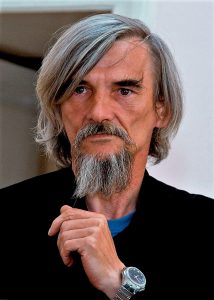
Russian historian Yuri Dmitriev, who has been imprisoned following research into murders committed by Stalin. Credit: Mediafond/Wikimedia
Western democracies have expressed concern and outrage, at least verbally, over the Novichok poisoning of Alexei Navalny—and this is clearly right and necessary. But much less attention is being paid to the case of Yuri Dmitriev, a tenacious researcher and activist who campaigned to create a memorial to the victims of Stalinist terror in Karelia, a province in Russia’s far northwest, bordering Finland. He has just been condemned on appeal by the Supreme Court of Karelia to thirteen years in a prison camp with a harsh regime.
The hearing was held in camera, with neither him nor his lawyer present. For this man of sixty-four, this is practically equivalent to a death sentence, the judicially sanctioned equivalent of a drop of nerve agent.
After an initial charge of child pornography was dismissed, Yuri Dmitriev was convicted of sexually assaulting his adoptive daughter. These defamatory charges appear to be the latest fabrication of a legal system in thrall to the FSB—a contemporary equivalent, here, of the nonsensical slander of “Hitlerian Trotskyism” that drove the Great Terror trials. It is these same charges, probably freighted with a notion of Western moral decadence in the twisted imagination of Russian police officers, that were brought in 2015 against the former director of the Alliance Française in Irkutsk, Yoann Barbereau.
I met Yuri Dmitriev twice: the first time in May 2012, when I was planning the shooting of a documentary on the library of the Solovki Islands labor camp, the first gulag of the Soviet system; and the second in December 2013, when I was researching my book Le Météorologue (Stalin’s Meteorologist, 2017), on the life, deportation, and death of one of the innumerable victims murdered by Stalin’s secret police organizations, OGPU and NKVD.
In both cases, Dmitriev’s help was invaluable to me. He was not a typical historian. At the time of our first meeting, he was living amid rusting gantries, bent pipes, and machine carcasses, in a shack in the middle of a disused industrial zone on the outskirts of Petrozavodsk—sadly, a very Russian landscape. Emaciated and bearded, with a gray ponytail, he appeared a cross between a Holy Fool and a veteran pirate—again, very Russian. He told me how he had found his vocation as a researcher—a word that can be understood in several senses: in archives, but also on the ground, in the cemetery-forests of Karelia.
In 1989, he told me, a mechanical digger had unearthed some bones by chance. Since no one, no authority, was prepared to take on the task of burying with dignity those remains, which he recognized as being of the victims of what is known there as “the repression” (repressia), he undertook to do so himself. Dmitriev’s father had then revealed to him that his own father, Yuri’s grandfather, had been shot in 1938.
“Then,” Dmitriev told me, “I wanted to find out about the fate of those people.” After several years’ digging in the FSB archive, he published The Karelian Lists of Remembrance in 2002, which, at the time, contained notes on 15,000 victims of the Terror.
“I was not allowed to photocopy. I brought a dictaphone to record the names and then I wrote them out at home,” he said. “For four or five years, I went to bed with one word in my head: rastrelian—shot. Then, I and two fellow researchers from the Memorial association, Irina Flighe and Veniamin Ioffe (and my dog Witch), discovered the Sandarmokh mass burial ground: hundreds of graves in the forest near Medvejegorsk, more than 7,000 so-called enemies of the people killed there with a bullet through the base of the skull at the end of the 1930s.”
Among them, in fact, was my meteorologist. On a rock at the entrance to this woodland burial ground is this simple Cyrillic inscription: ЛЮДИ, НЕ УБИВАЙТЕ ДРУГ ДРУГА (People, do not kill one another). No call for revenge, or for putting history on trial; only an appeal to a higher law.
Memorials to the victims of Stalin’s Terror at Krasny Bor, Karelia, 2018; the remains of more than a thousand people shot between 1937 and 1938 at this NKVD killing field were identified by Dmitriev, using KGB archival records
Not content to persecute and dishonor the man who discovered Sandarmokh, the Russian authorities are now trying to repeat the same lie the Soviet authorities told about Katyn, the forest in Poland where NKVD troops executed some 22,000 Poles, virtually the country’s entire officer corps and intelligentsia—an atrocity that for decades they blamed on the Nazis. Stalin’s heirs today claim that the dead lying there in Karelia were not victims of the Terror but Soviet prisoners of war executed during the Finnish occupation of the region at the beginning of World War II. Historical revisionism, under Putin, knows no bounds.
I am neither a historian nor a specialist on Russia; what I write comes from the conviction that this country, for which I have a fondness, in spite of all, can only be free if it confronts its past—and to do this, it needs courageous mavericks like Yuri Dmitriev. And I write from the more personal conviction that he is a brave and upright man, one whom Western governments should be proud to support.
This article was translated from the French by Ros Schwartz. It was originally published on the New York Review of the Books here under the headline Yuri Dmitriev: Historian of Stalin’s Gulag, Victim of Putin’s Repression.
Read our article exploring Dmitriev’s case and how history is being manipulated and erased here.[/vc_column_text][/vc_column][/vc_row]
6 Oct 2020 | Volume 49.03 Autumn 2020, Volume 49.03 Autumn 2020 Extras
[vc_row][vc_column][vc_custom_heading text=”The award-winning writer speaks to Rachael Jolley about the inspiration for her new short story, written exclusively for Index, which looks at the idea of ageing, and disappearing memories, and how it plays out during lockdown.”][vc_column_text]
 British-Canadian writer Lisa Appignanesi has found lockdown a difficult time to write, but despite this she has created a new short story exclusively for Index.
Appignanesi, a screenwriter, academic and novelist, said: “It’s very hard to move within the instability of the time to something imaginative.”
Her story, Lockdown, focuses on an older man, Arthur, who reflects on his past in Vienna during the period between the two world wars.
Appignanesi has a long relationship with the Austrian city.
“I’ve done an awful lot of work on Viennese literature and, indeed, on Freud, so Vienna always feels very, very close to me and I lived there for a year,” she said.
“Vienna is a fascinating place. It was a great city – first of all head of an empire with many, many immigrant groupings in it, and then when it lost its imperial status in World War I it was a very impoverished city.”
She says the period of lockdown focused her mind on the restrictions imposed upon the elderly. “I have long thought about what happens to the mind within the body, people’s relationship to time in that sense. You grow old and stuff happens to your body and, initially at least, it doesn’t seem to affect your mental capacity and the way you grow through time as you are living it.”
She is also interested in the idea of people being present in different ways and how, for instance, the potential anonymity and the disembodied nature of Twitter means that people can unleash their anger differently from how they would if they were in the room with someone.
“Some of the rampant emotions of our time, particularly anger,” she said, “were to do with the fact that people on Twitter are not only anonymous but they are disembodied.”
In an article for this magazine in 2010, Appignanesi wrote: “The speed of communication the internet permits, its blindness to geography, seems to have stoked the fires of prohibition. The freer and easier it is for ideas to spread, the more punitive the powers that wish to silence or censor become.”
Appignanesi, a long-time campaigner for freedom of expression, was born in post-war Poland as Elżbieta Borensztejn. Her Jewish parents had what she has described with understatement as “a difficult war”, hiding under different aliases to escape arrest. The family moved then to Paris, which she remembers, and later to Montreal, Canada. She once told BBC Radio 3 that she “grew up with the ghosts of those that died in the concentration camps”. Given the family history, it is no wonder she worries about authoritarian governments and restrictions on speech.
She is now concerned about how governments are changing the rules of freedom of expression while the world is distracted by Covid-19, and the threats that may manifest themselves. “Your attention is distracted by something – something happens behind the scenes, and usually the same people are doing the distraction. This time it was the virus.”
One news item that grabbed her attention recently was about the closure of Guatemala’s police archives (see page 27), a library of information about the country’s civil war. Her concern is that “those archives are about the disappearances of people under the dictatorships, which were lethal”.
As others track governments who want to control the national story, Appignanesi says we must learn from history.
“It’s very important for our documents in Britain to be interpreted in different ways, and supplemented by stories we don’t know.
“There are always new histories to discover.”
[/vc_column_text][/vc_column][/vc_row][vc_row][vc_column width=”1/4″][vc_icon icon_fontawesome=”fas fa-quote-left” color=”custom” custom_color=”#dd0d0d”][/vc_column][vc_column width=”3/4″][vc_custom_heading text=”The freer and easier it is for ideas to spread, the more punitive the powers that wish to silence or censor become.”][/vc_column][/vc_row][vc_row][vc_column][vc_column_text]
Lockdown by Lisa Appignanesi:
Arthur was old. Very old. So old that when the word “lockdown” had made its way onto the radio news he was listening to with only half an ear – and even that half tuned to inner voices – he had thought they were talking about him.
It seemed the world was joining him now. In lockdown.
But the whole country had been in metaphorical lockdown for some time, he reflected, its politicians preventing every connection between a fragmented people except angry sparks or empty boasts.
Lockdown was a perfect word to describe his present condition: confined to his cell for his own good by a greater authority. If he promised not to riot, he was allowed out for exercise at regular intervals.
Yet the notion of exercise took all the pleasure out of movement. He preferred to think of it as a walk, better still, a passeggiata. He always dressed carefully for the occasion – a suit, perhaps a silk waistcoat, a bow tie. The joy of a stroll was in part that people looked at, and greeted, each other – even smiled. So no stretchy joggers and sweatshirts for him of the kind his grandchildren wore. He liked form. He had always been something of a dandy, though these days, as he heaved what seemed to be boulders rather than legs along the streets, it was harder to turn a casual half smile on the world and appreciate its offerings. But then his senses, too, were in all but lockdown. His new glasses had him stumbling, the ground far closer than where he had last left it, as if he had shrunk back to childhood and well below what was once an adequate height for a man of his generation.
His first grandson had once asked him if he was named after King Arthur since he had a round table and Arthur hadn’t liked to contradict him – but the only table that had featured in his own childhood had been the one at the Professor’s house in Vienna. He played happily under that while the adults talked and occasionally the Professor would put a hand below the edge of the tablecloth and tousle his hair, then pat him as he did his dogs. He liked the Professor, who gave his name a proper ‘T’ – Artur. In fact, it was the writer who was called the professor’s “doppelgänger” who was responsible for Arthur’s name.
Doppelgänger was a word he learned early. Another, heard from beneath the table, was Zensur. He had thought that had the word hour in it, had thought maybe it meant ten o’clock, zehn Uhr. Amidst the chatter of the adult voices, he saw TEN blotting out all the hours that came before, a censoring hour.
Maybe that’s why he had this odd relationship to time now, as he reached his midnight. He was convinced that at this late age he finally understood, was indeed living, what Einstein had meant about time slowing in the presence of heavy objects. Arthur was so light now, his bones s0 hollowed out, that time didn’t slow for him. It sped.
Or maybe its racing effect was linked to the fact that there was so little of time left that what had once been full and slow was now racing towards an end. The thought of death could no longer be censored or repressed. No bonfire could destroy it. But then it hadn’t really worked for the books either. They had sprung up in other editions and elsewhere.
Arthur had been born in Berlin just weeks after the great conflagration of books the Nazis had staged and only a few months after the Reichstag fire. His mother had been walking near the Staatsoper on the night of the book burning. She had loved Arthur Schnitzler’s work and had known him a little, so he had become little Arthur.
It was as well the Professor was still alive or he might have become Siggy, since his books were in that bonfire too.
Was that why he had spent his life in books and collected so many in the process? He looked up at the study’s walls lined in first editions, one side leather bound, the other brighter in their contemporaneity.
“Arthur?”
He checked that the voice was real and forced himself into the present.
In the doorway stood the young woman he liked to think of as his companion, though his granddaughter, Mia, had called her – in insisting on the need for her – an au pair plus. Stella was certainly more than his equal, not only as tall as he once had been but with poise and a razor-sharp intelligence he sometimes thought could penetrate his thoughts without him needing to speak.
So she knew he liked the fact she was decorous and she hadn’t – at least not yet – upbraided him for it, as his granddaughter would. Stella was completing a PhD at Cambridge, and with a rueful smile admitted that she had been completing it for an unconscionable while, which most recently had included divorcing her husband. That was why she found herself in need of a room and an extra wage. No one had imagined lockdown.
Now she wanted him up and ready to begin the Sisyphean task of the morning passeggiata.
His study door opened onto a terrace and from there down into communal gardens, a square where the trees today were in full glorious flower. He was a lucky man. Doubly lucky that his granddaughter had somehow gifted him this magnificent creature.
“We’re going to begin today,” Stella said when they paused for him to catch breath beneath the flowering cherry. The sky between its branches was a Mediterranean blue. The blackbirds were in full throat. The young Americans with their twin toddlers weren’t out yet.
“I’m not ready.” Arthur heard the plaintive high pitch in his own voice and rushed to blur it in a cough.
If you wish to read the rest of the extract, click here.
[/vc_column_text][/vc_column][/vc_row][vc_row][vc_column width=”3/4″][/vc_column][/vc_row][vc_row][vc_column][vc_column_text]
Lisa Appignanesi is an award-winning writer and campaigner for free expression. She is the author of many books including Memory and Desire, Losing the Dead and The Memory Man.
Rachael Jolley is the former editor-in-chief of Index on Censorship magazine. She tweets @londoninsider. This article is part of the latest edition of Index on Censorship’s autumn 2020 issue, entitled The disappeared: how people, books and ideas are taken away.
Look out for the new edition in bookshops, and don’t miss our Index on Censorship podcast, with special guests, on Soundcloud.
[/vc_column_text][/vc_column][/vc_row][vc_row][vc_column width=”1/2″][vc_custom_heading text=”Listen”][vc_column_text]The autumn 2020 magazine podcast featuring Hong Kong-based journalist Oliver Farry, who discusses the crackdown on pro-democracy demonstrations in the region
LISTEN HERE[/vc_column_text][/vc_column][vc_column width=”1/2″][vc_custom_heading text=”Subscribe”][vc_column_text]In print, online. In your mailbox, on your iPad.
Subscription options from £18 or just £1.49 in the App Store for a digital issue.
Every subscriber helps support Index on Censorship’s projects around the world.
 SUBSCRIBE NOW[/vc_column_text][/vc_column][/vc_row][vc_row][vc_column][/vc_column][/vc_row]
15 Sep 2020
[vc_row full_width=”stretch_row_content_no_spaces” full_height=”yes” css=”.vc_custom_1600177152938{padding-top: 55px !important;padding-bottom: 155px !important;background-image: url(https://www.indexoncensorship.org/wp-content/uploads/2020/09/breaking-silence-head-scaled.jpg?id=114844) !important;background-position: center !important;background-repeat: no-repeat !important;background-size: cover !important;}” el_class=”text_white” el_id=”Introduction”][vc_column][vc_custom_heading text=”Breaking the silence” font_container=”tag:h1|font_size:48|text_align:center” use_theme_fonts=”yes” css=”.vc_custom_1600177165944{background-color: #000000 !important;background-position: center !important;background-repeat: no-repeat !important;background-size: contain !important;}”][vc_raw_html]JTNDZGl2JTIwc3R5bGUlM0QlMjJhbGlnbiUzQWNlbnRlciUzQm1hcmdpbiUzQWF1dG8lM0JiYWNrZ3JvdW5kLWNvbG9yJTNBcmdiYSUyODAlMkMwJTJDMCUyQzAuNSUyOSUzQiUyMiUzRSUzQ3AlMjBzdHlsZSUzRCUyMnRleHQtYWxpZ24lM0FjZW50ZXIlM0J3aWR0aCUzQTYwJTI1JTNCbWFyZ2luJTNBYXV0byUzQiUyMiUzRUElMjBuZXclMjByZXBvcnQlMjBvbiUyMHRoZSUyMGxlZ2FsJTIwbWVhc3VyZXMlMjB0aGF0JTIwd2lsbCUyMGdpdmUlMjBqb3VybmFsaXN0cyUyMGJhY2slMjB0aGVpciUyMHZvaWNlcyUzQyUyRnAlM0UlM0MlMkZkaXYlM0U=[/vc_raw_html][/vc_column][/vc_row][vc_row][vc_column width=”3/4″][vc_column_text]
Introduction
On 8 July 2020, Index on Censorship brought together a group of distinguished legal experts and practitioners from across Europe for a virtual roundtable to discuss the vexatious use of the law and the threat it poses to media freedom in Europe. The discussion took place on the back of the publication of the report, “A gathering storm: the laws being used to silence the media”, which was published by Index on Censorship in June.
The purpose of the roundtable was to discuss the trends raised by the report with a view to identifying implementable measures that could prevent Slapps (strategic lawsuits against public participation). The group also heard from a United States-based lawyer, Thomas R. Burke, who outlined the anti-Slapp legislation that was enacted in California in 1992.
The roundtable took place under the Chatham House Rule, but the salient points from the discussion form the basis for this report. The report also includes separate inputs from three lawyers: Swedish lawyer Ulf Isaksson, Italian lawyer Andrea di Pietro, and Norwegian lawyer Jon Wessel-Aas.
Please note you can download this report as a PDF or view it as a flipbook.[/vc_column_text][vc_single_image image=”114841″ img_size=”full” el_id=”Executive_summary”][vc_column_text]
Executive summary
A Slapp is a type of legal action not taken to succeed but to induce fear, silence and inaction.
They tend to have minimal legal merit, being used in an effort to exhaust their victims of time, money, and energy, so as to discourage them from expressing critical opinions on matters of public interest. They endanger not only independent journalism but academia, activism, and other forms of civic engagement.
The roundtable participants discussed the main issues around vexatious legal threats and actions, including Slapps, around Europe. These included:
- Excessive length of judicial procedures and statutes of limitation for defamation cases
- Abuse of privacy and data protection laws to target the media
- Tendency to file lawsuits in plaintiff-friendly jurisdictions
- Growing distrust and increased hostility toward the media
The roundtable’s participants also discussed a number of measures that could be introduced in order to provide journalists with greater protections when faced with a Slapp, that could stop Slapps from being so time-consuming and expensive, and that could ultimately prevent Slapps from being filed altogether:
- Better application of European Court of Human Rights case law
- Training for judges and journalists
- Introduction of anti-Slapp legislation
- Rethinking the role of the jury
- Increasing the use of press councils and ombudsmen
- Building networks and encouraging solidarity
The participants discussed the main trends and issues with regard to vexatious lawsuits against journalists in Europe. They identified four key areas of concern:[/vc_column_text][vc_single_image image=”114864″ img_size=”full” el_id=”The_problem_with_Slapps”][vc_column_text el_id=”Executive_summary”]
The problem with Slapps
The participants discussed the main trends and issues with regard to vexatious lawsuits against journalists in Europe. They identified four key areas of concern:[/vc_column_text][vc_column_text el_id=”Defamation_law”]
Defamation law
The excessive length of the judicial process in both civil and criminal defamation cases is having a chilling effect in several countries. “Even though we know that they [journalists] will win, it still takes several years,” said one participant with regard to criminal lawsuits in Hungary.
In Sweden, rather than length judicial process itself, it is the statute of limitations for libel offences – which enables legal action to be brought up to a year after publication – that is a threat to the media. “It is not, in my personal view, in conformity with European standards,” said lawyer Ulf Isaksson. “
Because the threshold of harm is so low for civil cases and much higher for criminal cases (enabling most journalists to be acquitted), one lawyer said that from a practical point of view, he thought his clients were sometimes better off facing a criminal rather than a civil lawsuit. The higher level of protection provided for public figures and public authority representatives in countries like Hungary is also having a chilling effect, some participants said.
Although Malta, Ireland, Romania, and the United Kingdom have abolished criminal defamation from their statutes, they are also among the countries where the media is facing the most serious threat from civil defamation. Should the abolition of criminal defamation continue to be a goal? Everyone agreed it should, but amendments should be made to better protect the media from vexatious actions.[/vc_column_text][vc_column_text el_id=”Privacy_and_GDPR”]
Privacy and GDPR
Several participants noted that privacy and data protection actions were increasingly being used to target the media. “In terms of substantive legal proceedings they are always an add-on,” described one participant with regard to Northern Ireland.
Despite the journalistic exemption, take-down requests under article 17 of GDPR (“the right to be forgotten”) are being used by some individuals in an effort to have their history erased from archive material. One participant said that due to the fact that media organisations do not want to spend time and money on assessing the merits of a request, they sometimes comply automatically. The case of Hells Energy against Forbes Hungary earlier this year was cited as an example of the abuse of GDPR.
Although GDPR states that the concept of journalism should be broadly interpreted (recital 153) and despite the CJEU’s preliminary ruling in February 2019 stating that citizen journalists were not excluded from the journalistic exemption (article 85.2), the issue of whether the GDPR exemption applies to citizen journalists has been an issue in several countries.
For example, a statement published by police in the Polish city of Olsztyn earlier this year referred to GDPR stating that “publishing videos from police interventions may give rise to liability for violation of the provisions on the protection of personal data”. The statement was made after an arrest by Olsztyn police was recorded and shared on social media. The Commissioner for Human Rights subsequently released a statement, confirming that they had contacted Olsztyn police requesting that the their statement be amended given that, according to the commissioner, “it may mislead citizens as to their rights and limit the actual exercise of them as part of exercising social control of the activities of public authority functionaries through public opinion”. The commissioner’s statement also referred to GDPR’s journalistic exemption.[/vc_column_text][vc_column_text el_id=”Libel_tourism”]
Libel tourism
The roundtable raised the issue of libel tourism, both in terms of journalists being victims of libel tourism and of countries being (and becoming) libel tourism hotspots. One participant noted that threats of legal actions from other jurisdictions are especially effective because of journalists’ and lawyers’ lack of familiarity with foreign legal systems.
Malta was cited as an example of a country whose journalists have become targets of libel tourism. According to one expert, on the day that Daphne Caruana Galizia was killed in October 2017, Maltese news organisations were subject to legal threats from law firms in the UK and USA. “The economic analysis of those outlets led them to believe that they were better to remove the materials than defending them. They stood by the veracity of what they had published, but removed them anyway.”
This trend continues. Between 1 May and 26 June 2020, two law firms – the US-based Lambert Worldwide and the UK-based Atkins Thomson – sent legal letters to Times of Malta, Malta Today, Malta Independent, Lovin Malta and The Shift News in relation to their reporting.
Some countries, such as the UK, are well-known libel hotspots. Some expressed concern that other countries, particularly Ireland, may become hubs for libel tourism in the future. This was a possibility, particularly given that the damages awarded by Irish courts tend to be the highest in Europe (see our earlier report). The number of tech companies that are based in Dublin was also seen as a potential incentive for taking legal action in Ireland. “And if an award for damages is granted in one EU country, it is automatically enforceable elsewhere in the EU,” warned the lawyer.[/vc_column_text][vc_column_text el_id=”Hostile_media_environment”]
Hostile media environment
Some participants perceived the current environment facing the media across Europe as an aggravating factor, both in terms of the amount of Slapp cases that are being brought against the media, and in terms of the prospect of action being taken to counter them. According to Italian lawyer Andrea di Pietro, “journalists in Italy are seen as a nuisance – as people who poke their noses into events. They are not seen as a resource for democracy”.
The fact that the daily newspaper Gazeta Wyborcza has faced more than 55 legal threats since 2015 was mentioned as an example of this trend. “The media is seen as an enemy of the people,” one participant said.
With regard to the prospect of introducing legislation aimed at protecting the media, another participant said, “Politicians are very reluctant at the moment to give additional protections to online media and social media. There’s rather a tendency to restrict and repress”.[/vc_column_text][vc_single_image image=”114832″ img_size=”full” el_id=”Measures_that_could_prevent_Slapps”][vc_column_text]
Measures that could prevent Slapps
The participants discussed a number of measures that could be introduced in order to protect journalists and prevent Slapps from being brought. They identified six key areas:[/vc_column_text][vc_column_text el_id=”Full_application_of_ECtHR_law”]
Full application of ECtHR law
There was agreement that the criteria, standards and principles developed by the European Court of Human Rights (ECtHR) on the basis of article 10 of the European Convention should be better integrated at national level. “If the case law of the ECtHR was better applied in the member states, we would have less problems with Slapp and vexatious litigation against journalists,” one participant said.
Norway’s experience was given by way of example. “In the 1980s and 1990s, defamation cases were a problem – a big problem for the Norwegian press because we had not incorporated properly the jurisprudence of the European Court,” one lawyer explained. The Human Rights Act came into force in 1999 and it empowered the courts to enforce the European Convention directly as Norwegian law. This enables all the same defences provided for by ECtHR jurisprudence to be used in Norwegian courts. “It doesn’t mean the media don’t lose cases,” the lawyer said, “but it’s a much more realistic attitude toward press freedom”.[/vc_column_text][vc_column_text el_id=”Training_for_judges_and_journalists”]
Training for judges and journalists
Several participants emphasised the need for training to be made available for judges, given that (in most cases) judges are not specialised. This, according to participants, results in judges being educated about the nuances of media and freedom of expression while in the courtroom. “That’s a difficult thing to do,” explained one participant, “you’re starting on the back foot”. Another participant agreed, saying that although most media cases in Poland refer to the ECtHR’s jurisprudence, “they are often quite superficial”.
One lawyer explained that a training course that had been organised for judges in Hungary enabled editors-in-chief and judges to informally discuss Article 10 cases. “That helped a lot,” the participant said. “This is not the solution, but education is important.”
Journalists should be better educated, believed the participants, particularly with regard to two areas of the law. Firstly, regarding what journalists need to do pre-publication in order to protect themselves from potential legal threats or actions. “A big issue is the education of the journalists because they don’t necessarily understand the importance of conveying to the court that they actually undertook that decision-making prior to processing the data,” explained one participant.
Secondly, journalists need to be educated as to their rights and obligations under GDPR, so as to avoid automatic take-downs purely out of caution. “It’s crucial that they understand their defences and their obligations,” said one participant. “It has become more complex.”[/vc_column_text][vc_column_text el_id=”Introduction_of_anti-Slapp_legislation”]
Introduction of anti-Slapp legislation
The group heard from Thomas R. Burke, a United States media lawyer and author of Anti-SLAPP Litigation. He outlined the main features of the California anti-Slapp statute, which was enacted in 1992. Under the statute, defendants may file a special motion to dismiss complaints through a very early and fast summary judgement-like procedure. Once the motion is filed there is an automatic freeze on discovery (the most expensive stage of litigation in the US), amendments to the complaint are not permitted, and the plaintiff cannot dismiss the complaint without facing mandatory lawyer fees. The court should hear the motion within 30 days. If the motion is granted, the action is dismissed and the defendant recovers their fees and costs. If the motion is denied, the defendant may appeal.
Burke described the anti-Slapp statute as a “a remarkable development”. However the California anti-Slapp statute includes exemptions, which he warned against including in future such measures in Europe. “They are nightmarish in their application,” he said. “If it’s a worthwhile case, they will survive the anti-Slapp.”
Unlike in the US, where anti-Slapp laws have been introduced in thirty states, there is no clear hierarchy between privacy and freedom of expression in Europe. The question was raised as to whether any jurisdictions have deployed their margin of appreciation in constitutional terms in favour of privacy. Would that constitute an impediment to having an EU-wide preference for freedom of expression, which would be within the margin of appreciation, should there not be national constitutional impediments? The margin of appreciation potentially causes a problem for having a European standard.
Given that plaintiffs who are natural persons have a right to privacy under Article 8 of the European Convention, it would be more difficult for the courts to throw out alleging that their rights have been violated. Courts would be concerned that could be found to have violated Article 8. It is still open as to whether corporations or state authorities are protected under Article 8.
Council of Europe was mentioned as a potential avenue for developing an aspirational model anti-Slapp law, which could provide for more robust measures to be put in place.[/vc_column_text][vc_column_text el_id=”Rethinking_the_role_of_the_jury”]
Rethinking the role of the jury
The issue of jury trials was raised as a significant obstacle to quickly “weeding out” Slapp cases. “If you bring an application to strike out a case for being vexatious, the judge hearing the application will invariably say ‘well I think I’ll let the jury make that decision’ so everything goes around in a circle,” explained one participant regarding the situation in Ireland. The necessity to have a jury adjudicate on every media case not only increases the time and cost, but makes outcomes more difficult to predict. Participants agreed that putting a defence – such as responsible journalism or public interest – before a jury was very difficult. In England and Wales, the abolition of jury trials for cases of civil defamation has led to a quicker, less complicated process.
Although press offences that are punishable under criminal law are the exclusive competence of a jury court (the Assises Court) in Belgium (except for incitement to racism and xenophobia), the fact that journalists and editors enjoy de facto criminal impunity for press offences means that media law cases are never subject to a jury.
But according to lawyer Ulf Isaksson, juries are “extremely important for the freedom of press situation in Sweden.” “The Swedish jury is entrusted with only one task,” he explained, “and that is to decide whether this specific dissemination was legal or not legal.” However, judges are not bound by the juries’ decision. “So they can still acquit the defendant.” Juries are part of judicial proceedings in mass media cases only. They jury may deliberate outside the presence of the judges, but may consult the presiding judge with specific questions on the law.
Norway has done away with juries altogether in favour of lay judges, which are used in criminal cases. Lay judges, which are common in civil law jurisdictions, are distinct from juries in that they have equal status to the presiding judge, and as such, have an inquisitorial role. They have been credited with being an efficient and less expensive way of expanding public participation. Norway has decriminalised defamation, but violation of privacy is still formally criminalised, although the authorities rarely investigate or prosecute alleged violations when the media is involved.
The roundtable raised the question of whether there are constitutional protections on a right to jury trial in civil defamation cases.[/vc_column_text][vc_column_text el_id=”Press_councils_and_ombudsmen”]
Press councils and ombudsmen
“We do think that a press council is a good idea,” said one participant, referring to its usefulness in identifying and weeding out meritless complaints. However, its positive impact is reduced when filing a complaint with the press council doesn’t prevent legal action. “We’ve had cases, where the claimant has brought something to the press ombudsman, has received a favourable decision, and has subsequently sued,” said one participant with regard to Ireland.
In a case involving the Norwegian daily Aftenposten, Norway’s Supreme Court ruled in 2015 that a condemnation from the press council does not automatically presume a violation of the law, as the journalistic ethics upheld by the council are intended as an ideal. Asked about the case, lawyer Jon Wessel-Aas (who represented Aftenposten in the case) said that when considering whether to impose legal sanctions, the courts have to take a much broader approach than press councils. “Deviations from the ‘ideal’ cannot automatically lead to legal liability,” he said. “Such deviations have to be weighed against all the other factors which, according to the ECtHR’s jurisprudence, are part of the balancing test between ECHR article 10 and article 8, including the degree of public interest involved.”
While most participants agreed that the press councils were a force for good with regard to preventing Slapp actions, some warned that there was a need to ensure they were completely independent. “There is a danger in some jurisdictions that press councils could be captured by political actors,” one expert said. For example, in its 2019 election manifesto Poland’s Law and Justice Party (PiS) proposed to introduce a “self-government” watchdog body aimed at “regulating the journalistic profession”. They have not (yet) taken action on this.[/vc_column_text][vc_column_text el_id=”Building_networks_and_encouraging_solidarity”]
Building networks and encouraging solidarity
One of the reasons why Norway was said to have been quite successful in protecting its journalists from undue legal threats was due to the well-organised nature of their editors’ and press associations. In contrast, journalists in Italy – who are frequently threatened with legal actions – were said to be isolated and disconnected from their colleagues. According to Andrea di Pietro, “journalists are really economically isolated, also from a trade union perspective, therefore weakening a journalists with a lawsuit is very possible thanks to a legal system that doesn’t punish [the vexatious litigators]”. Freelance journalists are particularly vulnerable to vexatious legal threats and actions: they are more risk-averse given their limited time, resources, and support.
The participants discussed the need to build solidarity within the media community, as well as with legal practitioners, experts, and civil society. The roundtable suggested two ways that this could be done:
-
Building a catalogue of Slapp cases
One participant said how useful it would be to have a list of all the Slapp cases in Europe. “There is a strategy happening all over Europe, if we had the cases that could help us to push for the anti-Slapp law.” Attention was drawn to the Council of Europe Platform, which is one of the ways currently being used to help catalogue Slapp cases. Would a database exclusively for Slapp cases be useful and feasible?
The need to grant access to civil society organisations to amici curiae (an independent advisor who is not party to a case) was one means by which the media could be supported when faced with these legal actions. “Collective intervention makes people feel less vulnerable,” said one participant. Associations in Norway were said to have been successful in intervening in strategic cases. “That has done a lot of good,” the participant said.[/vc_column_text][vc_column_text]
Acknowledgments
Photo credits: Darrin Zammit Lupi/Reuters (main image), Tumisu (sshh!), Shaun_F (highlighted text), Mahesh Patel (newspapers)[/vc_column_text][vc_row_inner][vc_column_inner width=”1/4″][vc_single_image image=”113711″ img_size=”full” onclick=”custom_link” link=”https://postkodstiftelsen.se/en/”][/vc_column_inner][vc_column_inner width=”3/4″][vc_column_text]This report has been supported by the Swedish Postcode Foundation. The foundation is a beneficiary to the Swedish Postcode Lottery and provides support to projects that foster positive social impact or search for long-term solutions to global challenges. Since 2007, the foundation has distributed over 1.5 billion SEK in support of more than 600 projects in Sweden and internationally.[/vc_column_text][/vc_column_inner][/vc_row_inner][/vc_column][vc_column width=”1/4″][vc_widget_sidebar sidebar_id=”smartslider_area_1″][vc_widget_sidebar sidebar_id=”smartslider_area_1″][vc_widget_sidebar sidebar_id=”smartslider_area_1″][vc_widget_sidebar sidebar_id=”smartslider_area_1″][vc_widget_sidebar sidebar_id=”smartslider_area_1″][vc_widget_sidebar sidebar_id=”smartslider_area_1″][vc_widget_sidebar sidebar_id=”smartslider_area_1″][vc_widget_sidebar sidebar_id=”smartslider_area_1″][vc_widget_sidebar sidebar_id=”smartslider_area_1″][vc_widget_sidebar sidebar_id=”smartslider_area_1″][/vc_column][/vc_row]
8 Sep 2020 | News, Statements
[vc_row][vc_column][vc_column_text]Index on Censorship has filed an alert to the Council of Europe about a defamation action that is being taken against the Dublin Inquirer, its co-founder Sam Tranum and reporter Laoise Neylon. The Council of Europe has formally notified Ireland of the legal action.
The alert is the first media freedom alert on Ireland since the Council of Europe’s alert platform was launched in 2015. The platform catalogues threats to media freedom in the Council of Europe’s 47 member states.
On the back of the alert, Index on Censorship and seven other media freedom organisations have also written to justice minister, Helen McEntee, and foreign affairs minister, Simon Coveney, to express their concerns over the lawsuit.
“We believe that this legal action is a Strategic Lawsuit against Public Participation (Slapp), intended to intimidate and silence an independent media outlet that is reporting in the public interest,” they wrote.
“The aim of a Slapp is not to succeed in court, but to drain their targets of money, time, and energy in an effort to discourage them from reporting further on a particular person or issue,” the letter explains.
The organisations urge the government to pursue reform of Irish defamation law and to support the creation of anti-Slapps legislation at EU level. “We call on you to get behind such measures in order to bring about concrete protections – including an anti-Slapps directive – for freedom of expression, access to information, and ultimately our democracies.”
Click here to read our report on the rise of Slapps.
Read below the letter to McEntee and Coveney in full:
8 September 2020
Dear Minister Helen McEntee TD, Minister for Justice
Dear Minister Simon Coveney TD, Minister for Foreign Affairs and Trade
Cc: Permanent Representation of Ireland to the EU
Index on Censorship, alongside the undersigned press freedom organisations, are writing to raise our concern about legal action that is being taken against the independent news outlet, the Dublin Inquirer, its co-founder Sam Tranum, and its reporter Laoise Neylon.
As outlined in the media freedom alert that was issued by the Council of Europe today, the Dublin Inquirer is facing a defamation lawsuit for an article it published on its website on 26 August, which reported on an eviction that had taken place in Glasnevin the previous week. Tranum, Neylon, and the Dublin Inquirer, were served with summons on 31 August.
We believe that this legal action is a Strategic Lawsuit against Public Participation (SLAPP), intended to intimidate and silence an independent media outlet that is reporting in the public interest. The aim of a SLAPP is not to succeed in court, but to drain their targets of money, time, and energy in an effort to discourage them from reporting further on a particular person or issue.
The SLAPP that the Dublin Inquirer is facing is just one example of a phenomenon that has become widespread in Europe in recent years: at the time of her death in 2017, Maltese journalist Daphne Caruana Galizia had 47 vexatious lawsuits filed against her. This year, the Council of Europe Platform for the Protection of Journalism and Safety of Journalists has recorded SLAPPs in Belgium, Malta, France, Bulgaria, Poland, and Romania – and we have reason to believe that these are just the tip of the iceberg.
The lengthy process and extremely high costs associated with defending a defamation case means that Ireland’s draconian defamation laws are an ideal tool with which to threaten and intimidate. Because of the arduousness of exhausting domestic measures, the European Court of Human Rights provides little practical protection to Irish journalists and media outlets. This means that small media outlets, like the Dublin Inquirer, could face closure when targeted with such legal threats and actions.
We therefore urge you, not only to pursue the long overdue reform of Irish defamation law, but to support the creation of robust anti-SLAPPs legislation at EU level. The European Commission has committed to considering suitable anti-SLAPP measures as part of its upcoming European Democracy Action Plan. We call on you to get behind such measures in order to bring about concrete protections – including an anti-SLAPPs directive – for freedom of expression, access to information, and ultimately our democracies.
Thank you in advance for your consideration of our concerns. We look forward to your response and would be glad to schedule a meeting to discuss in more detail.
Kind regards,
Index on Censorship
European Centre for Press and Media Freedom (ECPMF)
The Daphne Caruana Galizia Foundation
Irish Council for Civil Liberties (ICCL)
Free Press Unlimited (FPU)
Article 19
Reporters Without Borders (RSF)
Committee to Protect Journalists (CPJ)[/vc_column_text][/vc_column][/vc_row]
