27 Oct 2025 | Belarus, Europe and Central Asia, Lithuania, News, Volume 54.03 Autumn 2025
This article first appeared in Volume 54, Issue 3 of our print edition of Index on Censorship, titled Truth, trust and tricksters: Free expression in the age of AI, published on 30 September 2025. Read more about the issue here.
At the end of June, Belarusians witnessed something close to a miracle. After meeting with US Special Envoy for Ukraine Keith Kellogg, Belarusian dictator Alyaksandr Lukashenka “pardoned” and deported to Lithuania a group of political prisoners: five Belarusians and nine foreign nationals.
Among them were former Radio Free Europe/Radio Liberty journalist Ihar Karnei and Minsk State Linguistic University associate linguistics professor Natallia Dulina. Most unexpectedly, they also included Siarhei Tsikhanouski, blogger and activist, the first to challenge Lukashenka in the 2020 election. He is the husband of Sviatlana Tsikhanouskaya, who stepped into her husband’s political shoes when he was jailed and who many consider Belarus’s president-elect.
Index went to Lithuania and Poland to speak with these three.
Tsikhanouski was arrested in May 2020 shortly after he announced his plans to run for the presidency in opposition to Lukashenka. He was eventually charged with organising mass unrest and fuelling social hatred, and sentenced to 18 years in prison, with an extra one and a half years added during his sentence for supposedly breaking prison rules. He spent more than two years incommunicado before his unexpected release this summer.
In October 2022, Dulina was put behind bars for public order offences and promoting extremist activities, after she took part in peaceful protests. She was sentenced to three and a half years in a penal colony.
Karnei, a journalist, was arrested in July 2023 and charged with participating in an extremist group. After being sentenced to three years in prison, he was transferred to a penal colony, where he was placed in a punitive isolation cell.
In June, the three with 11 others went through a forced exile and were delivered to the Lithuanian border with bags on their heads, absolutely uninformed. The next thing they heard was: “It’s all right guys, you are under the protection of American diplomacy – you are free.”
Below, Tsikhanouski, Dulina and Karnei share, in their own words, a glimpse of what it means to be a political prisoner in Belarus. And while 14 were released in June, there are nearly 1,300 political prisoners still being held in penal colonies in Belarus.
Siarhei Tsikhanouski
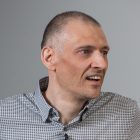 My arrest and criminal case clearly show that I was persecuted solely for my words. I was prosecuted for defending freedom of speech and the right to share information. The charges they invented had no evidence whatsoever – nothing was presented in court. The regime doesn’t even understand what a real court is. What they have has nothing to do with justice.
When you’re tried, Stalin-style, inside the prison itself, behind closed doors, your lawyers can’t defend you. Meanwhile, on state TV, they broadcast false and defamatory claims, but neither I nor my lawyers can respond. Sitting in prison “with my mouth shut,” I couldn’t even make a final statement. People couldn’t hear my evidence of innocence or my arguments – nothing. The regime throws out baseless accusations and hands down long sentences. My trial lasted about six months.
It’s absurd. The UN Working Group on Arbitrary Detention had already ruled that my detention was arbitrary and therefore illegal. But the regime didn’t care.
This is how the justice system works in Belarus: when the dictator appoints the head of the Investigative Committee, the prosecutor general, the head of the KGB and the ministers, he appoints everyone. He also appoints judges by his own decree. Our constitution states there is a separation of powers, three branches
of government, but in reality this does not exist. He appoints everyone by his decrees, and they carry out his will.
And it turns out that it is impossible to fight this within the framework of the law. Impossible. We suffered not because we fought in some way outside the law, but because we spoke up, exposed and showed it. Accordingly, they engaged their instruments of force and simply put everyone who did not stay silent and spoke out into prison.
Ihar Karnei
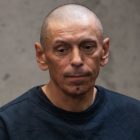 From the very start, a segregation process begins in prisons. Those convicted under so-called “extremist” articles – which cover a wide range of charges, from participating in public gatherings to posting comments allegedly insulting the honour and dignity of officials and the president – are stripped of nearly all rights.
Such prisoners are immediately labelled “malicious violators of prison rules”. Often, there is no real basis for this, but it’s simply the procedure: a person is automatically considered to be breaking internal regulations in detention facilities.
On this basis, they are placed on a preventive register, meaning they are under heightened scrutiny from their first day in a penal institution. Usually, they are subjected to all possible punishments: disciplinary cells, denial of parcels and packages from relatives, and bans on any visits.
Political prisoners – marked with yellow tags – are even denied the right to visit the library, use the sports yard or attend church, despite small chapels existing in all colonies. Torture by solitary confinement is common. I spent almost six months in a medium-security colony in Shklou. In total, I spent 160 days in solitary confinement there.
Natallia Dulina
 After a long period in prison, people often feel disoriented when they are released. Reactions vary. Some initially experience euphoria and joy at being reunited with loved ones, but may struggle to adjust to the changed reality. At first, they might feel okay, but many have told me that after a while, psychological problems begin. The original traumas don’t disappear – they’re deeply buried but eventually resurface.
I have personally experienced this in two ways. During short administrative arrests, the first time I was released, I felt very bad – scared, as if they were about to come for me again. I went through that fear, processed it, let it out and felt relief. Later, after subsequent short arrests, I was able to resume life as if nothing had happened. But those were very brief detentions.
Now, I have been released outside Belarus. I think if I had returned home, I would feel better – because being in exile brings its own challenges. My case is unusual, as my release was forced. I was taken out of the country without my knowledge, blindfolded, with no explanation of where I was being moved. In the first days, the anger and despair over still having no control over my life overshadowed everything else.
Thanks to the support I received in exile – practical, financial, and from friends – it became much easier for me. And perhaps one of the important things were the words of my loved ones. Now, they too have breathed a sigh of relief, and for their peace of mind, I am ready to face personal difficulties.
12 Feb 2025 | Belarus, Europe and Central Asia, News
When a dictator wants to publicly overcompensate for an election loss five years earlier, his ego must be very bruised. This is what happened in Belarus during the presidential “election” on 26 January 2025.
Belarusians still live in the reality of the fraudulent 2020 election when Russia-backed dictator Aliaksandr Lukashenka jailed or exiled his opponents, crushed mass pro-democracy protests, and launched a crackdown that has now been continuing for nearly five years.
Ahead of the 2020 election, hope was high as new politicians emerged, and informal polls on Telegram showed that 97% of people in Belarus wanted political change in the country, leaving Lukashenka with just 3% support. A meme was born: “Sasha 3%”. But his Central Election Committee “counted” 80% of votes for him, sparking mass protests and ongoing resistance.
Lukashenka waited nearly five years to respond to the meme that highlighted his woeful support. During his “re-election” on 26 January, he claimed that he received the support of 86.82% of voters. Conveniently, this was just under 1% lower than Putin had during his last elections in 2024 – so the dictatorial race remains friendly and, let’s say, respectful.
But jokes aside, no democratic country or institution could call it anything other than a sham election. Sviatlana Tsikhanouskaya, the president-elect of Belarus, told Index: “For the first time, the democratic world made statements of non-recognition of Belarus’s ‘election’ even before voting day. It’s clear that Lukashenka’s attempts to legitimise himself have failed. We can call it a self-reappointment, a farce, a circus – but not an election.”
The Belarusian dictator completely ignored all fundamental principles of free and fair elections. Moreover, he continues mass repression in the country every day. “The crackdown on the people only intensified ahead of the ‘election’,” said Tsikhanouskaya. “Lukashenka continues to behave as if hundreds of thousands are marching outside his palace, just like in 2020. But resistance against him is impossible in Belarus right now – you are immediately jailed and handed harsh sentences.”
This year’s election was an easy and relaxed “win” for Lukashenka, unlike in 2020 when he had to face public unrest and didn’t know how to respond – for example, to crowds of factory workers chanting “Lukashenka into prison van” or “Go away”.
One trick Lukashenka’s Central Election Commission has been using for decades is forcing people into early voting – changing the real ballots is easier this way rather than doing it on Sunday, the main election day. The Central Election Commision claimed that early voter turnout was a record 41% this time. Students and workers of the state sector are often persistently called and even brought in groups to do early voting. Independent observers often see this process as a tool to manipulate votes. Moreover, the human rights centre Viasna reported that at one polling station in the Ivatsevichy region in Southern Belarus, the commission members followed voters to booths and sometimes showed people where to mark the ballot for Lukashenka.
But another rigged election and the seventh term of the dictator doesn’t mean the fight is over. Belarusian activists, independent journalists, and exiled democratic forces refuse to let Lukashenka’s regime ignore the will of the people and silence their voices.
“For over four years, the people of Belarus have been showing the dictator that they want him gone,” said Tsikhanouskaya. “They see no future for the country with Lukashenka clinging to power. But their voices are silenced – it’s a situation where nine million people are held hostage. So our goal remains unchanged since August 2020: we keep working tirelessly for freedom and democracy in Belarus, the release of all political prisoners, and an end to violence and repression.”
While it is crucial for all Belarusians to have the support of the international community, the country’s free media are in special need of help and solidarity. Firstly, there are still many media workers inside the country who suffer severe repression from the regime.
There are many known names like Katsiaryna Bakhvalava (Andreyeva), a Belsat journalist who was sentenced to eight years and three months in prison; Ihar Losik, blogger and Radio Free Europe/Radio Liberty (RFE/RL) journalist, sentenced to 15 years; or Andrei Aliaksandraŭ, a BelaPAN journalist and former Index employee, sentenced to 14 years.
The independent organisation Belarusian Association of Journalists (BAJ) counts 41 media workers as political prisoners currently. But the real numbers are higher, as many cases of repression are intentionally not made public.
BAJ deputy chairman Barys Haretski explains the pressure people face from the regime: “Repressions against journalists in Belarus remain at a high level. Many of those behind bars prefer not to be spoken about publicly to avoid even more severe persecution. During the elections, pressure on the media only intensified – entire editorial offices were shut down, such as Intex-Press in Baranavichy, where the entire team ended up in pre-trial detention on criminal charges.
“The situation for journalists in the country remains critical. The authorities preemptively wiped out independent media even before the elections, and many media professionals who stayed in Belarus had to endure constant searches and detentions.”
Many independent media managed to leave the country and relaunch their work in exile in Lithuania and Poland, as the crackdown against civil society in Belarus aimed to decimate the whole field of those not controlled by the state. Having colleagues held hostage in Belarusian prisons, whilst trying to establish work in a new country and constantly fighting for the right of Belarusians to receive true and accurate news creates a very challenging environment.
Following the election, the situation became even more challenging for Belarusian free media. But this crisis came from an unexpected direction – the decision of newly-elected USA President Donald Trump to freeze foreign aid last month.
The dismantling of the United States Agency for International Development (USAID), and the 90-day freeze on funding for overseas aid projects, meant that many Belarusian exiled journalists, media workers, and NGOs face an uncertain future. This directly affects all Belarusians, as well as journalists.
“The organisations that had USA support were often well-established, producing high-quality media content with significant reach inside Belarus,” said the Belarusian Association of Journalists’s Haretski. “ Many of them are now on the verge of shutting down but in the Belarusian media sector, we are used to crisis situations. And BAJ is engaged in a very large number of products, projects, and support for the media sector as a whole. This includes everything from psychological support to fact-checking and education”.
Often, Belarusian media in exile are the only ones able to provide balance against the state propaganda machine of Lukashenka. People inside the country continue secretly reading these media outlets using virtual private network (VPN) services, despite these being blocked and labelled extremist in Belarus, with criminal penalties for following their websites and social media.
“Belarusian independent media maintain a huge audience within the country – around three million people, or even more,” added Haretski. “Despite forced migration, blockages, and the criminalisation of media consumption, their influence remains significant.
“Losing this influence would mean handing the audience over to state-run Belarusian and Russian propaganda, which are eager to fill this vacuum. This would also affect attitudes towards the war in Ukraine – without independent information, propaganda would quickly brainwash the population, making Belarus a more loyal ally of Putin. So far, this hasn’t happened, largely thanks to the work of independent media.”
10 Dec 2024 | Belarus, News
Belarus is ending 2024 and entering the new year with a grim outlook. The dictator of 30 years, who maintains his grip through unprecedented repression, is holding a sham “reelection” on 26 January – again. Aliaksandr Lukashenka is threatening to shut down the internet during the election – again. Any form of protest is being brutally suppressed – again.
Perhaps Lukashenka is still haunted by the mass protests of 2020, when hundreds of thousands of Belarusians rose up against fraudulent elections, violence and repression. Either way, in the almost four and a half years that have passed since the last elections, on 9 August 2020, the repression has never ceased. In fact, it is intensifying. Speaking out – whether on the streets, on social media, through work, art or symbolic acts – results in harsh, lawless punishment.
Estimates place the number of political prisoners today at over 1300, with some arguing these are humble estimates.
Many of those in jail are Belarusians who participated in the 2020 protests. They’ve been hunted one-by-one by the so-called law enforcement and are all serving years in prison. This recently happened to young Aliaksandr Nikitsin, a tour guide and expert at a well-known Museum of Old Believers and Belarusian Traditions in Vetka town. He was detained in May 2024, and his sentence remains unknown.
Some of them used their freedom to challenge the dictator politically and for that simple democratic act they’re serving brutal sentences, often being held incommunicado for over a year and a half. Like Maria Kalesnikava, one of the resistance leaders, who was detained in September 2020, sentenced to 11 years and subjected to inhumane treatment in prison that led to life-threatening health conditions. Like Siarhei Tsikhanouski, a blogger who announced his decision to run for president, who was detained in May 2020, sentenced to nineteen and a half years and became the first political prisoner in 2020 in Belarus. Even Maksim Znak, who was a lawyer of the united team of Tsikhanouskaya and Kalesnikava. He was detained in September 2020 and sentenced to 10 years for simply doing his job.
Some have suffered in pursuit of media freedom. Like Andrei Aliaksandrau, detained in January 2020, and Katsiaryna Andreyeva, detained in November 2020, journalists who were sentenced to 14 and 8 years, respectively, for their work. Both of their partners are also imprisoned.
Artists have been attacked too. Like Ales Pushkin, a famous painter, performer and curator. For decades, he protested Lukashenka’s rule through art, including his memorable 1999 performance, when he dumped a wheelbarrow of manure at the presidential residence in the centre of Minsk. He was arrested in 2021 and died in July 2023 after being brought to hospital from prison in critical condition. He was 57.
It has been four and a half years since the mass protests, yet the repression has never ceased – not for a single day. Add to these people who have been in prison for years following 2020 are many more who’ve been arrested recently. This autumn, the crackdown targeted activists in regional towns across Belarus. In the northern town of Hlybokaye, 12 people were detained, including historian Pavel Laurynovich. In the south, 10 people were arrested in Byaroza, with another 10 in Stolin. Similar mass detentions also occurred in Baranavichy, reflecting the dictator’s “cautiousness” and wish to silence the whole country ahead of the election.
Despite the grim landscape, there are reasons for hope. Belarusian independent media, forced into exile, continue their work against all odds – Nasha Niva, Zerkalo, Euroradio and others. Belsat TV, the only channel broadcasting in Belarusian, operates from Poland. Many of its employees are imprisoned by the regime, and dozens more journalists have been jailed simply for speaking to Belsat. Over 35 media workers are serving unjust sentences. But independent media, despite bans and censorship, still reach millions inside Belarus. They are the strongest antidote to the pro-Lukashenka and Russian propaganda.
All the repressed Belarusians have more in common than just the fact they’re wrongfully imprisoned. They are united by their desire to make Belarus better.
They have families, friends, and aspirations. The price of opposing Lukashenka is shockingly high. But this burden cannot rest solely on their shoulders.
The international community must amplify their voices, remember their sacrifices, and ensure the fight for freedom in Belarus continues. Their fight is ours too. These people are the greatest hope for ridding Belarus of a ruthless dictator – this January and beyond.
Speak out for imprisoned journalists and political prisoners. We cannot normalise terror or allow dictators to feel unpunished. Send letters of solidarity to them. Mobilise attention to Belarus and the brutal repression unfolding there. Today, the world desperately needs fewer dictators. So raise your voice for Belarusians.
29 Nov 2024 | Belarus, News, Russia, Ukraine, Volume 53.03 Autumn 2024
Mikhail Viktorovich Feigelman started working at the Landau Institute for Theoretical Physics in Moscow in 1980. Eleven years later, when the Soviet Union collapsed, funding and decent modern equipment were rare for Russian scientists but there was suddenly intellectual freedom.
“This is why I stayed in Russia at this time, despite the hardships,” the 70-year-old physicist told Index. “This freedom during the 1990s was very important, but it didn’t last long.”
In May 2022, just months after Russian President Vladimir Putin launched a full-scale invasion of Ukraine, Feigelman fled to western Europe.
“I left exclusively because of the war,” he said. “I could no longer live in Russia anymore, where I see many parallels with Nazi Germany. I will not return home until the death of Putin.”
Initially, Feigelman took up a position at a research laboratory in Grenoble, France, where he stayed for a year and a half. Today, he is employed as a researcher at Nanocenter in Ljubljana, Slovenia.
“I have not experienced any prejudice or discrimination in either France or Slovenia,” he said.
“But in Germany – at least in some institutions – there is a [ban] on Russian scientists, and it is forbidden to invite them for official scientific visits.”
These measures stem from a decision taken by the European Commission in April 2022 to suspend all co-operation with Russian entities in research, science and innovation.
That included the cutting of all funding that was previously supplied to Russian science organisations under the EU’s €95.5 billon research and innovation funding programme, Horizon Europe.
The boycotting had already begun elsewhere. In late February 2022, the Journal of Molecular Structure, a Netherlands-based peer-reviewed journal that specialises in chemistry, decided not to consider any manuscripts authored by scientists working at Russian Federation institutions.
One former employee at the journal, who wished to remain anonymous, said Russian scientists were always welcomed to publish in the journal. “A decision had been taken, for humanitarian reasons, after Russia’s invasion of Ukraine, not to accept any submission authored by scientists (whatever their nationality) working for Russian institutions,” they said.
Last January, Christian Jelsch became the journal’s editor. “This policy to ban Russian manuscripts was implemented by the previous editor,” he said. “But it was terminated when I started as editor.”
Feigelman believes all steps taken “to prevent institutional co-operation between Europe and Russia are completely correct and necessary.”
But he added: “Contact from European scientists with individual scientists must be continued, as long as those scientists in question are not supporters of Putin.”
Alexandra Borissova Saleh does not share that view.
“Boycotts in science don’t work,” she said. “There is a vast literature out there on this topic.”
She was previously head of communication at the Moscow Institute of Physics and Technology and head of the science desk at Tass News Agency in Moscow.
Today, Borissova Saleh lives in Italy, where she works as a freelance science journalist and media marketing consultant. She has not returned to Russia since 2019, mainly because of how scientists are now treated there.
“If you are a top researcher in Russia who has presented your work abroad, you could likely face a long-term prison sentence, which ultimately could cost you your life,” she said.
“But the main reason I have not returned to Russia in five years is because of the country’s ‘undesirable organisations’ law.”
First passed in 2015 – and recently updated with even harsher measures – the law states that any organisations in Russia whose activities “pose a threat to the foundations of the constitutional order, defence or security of the state” are liable to be fined or their members can face up to six years in prison. This past July,
The Moscow Times, an independent English-language and Russian-language online newspaper, was declared undesirable by the authorities in Moscow.
“I’m now classed as a criminal because of science articles I published in Russia and in other media outlets,” Borissova Saleh explained.
Shortly after Putin invaded Ukraine, an estimated 7,000 Russian scientists, mathematicians and academics signed an open letter to the Russian president, voicing their public opposition to the war.
According to analysis carried out by the Russian newspaper Novaya Gazeta, since February 2022 at least 2,500 Russian scientists have left and severed ties with Russia.
Lyubov Borusyak, a professor and leading researcher of the Laboratory of Socio-Cultural Educational Practices at Moscow City University, carried out a detailed study of Russian academics included in that mass exodus.
Most people she interviewed worked in liberal arts, humanities and mathematics. A large bulk of them fled to the USA and others took up academic positions in countries including Germany, France, Israel, the Netherlands and Lithuania. A common obstacle many faced was their Russian passport.
It’s a bureaucratic nightmare for receiving a working and living visa, Borusyak explained.
“Most of these Russian exiles abroad have taken up positions in universities that are at a lower level than they would have had in Russia, and quite a few of them have been denied the right to participate in scientific conferences and publish in international scientific journals.”
She said personal safety for academics, especially those with liberal views, is a definite concern in Russia today, where even moderate, reasonable behaviour can be deemed as extremist and a threat to national security.
“I feel anxious,” she said. “There are risks and I’m afraid they are serious.”
Hannes Jung, a retired German physicist believes it’s imperative scientists do not detach themselves from matters of politics, but that scientists should stay neutral when they are doing science.
Jung is a prominent activist and co-ordinator for Science4Peace – a cohort of scientists working in particle physics at institutions across Europe. He said their aim was “to create a forum that promotes scientific collaboration across the world as a driver for peace”.
He helped form Science4Peace shortly after Russia invaded Ukraine in 2022, as he felt the West’s decision to completely sever ties with Russian scientists was counterproductive and unnecessary.
“At [German science research centre] Desy, where I previously worked, all communication channels were cut, and we were not allowed to send emails from Desy accounts to Russian colleagues,” said Jung. “Common publications and common conferences with Russian scientists were strictly forbidden, too.”
He cited various examples of scientists working together, even when their respective governments had ongoing political tensions, and, in some instances, military conflicts. Among them is the Synchrotron-light for Experimental Science and Applications in the Middle East (Sesame) in Jordan: an inter-governmental research centre that brings together many countries in the Middle East.
“The Sesame project gets people from Palestine, Israel and Iran working together,” Jung said.
The German physicist learned about the benefits of international co-operation among scientists during the hot years of the Cold War.
In 1983, when still a West German citizen, he started working for Cern, the European Organization for Nuclear Research. Based on the Franco-Swiss border near Geneva, the inter-governmental organisation, which was founded in 1954, operates the largest particle physics laboratory in the world. At Cern, Jung was introduced to scientists from the German Democratic Republic, Poland and the Soviet Union. “[In] the Soviet Union the method for studying and researching physics was done in a very different way from in the West, so there was much you could learn about by interacting with Soviet scientists,” he said.
In December 2023, the council of Cern, which currently has 22 member states, officially announced that it was ending co-operation with Russia and Belarus as a response to the “continuing illegal military invasion of Ukraine”.
Jung believes Cern’s co-operation with Russian and Belarussian scientists should have continued, saying there was no security risk for Cern members working with scientists from Belarus and Russia.
“There is a very clear statement in Cern’s constitution, explaining how every piece of scientific research carried out at the organisation has no connection for science that can be used for military [purposes],” he said.
In June, the Cern council announced it would, however, keep its ongoing co-operation with the Joint Institute for Nuclear Research (JINR), located in Dubna, near Moscow.
“I hope Cern will continue to keep these channels open to reduce the risk for nuclear war happening,” said Jung.
Can cultural and academic boycotts work to influence social and political change? Sometimes.
They seemed to play a role, for example, in the breakup of apartheid South Africa (1948 to 1994). This topic was addressed in a paper published in science journal Nature in June 2022, by Michael D Gordin.
The American historian of science argued that for science sanctions to work – or to help produce a change of mindset in the regime – the political leadership of the country being sanctioned has to care about scientists and science. “And Russia does not seem to care,” Gordin wrote.
His article pointed to the limited investments in scientific research in Russia over the past decade; the chasing after status and rankings rather than improving fundamentals; the lacklustre response to Covid-19; and the designation of various scientific collaborations and NGOs as “foreign agents”, which have almost all been kicked off Russian soil.
Indeed, Putin’s contempt and suspicion of international scientific standards fits with his strongman theory of politics. But such nationalist propaganda will ultimately weaken Russia’s position in the ranking of world science.
Borissova Saleh said trying to create science in isolation was next to impossible.
“Science that is not international cannot and will not work. Soviet science was international and Soviet scientists were going to international scientific conferences, even if they were accompanied by the KGB,” she said.
Sanctioning Russian scientists will undoubtedly damage Russian science in the long term, but it’s unlikely to alter Russia’s present political reality.
Authoritarian regimes, after all, care about only their own personal survival.
