1 Apr 2022 | Hungary, News, Uncategorized
LGBTQI rights. Gender equality. Media freedom. The fate of liberties in Hungary hang in the balance as the nation heads to the polls on Sunday. With a falling currency, a mismanaged response to the pandemic still fresh to mind and a stronger opposition under United For Hungary – a coalition of six parties spanning the political spectrum – the election campaign has been the closest in years. But the war in Ukraine, right on Hungary’s border, has changed its course in unexpected ways. Below we’ve picked the most important things to consider when it comes to the April 2022 elections.
Basic rights could worsen
Since his election in 2010, Hungarian Prime Minister Viktor Orban has whittled away fundamental rights in the country to the extent that Hungarian activist Dora Papp told Index in 2019 free expression had no more space “to worsen”.
Orban’s main targets have been people who identify as LGBTQI. Last year, amid global outcry, he passed a law that bans the dissemination of content in schools deemed to promote homosexuality and gender change. Seeking approval for this legislation, Hungary is holding a referendum on sexual orientation workshops in schools this Sunday alongside the parliamentary elections.
Orban also takes aim at the nation’s Roma and immigrants, and has revived old anti-Semitic tropes in his attacks on George Soros, a Hungarian-born Jewish philanthropist who Orban claims is plotting to flood the country with migrants (an accusation Soros firmly denies).
As for half of the population, Orban’s macho-style leadership manifests in rhetoric on women that is dismissive, insulting and focuses on traditional roles. Asked in 2015 why there were no women in his cabinet, he replied that few women could deal with the stress of politics. That’s just one example. The list goes on.
His populist politics have seeped into every democratic institution and effectively dismantled them. The constitution, the judiciary and municipal councils have all been reorganised to serve the interests of Orban. Education, both higher and lower, has seen huge levels of interference. Progressive teachers and classes have been removed. Even the Billy Elliot musical was cancelled after Orban called the show a propaganda tool for homosexuality.
But the media can’t freely report much of this
In response to claims of media-freedom erosion, the Hungarian government likes to point out that there are no journalists in jail in Hungary, nor have any been murdered on Orban’s watch. But as we know only too well there are many ways to cook an egg. Through gaining control of public media, concentrating private media in the hands of Orban allies and creating a hostile environment for the remaining independent media (think misinformation laws and constant insults), the attacks come from every other angle. Orban has even been accused of using Pegasus, the invasive spyware behind the murder of Saudi journalist Jamal Kashoggi, to target investigative journalists.
It’s little wonder then that in 2021 Reporters Without Borders labelled Orban a “press freedom predator”, the only one to make the list from the EU.
As election day approaches the attacks continue. In February, for example, pro-government daily Magyar Nemzet said it had obtained recordings showing that NGOs linked to Soros were “manipulating” international press coverage of Hungary, a claim instantly rejected by civil society groups.
Ukraine War has shifted the narrative, for better and worse
Given Orban’s track-record on rights, it comes as no surprise that he’s the closest EU ally of Vladimir Putin. This wasn’t a great look before 24 February and it’s even less so today, as the opposition are keen to highlight. They are pushing Orban hard on his neutral stance, which has seen him simultaneously open Hungary’s borders to Ukrainian refugees and oppose sanctions and the sending of weapons.
But Orban is playing his hand well. Fears of becoming embroiled in the war appear to be stronger in Hungary than anger at Putin’s aggression, many analysts says. Orban is claiming a vote for him is a vote for stability and neutrality, while a vote for the opposition is a vote for war. He’s even tried to cast his February visit to Moscow as a “peace mission”.
And though he has condemned the invasion, he has yet to say anything bad about Putin himself. Worse still, Hungarian media is blasting out Russian propaganda. Pundits, TV stations and print outlets are pushing out lines like the war was caused by NATO’s aggressive acts toward Russia, Russian troops have occupied Ukraine’s nuclear plants to protect them and the Ukrainian government is full of Nazis.
Anything else?
Yes. Orban met with a coalition of Europe’s far-right in Spain at the start of the year. They discussed the possibility of a Europe-wide alliance. What that looks like now in a post-Ukraine world is hard to tell. We’d rather not see.
Then there’s the fact that Serbia also goes to the polls Sunday. Like Orban, the ruling Serbian Progressive Party (SNS), led by president Aleksandar Vučić, has been unnerved by growing opposition. Also like Orban, they’re close to Putin and using the Ukraine war to their advantage – reminding people of the 1999 Kosovo war when NATO launched a three-month air strike. Orban and Vučić have developed close ties and will no doubt be buoyed up by each other’s victories should that happen on Sunday.
So will the Hungary elections be free and fair?
If the 2018 elections are anything to go by, they will be “free but not fair”, the conclusion of the Organisation for Security and Co-operation in Europe (OSCE), who partially monitored the 2018 election process. That’s the optimistic take. Others are fearful they will be neither free nor fair, so much so that a grassroots civic initiative called 20K22 has recruited more than 20,000 ballot counters – two for each of Hungary’s voting precincts – to be stationed at polling centres on election day with the aim of stopping any voting irregularities.
News from yesterday isn’t confidence-boosting either. Hungarian election officials reported a suspected case of voter fraud to the police. Bags full of completed ballots were found at a rubbish dump in north-western Romania, home to a large Hungarian minority who have the right to vote in Hungary’s elections. Images and videos shared by the opposition featured partially burnt ballots marked to support them. As of writing, no details have been provided of the actual perpetrators and their motives, and Orban has been quick to accuse the opposition of being behind the incident. Either way, it leaves a bad taste in the mouth.
1 Apr 2022 | News, Russia, Ukraine
Oleksandra Matviichuk is head of the Centre for Civil Liberties in Kyiv. She recorded this video for Index on Censorship to appeal to the international community to act over Russian abuses of free expression in the Ukrainian territories occupied by Russian troops since 24 February. She is particularly concerned with beatings and abductions of protesters and journalists in cities in the southeast of the country and names Khakova, Mariupol, Kherson and Berdyansk in her powerful testimony.
Index has been working closely with members of the Ukrainian media and civil society since the outbreak of the conflict. It is our intention to build a network of journalists, writers and artists in Ukraine itself and in the diaspora to help keep the outside world informed.
Index was inspired by dissidents in Russia and Czechoslovakia who protested against the Soviet invasion of 1968. We are proud to stand by those who continue to fight for freedom of expression in Ukraine today.
28 Mar 2022 | News, Russia, Ukraine
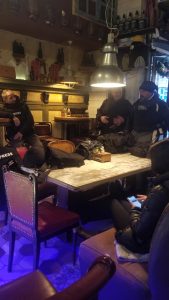
Photo: Reporters inside Kyiv’s Buena Vista Social Bar
There’s always a bar. In Kyiv, in 2022, it’s the Buena Vista Social bar, bang next to a Ukrainian police checkpoint which is both funny ha-ha and funny peculiar because there is a nationwide ban on the sale of alcohol. Sssh. It’s a joyful shebeen, Cuban-themed, run by Maks, and you never quite know what’s available to drink and who’s going to be there. All the women have a past; all the men have no future. You get the vibe.
Early on in the war, a fellow regular was a big bloke with a thick moustache and a mane of bubbly, curly hair, often seen with his fixer, a Ukrainian freelancer. I never spoke to him but I clocked him as someone who had presence, who was an interesting character, who I had probably seen in Sarajevo or somewhere like that. He was Pierre “Zak” Zakrzewski, she Sasha Kuvshynova, and they were both killed on 14 March 2022 when their vehicle came under fire in Bucha – pronounced Butcher – to the northwest of Kyiv. British journalist Ben Hall was wounded in the same attack. They were working for Fox News, something Zak, 55, who had been brought up in Ireland, had mixed feelings about. But he knew the risks of war too well and made a decision that working for a big corporate was better risk-management than being freelance. His co-workers at Fox loved him, giving him an award as “Unsung Hero” after he helped get Afghan freelancers out of Kabul.
Sasha was 24, bold and fiercely smart. After her death, her dad said that she learnt to read at the age of three and picked up English from reading restaurant menus while on family holidays. She was a fanatical photographer with five stills cameras, had founded a music festival for up-and-coming jazz musicians, worked as a DJ and wrote poetry. She wanted to make movies.
If you don’t like free expression in a democracy, you blow up the TV tower. The Kremlin’s first journalist victim was Yevhenii Sakun, 49, a camera operator for Ukraine’s LIVE station, on 1 March. The Russian army sent in four missiles in the evening, killing a worker in the TV tower complex and four civilians. The next morning I saw the people from the morgue take away the bodies of a middle-aged man and a mother and her child with my own eyes.
The most dangerous area of Kyiv is the northwest suburbs, where the Russian army’s offensive, driving down through Chernobyl, has come closest to the capital. Reporters seeking human stories, of refugees fleeing with their dogs on a lead or their cat in a box, went repeatedly to Irpin. Fearing further Russian advance, the Ukrainian army flooded the river plains near the suburb and blew up the most southerly bridge, leaving people to pick their way across the skeleton remains. Once beyond that crossing, there is a second bridge. That’s where US film maker Brent Renaud, 50, originally from Little Rock and formerly of the New York Times, found himself, filming refugees running for their lives. Brent knew what he was doing, having filmed and reported man’s cruelty to man in Iraq, Afghanistan, Libya: all the nice places.
At Irpin, at the second bridge, the Russian army shot him in the neck and he died of his wounds.
Oksana Baulina was one of those intensely brave Russians who were on Team Navalny before their champion was arrested on fake charges and the organisation broken up. Oksana, 43, was declared a “terrorist” by the Kremlin and had to flee Russia. She set up as a reporter and film maker in Poland and reported on the war. When Russian artillery smashed into a shopping centre in Podil, in the northwest of the city, she was killed.
To be honest with you I have done my best to avoid writing this piece for days now because it can only fill one with gloom to think of these brave truth-tellers sent early to their graves by the mobster in the Kremlin. But my pals and I in the Buena Vista are buoyed up the thought that we are in Ukraine exactly because Vladimir Putin does not want us to be here. And on that point, Mr Putin, do fuck off.
And the rum is good.
There is, also, the line from Tom Stoppard’s great play, Night And Day, which I quoted on Twitter while hurrying back from the bar just before – well, actually, just after curfew – had fallen. This, from memory, is how it goes, how the lover of the dead young journalist, played by Diana Rigg, killed on the frontline denounces the false romance of journalism, “it’s not worth the heart-break beauty queen or the crossword and it’s definitely not worth the leader.”
And the old hack, played by John Thaw, replies: “Yes, you’re right. But also the other thing. People do awful things to each other. But it’s worse in places where everybody is kept in the dark. Information is light. Information, in itself, about anything, is light.”
RIP Zak, Sasha, Yevhenii, Brent and Oksana.
24 Mar 2022 | News, Russia, Ukraine
A Ukrainian journalist detained by Russia’s FSB while reporting on the invasion of the country has been forced to record a video saying that she had not been held captive and that her captors had actually saved her life before being released.
Victoria Roshchina, who works for the hromadske news channel, was released on 21 March, nine days after she went missing in the occupied city of Berdyansk en route to Mariupol. Four days after she went incommunicado, hromadske learned that she had been detained by Russia’s FSB security forces.
She has now returned to Zaporizhia, an area controlled by the Ukrainian government, where she will rejoin her worried family.
After her release, pro-Russian media and Telegram-channels shared a video in which Roshchina denied she had been held in captivity and that the officers had saved her life.
Her employer said that the video was filmed under coercion of the Russian occupiers and that the reporter would tell the true story in due course.
We reported about Roshchina’s reports from the front line and how she had been forced to hide from Russian tanks.
Although Roschina has been freed, the whereabouts of other journalists reporting from the front line is uncertain.
Renowned Ukrainian photojournalist and documentary filmmaker Maks Levin disappeared on 13 March in the Vishgorod district, near Kyiv. There had been intensive fighting in the area and it is assumed he has been injured or captured by Russian troops.
Levin has worked for the BBC, Reuters, the Wall Street Journal and new website LB.ua among others.
Index on Censorship calls for the immediate and unconditional release of all journalists held by the Russian forces and for all parties to ensure the safety of media reporting on the war.
