19 July: What surveillance means to YOU
Join us 19 July for a live Google hangout with Index on Censorship as Trevor Timm of the Electronic Frontier Foundation and Rebecca Mckinnon of Gloval Voices discuss what mass surveillance means to all of us as individuals. Hosted by Padraig Reidy of Index, the hour-long event will delve in the issues around government surveillance of innocent civilians.
(More information)
INDIA Impediment of Speech and Imbalance of Justice
In March 2013 Gujarat Chief Minister Narendra Modi was invited by some pro-business, pro-industry students at an American university to give a keynote address via video conference.
(Dissident Voices)
RWANDA Rwandans Consider Their Media Free – Survey
A Rwanda Media Barometer (RMB) survey carried out by Rwanda Governance Board (RGB) and consultants from Transparency International Rwanda has shown that media freedom in the country, in the perceptions of its population, was at its highest.
(AllAfrica)
TURKEY Turkish journalists join up against censorship and violence
Protests against the Turkish government continue, with journalists and artists now joining the fold. They’re speaking out against the violence against journalists and censorship of the press that takes place in Turkey.
(DW)
UNITED KINGDOM UK Ideological Travel Ban Helps Hate
So, this sounds like as good a time as ever to make a counterintuitive argument. Pamela Geller and Robert Spencer—two notable critics of “creeping sharia” and the “Islamization” of America—were invited to speak at an English Defense League (EDL) rally in Woolwich, the city where a British soldier was brutally murdered in May in what has been described by authorities as a terrorist attack. The EDL is a far-right nativist street protest group, formed out of the soccer “hooligan” subculture in Britain. It is frequently identified as a “hate group.”
(ACLU)
UNITED STATES Should we have a list of words for self-censorship?
The other day, a young child scolded her father for using the “S” word. She further explained her teacher had told her class not to call people the “S” word, From this information the word might have been “stupid” or “silly,” adjectives important today.
(Delaware Online)
Whatever happens to the NSA whistleblower, the repercussions of his actions will endure
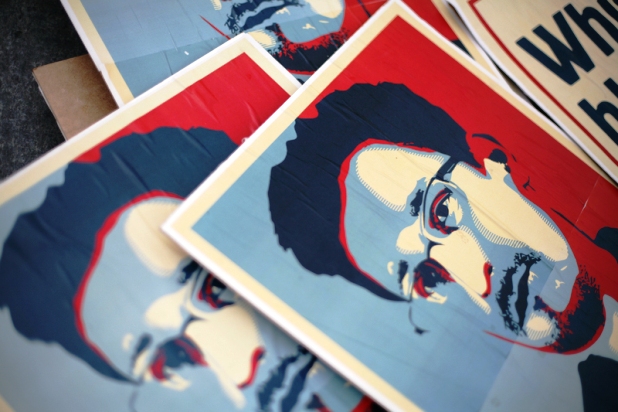
Edward Snowden placards at a protest in Berlin (David von Blohn/Demotix)
This is a guest post by Daniel Keane
Edward Snowden’s leaks have exposed an ideological chasm between the partisans of free information and liberty and the guardians of state security. They have also asked demanding questions of the public at large: when does intelligence gathering become an unwarranted intrusion into private lives? Is the first responsibility of an intelligence agent to the country he serves or to a — self defined — greater good? Can we have a free society without people who do dirty work like spying on our emails?
Public reaction in the polls remains mixed, with a Huffington Post/YouGov’s poll this week finding that 38 per cent of Americans believe Snowden did the wrong thing, while 33 per cent believing the contrary. However a survey released by Quinnipiac showed that 55 per cent of Americans believed Snowden was a whistle blower rather than a traitor.
Snowden also denied in interviews published that he gave any information to the Russian or Chinese governments while in transit there. Allegations of leaking information to these authorities arose from the New York Times, which claimed China had ‘drained the contents of Snowden’s laptops’. Snowden claimed he “never gave any information to either government.”
Snowden also declared in an interview given before he left his home in Hawaii with German newspaper ‘Der Spiegel’ that the NSA is “in bed together with the Germans the same as with most other Western countries” and that the USA and Israel co-wrote Stuxnet, the malicious computer virus utilised against an Iranian nuclear site.
These revelations made by Snowden come as a shock to the public consciousness and this is certainly reflected in the activities of pressure groups in the US and the UK. The Electronic Privacy Information Center, based in Washington DC, has filed an emergency petition to the US Supreme Court in order to halt the NSA’s logging of the nation’s telephone records.
Meanwhile in the UK, human rights group Liberty has filed a claim to the Investigatory Powers Tribunal against the British Intelligence Services for their role in the PRISM or Tempora surveillance programmes. It remains to be seen, however, whether both of these attempts to halt or impair mass surveillance will be successful: the US Supreme Court is unlikely to do away with a programme seen as vital to domestic security, while the IPT makes its decisions in private leaving any reform in Britain largely improbable.
If he reaches asylum, possibly in Nicaragua, Venezuela or Bolivia, Snowden could continue to leak crucial information regarding the NSA. The Obama administration finds itself in a crisis should he evade extradition: the inevitable slew of secrets weakening their international credentials.
Furthermore as Snowden reveals more regarding the collaboration of the US with Western European states, countries like Britain and France face a public dilemma as we learn more about the undermining of our personal liberties. These governments risk being whisked into undesirable public debate regarding the legitimacy of organisations such as GCHQ.
Even if Snowden returned to America to face trial the issue would not disappear. People will want to hear what he will say in court.
Many governments probably wish Edward Snowden was condemned to perpetual Limbo in Sheremetyevo Airport. But whatever happens, the repercussions of his actions are sure to endure for a long time as the debate between liberty and security rages ever on.
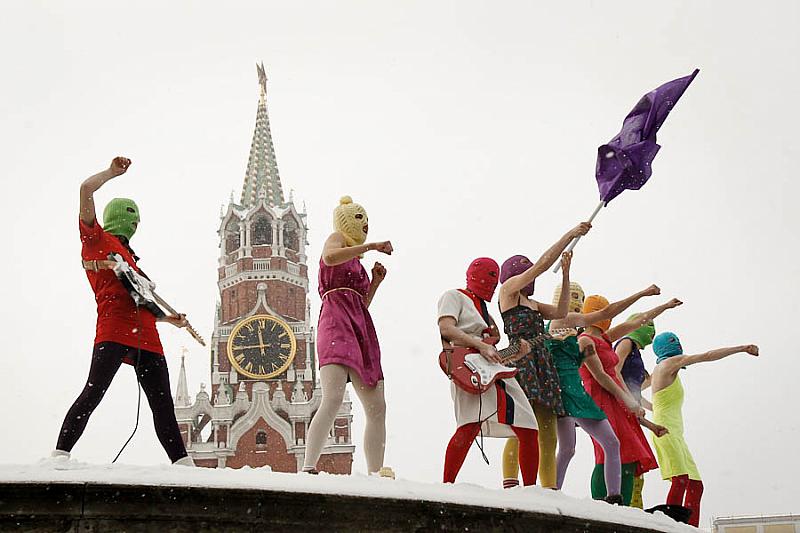
A Russian Orthodox has launched a video game in which players attack members of punk feminist group Pussy Riot with a crucifix
According to Reuters, “Players use a mouse to move a cross over the screen and zap colorful cartoon representations of the women from Pussy Riot – each with a balaclava like those worn by the band members in their protest — as they try to enter a white church.”
Pussy Riot have declined to comment on the game.
Two of the punk group, Maria Alyokhina and Nadezhda Tolokonnikova, are serving sentences in a penal colony after they staged a protest against Vladimir Putin at Moscow’s Christ The Saviour Cathedral in February 2012. A third, Yekaterina Samutsevich, was released on appeal.
Index on Censorship met two members of the eight-woman strong collective in London last month. You can read the interview here.
BELARUS Praying in Homeless Shelter a Crime
A young Catholic layman, who turned his home into a shelter for homeless people with a prayer room, is being accused of leading an unregistered religious organization. Aleksei Shchedrov, who says he has helped about 100 local people since December 2011, is being investigated on criminal charges under Article 193-1. As a result, he now faces a maximum possible sentence of two years’ imprisonment.
(Canadian Free Press)
Censoring Canadian science
Last summer, a rally of over 2,000 researchers, scientists, and students gathered on Parliament Hill to protest a federal trend of scientific censorship that began when the Conservative party took control of the Federal government in 2006. For the protesters, the government had crossed the line with numerous budget cuts to environmental research programs, extensive job cuts to Agriculture and Agri-Food Canada and the Department of Fisheries and Oceans, and numerous restrictions on investigators’ communications with the media.
(McGill Daily)
GHANA Journalist freed in Ghana amid free speech concerns
A Ghanaian newspaper editor was released Thursday after serving a controversial 10-day jail term ordered by the west African nation’s supreme court for criticising the judges’ handling of a dispute over last year’s presidential election.
(AFP)
GUINEA Radio Station Director Charged for Libel
Managing Director of Planete FM, Mandian Sidibe, has been charged with libel and placed under judicial review by a Magistrates’ Court in Conakry, the capital, for comments he made during a radio programme.
(All Africa)
INDONESIA Indonesia Affirms Restrictions to Freedom of Expression
On July 10 and 11, 2013 the UN Human Rights Committee reviewed the implementation of the International Covenant on Civil and Political Rights, one of the most important human rights treaties Indonesia has ratified and has the obligation to implement to ensure protection of these rights in Indonesia.
(Scoop)
NEW ZEALAND Suicide reporting rules under review
The Government has announced that New Zealand’s 25-year-old censorship of suicide reporting is to be reviewed by the Law Commission. JAMES HOLLINGS talks to two leading experts who think the restrictions should go.
(The Press)
RUSSIA New Russian video game takes aim at punk band riot
A Russian Orthodox youth group unveiled a video game on Thursday that gives players a chance to “kill” members of the punk band Pussy Riot, whose profanity-laden protest in a Moscow cathedral last year angered the church and offended some believers.
(Reuters)
TRINIDAD AND TOBAGO Defending press freedom
Although freedom of the press is enshrined in our Constitution, it is a right which nonetheless requires eternal vigilance. This is because powerful persons and groups are continually trying to erode this right, to the detriment of the average citizen.
(Trinidad Express)
TUNISIA Tunisia’s version of Tamarod
A Tunisian version of the Egyptian Tamarod movement has been collecting signatures against the country’s government and institutions, writes Lasaad Ben Ahmad in Tunis
(Al-Ahram)
TURKEY Scientific Conflict in Turkey
The Turkish government’s refusal to fund a summer school course on evolution has brought into sharp focus the divisions between political Islam and secular society in Turkey.
(BBC)
UNITED STATES Porn Producers Say Unprotected Sex Is Free Speech Right
Pornographic movie makers told a judge that a Los Angeles County voter-approved measure requiring adult-film actors to wear condoms violates their constitutional right to free speech.
(Bloomberg)
Removing the Kahane Google App Isn’t Censorship
In a recent Open Zion column, Zack Parker criticized Google’s decision to take down a Google App containing Kahane quotes, to which the radical settler extremist Baruch Marzel had linked, as censorship. While the objective of preserving free speech is pure, the criticism of the takedown as censorship misunderstands the nature of free speech and the implementation of the criticism would be a severe blow to counter-radicalization efforts.
(The Daily Beast)
My fight for free speech at LSU
I decided in seventh grade that one day I was going to attend Louisiana State University’s law school, and anyone who knows me can tell you that I’ve bled purple and gold ever since. So when I finally got there last fall, I never expected that in a few short months I would be involved in a lawsuit against the school.
(Live Action News)