11 Jun 2013 | Digital Freedom
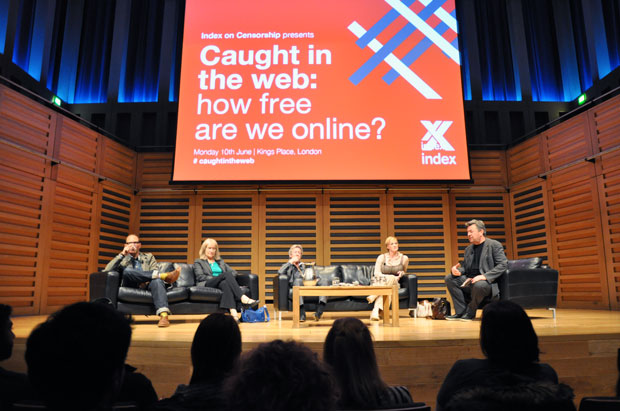
(Photo: Andrei Aliaksandru/Index on Censorship)
Against a backdrop of ongoing revelations around the US Prism programme, mass surveillance dominated the discussion at the Index on Censorship event Caught in the web: How free are we online? Brian Pellot reports
Index on Censorship brought together a panel of experts at King’s Place in London last night. Investigative journalist Heather Brooke, author and digital rights activist Cory Doctorow, media lawyer Paul Tweed, Index CEO Kirsty Hughes and chair David Aaronovitch discussed the threats to freedom of expression online.
Brooke, warned that as we increase our online expression, we “create a handy one-stop shop for snooping officials”. She also cautioned that concentrated power in secretive states is a far greater danger to humanity than unbridled free speech.
(Brooke, author of The Revolution will be Digitised, kindly joined the panel at the last minute, replacing Guardian data editor James Ball, who is currently in the US covering the developing Prism scandal)
Doctorow, co-founder of the hugely influential Boing Boing blog, said while he was pessimistic about the “Orwellian control” that digital technologies provide governments, he remains optimistic that such technologies can enable us to cooperate, coordinate and collaborate in unprecedented ways to seek positive social change.
Doctorow questioned the efficacy of overcollection of data, characterised by PRISM, saying that as an intelligence technique is “like pointing at a pixel with a hotdog”.
Belfast-based libel lawyer Tweed said that anonymity online enables speech that constitutes dangerous harassment. He argued that freedom of expression must be protected, but that controls are needed to prevent the undermining of reputation and privacy. He recounted examples from his practice of clients that are harassed and attacked on the web with very little recourse against “internet goliaths”.
“There has to be a button to protect the man on the street”, Tweed said.
Hughes discussed the emerging geopolitics of digital freedom, noting that while EU countries and the US are lobbying for the preservation of a multistakeholder model of internet governance, Russia, China and others are pushing for top-down government control. Some of the greatest threats to online freedom of expression she discussed are censorship in the form of firewalls and filters, laws criminalising offence, the privatisation of censorship and, of course, surveillance.
Aaronovitch fielded questions from audience members who were focused on government surveillance and censorship.
Doctorow claimed that web filters are a blunt and inefficient instrument, giving the example of Denmark’s secret child abuse filters, which leaks showed had blocked a huge amount of material that was not related to sexual imagery of children.
“Everyone knows web filters don’t work, but once used, removing them would be political suicide,” he said.
Brooke acknowledged that current laws are not keeping pace with technology but does not think new laws are the solution. More important is that “our fundamental values be translated into the digital age”, she said.
“Nothing to hide, nothing to fear is an arrogant statement”, Brooke commented on UK foreign secretary William Hague’s response to questions on PRISM on Sunday.
Hughes elaborated on a statement she made earlier in the day essentially saying that mass surveillance is an invasion of our right to privacy and a direct chill on free speech.
Index on Censorship has released a joint statement with English PEN, Privacy International and Open Rights Group condemning the use of national security to justify mass surveillance.
Let us know your thoughts on the Prism scandal by commenting below
Related:
• Pod Academy coverage of this event
11 Jun 2013 | In the News
CANADA
Rob Ford wins partial costs in wake of failed libel suit
Boardwalk Pub restaurateur George Foulidis must pay mayor and Bruce Baker $137,000, judge ruled Monday. (Toronto Star)
CHINA
Beyond the Great Firewall: How and What China Censors
China’s lack of transparency has long posed a daunting challenge to outside observers trying to understand what the government’s interests, goals, and intentions are. Gary King, a Professor in Government at Harvard University, has provided telling new insights into these questions with his research on the government’s censorship of social media websites. (The Diplomat)
EGYPT
Maspero in crisis: report
The AFTE also claimed former head of the state-run TV sector Essam El-Amir resigned last December because of intervention in the coverage of the presidential palace clashes. (Daily News Egypt)
HONG KONG
Yes, Free Speech Is Big in Hong Kong—Because They Must Constantly Defend It
Hong Kong has a strong tradition of free speech.” That’s how Edward Snowden, the 29-year-old leaker who slammed National Security Agency surveillance as an “existential threat to democracy,” described his decision to flee to China. (New Republic)
RUSSIA
Accusations of censorship as more exhibitions are shut down at Perm festival
The White Nights festival in Perm has come under pressure after four of its exhibitions have been closed, seemingly at the request of unhappy local politicians. In response, Marat Guelman, one of the festival’s organisers has accused critics of political game-playing. (Calvert Journal)
UNITED STATES
Should the Lubbock AJ host Blogs?: Freedom of Speech Issues
In the spring of 2012 I was invited to begin a blog hosted on the Lubbock AJ on-line site. Having been drawn into the arena of public debate during the effort to close the city’s Health Department I felt that such an opportunity to encourage civic involvement was a good idea.
(Lubbock Avalanche-Journal)
‘Free Speech’ Doesn’t Include Showing Dead Fetus Posters to Kids
The Supreme Court refused to hear the appeal of an anti-abortion protestor who claimed his free speech was violated by the state of Colorado. By declining to hear the case, the Court allowed a lower court ruling barring certain types of anti-abortion protests in public areas to stand, which, on its surface, might sound like a good thing. But the truth’s a little messier.
(Jezebel)
As libel trial losers battle $1M legal bill, FBI probes claimed mid-trial DUI set-up of their lawyer
The trial in a defamation case between two radio shock jocks in Florida has been over for months. But there’s no end in sight to continuing issues involving the law firms for both sides, the Tampa Bay Times reports.
(ABA Journal)
A twist in the tale of the Christian valedictorian
You’ve probably heard about the South Carolina high school valedictorian who tore up his prepared speech at graduation ceremonies and instead recited the Lord’s Prayer, to cheers and applause. But there is a twist in the tale of Roy Costner IV, who has become a poster boy for Christian conservatives.
(Los Angeles Times)
VIETNAM
Vietnam bans action movie despite removal of violent scenes
Vietnam latest action movie about gang fights in Ho Chi Minh City’s Chinatown has been officially banned after the censors disapproved of the new, censored version. (Thanh Nien)
4 Jun 2013 | In the News
INDEX REPORT
Taking the offensive – defending artistic freedom of expression in the UK
Report Contents: Summary | Introduction | What is artistic freedom of expression? | What are the limits to freedom of expression? | Institutional self-censorship | Reinforcing support for artistic freedom of expression | Conclusion | Appendix I: Audience Feedback and Statistics | Appendix II: Conference Programme | Appendix III: Cases of Censored Artwork | Artist Videos | Full report in PDF
INDEX EVENTS
10 June: Caught in the web: how free are we online?
The internet: free open space, wild wild west, or totalitarian state? However you view the web, in today’s world it is bringing both opportunities and threats for free expression.
22 June: Turkey vs the UK: what’s the score on free expression?
The Turkish Writers Football Club is coming to London to play the England Writers Team and the pressure is on. But it’s not just about sport. Index on Censorship is grabbing the chance to bring both sides together to debate the state of free expression in both countries.
GLOBAL
UN report calls for freedom of expression in post-2015 development
Calling for a transformation in the approach to global development that includes a larger role for freedom of expression, the United Nations’ High Level Panel of Eminent Persons released its Post-2015 Development Agenda report, Milana Knezevic writes. (Index on Censorship)
BAHRAIN
Bahrain court jails three protesters
A Bahrain court on Monday jailed three protesters for up to 15 years on charges including attempting to kill a policeman and taking part in anti-government demonstrations, a lawyer said. (AhramOnline)
CANADA
CJFE disturbed by arrest of Toronto Star reporter
Canadian Journalists for Free Expression (CJFE) is concerned about the arrest and treatment of Toronto Star journalist Alex Consiglio, charged with trespassing for taking photos on June 2 of an injured GO Transit officer at Union Station in Toronto. (Press Release)
CHINA
7 things you can’t talk about in China
They’re like George Carlin’s seven dirty words, except it’s not the FCC who’s banning them, but the Communist Party of China. (Global Post)
JORDAN
Jordan blocks over 200 ‘unlicensed’ websites
The Jordanian government began blocking over 200 websites on Sunday for failing to obtain licenses under a strict set of new guidelines, Ruth Michaelson reports. (Index on Censorship)
MALAYSIA
‘Tanda Putera’: Let the public decide, say legal activists
Show the movie Tanda Putera and let the public decide – as to do otherwise would amount to stifling freedom of speech, say legal activists. (The Sun)
MIDDLE EAST
Freedom of Expression: The Second Arab Battle
Syria and the uprisings in Bahrain and other countries represent one of the two important battles underway in the Arab world, whose outcomes will largely determine the future shape of Arab political systems. The second battle is not about who rules in a country, but rather about the right of a citizen to express him or herself. (Cairo Review of Global Affairs)
RUSSIA
Shutting down Russia’s LGBT community
Elena Vlasenko reports on the continuing official campaign against lesbians and gays. (Index on Censorship)
SINGAPORE
Singapore’s new website licensing seen as censorship
The Government in Singapore has introduced new rules meaning popular news websites have to apply for a licence if they want to keep operating. (ABC/Radio Australia)
TAIWAN
Taiwan backs off plan to block sites violating copyright laws
Taiwan’s authorities in charge of intellectual property protection have decided to give up a plan to block overseas Internet services that violate copyright laws amid opposition to the plan from free-speech advocates.
(Focus Taiwan)
TUNISIA
In Tunisia, a free speech tussle could land a professor in jail
Last year a Tunisian academic complained that a member of the constitutional drafting committee had watered down free speech protections in the document. (Christian Science Monitor)
TURKEY
Turkey losing its way on free speech
The protests erupting across Turkey have shown a wider audience – domestic and international – the increasingly problematic nature of Turkish democracy, and its growing authoritarian tendencies. Index on Censorship CEO Kirsty Hughes writes (Index on Censorship)
“There is now a menace called Twitter”
Against a backdrop of unrest that started in an Istanbul park last week and has spread throughout the country, Ece Temelkuran asks why the Turkish government is afraid of the internet (Index on Censorship)
Turkey protests: Union to start two-day strike
One of Turkey’s big trade union groups is staging a two-day strike to support continuing anti-government protests in a number of cities. (BBC News)
UKRAINE
Ukraine holds first gay pride parade amidst intolerance and suppression
Ukraine successfully held the country’s first ever gay pride parade, but the level of intimidation faced by the LGBT community is growing. Andrew Connelly reports from Kiev (Index on Censorship)
UNITED STATES
AFDI to Protest Justice Department’s Attempt to Criminalize Criticism of Islam
The human rights organization American Freedom Defense Initiative (AFDI) is holding a demonstration for free speech in Tennessee, at the site of a Justice Department initiative advising the application of civil rights laws to shut down criticism of Islam. (Press Release)
Christian Group Believes Atheists Have Right to Post Monument at Fla. Courthouse
A member of a Christian organization that posted a Decalogue outside a Florida courthouse said an atheist group posting a monument in the same location has the right to do so. (The Christian Post)
Terminated employee’s free speech case appealed to U.S. Supreme Court
An attorney monitoring a First Amendment case from Ohio being appealed to the U.S. Supreme Court says it could set a precedent for religious freedom in the United States.
(One News Now)
The United States vs. Freedom of Speech
The criminalization of journalists in the United States is not a new occurrence, but the overt and veiled threats to reporters and their sources is becoming less of a rarity. (Huffington Post)
Pitching a Tent Is Free Speech, Says ACLU
The American Civil Liberties Union of Ohio has filed a lawsuit against the City of Columbus on behalf of the local Occupy Wall Street group. The complaint, filed on May 30 in U.S. District Court, claimed that placing a tent or other structure that “is not easily movable” in a public space qualifies as free speech protected by the First Amendment and the state constitution.
(National Review)
U.S. Attorney says Muslim tolerance event will discuss free speech rights
An event federal prosecutors and the FBI are planning Tuesday to discuss the enforcement of civil rights laws to protect Muslims will also focus on what kinds of speech are guaranteed by the First Amendment, U.S. Attorney Bill Killian said in a statement Monday.
(Politico)
The Distasteful Side of Social Media Puts Advertisers on Their Guard
As social media sites pursue advertising in a bid for new revenue, they are finding that they must simultaneously create a safe space for the advertisers they attract.
(The New York Times)
3 Jun 2013 | Europe and Central Asia
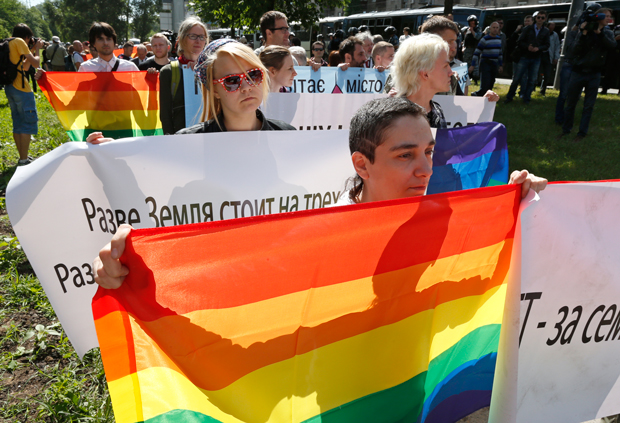
Despite intolerance and government suppression, LGBT supporters held the first gay pride march in the Ukraine. (Photos: Ivan Chernichkin for Index on Censorship)
Despite an initial ban by the authorities, Ukraine successfully held the country’s first ever gay pride parade but the level of intimidation faced by the lesbian, gay, bisexual and transgender community and proposed legislation outlawing ‘homosexual propaganda’ are causing concern for many. Andrew Connelly reports from Kiev
Last week, around 50 LGBT activists gathered on the outskirts of the Ukrainian capital Kiev to conduct the first ever equality march in the post-Soviet nation’s history. The event took place amidst an unprecedented amount of security with several hundred riot police and Special Forces drafted in to protect participants from thousands of protesters from the Orthodox Church, Ukrainian and Russian nationalists and football hooligans.
The parade was originally planned to take place in the centre of town, beginning at Independence Square, the scene of Ukraine’s 2004 Orange Revolution which (temporarily) overthrew pro-Russian President Victor Yanukovich. However, the Kiev district city court banned the event citing the clash with Kiev Day, a series of cultural events held across the city. In reality it would seem that, whilst this was a consideration, the amount of anti-LGBT demonstrators that also submitted applications to hold parallel marches may have more profoundly influenced the authorities’ decision. Still, the move was enough to prompt organiser Stas Mischenko to accuse them of “depriving our right to freedom of assembly” and an alternative location had to be hastily arranged.
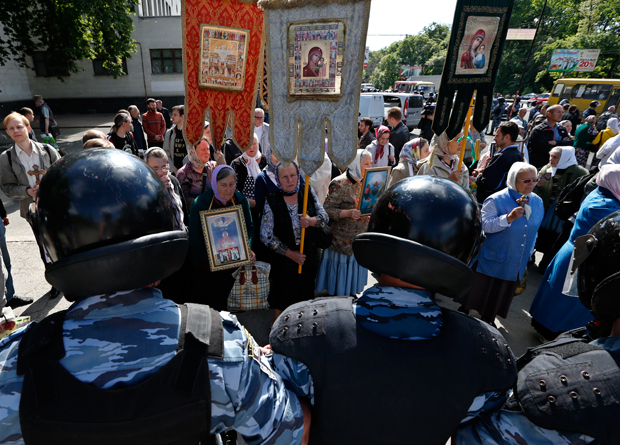
Counter demonstrators waved religious banners.
Despite the new site being kept secret, hundreds of crucifix-wielding protesters descended on Victory Avenue, waving banners with expressions such as ‘Kiev is not Sodom’ and ‘Homosexuality = Paedophilia’. LGBT activists were surrounded by lines of police yet the march was still intermittently disrupted when extremists managed to infiltrate the area, attempted to tear down banners and screamed ‘gays out of Ukraine’ and other epithets as they were dragged away into police vans. One firework was thrown that exploded in the middle of the crowd but nobody was injured. In total thirteen arrests were made.
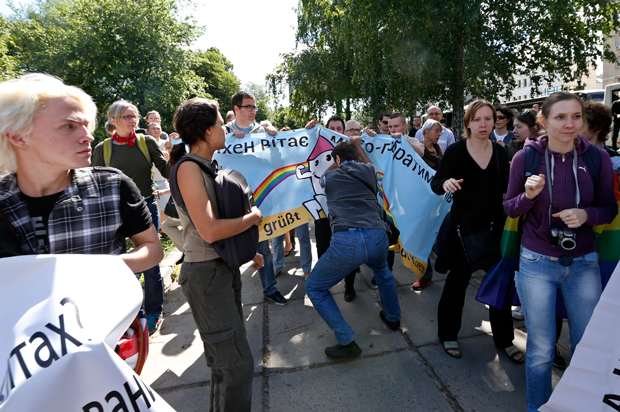
Opponents of the gay pride march attempted to disrupt by tearing down banners.
Nevertheless, the occasion was a marked improvement from last year’s attempt to organise a parade which was cancelled when police withdrew their guarantee of security an hour before the start due to threats from far-right hooligans planning to disrupt the event. Organiser Syvatoslav Sheremet was pepper sprayed then viciously attacked by thugs resulting in his hospitalisation.
Despite being the first post-Soviet country to legalise homosexuality, it remains a strongly taboo subject in Ukrainian society. There are almost no publicly gay figures and legislation does not recognise discrimination based on sexual orientation or gender identity. Ukrainian civil society groups are trying to press for anti-discrimination legislation at the same time as resisting two draft laws that would marginalise and severely infringe the rights of the LGBT community in addition to having a chilling effect of the freedom of the press.
Law 0945 concerns “the protection of children’s right to a safe information space” and proposes a ban on the production and publication of content which “promotes” and propagates” homosexuality that extends to the use of TV, radio, printing of publications, creative writings, cinematography or video materials.
Related: Shutting down Russia’s LGBT community
Elena Vlasenko reports on the continuing official campaign against lesbians and gays.
If this wasn’t authoritarian enough, Law 1155 is even more detailed, far reaching and restrictive in nature, calling for the “prohibition of propaganda of same-sex relationships aimed at children” defining homosexual propaganda as “intentional activity which aims to and is expressed in dissemination of any positive information about same-sex relations which could negatively affect…the development of the child including forming a misconception of traditional and non-traditional marriage relations being equal, and in the future impact his or her choice of sexual orientation.” This extends to a ban on media disseminating information from others that portrays same-sex relations in a positive light. Olena Shevchenko, head of the Kiev-based LGBT NGO Insight, outlines what this means in real terms:
“If you encourage a group of people to read a book of Oscar Wilde, it will be propaganda. If I give an interview in the mass media, openly say that I am a lesbian and that I think that it is normal, just like heterosexuality, then that will also be propaganda.”
Svitlana Tuchynska is a journalist at the Kyiv Post:
“If this law passes it will introduce media censorship. You will not be able to cover any activities of the LGBT community at all, any problems that they face or any opinions they have on their sexuality.”
The list of criteria is extensive, covering demonstrations, mass gatherings, workshops and classes amongst other public meetings. Violations of the law may result in fines reaching up to €2,400 or jail sentences of up to six years
“This legislation will affect us because we are spreading information about homosexuality amongst LGBT and the general population, that’s part of our job and this will definitely be considered propaganda”, Kiev Pride organiser and Vice President of Gay Alliance Ukraine Stas Mischenko explained.
“Such laws are very dangerous because I work in HIV prevention and people who are living under these harsh conditions don’t take care of themselves. They hear from other people that they are second class and they have no future, so they have risky sexual behaviour. If you are not able to explain to them that they are normal and good people, they will have more risky behaviour and the level of HIV will double or triple”, Mischenko said.
Ukraine currently has the highest HIV infection rate in Europe.
Hostile attitudes towards sexual minorities remains deeply rooted in Ukrainian society and these prejudices are now legitimised in parliament. Following the 2010 elections, the ultranationalist Svoboda (Freedom) party won 10% of the popular vote and have since stirred up homophobic, anti-Semitic and xenophobic sentiment in the country. In December 2012, an LGBT protest was disrupted by activists from the party who tear gassed and assaulted demonstrators, one of whom received a broken nose. On the official Svoboda website, a spokesman boasted of “breaking up the Sabbath of perverts”. Hate crimes are not legally recognised as such and are often referred to as ‘hooliganism’ with perpetrators rarely brought to justice.
The government in Kiev is currently deliberating whether to choose closer integration with Europe or to strengthen ties with Russia, but for Ukraine’s LGBT community the proposed propaganda legislation risks dragging the country to a much darker place entirely.
