17 Jan 2013 | Russia
A Russian court yesterday dismissed the appeal of Maria Alekhina, one of the three members of feminist punk group Pussy Riot. Alekhina, 24, appealed to the local court asking to defer the remaining 13 months of her two year sentence until her six-year-old son, Filipp, turns 14.

Judge Galina Yefremova said that the initial ruling had taken Alekhina’s young son into account, and added that her “felony” is the reason for her son’s suffering, rather than separation from his mother. Alekhina is currently serving her sentence labouring as a seamstress in a prison colony in the Ural mountain city of Berezniki.
Alekhina has six penalties against her in the colony, but she has rejected them, as two of the offences against her were for failing to wake up at 5:30 AM. Alekhina said that she did not hear the call of the reveille, signaling the start of a day working in the colony. Staff from the prison camp testified against Alekhina during yesterday’s hearing. She was also penalised after she attempted to provide her lawyer with documents for the European Court of Human Rights in person rather than by post.
The activist was sentenced to two years in prison along with two other members Pussy Riot, Nadezhda Tolonnikova and Ekaterina Samutsevich on charges of hooliganism in August 2012
The trio performed a “punk prayer” against Vladimir Putin on 21 February, and charges were brought against them only days after, along with a call from the Russian Orthodox Church for more stringent punishment for blasphemy.
While Samutsevich was released on bail on 10 October, Tolokonnikova and Alekhina were sent to serve their two year sentences in prison colonies. Tolokonnikova is also a mother to a young child and has also appealed for deferment. However, a date has not yet been set for a hearing.
The charges brought against the trio drew criticism and outrage across the globe, with leading human rights organisations condemning the case for being politically motivated.
Alekhina plans to appeal the court’s ruling, but Russian courts rarely change verdicts in politically motivated cases. While unwavering in appealing her case, Alekhina refuses to plead guilty, and said yesterday “no one will ever force me into admitting guilt — not for the sake of deferment or conditional early discharge.”
15 Jan 2013 | Uncategorized
It was a few minutes before kick off last Sunday when when the banners went up. To be fair they were more painted bed sheets than banners. One read “£62 and we’re still here.” Another said “£62!! Where will it stop?” The tone of the first was defiant, the second quietly despairing. Either way, as protests go, they were well mannered.
There had been much debate about the price of away tickets for Manchester City fans at Arsenal. Premiership clubs offer a bizarre pricing hierarchy whereby fans of the most successful clubs (invariably the richest clubs) are charged most for tickets. This might have a degree of fairness if, say, Manchester City’s owner Sheikh Mansour paid for the fans’ tickets, but he doesn’t. The reality is that a Manchester City fan is just as likely to be struggling financially as a Reading or QPR fan.
Even by premiership standards £62 for an away ticket is ludicrously high. Some fans boycotted the match, and 900 of the 3,000-strong allocation were reportedly returned to Arsenal. Others (me included) decided to go, enjoy the match (City’s first league victory at Arsenal in 37 years as it happens) and sing their heart out about the injustice of it all.
City supporter Richard Taylor, an estate agent from Stalybridge, had painted the banner the previous night in Manchester. He says he was impressed with the result. “It’s a lot neater than I thought it would be. Ticket prices are a big problem, especially for away supporters. I thought the banner might get the issue a bit of publicity.”

The banner that was banned from the Emirates at Richard Taylor’s home before the match –
photograph Richard Taylor
So 10 minutes before kick-off, he unfurled his handiwork.
“We’d only had it up a few seconds when a steward came over. He said we’ve been instructed by our bosses to take it away. Actually, he said ‘I agree with what you are saying’, but I’ve been told I’ve got to take it away’. I told him he had no right to take it off me, that it was peaceful protest, and there’s nothing offensive about the banner. He said ‘Don’t make my work harder for me because then I’ll have to get the police involved’.”
Reinforcements soon arrived in the form of the Metropolitan police. A couple of officers hurdled empty chairs Sweeney-style to reach the refuseniks. “They came over quite aggressive actually, jumping over the seats to get to us. Two came over to me and two stood at the end of the aisle. They demanded Taylor hand over the banner or be arrested. “Well I wasn’t going to walk out and miss the match. I’d paid £62 for it, so I gave the banner to them. We tried to argue about it, but it wasn’t worth getting kicked out when we’d paid £62.”
Did they say what they would arrest him for? “No.”
By now the whole away end were singing “£62 and we’re not here” [an adaptation of an old Manchester City chant].
This is by no means the first time peaceful protest and freedom of expression have been issues at football matches. In 2010, Manchester United fans said that they had been over-policed after unfurling banners protesting against the club-owners, the Glazer family. In 2008 anti-censorship campaigners (including Index on Censorship) complained after there was talk of banning Glasgow Rangers supporters from taunting Celtic fans with a song about the Irish famine (“’From Ireland they came, brought us nothing but trouble and shame’.) In 1998, Swindon Town chairman Rikki Hunt threeatened to ban fans for life after they had staged a sit-down protest following a 4-1 defeat and chanted for the sacking of their manager.
I asked Arsenal if they felt a football match at the Emirates was an inappropriate venue for protest and whether they did not believe in freedom of expression. The spokesman laughed and pointed out Arsenal’s admirable record on inclusion (they were the first club to be awarded anti-racism campaign Kick It Out‘s Advanced level of the Quality standard). “Of course we encourage freedom of expression, but in this case the banner was just too big. It impeded the views of supporters and was a health and safety issue.” What would Taylor have been arrested for? “Breach of the peace.”
So I mentioned another incident that happened just after Taylor’s banner was removed — police approached a man in the crowd wearing a felt-tip scribbled T-shirt. This time there were around a dozen officers.The police asked him to remove his T-shirt, and eventually he did.
I asked Arsenal if this was also a visibility/health and safety issue. The club said it had no record of this encounter, but asked what the fan had written on his T-shirt. “You can stick your £62 up your arse,” I said.
“Ah well, that’s just offensive isn’t it?” said the spokesman. “It’s nothing to do with the views expressed, just the language.”
At the end of the match, Richard Taylor retrieved his banner — the police had left it with the stewards for him to reclaim. Although he was “disgusted” by the club’s reaction to the banner, he believes it has only served to publicise his cause.
He mentioned model football clubs such as Borussia Dortmund, where he travelled to early in the season in the Champions League. “Our tickets were £24, and we had free travel on the day” For Taylor his campaign has now become two-pronged — not only is he fighting football clubs that charge excessive prices, he is also campaigning against those whom he believes are prohibiting the democratic right to peaceful protest.
Simon Hattenstone is a feature writer for the Guardian and a Manchester City supporter. He tweets at @shattenstone
10 Dec 2012 | Uncategorized
Today is International Human Rights Day, so with the UN’s International Telecommunications Union (ITU) meeting in Dubai to reframe its guiding texts, adding a few lines reminding states of their human rights obligations should be both desirable and simple. Not quite.
The ITU’s 3-14 December World Conference on International Telecommunications (WCIT) is seeking to update its rules for the internet age and extend its writ over the web, but several states — the US chief among them — strongly oppose this.
They want even the mere mention of the internet kept out of the ITU’s International Telecommunication Regulations (ITRs) to make sure, in the words of US delegation chief they “stay pure to telecom”.
That meant that it was a no to Tunisia’s worthy attempt to have guarantees protecting freedom of expression online written into the ITRs, partly because the wording added a slash and “ICTs” to the phrase ‘telecommunications/ICTs”.
It also meant no to the use of the words “freedom of expression”, which the US and others fear will trigger an unresolvable wider discussion of content online among conference members already seeking new ways to legitimise online bans on Innocence of Muslims-type YouTube uploads.
In a game of treaty language whack-a-mole, words designed to blur the ITRs specifics to allow more state authority over the net pop up, are withdrawn, then pop up again elsewhere. One such set of clauses from Russia, dropped last week in the face of outrage from free speech minded states and civil society, reappeared later in an even worse new “compromise text” to be tabled today.
Sometimes vagueness is sought by dropping — not adding — words, such as a call to cut “recognised” from the treaty phrase “recognised operating agency”. That would extend the ITRs writ from a set list of firms to “any individual, company, corporation or governmental agency which operates a telecommunication installation” — theoretically, anyone with a home wi-fi network.
Despite all this, a number of states still want human rights language in the ITRs somewhere, probably in the preamble, where the words would get the required respect, without the actual impact. All that would be added is the line: “While implementing these Regulations Member States shall take into account their international obligations in relation to universal human rights.”
Yet even this makes some states a touch nervous. “Definitions define exactly what is being covered,” commented one observer, harking back to the first big global summit on the internet — in Tunisia, in 2005. “Discussions around use of a certain word or combination of words can be mind-numbingly dull. But wording from Tunis is still used seven years later to win an argument.”
Rohan Jayasekera is Associate Editor and Deputy Chief Executive of Index on Censorship
What can you do?
Index and many other civil society organisations that fight for free speech and internet freedom oppose moves to give the ITU authority over the internet. Join more than 33,000 other citizens from 166 nations and sign here to ask your nation’s leaders to protect global internet freedom
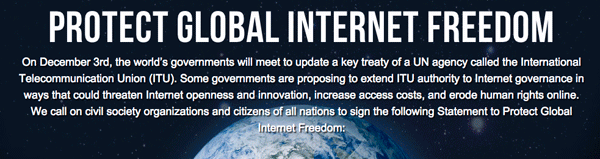
If you are an academic or work for a civil society organisation — join us by signing on here and send the letter to government officials who are participating in the ITU process
23 Nov 2012 | Middle East and North Africa
OPINION
“Maybe we have a discussion about who is a journalist,” said Israeli government spokesman Mark Regev, in a much-publicised interview with Al Jazeera on Monday during which he was grilled about Israeli attacks on media centres in Gaza City. Even with the hopes for the current ceasefire holding, this is undoubtedly still a discussion that needs to be had, as Israel’s behaviour towards journalists throughout the week-long Gaza crisis has set something of a precedent.
The main target, hit during three out of the five incidents, was the Al Shorouq tower, known locally as “the journalists’ building”, as it housed media outlets including Sky News, Al Arabiya, Al Quds TV and Russia Today. The third attack killed two people, including a local head of a branch of the militant group Al Quds brigades, and wounded eight journalists. Regev dismissed suggestions Israeli forces were targeting journalists, saying:
If you can bring me someone who is a bona fide journalist who was injured, I want to know about it.
At the suggestion that Palestinian journalists were not being given the same level of respect that Regev gives the Israeli media — which he praises for its freedom — the spokesman argued that the media in Gaza is not free, implying it is a legitimate target for Israeli attacks.

An Israeli air strike on Gaza City – Demotix
The illegitimacy of Palestinian media has been the first line of defence by Israelis justifying four separate attacks on media centre buildings — and one journalist directly — since the beginning of the Gaza crisis. The first attack last Sunday morning used five missiles to target a tower block housing pro-Hamas station Al Aqsa TV as well the offices of independent Palestinian news agency Ma’an, and has previously housed international media such as the BBC. According to Reporters Without Borders, “around 15 reporters and photographers wearing vests with the words TV Press were on the building’s roof at the time, covering the Israeli air strikes”. In an attack on Tuesday, two journalists from Al Aqsa TV were killed by an Israeli airstrike while driving in a car marked “press”.
Regev told the Al-Jazeera presenter: “unlike the country where you’re broadcasting from, Israel has a free press, the Israeli press is very aggressive and we respect that right.” He later added: “If you think Al Aqsa is free press, like say Tass in the former Soviet Union is a free press [sic], then let’s be serious for a second.”
Regev ignored how Israeli media is, like Al Aqsa, also likely to publish articles in favour of its own government’s policy, particularly in a time of heightened conflict. Witness the infamous Jerusalem Post article published by Gilad Sharon (son of Ariel), entitled “A decisive conclusion is necessary”, which stated: “There is no middle path here — either the Gazans and their infrastructure are made to pay the price, or we reoccupy the entire Gaza Strip.”
Al Aqsa in particular may not be a sterling example of free media, but that an attacking army is allowed to cherry pick sources of “legitimate” media is highly disturbing. It also implies that the IDF are of the belief that for Palestinians, their nationality trumps all, making them supposedly legitimate targets. Regev himself used the word “legitimate” to describe channels such as Al-Jazeera and the BBC in comparison to Al Aqsa, although offices used by Al Jazeera were also damaged during a nearby attack on the Abu Khadra building on Wednesday night, and offices of Agence France-Press (AFP) were targeted on Tuesday evening. Journalists, regardless of whether their outlet is considered “legitimate”, have been treated as collateral damage in this conflict.
Regev also blamed Hamas for “using journalists as human shields” by “placing their communications equipment in buildings that they know that journalists will use”. For their part, Ma’an stated when reporting on this issue that “there is no military infrastructure of any kind inside the building,” referring to the Al Shawa tower, another media base. The IDF have provided no proof of the communications equipment on either building.
Israel made much of its decision to allow international media into Gaza, from keeping the northern Erez checkpoint open to fast-processing of the press cards that allow journalists to cross it. On arrival at Erez, it was mandatory for all journalists to sign a waiver, stating that should they come to any harm, the IDF bears no responsibility.
The Israeli Government Press Office was also quick to condemn rumours of Hamas refusing to allow journalists to leave Gaza, but had fewer qualms about making its own demands that restrict journalists’ movement when inside the Strip. It explicitly warned journalists to stay away from anything or anyone connected to Gaza’s ruling Hamas party — a difficult task in a place as densely-populated as Gaza. In one incident, Nicole Johnston from Al Jazeera’s English service reported receiving a message from the IDF which said:
Don’t take any Hamas or Islamic Jihad leaders in a car with you. We know who we’re looking for. We know their cars.
This implies that journalists were expected to consider contact with any Hamas official as overtly making themselves a target, a tactic designed to dissuade them from conducting interviews or engaging in any activity where the perspective of Hamas might be broadcast.
International media have praised the Israelis for their decision to allow Gaza to remain open, in contrast to Operation Cast Lead in 2009. But there is evidence of sleight-of-hand with journalistic safety, and the so-called “rules of engagement”. Targeting media, or in this case — targeting journalists who either don’t or can’t comply with the IDF’s demands — ignores Protocol 1, Article 79 of the Geneva Convention which states it is a war crime to target the media. This is despite a press release distributed by the Israeli government press office, which stated: “Israel and the IDF are fully committed to international law in general, and to the Laws of Armed Conflict in particular”.
International media have been flooding into Gaza to work alongside Palestinian media. But with such an aggressive targeted air campaign in one of the most densely populated areas on Earth and no “front line” to speak of, the most that both parties were able to do was to speak up in order to hope that Israel would react to international pressure to accept some part of the so-called “rules of engagement” and avoid targeting journalists.
The ceasefire is holding for now, but there are many lessons to be learned from the past week and a half, most of all because the vast majority of people believe that similar attacks on Gaza are likely to happen again. If that is the case, it is not unreasonable to expect that Israel and the IDF will have learnt that the harming of media of any nationality is not just an action which attracts the bad press that they seek to avoid. It is a crime.
Ruth Michaelson is a freelance journalist currently on assignment in Gaza. She tweets at @_Ms_R
