Belarus: KGB issues warrant for Nikolai Khalezin
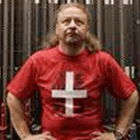 Nikolai Khalezin in hiding after the KGB issue arrest warrant for the co-founder of the Belarus Free Theatre. Mike Harris reports
(more…)

Nikolai Khalezin in hiding after the KGB issue arrest warrant for the co-founder of the Belarus Free Theatre. Mike Harris reports
(more…)
This Sunday at 6.30pm, Index on Censorship will be presenting the UK premiere of “Staging A Revolution”, a film about the Belarus Free Theatre, at the Free Word Centre, 60 Farringdon Road, London, ECIR 3GA. It includes powerful scenes from one of the theatre’s underground performances. This free screening will coincide with the end of voting in the Belarussian presidential elections.
We’ll be joined by the film’s directors Albina Kovalyova and Mathew Charles and later we’ll get some live reaction to the elections by video-link from Belarus, and enjoy some informal drinks.
Please do come and join us, and continue to tell your friends to sign the petition: http://zoneofsilence.org
Formal Invocation to the Reader:
Dear (Mysterious) Reader, Whoever You May Be:
Whether near or far, whether in the present or the future or even – in your spirit form – in the past,
Whether old or young, or in the middle of your life,
Whether male or female, or located somewhere along the continuum that joins these two supposed polarities,
Of whatever religion, or none; of whatever political opinion, or nothing much definite;
Whether tall or short, whether luxuriously-haired or balding; whether well or ill; whether a golfer or a canoeist, or a soccer fan, or the player or devotee of any number of other sports and pastimes;
Whether a writer yourself, or a lover of reading, or a student forced into reluctant readership by the necessities of the educational system;
Whether reading on paper or electronically, in the bathtub, on a train, in a library, school, or prison, under a beach umbrella, in a cafe, on a rooftop garden, under the covers with a flashlight, or in a myriad other manners and possible locations; It is you whom we writers address, always, in your unknown singularity. Oh Reader, live forever! (You – the individual reader – won’t live forever, but it’s fun to say, and it sounds good):
We writers cannot imagine you; yet we must,
For without you, the activity of writing is surely meaningless and without destination,
And therefore it is by its very nature an act of hope, since writing implies a future in which the freedom to read will exist:
We conjure and invoke you, Mysterious Reader; and Lo: You exist! The proof of your existence is that you have just read about that existence of yours, right here.
There. That’s what we’re talking about: the fact that I could write these words, and that you, via the go-between of paper or screen, can read them.
Which is by no means a foregone conclusion: for this is the very process that all governments and many other groups – religious, political, pressure lobbies of all shades and varieties, you name it – would like to harness, control, censor, bowdlerise, twist to their own purposes, exile, or extirpate. The extent to which they can implement this desire is one of the measures on the graduated line that extends from liberal democracy to locked-down dictatorship.
The publication of this special commemorative issue of Index on Censorship is a noteworthy occasion – and it is an important one, for often PEN and Index on Censorship have been the chief witnesses and recording angels of the erasures of books, as well as other acts against our shared writing-and-reading activity – the murders of journalists, the closing down of newspapers and publishing houses, the trials of novelists.
Neither organisation wields any power apart from the power of the word: what is sometimes called ‘moral suasion’. Thus both organisations can exist only in societies that allow a fairly free circulation of words. I say ‘fairly free’, for there has never been a society that sets no limit at all on what can legally be made public, or ‘published’. A country in which anyone could say anything he or she chose would be one without any legal recourse for the slandered or traduced. ‘Bearing false witnesses’ is probably at least as old as language, and no doubt so are the prohibitions against it.
But a brief history of censorship would by no means be brief. Cast your mind over the various laws, past and present, here and there, against hate speech, child pornography, blasphemy, obscenity, treason, and so forth, all of which come with the best of justifications – preserving public order, protecting the innocent, enhancing religious toleration and/or orthodoxy, and so forth, and you’ll see there’s been no end of effort. It’s the balance between forbidden and permitted, however, that is one of the litmus tests of an open democracy in progress. Like the coloured water in a tube barometer, this balance is in constant flux.
In honour of this special Index on Censorship issue, I’ve been asked to write some words about ‘the writer as political agent’. This is a little difficult for me to do, because I don’t believe that writers necessarily are political agents. Political footballs, yes; but ‘political agent’ implies a deliberately chosen act that is primarily political in nature, and this is not how all writers work. Instead, many writers stand in relation to politics as the small child does to the Emperor with No Clothes: they remark on the man’s nakedness not to be bratty or disruptive, but because they just can’t see any clothes. Then they wonder why people are yelling at them. It can be a dangerous kind of naivety, but it’s common. No one was more surprised than Salman Rushdie by the fatwa issued against him for The Satanic Verses: here he thought he was putting immigrant Muslims on the literary map!
There are of course many different kinds of writers. Journalists and non-fiction authors frequently write deliberately as political agents – that is, they want to further a specific end, often by making known facts that are inconvenient to those with power. It’s frequently these kinds of writers who are gunned down in the street, like so many Mexican journalists, or assassinated where they live, like the crusading Russian reporter Anna Politkovskaya, or have air-to-surface missiles lobbed at them, like the al Jazeera broadcasters during the American invasion of Baghdad. Such deaths are intended to shutdown dissent, both by silencing individuals and by sending a message to any others who might feel the temptation to get mouthy.
Government crackdowns on the media have now been circumvented to some extent by the internet. You can take the guts out of the investigative journalists, both figuratively and literally, but so far no one has been able to completely suppress the human urge that’s at least as old as the Book of Job: the need to tell. Catastrophes strike Job’s family members, one after the other; but each of them produces its messenger, who says: ‘I only am escaped alone to tell thee.’ The urge to tell is balanced by the urge to know. We want the story, we want the true story, we want the whole story. We want to know how bad things are, and whether they might affect us; but also we want to make up our own minds. For if we don’t know the truth of a matter, how can we have any valid opinions about it?
True or not true: these are the primary categories that we apply to reporting journalism and political non-fiction. But I am primarily a fiction writer and a poet, so it’s the suppression of these kinds of writing that concerns me the most. What we expect from journalists is accuracy, but the ‘truths’ of fiction and poetry are other. Let’s just say that if you can’t make a novel plausible in its detail, engaging in its language, and/or compelling in the story it is telling, you will lose the Mysterious Reader.
Novelists, poets and playwrights have had varying stated intentions over the years: the re-enactment of a society’s core myths, the flattering of the aristocracy, the holding of a mirror up to Nature so that we might see our own natures in it. During and after the Romantic era it became a truism that the ‘duty’ of a writer was to write in opposition to whoever was in power, as such incumbents were assumed to be corrupt and oppressive; or to expose abuses, as in Charles Dickens’s take on the kill-a-boy Dotheboys Hall schools of his time; or to tell the stories of the oppressed and marginalised, as in Les Miserables, an approach that has subsequently launched millions of novelistic ships; or to champion a cause, as Uncle Tom’s Cabin did for abolition.
But this is very far from saying that novelists and poets have to write with such intentions. To judge novels on the justness of their causes or the ‘rightness’ of their ‘politics’ is to fall into the very same kind of thinking that leads to censorship.
Many is the revolution that has ended by eating its writerly young, as their once-acceptable productions are pronounced heretical by the victors in the inevitable power struggles. As a red-diaper friend of mine said recently of her parents’ communist group: ‘They were always so hard on the writers.’
For revolutionaries, reactionaries, the religiously orthodox, or simply the passionate adherents of any cause whatsoever, the writing of fiction and poetry is not only suspect but secondary – writing is a tool to be employed in the service of the cause, and if either the work or its author doesn’t toe the line of the moment, or worse, goes directly against it, the author must be denounced as a parasite, ostracised, or disposed of, as Federico Garcia Lorca was by the fascists in Spain – shot without trial, then dumped into an unmarked grave.
But for the fiction and poetry writer, the writing itself – the craft and the art – is primary, whatever other impulses or influences may be in play. The mark of a society approaching freedom is the space allowed to the far-ranging human imagination and to the unfettered human voice. There’s no shortage of folks standing ready to tell the writer how and what to write. Many are those who feel impelled to sit on panels and discuss the ‘role of the writer’ or the ‘duty of the writer’, as if writing itself is a frivolous pursuit, of no value apart from whatever external roles and duties can be cooked up for it: extolling the fatherland, fostering world peace, improving the position of women, and so forth.
That writing may involve itself in such issues is self-evident, but to say that it must is sinister. ‘Must’ breaks the bond between the writer, such as me, and you yourself, Mysterious Reader: for in whom can you place your readerly trust if not in me, the voice speaking to you from the page or screen, right now? And if I allow this voice to be turned into the dutiful, role-fulfilling sock puppet of some group, even a worthy one, how can you place any faith in it whatsoever?
Both Index on Censorship and PEN defend the word ‘may’ in this connection, and oppose the word ‘must’. They defend the open space in which writers may use their own voices freely, and readers may then read freely. Thus I was happy to write something for them; though it may not be exactly what they had in mind.
To begin with, I’ve always liked the name of the committee: the Writers in Prison Committee. I like the way it simply describes a concrete reality, and doesn’t lay claim to superior abstractions about the sanctity of the spoken or written word. It deals with the immediate fact: there’s a writer in prison and the committee is on the case. I also like the name because it reminds me that I’m not in prison. This is quite an important fact about me, and normally I don’t give it any thought. Why would I? I live in a country where not being in prison is the state of rest. I don’t even catch myself thinking, ‘There but for the grace of God …’. I don’t think it’s true.
A very small part of what I’ve written would have got me into trouble in a dictatorship, but in a dictatorship I probably wouldn’t have written it. I’m not a confrontational kind of writer.
The words ‘writer in prison’ evoke a stark, dangerous, head-on, stand-up-and-be-counted sort of world, which makes me conscious of the displacement between harsh reality and the way I write about harsh reality. I come at it from an angle; an ironic angle, or an absurdist angle, or even a farcical angle. This is not a plan, it’s the way the writing writes itself. In Russia in Soviet times, a word one heard was ‘Aesopian’, which referred to a way of writing dangerous things more or less safely – by concealing the true subject matter beneath an ostensible ‘Aesopian’ subject matter. But I don’t know if that’s a trick I could have learned. My trick is different, especially because it’s not a trick.
On the few occasions I have approached a truly unfunny ‘harsh reality’, I found I couldn’t change my tone of voice to fit the occasion. The main character in Every Good Boy Deserves Favour shapes up as what you might call a tragic hero, I suppose, but inevitably (in my case) he has to compete with a punning madman and a ludicrous doctor, and the device which ultimately frees him from his prison hospital is a verbal joke, by which time the play has departed from any kind of totalitarian reality. I should make it clear that I’m not apologising, and anyway funny writers go to prison, too, if they’re in the wrong place at the wrong time. But when I think about the Writers in Prison Committee (WiPC), when I simply see those words on paper, I am made aware again that whatever my subject matter, my life is life on a bouncy castle.
In 1960, when the WiPC was established, I wrote a play about a writer in prison. At least, I think he was a writer. I can’t really remember, and I hope no one else can. What I do remember is that the play wasn’t much like prison. Its main intention was to feed off, and hopefully into, the cur-rent fashion for absurdist theatre. Then and later I had no urge to be an ‘engaged’ playwright. When my 1967 play Rosencrantz and Guildenstern Are Dead was banned from performance (although published) behind the Iron Curtain, I was surprised and bemused. In the end (in 1977, which was officially Prisoners of Conscience Year), I did write two plays which would have earned banning, but I never did, and still have not, could not, write a play from ‘the inside’. My thoughts while writing this piece are closer to an awareness of the inside than while writing fiction, and all the closer on the occasions when I have met imprisoned writers or writers in the firing line.
In my own life, Václav Havel was the most inspiring, partly from love of his plays, which significantly include very funny satires of life under an unfunny regime. I never for a moment questioned his oblique, absurd, ironical angle on harsh reality, because writing from the inside earns the right to any tone you can call your own. Getting to know someone like Havel, or even meeting someone like Wole Soyinka just once (I shared a prize with him about 40 years ago), brings you up against the idea of the writer who is not oneself, and, from the perspective of WiPC, the writer who is oneself is not that interesting, in the way that good fortune is not that interesting.
When you’re safe and sound, you think that being a writer is the most interesting thing about you, and a kind of protection. The simple statement which is the name of the Writers in Prison Committee cuts right through that to a world where it’s sometimes safer not to be one. Out here, it’s debatable whether the writing exerts any leverage on the fate of nations, but when it comes to the fate of individuals, no one, not even a writer, needs to be use-less. Political prisoners are less vulnerable when they are kept in our view and known to be so. Write to the writers in prison. The committee has their addresses. [email protected]