28 Mar 2014 | News, Politics and Society, Religion and Culture, United Kingdom, Young Writers / Artists Programme
(Illustration: Shutterstock)
“The media tells you what to think!”
That’s a basic criticism of Western journalism, whether it’s of the “CNN controls your mind” or “Left Liberal Elites have monopolised the agenda” variety. Most people reject this, rightly, as a straw-man. We pride ourselves on our ability to sift information, reject weak arguments and come to our own points of view.
A more worrying criticism is that the news directs what you think about. Decisions to give Story X prominence and headlines, and to bury or spike Story Y, mean most of us can only encounter X. Newsworthy stories become obscure if drowned out by others or omitted entirely. We’re denied investigation or campaigning on vital issues because nobody knows they exist.
In Britain this is not what we typically mean by ‘censorship’, not the recourse of despots or prudes. Nevertheless, self-censorship with market and readership in mind denies all but the most devout news-addict important stories. And without the news we can’t have comment pieces, columns, Twitter debates and opinion blogs.
Consider the EuroMaidan protests in Kiev through spring. Coverage gave the impression of a pro-EU crowd led by a heavyweight champion, with a worrying fringe of violent nationalists – Svoboda and Right Sector. This followed the ‘mainstream-extremist’ simplification presented in Egypt, Syria and Libya. Other crucial groups were ignored: LGBT activists set up the protest’s hotlines, feminists ran the makeshift hospitals, Afghan war veterans defended them.
The world’s focus on Kiev and Crimea drove other issues from the spotlight. The Syrian civil war has hardly featured recently, but that conflict has far more casualties, worse upheaval and more immediate consequences for Britain. Refugees are currently en route to claim asylum – this is the last we heard. Similarly, the Philippines dominated the winter’s news after Typhoon Haiyan. Now it’s forgotten in favour of flight MH370 despite the catastrophic ongoing humanitarian crisis, again with more lives at stake.
The Arab Spring is itself a good example of one narrative deafening public consciousness. How many of us knew that at the same time as protests ignited Yemen and Syria in July 2011, Malaysia’s government gassed peaceful crowds and arrested 1,400 protesters after tens of thousands marched for electoral reform? It’s tempting to wonder whether greater coverage, and greater international pressure, could have supported the democratic reforms demanded.
Closer to home, consider the brief uproar caused by the 2013 UK policing bill, drafted to outlaw ‘annoyance and nuisance’ and give police arbitrary powers to ban groups from protest areas. Although the drafts were publicly available, and campaign groups voiced outrage swiftly, left-wing papers took notice only after the bill had passed the Commons. The bill was softened, not by popular pressure or national debate, but by a few conscientious Lords.
Readers could forgive the media for prioritising other stories if they are more pressing. When headlines are crowded by non-events, however, this seems a poor excuse. The British news spectrum was recently obsessed with Labour politicians Harriet Harman and Patricia Hewitt, who worked for the National Council for Civil Liberties (now ‘Liberty’) in the 1970s. That council granted affiliate status to the now-banned Paedophile Information Exchange (PIE). The Daily Mail made a huge splash about its PIE investigation in February, despite uncovering no new information. That paper alone had reported the same story in 1983, 2009, 2012 and 2013. Eventually the BBC, online world and print media all covered the controversy, meaning more worthy issues lost precedence.
Madeleine McCann has dominated countless front pages, reporters chewing over the barest scraps of Portuguese police leaks. No real progress has been made for years. Pundits admit the story retains prominence largely because the McCanns are photogenic, and similar stories would have fallen off the agenda. There are hundreds of similar unsolved child disappearances, just from the UK. Drug scares, MMR vaccine hysteria, celeb gossip and royal gaffes (not to mention Diana conspiracies) complete the non-story roster.
If this seems regrettable but harmless, consider sexual violence. Teacher-child abuse, violent assaults and gang attacks deserve coverage, but their sheer news monopoly perpetuates the public’s false idea of ‘real rape’. Most sexual abuse is between couples or acquaintances: campaigners have shown the myth that ‘real rape’ must involve a violent stranger impedes both prosecution and victim support.
There is no silver bullet, just as no one news organisation can really be blamed for censorship by omission. Few people want or need constant updates on upheaval in South Sudan or Somalia – but we could be reminded they’re happening at all. Editors will always reflect on what is vogue, what will sell, and a diverse free press ensures a broad range of stories. Perhaps the rise of online citizen-reporting can bridge the gap. Nevertheless, the danger of noteworthy events falling into obscurity should niggle at the back of the mind – for those who know enough to think about it.
This article was posted on March 28, 2014 at indexoncensorship.org
4 Mar 2014 | Africa, News, Uganda
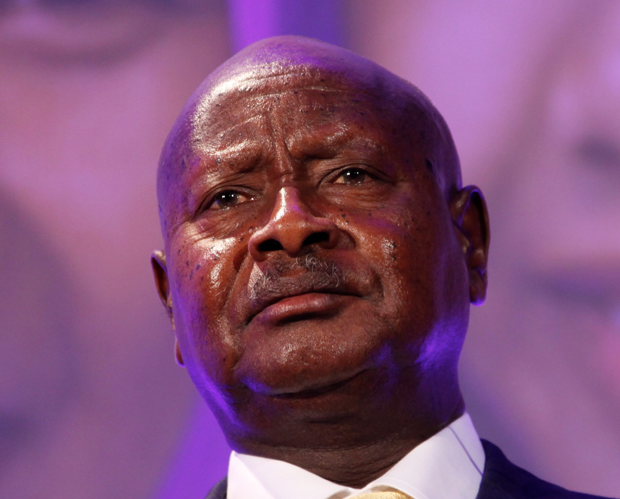
Ugandan president Yoweri Museveni (Photo: Wikipedia)
President Yoweri Museveni signed Uganda’s Anti-Homosexuality bill into law on 24 February, and the fallout has already started. The World Bank has cancelled a $90 million loan to the country, European Union countries are threatening to withdraw aid, and the United States is reviewing its cooperation with Uganda. President Museveni has hit back, saying Uganda would raise its own money to fund its development projects. The US, which was the first voice its discontent, was told off: “Our relationship with the US was not based on homosexuality.” David Bahati, the MP who introduced the bill, said in an interview that the west is imposing social imperialism on Uganda, a thing they are not ready to accept.
“I will work with the Russians,” Museveni said.
So the president feels that even without the west, Uganda has development partners that it can still rely on. Considering he was not supportive of the so-called Bahati bill in its initial stages, Museveni’s last-minute change of heart is baffling.
The law stipulates that punishment for homosexuals will be a life jail sentence, while those who “attempt” to engage in homosexual acts face seven years in prison. The law also targets journalists and others seen to participate in “production, procuring, marketing, broadcasting, disseminating, publishing of pornographic materials for purposes of promoting homosexuality”. It even attempts to reach beyond the country’s borders, implong that Uganda will have to ask countries where gay Ugandans live to extradite them so that they can face the law.
Public opinion goes both ways. Many are happy that the president is standing firm against “the west” and the perceived scheme of promoting homosexuality in Uganda and Africa at large. Others claim that the president signed this law to achieve cheap popularity with the 2016 elections around the corner. It is also claimed that President Museveni is just playing his usual political games. When the anti-homosexuality bill was passed by parliament early this year, one of the president’s legal brains, Fox Odoi, publicly stated that if the president ever assents to this law, he would challenge it in court.
Odoi has now teamed up with Ugandan journalist Andrew Mwenda to take the case to the constitutional court. It is alleged that this was Museveni’s game plan: sign the law, annoy the west and appease the locals, and then have his henchmen challenge this law in court and make sure it remains there forever. In this case, the west will soften their stance towards Museveni, and the locals will be told to be patient and leave the legal process to take its course. In that case, he will have killed two birds with one stone, and would go for the 2016 elections with both the west and the locals in his pockets.
Civil society has also been critical, not because the anti-homosexuality law is unnecessary per se, but they have questioned whether homosexuality is the biggest problem Uganda faces today, and warrants such urgency. With high youth unemployment, squalid conditions in health facilities and theft of public funds in government institutions, they believe priorities should lie somewhere else other than “fixing” homosexuality.
“The timing for the assenting to this law by the president is meant to divert the country’s attention from the discussion on the deployment of Ugandan forces in South Sudan and our mandate there. This law is very diversionary, and it is unfortunate that Ugandans have swallowed the president’s bait,” said Godber Tumushabe, a renowned civil society activist.
Opposition leader Kizza Besigye has criticised the new law, saying that homosexuality was not “foreign” and that the issue was being used to divert attention from domestic problems. “Homosexuality is as Ugandan as any other behaviour, it has nothing to do with the foreigners,” said Besigye. He accused the government of having “ulterior motives” and using the issue to divert attention from other issues, including Uganda’s military backing of neighbouring South Sudan’s government against rebel forces.
Sweden’s Finance Minister Anders Borg, who visited the country a day after the signing of the law, said it “presents an economic risk for Uganda”.
But Besigye accused them of double standards, saying that their cutting of aid over gay rights alone was “misguided”:
”They should have cut aid a long time ago because of more fundamental rights, our rights have been violated with impunity and they kept silent,” he said.
This article was posted on March 4, 2014 at indexoncensorship.org
3 Jan 2014 | News, Politics and Society, Religion and Culture
At its core, freedom of religion or belief requires freedom of expression. Both fundamental rights are protected in the Universal Declaration of Human Rights, yet nearly half of all countries penalize blasphemy, apostasy or defamation of religion. In 13 countries, atheists can be put to death for their lack of belief.
The U.S. State Department names and shames eight “Countries of Particular Concern” that severely violate religious freedom rights within their borders. These countries not only suppress religious expression, they systematically torture and detain people who cross political and social red lines around faith. The worst of the worst are:
1. Burma
Burma’s population is 90 percent Theravada Buddhist, a faith the government embraces and promotes over Christianity, Islam and Hinduism. Minority populations that adhere to these and other faiths are denied building permits, banned from proselytizing and pressured to convert to the majority faith. Religious groups must register with the government, and Burmese citizens must list their faith on official documents. Burma’s constitution provides for limited religious freedom, but individual laws and government officials actively restrict it. Most at risk in Burma are Rohingya Muslims, 240 of whom were killed this year in clashes with Buddhist mobs. Burma has refused to grant citizenship to 800,000 Rohingya, 240,000 of whom have fled their homes in recent clashes.
2. China
The ruling Chinese Communist Party is officially an atheist organisation. China’s constitution provides for freedom of religious belief, but the government actively restricts any religious expression that could potentially undermine its authority. Only five religious groups — Buddhists, Taoists, Muslims, Catholics and Protestants — can register with the government and legally hold services. Adherents of unregistered faiths and folk religions often worship illegally and in secret. Uighur Muslims, Tibetan Buddhists and Falun Gong practitioners have faced particularly severe repression in recent years, including forced conversion, torture and imprisonment.
3. Eritrea
The Eritrean government only recognizes four religious groups: the Eritrean Orthodox Church, Sunni Islam, the Roman Catholic Church, and the Evangelical Lutheran Church of Eritrea. These groups enjoy limited religious freedom while adherents of other faiths face harassment and imprisonment. Religious persecution in Eritrea is generally driven by government rather than social concerns. Jehovah’s Witnesses and other conscientious objectors who refuse to enroll in compulsory military training are subject to physical abuse, detention and hard labour. People of non-recognized religions are barred from congregating in disused houses of worship and have trouble obtaining passports or visas to exit the country.
4. Iran
Iran’s constitution offers some religious freedom rights for recognized sects of Islam along with Christians, Jews and Zoroastrians. Baha’is, who the government considers apostates and labels a “political sect,” are excluded from these limited protections and are systematically discriminated against through gozinesh provisions, which limit their access to employment, education and housing. Evangelical Christians and other faith groups face persecution for violating bans on proselytizing. Religious minorities have been charged in recent years and imprisoned in harsh conditions for committing “enmity against God” and spreading “anti-Islamic propaganda.” Government-controlled media regularly attack Baha’is, Jews and other minority faiths to amplify social hostilities against them.
5. North Korea
North Korea’s constitution guarantees religious freedom, but this right is far from upheld. The state is officially atheist. Author John Sweeney says the country is “seized by a political religion” and that it considers established religious traditions a threat to state unity and control. North Korea allow for government-sponsored Christian and Buddhist religious organizations to operate and build houses of worship, but political analysts suspect this “concession” is for the sake of external propaganda. A Christian group says it dropped 50,000 Bibles over North Korea over the past year. If caught with one, citizens face imprisonment, torture or even death. Given the government’s extreme control over the flow of reliable information, it is difficult to determine the true extent of religious persecution in North Korea.
6. Saudi Arabia
Saudi Arabia’s constitution is not a standalone document. It is comprised of the Quran and sayings of the Prophet Muhammad, which do not include religious freedom guarantees as spelled out in Article 18 of the Universal Declaration of Human Rights. In Saudi, it is illegal to publicly practice any faith other than the state’s official religion Sunni Islam. Members of other faiths can worship privately, but non-Muslim houses of worship may not be built. The Committee for the Promotion of Virtue and Prevention of Vice, otherwise known as Saudi’s morality or religious police, enforce Shariah law on the streets. Apostasy and blasphemy against Sunni Islam can be punished by death, as several high-profile Twitter cases have reminded global media in recent years.
7. Sudan
Sudan’s interim constitution partially protects religious freedom but restricts apostasy, blasphemy and defamation of Islam. Muslim women are also prevented from marrying non-Muslim men. The country’s vaguely worded apostasy law discourages proselytizing of non-Muslim faiths. Christian South Sudanese living in Sudan are subject to harassment and intimidation by government agents and society at large, but untangling the religious and ethnic motivations for this persecution can be difficult. Muslims generally enjoy social, legal and economic privileges denied to the Christian minority population. Government authorities have reportedly destroyed churches in recent years, and Christian groups have reportedly been subject to disproportionate taxes and delays in building new houses of worship. Read more about Sudan’s crackdown on Christians.
8. Uzbekistan
Proselytizing is prohibited in Uzbekistan, and religious groups must undergo a burdensome registration process with the government to enjoy what limited religious freedom is permitted in the country. More than 2,000 religious groups have registered with the government, the vast majority of which are Muslim but also include Jewish, Catholic and other Christian communities. Registered and unregistered groups are sometimes subject to raids, during which holy books have been destroyed. Individuals and groups deemed “extremist,” often for national security concerns rather than specific aspects of their faith, are imprisoned under harsh conditions and tortured, sometimes to death.
2 May 2013 | Newswire, Religion and Culture
An arm of the US government named 15 nations as the “worst violators of religious freedom”.
The Commission on International Religious Freedom (USCIRF), an independent advisory body created by the International Religious Freedom Act to monitor religious freedom abuses internationally, released its 2013 report, which idenitifes “governments that are the most egregious violators.”
The 15 countries are Burma, China, Eritrea, Iran, North Korea, Saudi Arabia, Sudan, Uzbekistan, Egypt, Iraq, Nigeria, Pakistan, Tajikistan, Turkmenistan and Vietnam, all of which severely restrict independent religious activity and harass individuals and groups for religious activity or beliefs. These nations are classified as Tier 1 “countries of particular concern” (CPCs) in the report.
Despite its recent opening and political reforms, change in Burma have “yet to significantly improve the situation for freedom of religion and belief.” The report states that most violations occurred against minority Christian and Muslim adherents. China’s government is also cited for its ongoing severe abuses against its citizens’ freedom of thought.
The report said that Egypt’s transitional and elected governments have made progress toward religious freedom, it further highlighted the attacks that Coptic Christians have sustained in the period after the Arab Spring that brought down the Mubarak regime. “In many cases, the government failed or was slow to protect religious minorities from violence.”
The former Soviet states of Tajikistan, Turkmenistan and Uzbekistan were included for pursuing state control over religion, targeting Muslims and minorities alike. Iraq was cited for, among other things, tolerating “violent religiously motivated attacks” and Iran for “prolonged detention, torture, and executions based primarily or entirely on the religion of the accused.”
Saudi Arabia continues to suppress religious practices outside of the officially-sanctioned Wahhabi interpretation of Islam, interferes with the faith of guest workers and prosecutes individuals for “apostasy, blasphemy and sorcery”, according to the report. Pakistan has a strict blasphemy law and failure to prosecute acts of religious violence, the report said.
The situation in Sudan has deteriorated since South Sudan gained its independence. Criminalization of apostasy, the imposition of the government’s strict interpretation of Shari’ah on both Muslims and non-Muslims and attacks against Christians, were cited in the report for the decline.
The report also identified Nigeria for continuing religious violence between Muslims and Christians compounded by the government’s toleration of the sectarian attacks. North Korea’s totalitarian regime was also included for its ongoing harassment and torture of citizens based on religious beliefs.
A second tier includes Afghanistan, Azerbaijan, Cuba, India, Indonesia, Kazakhstan, Laos and Russia, where abuses of religious freedom are tolerated by the government and meet the threshold for CPC designation by the US Department of State, but don’t meet all of the standards for “systemic, ongoing, egregious” measurements.
Other countries regions being monitored included Bahrain, Bangladesh, Belarus, Ethiopia, Turkey, Venezuela and Western Europe.
