The deaths of two ethnic Mongolians, allegedly killed by Han Chinese, in China’s Inner Mongolia region in May, has sparked the worst riots this region has seen in decades. Many areas, including the regional capital, Hohhot, are under martial law.
Scores of people have been detained and there is no information on possible deaths.
Enghebatu Togochog, director of the US-based Southern Mongolia Watch, a pressure group advocating ethnic Mongolian rights in China, told UNCUT:
We are still unable to verify it [a possible death count]. However we confirmed that there have been arrests of dozens in Hohhot on May 30 during the protest. Exact number of the detainees is still yet to be confirmed. In Shiliin-gol league at least 44 people were arrested, and none of them have been released so far.
It’s no surprise then that China’s censors have sprung into action to control news of the unrest. Internet and phones services have either been cut off or are intermittent in some areas.
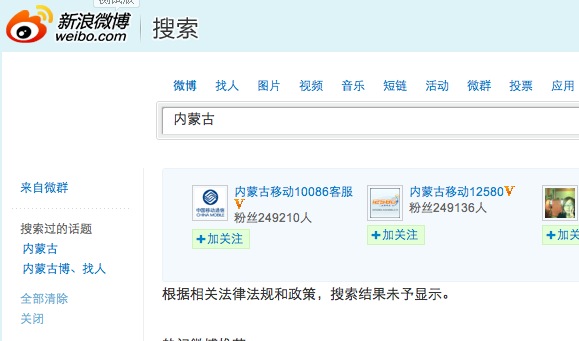
Nationally, top micro-blogging sites such as Sina (Weibo) and Tencent (Taotao), have reportedly blocked searches with the keywords “Inner Mongolia” and “Hohhot” with the message: “according to related laws, regulations and policies, the results of your search cannot be displayed.” See image.
The domestic news service has more or less shied away from reporting such a major news story although the English-language China-based media has offered some low-key coverage.
Of interest is an opinion piece in the Global Times yesterday, headlined “Putting Mongolian protests into context”, which takes a sympathetic slant towards the protesters.
It argues that the Mongolians have genuine concerns.
“Some of their requests are reasonable, and should be responded to by the local government,” it said.
Followed by: “We believe the majority of Chinese sympathize with their reasonable requests.”
The deaths sparked long-held resentment about the damage Han-owned coal mines have done to the local grasslands and government efforts to control local herders’ lives, as well as anger over the men’s deaths.
The New York Times commented that the authorities are acting in a much more conciliatory way compared with how ethnic Uighur and Tibetan violence was handled in protests in Xinjiang province in 2009 and in Tibet a year earlier.
“The acknowledgment of the anger, coupled with the large deployment of soldiers and police officers, suggested that the authorities were intent on avoiding the ethnic mayhem that struck other areas of China.”
At least hundreds of people died in those protests.
His 15-year jail term for spying and separatist activities is finally over, but Chinese dissident Hada, (who is ethnically Mongolian) is missing, along with his wife and son.
The organisation said his sister-in-law had told them a state security official had delivered a CD over the weekend with pictures of Hada with his wife and son posing in what looks like a hotel room next to a table laden with food. The photos are dated 10 December, the day of his expected release. Curiously the photos had also been anonymously posted to a human rights website boxun.com a few hours earlier.
It is highly likely that the authorities are holding them either under house arrest or detention for the purpose of silencing them through isolation and so-called “ideological work”, the organisation’s president, Enghebatu Togochog, told Index.
It is common in China for freed dissidents to be further detained after their release for a while as a measure to prevent possible unrest and to stop media interviews. The photos may be to reassure his family he is fine and out of jail. But until now he has been prevented from calling his family.
So who is Hada?
The New York Times called him “one of China’s longest serving political prisoners.” He had called for greater autonomy for ethnic Mongolians living inside China in the Inner Mongolia region, a vast land of flat steppe: desert in the west, grassland in the east. The Mongolians share similar grievances as the Tibetans: They believe their culture is being diluted and destroyed by Chinese Han migrants.
Hada was arrested at a rally in the regional capital Hohot back in 1995 for his activities with the underground Southern Mongolian Democracy Alliance. According to the New York Times, the spying charges came from interviews he gave with overseas news media.
A lieutenant colonel in the French army has been caught on camera menacing a Togolese journalist after the man took photographs of him admonishing youths. Romuald Letondo also threatened to smash Didier Ledoux’s camera.
Unfortunately for Letondot, the whole incident, including the rather pompous question “Do you know who I am?” was caught on video and has been posted on YouTube. The officer’s actions, unacceptable even back when Togo was a French colony, have drawn widespread condemnation from both the African media and French officials. Letondot was forced to apologise directly to Ledoux.
Letondot claims that he had been worried that the photos would be misinterpreted. Luckily the video clears up the affair. Fun starts at 50 seconds.
The Scottish golfer and Ryder Cup captain, Colin Montgomerie, has successfully won a court injunction against details of his private life being exposed. Montgomerie won the order against a tabloid newspaper in July, but the details have only recently come to light. A settlement between the two parties was reached out of court and there is no evidence that the allegations were true. The order came after reports that Montgomerie’s second marriage was in trouble. The golfer is the latest celebrity to use a gagging order to prevent articles about their private life being published.