3 Mar 2014 | Europe and Central Asia, News, Russia, Ukraine
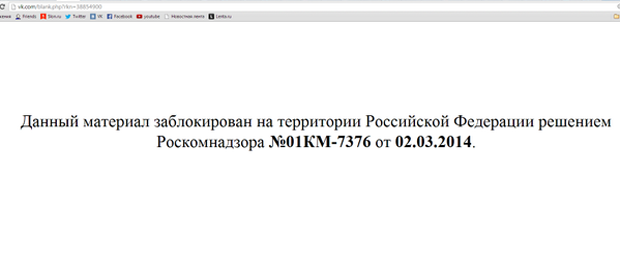
(Image: @ilya_shepelin/Twitter)
Russian authorities have blocked access to 13 sites connected to “Ukrainian nationalist organisations” on the social media site Vkontakte, Russia’s answer to Facebook.
The Russian General Prosecutor’s Office requested that Roskomnadzor — the Federal Service for Supervision of Communications, Information Technology and Mass Media — block the pages, the body said in a statement Monday. The pages promoted Ukrainian nationalist groups and “contained direct appeals to Russian people to conduct terrorist activities,” the statement read.
There had been reports over the weekend of pages on Vkontakte being blocked, but the message from Roskomnadzor confirms this.
While it is unclear which sites the ban covers, it appears a group connected to the Euromaidan protests is one of them. A screen grab, allegedly from a Euromaidan group, first shared by a journalist from Russian news site slon.ru, read: “This material was blocked on the territory of Russian Federation by a decision by the State Communication Committee” and that the decision had been made on 2 March.
This article was posted on March 3, 2014 at indexoncensorship.org
23 Jan 2014 | Europe and Central Asia, News, Ukraine
This video from YouTube shows a protester abused by police in Kiev.
As the conflict in Kiev continues to unfold, Ukrainian civil society activists tell Index negotiations and urgent reaction of the international community are vital to resolve the crisis.
Severe clashes between the riot police and protesters have led to at least three deaths; two of the protesters were shot with firearms on Wednesday. One more activist was found dead after unidentified people kidnapped and tortured him. Hundreds of protesters were injured as the police used flash grenades and other weapon (along with firearms, as it appeared) against the Euromaidan demonstrators.
The Institute of Mass Information reports at least 42 journalists were injured by the actions of the police.
Index joined 25 other organisations, united in the Civic Solidarity Platform, a coalition of human rights groups from Europe, Asia and North America, in a call for an immediate end to violence and dialogue between the opposing sides, to reach a peaceful resolution to an “acute human dimension crisis in Ukraine.”
“Developments in the situation in Ukraine are critical for the whole post-Soviet history and for the issue of human rights in the OSCE countries. This is why stabilisation of the situation in Ukraine – not in an authoritarian, but in a democratic sense – is crucial for the whole OSCE region,” the joint statement reads.
The protest in Ukraine started last November as it became clear the authorities refused to sign an Association Agreement with the EU.
“Now the protests are not about the European integration. It is all about the right to live in a free country, the right to speak out, to unite and defend our freedoms,” says Maryna Tsapok, an expert from the UMDPL Association, an NGO that monitors the activities of law enforcement.
She refers to a new law adopted in Ukraine on 16 January 2014 that seriously restricts freedoms of expression, assembly and association in the country.
“The authorities say this law and the actions of the police are aimed at restoring of the rule of law. But you cannot restore the rule of law by breaking the Constitution and international treaties. The escalation of the conflict should be stopped immediately by negotiations. But while the government is talking with the opposition, the police continue to use severe force against people in the streets, and the death toll is counting.”
“The authorities of the country have crossed the line,” says Olexandra Matviychuk, the Chair of the Centre for Civic Liberties. “It is almost impossible to predict the development of the situation. But what’s clear is that real and immediate measures from the international community are needed.”
“Serious escalation of the situation in Ukraine is the direct effect of the fact that from the very beginning of the protest movement the government has not taken any single step to build a comprise, but instead made a whole range of steps to suppress the protestors. They include attempts to forcefully disperse peaceful protestors and then to persecute them, violence against journalists, threatening of activists in the regions and, finally, adoption of the draconian legislation curtailing human rights and freedoms in the country,” says Antonina Cherevko, a media lawyer.
She adds: “The Ukrainian issue today can potentially create security problems not only for the country itself, but for the whole region. In this situation, a strong reaction and action from the established democracies is highly needed.”
This article was published on 23 January 2014 at indexoncensorship.org
20 Jan 2014 | Europe and Central Asia, News, Ukraine
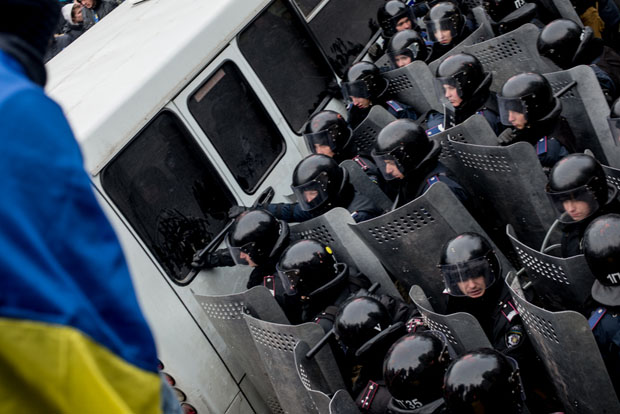
Clashes in Kiev between police and protesters on 19 January (Image: Julia Kochetova/Demotix)
At least 26 journalists were injured during the clashes between police and protesters in Kiev on 19 and 20 January.
According to the Institute for Mass Information (IMI), most of the reporters were wounded by stun grenades or rubber bullets used by the police while dispersing a rally in central Kiev, in protest at the new repressive legislation adopted in Ukraine last week.
IMI’s reports says the riot police on several occasions particularly targeted journalists, despite them having “Press” signs on their equipment and clothes. For instance, police officers shook a bus, while several journalists were filming the events from its roof, leading to several reporters falling off. The police attacked one of them, Denis Savchenko, a cameraman of 5 Channel. They tore his “press” badge of him and detained him briefly. The reporter now at home, with his leg broken.
Anatoly Lazarenko, a reporter of Spilno.tv online television, was shot in the hand while broadcasting live from the scene of the clashes. The reporter says the police aimed specifically at him to prevent him from reporting.
The legislation, adopted in Ukraine on 16 January 2014, has already been dubbed “the Dictatorship Law” by the country’s civil society. According to legal analysis done by experts of the Centre for Civil Liberties and Euromaidan SOS initiative, the law violates legislative procedures, runs counter to international treaties and domestic legislation and seriously restrict rights and freedoms of Ukrainian citizens.
The new law particularly targets free speech. It criminalises defamation, provides for liability for “distribution of extremist materials” and introduces a requirement for the registration of online media. It is now also forbidden to collect and disseminate information concerning law enforcement officers and judges.
The repressive law was officially signed by the President Yanukovich on 17 January, and has already come into force.
The full text of the independent legal analysis of the human rights related bills, adopted in Ukraine, is available here.
This article was posted on 20 January 2014 at indexoncensorship.org
16 Jan 2014 | Europe and Central Asia, News, Ukraine
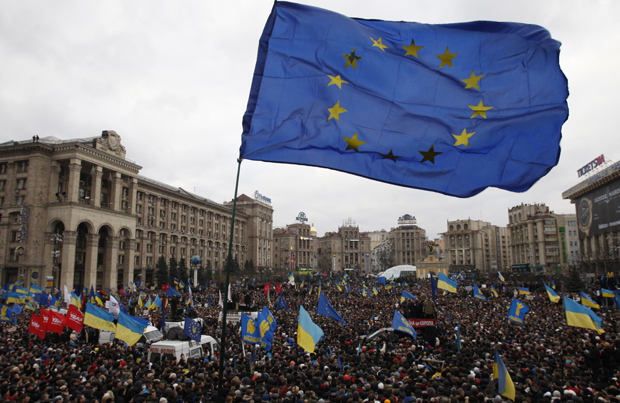
(Photo: Anatolii Stepanov / Demotix)
The Ukrainian parliament has adopted a new repressive law that seriously restricts freedom of expression and assembly, in a move the country’s civil society calls “a constitutional coup d’état”.
Law No. 3879, which enters into force tomorrow, criminalises libel (with a maximum sentence of two years of limited freedom), introduces criminal liability for “distribution of extremist materials”, allows blocking of websites and creates a Russian-style “foreign agent” definition for NGOs that use foreign funding.
Criminal liability for defamation and dissemination of extremist materials includes content posted online. The National Commission of State Regulation of Communication and Informatisation has the right to restrict access to websites “that are considered by experts to contain information that breaks the law.” Internet service providers will be obliged to buy special equipment to allow security services to monitor the internet and to restrict the access “to websites of information agencies that have no state registration.”
The law also requires mobile operators to identify SIM-cards owners; to buy a mobile contract one will have to present a passport and sign a formal contract.
The freedom of peaceful assembly is also threatened. In particular, the law forbids taking part in protests while wearing a helmet or a mask. Participating in a motorcade of five or more cars will lead to a fine and confiscation of the cars.
As the opposition tried to block the adoption of the draft law, the pro-government majority voted for the new legislative act with a simple show of hands, and without any discussion. The urgency of the law was explained by “a significant aggravation of [the] political and social crisis” in Ukraine.
“The law has been adopted by breaking all procedure rules. In fact it is a constitutional coup d’état that restricts fundamental freedoms and rights in Ukraine,” Olexandra Matviychuk, the chairperson of the Centre for Civil Liberties, told Index.
The restrictions outlined by the new law are aimed at civil society activists involved in the peaceful protests that started in Ukraine in November 2013 after the government refused to sign an association agreement with the EU.
This article was posted on 16 Jan 2014 at indexoncensorship.org
