23 Jun 2022 | News, United Kingdom, Volume 51.02 Summer 2022, Volume 51.02 Summer 2022 Extras
Britain’s first LGBT+ Pride march took place 50 years ago, on 1 July 1972. What began as one event in London has since grown into more than 160 Pride events across the UK – from big cities to small towns. Pride has also spread to more than 100 countries, making it one of the most ubiquitous and successful global movements of all time.
How did it all begin?
After the Stonewall uprising in New York in 1969 – when the patrons of gay bars fought back against police harassment – the newly-formed gay liberation movement in the USA decided to organise protests to coincide with the anniversary. The idea spread to the UK, and a group of us in the Gay Liberation Front in London came up with the idea of holding a celebratory and defiant “Gay Pride” march, to challenge queer invisibility and the prevailing view that we should be ashamed of our homosexuality. The ethos of Pride was born.
This was an era of de facto censorship of LGBT+ issues. There was no media coverage of homophobic persecution, no public figures were openly LGBT+ and there were no positive representations of queer people. The only time we appeared in the press was when a gay person was arrested by the police, murdered by queer-bashers, outed by the tabloids, or exposed as a spy, child molester or serial killer.
This is why a Pride march was necessary: to show that we were proud of who we were. But a march was a gamble. Would anyone join us?
Back then, most LGBTs were closeted and dared not reveal themselves publicly, fearing police victimisation. Many aspects of same-sex behaviour were still a crime, given that homosexuality had been only partially decriminalised in 1967. Some were afraid that coming out publicly would result in them being queer-bashed, rejected by family and friends or sacked by homophobic employers.
But, much to our surprise and delight, about 700 people turned out for the first UK Pride in 1972. It was a joyful, carnival-style parade through the streets of London, from Trafalgar Square via Oxford Street to Hyde Park.
We had a political message: LGBT+ liberation. Our banners proclaimed: “Gay is good” and “Gay is angry”. Despite heavy policing and abuse from some members of the public, we made our point.
Buoyed by this first modest success, we had the confidence to organise further Pride marches in the years that followed. They had explicit political demands such as an equal age of consent, an end to police harassment and opposition to lesbian mothers losing custody of their children on the grounds that they were deemed to be unfit parents.
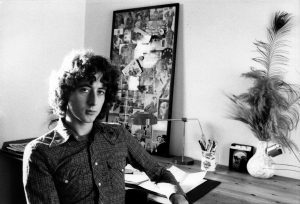
Peter Tatchell in 1974
For most of the 1970s, Pride remained feisty but tiny, with fewer than 3,000 people. However, by the mid-1980s the numbers marching rose to 12,000.
Then we were hit with a triple whammy. First came the moral panic of the Aids pandemic. Dubbed the “gay plague”, it demonised gay and bisexual men as the harbingers of death and destruction. Next the prime minister, Margaret Thatcher, attacked the right to be gay at the 1987 Conservative Party conference. And then, in 1988, Section 28 became law, prohibiting the so-called “promotion” of homosexuality by local authorities – the first new homophobic law in Britain for a century.
The LGBT+ community felt under attack – and we were. It brought us together and mobilised a fightback which was reflected in the turnout for Pride in 1988, with 30,000 marchers compared with 15,000 the year before. The march was angry and political, with some people attempting to storm Downing Street.
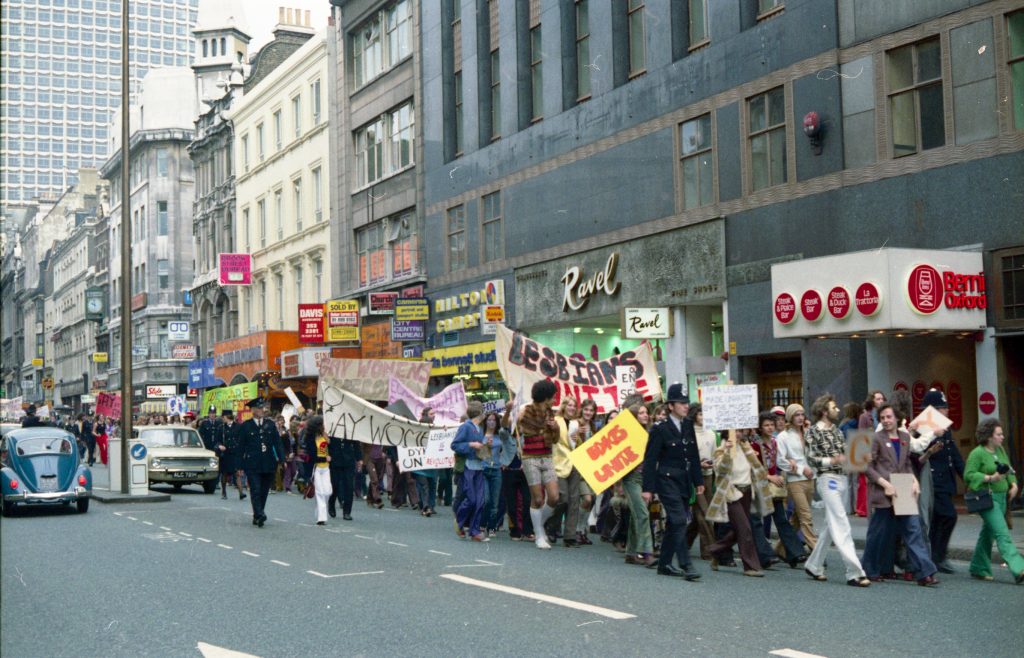
The first ever Pride in London, 1972. Photo: Jamie Gardiner
From 1988, Pride grew exponentially year on year. By 1997, there were 100,000 people on the march and the post-march festival on Clapham Common was attended by 300,000 revellers. This was the high point of Pride, run by – and for – the community, with strong LGBT+ human rights demands.
Since then, it has been downhill. A takeover by gay businesspeople at the turn of the century rebranded Pride as a “Mardi Gras” party and started charging for the post-march festival. Many people felt that Pride had been hijacked by commercial interests. Numbers plummeted, income crashed and the business consortium walked away.
For the past decade, the event has been run by a private community interest company, Pride in London, under contract and with funding from the mayor of London. It has been accused of being not representative of, or accountable to, the LGBT+ community, and of turning Pride into a depoliticised, overly commercial jamboree.
While some business sponsorship may be necessary to finance Pride, there is unease at the pre-eminence of commercial branding and advertising and the way huge extravagant corporate floats dominate the parade, overshadowing LGBT+ community groups.
Critics also question the participation of the police, arms manufacturers, fossil fuel companies, the Home Office and airlines involved in the deportation of LGBT+ refugees. Is this compatible with the liberation goals that inspired the first Pride?
And there is huge resentment that only 30,000 people are allowed to march in the parade, making Pride in London one of the smallest Prides of any Western capital city. Every year, thousands of people who want to march are turned away. This is against the original premise of Pride: that it should be open to everyone who wants to participate.
Pride in London claims that 1.5 million people attend. But there is no evidence to back this claim and it looks like hype to lure advertisers and sponsors. Even if we generously assume that 100,000 spectators line the route and there are 30,000 people in Trafalgar Square and 50,000 in Soho, plus 30,000 marchers, that’s still only 210,000.
Discontent led to last year’s Reclaim Pride march. It reverted to the roots of Pride, with a grassroots community focus, no corporate sponsors, and demands to ban LGBT+ conversion therapy, reform the Gender Recognition Act and provide a safe haven for LGBT+ refugees fleeing persecution abroad – political issues that have been absent from the official Pride for two decades.
It cost only £1,800 to organise, refuting Pride in London’s claims that Pride cannot exist without corporate funding to the tune of hundreds of thousands of pounds.
This year’s Pride in London parade is on 2 July. The day before, on the 50th anniversary of the UK’s first Pride, a handful of surviving Gay Liberation Front and 1972 Pride veterans will retrace the original route from Trafalgar Square to Hyde Park. Among other things, we’ll be urging the decriminalisation of LGBT+ people worldwide – including in the Commonwealth, where 35 out of the 54 member states still criminalise same-sex relations.
As radical and committed as ever, we pioneers of Pride continue the liberation struggle we began half a century ago. There will be no stopping until homophobia, biphobia and transphobia are history.
This article appears in the forthcoming summer 2022 edition of Index on Censorship. Get ahead of the game and take out a subscription with a 30% discount from Exact Editions using the promo code Battle4Ukraine.
22 Jun 2022 | Events
Join Index on Censorship and Pushkin House for a night discussing freedom of expression in Russia as part of the launch of the latest issue of Index on Censorship magazine.
The 2022 summer magazine looks at how the Russian invasion in Ukraine impacts freedoms within Ukraine and across Europe, Turkey and Russia. While the pages are filled with stories of brave and brilliant people speaking up and out, many write on the growing challenges for freedom of expression. This is especially the case for those living in Russia under Vladimir Putin. This will be the topic of our discussion for the launch.
Featuring a panel of people with direct experience and knowledge of Russia under Putin, the evening will address how much freedom there is in Russia right now, particularly in relation to media freedom and protest.
The panel will include Russian investigative journalists Andrei Soldatov and Irina Borogan, as well as Ben Noble, Associate Professor in Russian Politics at University College London. The conversation will be chaired by Index on Censorship magazine Editor-In-Chief Jemimah Steinfeld. The event will also include a reading of a passage written by the late Russian journalist Anna Politkovskaya, who was murdered in Moscow in 2006.
A wine reception will follow.
This event is free, but seats are limited. Advanced booking is essential. Register for your ticket here.
MEET THE SPEAKERS
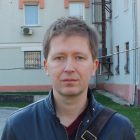 Andrei Soldatov is a Russian investigative journalist, co-founder, and editor of Agentura.ru, a watchdog of the Russian secret services’ activities.
He is co-author with Irina Borogan of The New Nobility. The Restoration of Russia’s Security State and the Enduring Legacy of the KGB (PublicAffairs, 2010), The Red Web: The Struggle Between Russia’s Digital Dictators and the New Online Revolutionaries (PublicAffairs, 2015) and The Compatriots: The Brutal and Chaotic History of Russia’s Exiles, Émigrés, and Agents Abroad (PublicAffairs, 2019).
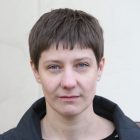 Irina Borogan is a Russian investigative journalist, co-founder and deputy editor of Agentura.ru, a watchdog of the Russian secret services’ activities. She chronicled the Kremlin’s campaign to gain control of civil society and strengthen the government’s police services under the pretext of fighting extremism.
She is co-author with Andrei Soldatov of The New Nobility. The Restoration of Russia’s Security State and the Enduring Legacy of the KGB (PublicAffairs, 2010), The Red Web: The Struggle Between Russia’s Digital Dictators and the New Online Revolutionaries (PublicAffairs, 2015) and The Compatriots: The Brutal and Chaotic History of Russia’s Exiles, Émigrés, and Agents Abroad (PublicAffairs, 2019).
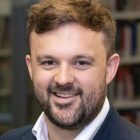 Dr Ben Noble is Associate Professor of Russian Politics at University College London (UCL SSEES) and an Associate Fellow of Chatham House. His research focuses on legislative politics, authoritarianism, and Russian domestic politics, with awards from The Leverhulme Trust, the Political Studies Association, and the British Academy. His co-authored book Navalny: Putin’s Nemesis, Russia’s Future? (Hurst and Oxford University Press, 2021) has so far been translated into eight languages, was selected by the Financial Times as one of the best books on politics in 2021, and has been shortlisted for the Pushkin House Book Prize in 2022. Ben frequently provides commentary and analysis on Russian politics for academic, policy, media, and general audiences.
 Jemimah Steinfeld is the editor-in-chief at Index on Censorship. Prior to Index she lived in China. She is the author of the book Little Emperors and Material Girls: Sex and Youth in Modern China, and has written for a variety of publications, including The Guardian, The Telegraph, The Independent, CNN, New Statesman and openDemocracy. She can be found tweeting @JFSteinfeld.
When: Monday 18 July 2022, 7pm
Where: Pushkin House, 5a Bloomsbury Square, London WC1A 2TA
22 Jun 2022 | News, Russia, Ukraine, Volume 51.02 Summer 2022, Volume 51.02 Summer 2022 Extras
In the dark times
Will there be singing?
Yes, there will be singing
About the dark times.
Bertolt Brecht, motto to Svendborg Poems 1939
For someone who has by now lived most of my adult life in the West but grew up in Belarus – a country that borders both Ukraine and Russia – these have certainly been dark and turbulent times.
The horror of what people in Ukraine are going through is heart-breaking. It is also confusing if my own country of birth is viewed as an aggressor or a victim.
Should people who have bravely protested in hundreds of thousands in 2020 and paid a very high price for it be now equated to the regime that rules them? Does Belarus, the country and the people, mean Lukashenka? What about Russia? The support for Putin is undoubtedly bigger there. But does Russia and Russian culture mean Putin?
Having always been a passionate advocate of freedom of expression under the most trying of conditions, what to make now of the blanket censorship of Russian and Belarusian artists not in Russia and Belarus… but in the West?
When the horror of the invasion of 24 February sank in, the Western cultural scene was immediately rocked by a succession of cancellations and calls for boycotts. Some of them were easier to understand and justify than others.
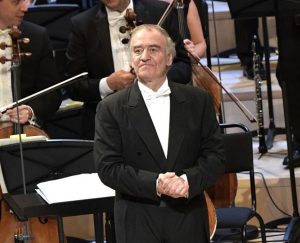
Opera singer Anna Netrebko and conductor Valery Gergiev have been tied to Putin’s regime and identified as representatives of his soft power: association with them became too toxic for Western cultural institutions. Recently, the evidence of oligarchic wealth accumulated by Gergiev due to his political connections has also come to light. This made any defence of him even more difficult
Art in some ways has always been held hostage. The authoritarian Soviet regime used the prestige of the Bolshoi and the power of Russian culture as soft power.
One is reminded of a powerful 1968 performance by cellist Mstislav Rostropovich at the BBC Proms in London where he performed – intitally to the calls of protest and with tears streaming down his face – a tortured and impassionate piece of music by a Czech composer Antonin Dvorak on the day Soviet tanks rolled into Czechoslovakia to crush the Prague Spring.
His wife, the opera singer Galina Vishnevskaya, recalled the event in her autobiography:
“In the hall, six thousand people greeted the appearance of Soviet artists with long unceasing cries, stomping, whistling, preventing the concert from starting. Some shouted: ‘Soviet fascists, get out!’ Others: ‘Shut up, the artists are not to blame!’
“Slava (his nickname) stood there completely pale, absorbing the shame for his criminal government, and I, closing my eyes and not daring to raise my head, huddled in the far corner of the viewing box. But then, finally, the hall fell silent. Dvořák’s music poured over the people like a requiem, and Rostropovich, shedding tears, spoke through his cello.
“The hall froze, listening to the confession of the great artist, who at that moment, together with Dvořák merged with the very soul of the Czech people, suffering with him and with them asking his forgiveness and praying for them.
“As soon as the last note played, I rushed backstage to Slava. Pale, with trembling lips, having not yet recovered from his experience on stage, with eyes full of tears, he grabbed my arm and dragged me to the exit:
“‘Let’s go to the hotel, I can’t see anyone.’
“We went out into the street – the demonstrators were shouting there, waiting for the musicians of the orchestra to express their indignation to them.
“Seeing the two of us, they suddenly fell silent and parted in front of us. In the ensuing silence, not looking at anyone, feeling like criminals, we quickly walked to the car waiting for us and, returning to the hotel, we could finally give vent to our despair.
“But what could we do? We did the only thing that was in our power – got drunk.”
What then should the answer to this moral dilemma be? Should musicians and artists be allowed to perform only once they have stated their opposition to their government?
And is it then morally justifiable from the point of view of Western democracies to put someone living under completely different conditions in that position? To demand dissent from someone who might not be in the position to speak freely?
The German music critic Jan Brachmann gives the example of Dmitri Shostakovich, who, in 1949, appeared at a Soviet-backed peace conference in New York, having been pressured by Stalin into attending.
The émigré Russian composer Nicolas Nabokov publicly interrogated Shostakovich about Soviet denunciations of modernist music, even though he knew that his colleague could not speak his mind. Shostakovich muttered, barely audible: “I fully agree with the statements made in Pravda.”
It is unclear what exactly had been gained from that exercise. But Gurgiev aside and any moral clarity there notwithstanding, there have been other, much less clear-cut cases recently.
Sergei Loznitsa, one of Ukraine’s most prolific filmmakers, who has explored the Maidan uprising, the Donbass war, Stalin’s personality cult and the tragedy behind the Babyn Yar massacre, has recently been expelled from the Ukrainian Film Academy for speaking out against blanket boycott of Russian filmmakers.
His opposition is based on the fact that people should be judged by their actions not their passports. It is hard to disagree. People can still love their country and feel deeply ashamed of their government’s actions.
Kirill Serebrennikov, a Russian dissenting artist of great talent, is currently also in the line of fire.
Serebrennikov, who had his homoerotic production, Nureyev, taken off stage at Bolshoi in 2017, was placed under house arrest accused of embezzling theatre funds – a charge widely seen as being politically motivated. He was not allowed to attend a premiere of his production of Cosi Fan Tutte at Zurich Opera nor to the Cannes premiere of his hugely acclaimed ode to rock ‘n’ roll and dissent in 1980s Leningrad, Leto.
Recently Bolshoi has once again cancelled a scheduled production of Nureyev, this time as a retaliation for him speaking up against the war. Serebrennikov told France 24 in an interview last month that “it’s quite obvious that Russia started the war”, and that it was breaking his heart.
“It’s war, it’s killing people, it’s the worst thing (that) ever might happen with civilisation, with mankind… It’s a humanitarian catastrophe, it’s rivers of blood,” he said.
And yet the Ukrainian State Film Agency opposed Serebrennikov’s inclusion in Cannes Film Festival and the premiere of his new film on the grounds that he is a Russian filmmaker, and it was unacceptable in times of war. While this reaction is humanly understandable and can even be seen by some as a moral decision, we need to ask ourselves who ultimately benefits from silencing, cancelling, de-platforming and similar methods? It is never a viewer, a reader or any ordinary person.
The power of art is in our shared humanity and not in division. Art and its healing power is what gets us through the hard and dark times. We need to show solidarity with people in Ukraine and Ukrainian artists, shine a spotlight on their experiences and prioritise their voices, as well as support those who struggle under authoritarianism in their own countries. This is a task for any functioning democracy.
Having started by quoting Bertolt Brecht, another quotation, this time by the Soviet dissident Alexander Solzhenitsyn comes to mind: “The line separating good and evil passes not through states, nor between classes, nor between political parties either – but right through every human heart – and through all human hearts.”
This article appears in the forthcoming summer 2022 edition of Index on Censorship. Get ahead of the game and take out a subscription with a 30% discount from Exact Editions using the promo code Battle4Ukraine.
For another view, read Marina Pesenti’s article where she argues that promoting Russian culture risks furthering Putin’s agenda.