8 Jul 2016 | Azerbaijan, Azerbaijan News, Europe and Central Asia, Mapping Media Freedom, News, Russia, Turkey, United Kingdom
Click on the dots for more information on the incidents.
Each week, Index on Censorship’s Mapping Media Freedom project verifies threats, violations and limitations faced by the media throughout the European Union and neighbouring countries. Here are five recent reports that give us cause for concern.
Turkey: DIHA reporter arrested in Batman
4 July 2016: Dicle News Agency reporter Serife Oruc was sent to court on the charges of being “member of an illegal organisation”, news website Bianet reported. Oruc was arrested with two other men who were in the same car with Oruc, Emrullah Oruc and Muzaffar Tunc.
All three were transferred to a prison in Batman.
UK: Journalist claims Telegraph censored article critical of Theresa May
2 July 2016: The Daily Telegraph pulled a comment piece critical of Theresa May as May fought to become the leader of the Conservatives.
The piece was published on 1 July in the news section of the Telegraph but was subsequently taken down from the website. It was entitled “Theresa May is a great self-promoter but a terrible Home Secretary”.
“Daily Telegraph pulled my comment piece on Theresa May ministerial record after contact from her people #censorship”, journalist Jonathan Foreman tweeted on 2 July.
The journalist authorised Media Guido to republish the piece and it can be read on their website.
Russia: Free Word NGO declared a “foreign agent”
1 July 2016: The Pskov office of the Russian justice ministry declared Svobodnoye Slovo (Free Word), an NGO which publishes the independent newspaper Pskovskaya gubernia, a “foreign agent”.
The decision was made after an assessment of the organisation was conducted by the Pskov regional justice ministry department. It established that the organisation “receives money and property from another NGO which receives money and property from foreign sources”.
In addition, the statement said the NGO is running “political activities” because the newspaper is covering political issues.
Independent regional Pskovskaya Gubernia became well-known after a series of articles revealing Russian casualties in eastern Ukraine in the beginning of the Donbass conflict in the summer of 2014.
Azerbaijan: Editor sentenced to three months in jail for extortion
1 July 2016: Fikrat Faramazoglu, editor-in-chief of jam.az, a website that documents cases and arrests related to the ministry of national security, was arrested last Friday. He has been given a three-month sentence after being accused of extorting money by threats.
Faramazoglu’s wife said a group of three unidentified men showed up at their home, confiscating his laptop. Documents and even CDs from his children’s weddings were confiscated without any warrant. The three men informed Faramazoglu’s wife that her husband had been arrested.
Russia: Police detains Meduza freelancer covering death of children in Karelia
30 June 2016: Police detained Danil Alexandrov, a freelance journalist for Meduza news website working in Republic of Karelia reporting on the death of 14 children in a boating accident on Syamozero Lake. He was accused of working “without a license“.
Alexandrov was detained on his way out of the Essoilsky village administration building, where he spoke to the head of the town. The police reportedly approached Alexandrov and threatened to confiscate all his equipment unless he signed aan administrative offence report. He signed the document.
“They hinted that it might be necessary to confiscate ‘evidence of my journalistic activities’,” Alexandrov told Meduza, adding that the police insisted the publication was a foreign media outlet and had to be accredited by the Ministry of Foreign Affairs.
The Foreign Ministry’s rules on accreditation discuss full-time staff members of foreign media outlets but do not comment on freelancers. Alexandrov’s court case is scheduled for 6 July. He faces a maximum penalty of 1,000 rubles (€14) for working “without a license”.
24 Jun 2016 | Azerbaijan, Azerbaijan News, mobile, News
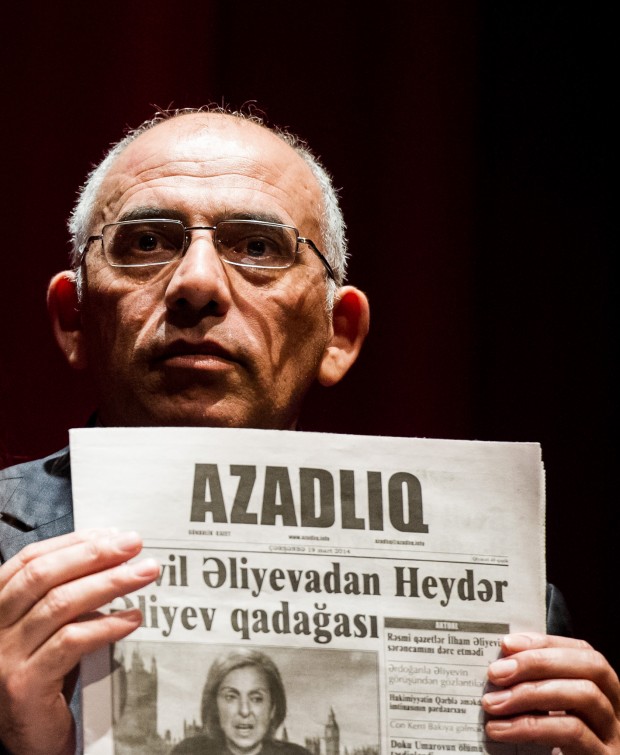
Rahim Haciyev, editor-in-chief of Azerbaijani newspaper Azadliq, accepts the 2014 Index Freedom of Expression Journalism Award. (Photo: Alex Brenner for Index on Censorship)
On 14 June, Qasid, an Azerbaijan’s state-owned media distributor warned that it will shut down the 2014 Index on Censorship Freedom of Expression Journalism Award-winning newspaper Azadliq by 27 June if it doesn’t pay an outstanding debt of approximately $12,000 it allegedly owes, Radio Free Europe reported.
Rahim Haciyev, acting editor-in-chief of Azadliq, told Index why it’s important to keep the paper’s journalists reporting.
Why is it important for Azadliq to continue its mission?
Rahim Haciyev: Azadliq is an independent newspaper that fights for freedom of speech in Azerbaijan. In fact, the main job of the press is to provide readers with objective information. Freedom of speech is under severe pressure from the government. We at the newspaper fight for freedom as well as provide readers with objective information. Our activity is of great importance because we are the only remaining press agency inside Azerbaijan that challenges the government.
Why is the government trying to shut down the paper?
Rahim Haciyev: Azadliq always follows the “golden rule of journalism”, which is to only serve the truth. In a country with wide-scale corruption and sharp limitations to human rights and freedom, it should not be surprising that the only newspaper that publishes articles about all of these issues is under intense pressure. It is common for authoritarian regimes to restrict the freedom of speech and expression in order to silence press outlets which provide citizens with objective information. This is what the Azerbaijani government attempts to do. The newspaper pays great attention to the problem of political prisoners and continues to do so right now. Each issue of the newspaper contains photos of political prisoners that the government would rather people forget.
How many people are still contributing to the paper’s coverage?
Rahim Haciyev: Azadliq, as a daily newspaper, is facing severe financial constraints. Our small staff of 20 journalists are working under the dual threat of government harassment and financial insecurity. We can’t hire more journalists because the state-owned news distributor, Qasid, refuses to pay the paper for sales. Right now it owes us approximately $50,000, but is demanding we pay them $12,000. At the same time, a lot of journalists don’t want to work with us because of the real personal and professional risk of being associated with an opposition newspaper.
17 Jun 2016 | Azerbaijan, Azerbaijan News, Europe and Central Asia, European Union, France, Italy, Mapping Media Freedom, News, Russia, Turkey
Click on the dots for more information on the incidents.
Each week, Index on Censorship’s Mapping Media Freedom project verifies threats, violations and limitations faced by the media throughout the European Union and neighbouring countries. Here are five recent reports that give us cause for concern.
A Baku prosecutor asked for an 8.5-year sentence for Rovshan and Rufat Zahidov, relatives of Azadliq (Radio Liberty) newspaper editor-in-chief Ganimat Zahid on charges of drug possession, the media outlet reported. Rufat and Rovshan Zahidovs were arrested in July 2015 and accused of the possession and sale of drugs. The hearing of the case began in February 2016. Ganimat Zahid lives in exile and runs Azerbaijan Hour online TV channel. Zahid served 28 months of a four- year sentence in retaliation for his critical journalism wrote CPJ following Zahid’s release in 2010. Zahid was convicted under articles 127.2.3 (hooliganism with intentional infliction of minor bodily harm) and 221 (hooliganism).
Police forces pushed, shoved and hit journalists with batons while dispersing a protest against the proposed labour law in Rennes, France 3 reported. The police charged the crowd from their cars, using tear gas against protesters and hitting them with batons, France 3 reported. Bruno Van Wassenhove, a France 3 reporter, explained journalists who had been criticising the violence of the assault were pushed to the side by the police officers and hit intermittently with batons. Rennes Press Club has firmly criticised the attacks against journalists perpetrated by the police. “Journalists were not targets but ‘they were hit by batons'”, the Club wrote on twitter, quoting an article of newspaper Le Parisien.
Editor Pasquale Clemente was sentenced to two years in prison and fined €1,500 on libel charges (Art. 13 of the press law n.47 /48) in the criminal court of Nola in Naples, Ossigeno reported. Clemente is the former editor-in-chief of the Gazzetta di Caserta and currently editor-in-chief of Roma newspaper. On 22 July, 2010, Pasquale Giuliano, a former judge and senator at the time, sued the journalist for an article published on 30 April, 2010 edited by Clemente. In that article, Clemente criticises the politician: “A province like ours – he writes – can not afford to blow up the first Provincial Council …. A shame ratified by threats from the courtroom of two parliamentary politicians like Coronella and Giuliano, who had nothing to do with anything”.
Journalists Aleksandr Valov and Dmitry Saltykovsky along with a film crew for US channel HBO were detained while working near the southern Russian city of Sochi. The Russian journalists and the six-person TV crew were reportedly investigating claims of misuse of real estate properties constructed during the 2014 Winter Olympic Games which were held in Sochi. The US citizens were released after seven hours, while the two Russian journalists were detained further and transported to the FSB headquarters in Sochi. Initially, law enforcement claimed they were operating in a near-border zone without “necessary permits.” Valov’s lawyer reports that a court in Adler charged him with “organising a public event in a near-border zone.” Valov is set to remain in jail for five days. Dmitry Saltykovsky, who worked as an interpreter for the HBO crew, was released, but fined 1,000 rubles ($15), according to the journalists’ lawyer, Alexander Popov, on Twitter. Aleksandr Valov is the editor-in-chief of Blog Sochi.
Syrian independent journalist Ahmed Abd al-Qader survived second murder attempt in Urfa, where he is based. Exiled Syrian news outlet, Eye on Homeland, said, Ahmed Abd al-Qader was attacked while out shopping by two gunmen riding a motorbike, RSF reported. Injured in the head, he was taken to a hospital in Urfa and is now placed in intensive care and is reportedly in stable condition. The attack was claimed by the Islamic State according to ABC news. In March of 2016, Ahmed Abd al-Qader survived a first attempt at his life when two men ambushed his residence in Urfa. His brother Ibrahim Abdelqader was murdered in Urfa on 30 October 2015 together with a friend, Fares Hammadi, which the Islamic State also claimed responsibility for. In April, another Syrian journalist Mohammed Zahir al-Shergat died as a result of gunshot wounds in Turkish city of Gaziantep. Shergat was shot when walking on a street by members of the IS, who have since confirmed their responsibility of the attack.
25 May 2016 | Azerbaijan, Azerbaijan News, Europe and Central Asia, mobile, News
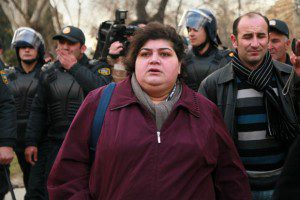 Azerbaijan’s Supreme Court has ordered the release of investigative journalist Khadija Ismayilova. But who is Ismayilova and why was she in prison?
One of Azerbaijan’s most celebrated journalists, Ismayilova investigated, among other things, Azerbaijan’s human rights abuses and the corruption involving the family of president Ilham Aliyev. The recent Panama Papers have followed up on her work, exposing links between the president’s family and a network of offshore tax havens and hidden wealth.
Ismayilova was arbitrarily imprisoned in December 2014 and was sentenced in September 2015 to seven-and-a-half years in prison. Although she is officially charged with large-scale misappropriation and embezzlement, illegal entrepreneurship, tax evasion and abuse of official duties, it is widely believed that the real reason for Ismayilova’s imprisonment is her investigative journalism.
Before her arrest, Ismayilova had been subjected to a relentless campaign of intimidation and persecution, possibly orchestrated by the Azerbaijani authorities to discredit her investigative reporting on corruption amongst the highest levels of society.
“Khadija Ismayilova has suffered a serious invasion of her personal privacy through the installation of hidden cameras and wires in her flat and publication of secretly filmed videos among other incidents. Azerbaijan has a positive obligation to carry out an effective investigation into these violations,” said Camila Graham-Wood, legal officer at Privacy International.
Human rights lawyer Amal Clooney has been representing Ismayilova during her case at the European Court of Human Rights.
Her work was recognised by the United Nations which awarded her the prestigious Unesco/Guillermo Cano World Press Freedom Prize. When Ismayilova was in prison, her mother, Elmira Ismayilova, accepted the award on her daughter’s behalf. She read a statement Ismayilova wrote from prison: “As you gather here tonight, I ask you not to laud my work or my courage, but to dedicate yourself to the work each one of you can do on behalf of press freedom and justice.”
She read a statement Ismayilova wrote from prison: “As you gather here tonight, I ask you not to laud my work or my courage, but to dedicate yourself to the work each one of you can do on behalf of press freedom and justice.” Ljiljana Zurovac, president of the Unesco/Guillermo Cano World Press Freedom Prize 2016 jury, said: “Khadija Ismayilova highly deserves the prize and I am happy to see that her courage and professionalism are recognised.”
Azerbaijan is one of the lowest ranked countries for press freedom, being placed 163 out of 180 countries on the 2016 Reporters Without Border’s World Press Freedom Index.
Protests due to take place this Friday to mark Ismayilova spending her 40th birthday in prison will still go ahead to celebrate her release, call for her full acquittal and for the release of the country’s political prisoners, including Ilgar Mammadov, Seymur Hezi and Ilkin Rustemzade.
