19 Aug 2016 | Azerbaijan, Azerbaijan News, Mapping Media Freedom, mobile, News and features, Russia, Serbia, Turkey
 Each week, Index on Censorship’s Mapping Media Freedom project verifies threats, violations and limitations faced by the media throughout the European Union and neighbouring countries. Here are five recent reports that give us cause for concern.
16 August, 2016 – IMC TV reporter Gulfem Karatas and cameraman Gokhan Cetin were assaulted and detained while covering the police raid on the daily Ozgur Gundem. Footage of the attack was shared via IMC TV Twitter account, showing police grabbing the camera and physically assaulting the reporter, who is heard screaming in the footage.
Karatas and Cetin were detained along with journalists Günay Aslan, Reyhan Hacıoğlu, Ender Öndeş, Doğan Güzel, Ersin Çaksu, Kemal Bozkurt, Sinan Balık, Önder Elaldı, Davut Uçar, Zana Kaya, Fırat Yeşilçınar and Mesut Karnak.
In an official statement IMC TV said: “During the live broadcast, the police prevented Gulfem Karatas and Gokhan Cetin from reporting and detained them violently along with at least 21 Ozgur Gundem employees. We condemn this unacceptable treatment to our colleagues who were on duty and ask for their immediate release.”
16 August, 2016 – Journalist Vladimir Zivanovic and photographer Boris Mirko, who work for the daily Serbian Telegraph were threatened and insulted while reporting on the illegal construction of an aqua park in the capital Belgrade.
The journalists were in an area of the city where former professional football player Nikola Mijailovic is building the controversial aqua park. Mijailovic approached the journalists and shouted a series of insults about them and their families. He reportedly told them that they should be put in a gas chamber together.
Mijailovic also reportedly tried to bribe them. The journalists have reported the threats to the police and Serbia’s Independent Association of Journalists has condemned the incident.
15 August, 2016 – A court in Baku ruled to uphold a travel ban against investigative reporter Khadija Ismayilova. “Binagadi Court told me because I have no husband, kids or property, I might not be able to return if I leave the country,” Ismayilova said following the hearing in Baku.
Ismayilova was released from prison on 25 May on a suspended three-and-a-half-year sentence.
Also read: Azerbaijan’s long assault on media freedom
16 August, 2016 – The eighth administrative court in Istanbul ordered the closure of the newspaper Ozgur Gundem on the grounds of “producing terrorist propaganda”.
The court order described the closure as “temporary” although no duration appears to be specified in the text of the decision.
Later that day, Ozgur Gundem’s offices were raided by the police.
According to P24, the 23 members of staff were taken into custody. They are: Editor-in-Chief Zana Kaya, journalists Zana Kaya, Günay Aksoy, Kemal Bozkurt, Reyhan Hacıoğlu, Önder Elaldı, Ender Önder, Sinan Balık, Fırat Yeşilçınar, İnan Kızılkaya, Özgür Paksoy (DİHA news agency) , Zeki Erden, Elif Aydoğmuş, Bilir Kaya, Ersin Çaksu, Mesut Kaynar (DİHA), Sevdiye Gürbüz, Amine Demirkıran, Baryram Balcı, Burcu Özkaya, Yılmaz Bozkurt (member of the press office of the Istanbu Medical Chamber), Gülfem Karataş (İMC), Gökhan Çetin (İMC) and Hüseyin Gündüz (Doğu Publishing House).
Also read: Turkey’s continuing crackdown on the press must end
11 August, 2016 – Dmitri Remisov, the Rostov-on-Don regional correspondent for Rosbalt news agency, told the agency that he was repeatedly assaulted by police officers while being questioned at the regional Center for Counteracting Extremism.
According to Remisov, he was asked to come to the CCE to answer questions related to a criminal case “on the preparation of a terrorist act” in Rostov, a city in south-west Russia.
He reported that two police officers asked him whether he knew certain individuals, where most of the people he was asked about were opposition activists.
“Then they asked me if I knew a certain Smyshlayev. I said that I didn’t remember such a person,” Remizov said.“One officer started saying I did know this person in 2009, after which he struck my head three times. Afterwards, he began threatening me, saying he could prosecute me under the criminal law or could have some Nazis punish me.”
After he was questioned another policeman threatened him with physical punishment, saying “we will meet [with you] once again”.
The Rosbalt correspondent received medical care after the questioning. He also filed a complaint against police officers, Rosbalt reported.
2 Aug 2016 | About Index, Index Reports, Press Releases
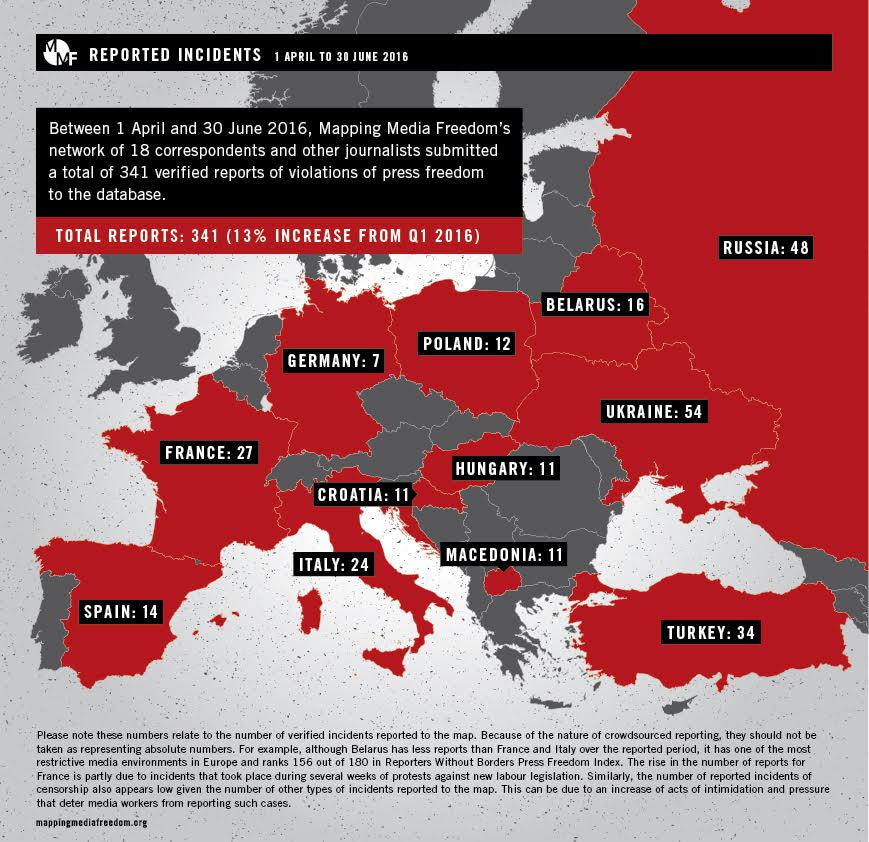
Violence against journalists in Europe increased in the second quarter of 2016, reports submitted to Index on Censorship’s Mapping Media Freedom platform show, as a government crackdown in Turkey intensified and protests turned violent in countries from France to Finland.
“Europe is considered one of the safest places for journalists in the world. However, increasing concerns about national security in the region – coupled with creeping authoritarianism – is making it an increasingly difficult place for the media to operate freely and safely,” said Hannah Machlin, project officer for Mapping Media Freedom. “And the threats are not just coming from the usual suspects: 12 incidents of injuries to journalists occurred in France and in a number of these cases journalists appear to have been directly targeted by police.”
Between 1 April and 30 June 2016, Mapping Media Freedom’s network of 18 correspondents and other journalists submitted a total of 341 violations of press freedom to the database, a 13% rise over the first quarter of 2016.
Key findings from the Q2 report
- Two journalists were killed. Mohammed Zahir al-Shergat died as a result of gunshot wounds in the city of Gaziantep, Turkey; journalist and radio host Luka Popov from northern Serbia was found dead in his home in Srpski Krstur
- 60 incidents of physical assault were confirmed
- 45 criminal charges and civil lawsuits were filed
- Media professionals were detained in 41 incidents
- 80 verified reports of intimidation, which includes psychological abuse, sexual harassment, trolling/cyberbullying and defamation were recorded
- Work was censored or altered 15 times
- Media professionals were blocked from covering a story in 73 incidents
“The fight for the abolition of prison sentences for offences committed through the press is unfortunately still relevant in Europe and neighboring countries,” Christophe Deloire, Reporters Without Borders secretary general said. “In a climate of growing fear and suspicion, judicial persecution of journalists takes more and more diversified forms. The Turkish authorities continue to invoke the anti-terrorism law, the protection of state secrets or insults to the head of state to prosecute and imprison more journalists.”
“Journalists are beaten, intimidated, imprisoned and killed in the pursuit of telling a story, exposing the truth and informing the public. These courageous men and women are the vanguard for free speech, freedom of expression and, ultimately, a free and democratic society. We need to come together and fight for journalists’ safety and end impunity for crimes committed against journalists,” said Dunja Mijatović, the OSCE Representative on Freedom of the Media.
The report is available now at https://mappingmediafreedom.org/plus/ or as a PDF.
For more information, please contact Hannah Machlin, Mapping Media Freedom project officer at [email protected]
About Mapping Media Freedom
Mapping Media Freedom – a joint undertaking with the European Federation of Journalists and Reporters Without Borders and partially funded by the European Commission – covers 42 countries with a network of correspondents, including all EU member states, plus Albania, Azerbaijan, Belarus, Bosnia, Iceland, Kosovo, Macedonia, Montenegro, Norway, Russia, Serbia, Turkey, Ukraine and Vatican City. In September 2015 the platform expanded to monitor Russia, Ukraine and Belarus and in February 2016 into Azerbaijan. Each report is fact checked with local sources before becoming available on the interactive map. Since launching in May 2014, the map has recorded over 2,000 incidents threatening media freedom.
14 Jul 2016 | Azerbaijan, Azerbaijan Letters, Europe and Central Asia, mobile, News and features, Ukraine
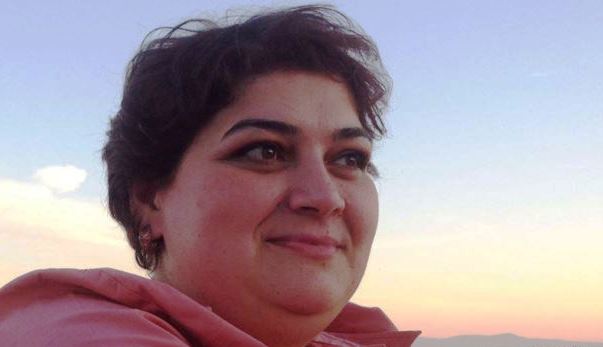
Khadija Ismayilova
I wrote this letter during my time in prison. I don’t remember the exact date but it was in the middle of the Ukrainian crisis and the so-called “trial” of Dilgam Askerov and Shahbaz Guliyev. The prison management had learned that I was writing something and sent officers in search of it. All my writings were taken including this letter. It was returned to me two months later when it was outdated no longer made sense to send. I am sharing it with you now:
There is an attempt to obscure human rights discourse with “mind your own business” arguments. As if human rights problems of, let’s say, the United States somehow justify the violation of human rights in Azerbaijan. This is another attempt to obscure the discourse by bringing up non-relevant “patriotic-sensitive” topics.
When the US Department of State or international organisations bring up the issue of political prisoners in Azerbaijan, or the corruption of government officials in Baku, they may ask something like: “Why did you keep silent about two internally displaced Azerbaijanis who attempted to visit their homeland under Armenian occupation despite the ongoing war and were taken hostage and are being ‘tried’ by mock trial of separatists?”
The question is surely legitimate but has nothing to do with the issue of human rights violations and political oppression in Azerbaijan.
Of course the lives of Dilgam and Shahbaz matter and the world’s ignorance with regard to criminal actions of Armenia and a separatist regime in occupied Karabakh has been an issue for a long time.
I do admire the courage of Askerov and Guliyev, who ignored the “de-facto” results of the occupation and paid continuous visits to the graves of their siblings and their homes under occupation. They have been doing it for the past ten years, using mountain paths, bypassing Azerbaijani troops and occupants, right up until they were captured.
The occupation of their homeland of Kalbajar, which has never been an Armenian settlement and has never been disputed, was a crime. Their custody in occupied Shusha by a criminal regime of the separatists is also a crime. Azerbaijani society is right in expecting the world to react adequately. Separatists in Karabakh are no different from those in Ukraine’s seized regions and it is fair enough to expect that the world would react to the ongoing occupation of Nagorny Karabakh as strongly as it did react to the occupation of Ukraine’s seized regions.
However, another fair question is: what does this to do with the crimes of president Ilham Aliyev’s regime? How can it be used as justification? This lame attempt by Azerbaijan’s ruling regime to obscure the human rights discourse is a very dangerous one. Is the Azerbaijani government trying to tell the world that they must have the same expectations of the criminal regime in Nagorny Karabakh as they have from the government of Azerbaijan, a sovereign state, a member of the Council of Europe, OSCE, UN etc?
My problem is not the law self-esteem of Aliyev’s regime. I am rather troubled with what role they give to the statehood of Azerbaijan in this lame argument. No matter how low my expectations are of Aliyev and his clique, I have never ever thought of comparing the state of Azerbaijan with the criminal separatist regime.
I don’t think the officials in Baku have paid due attention to this side of the story. In the tit-for-tat business of politics, the argument put on the scale must not be the state’s dignity. The Azerbaijani government had put too much into the game of securing power for Aliyevs. As dictatorships rarely have solid arguments, I do understand that justification of oppression is not an easy task. I don’t know if leading schools of the world teach it or not. The Soviet-era schooling system of partshkola exhausted its limits long ago and its remnants are only good for addressing uneducated masses inside the country. It is for those who are oppressed so much they cannot demand their government stop using the conflict as justification for all mismanagement, corruption and crime.
The people of Azerbaijan deserve better than what they have. The world and the organisations Azerbaijan is a member of deserve better representation from the country so it would be possible to carry out civilised discussion. And more than that, the 21st century deserves better than remnants of old Soviet partshkola in diplomacy.
8 Jul 2016 | Azerbaijan, Azerbaijan News, Europe and Central Asia, Mapping Media Freedom, News and features, Russia, Turkey, United Kingdom
Click on the dots for more information on the incidents.
Each week, Index on Censorship’s Mapping Media Freedom project verifies threats, violations and limitations faced by the media throughout the European Union and neighbouring countries. Here are five recent reports that give us cause for concern.
Turkey: DIHA reporter arrested in Batman
4 July 2016: Dicle News Agency reporter Serife Oruc was sent to court on the charges of being “member of an illegal organisation”, news website Bianet reported. Oruc was arrested with two other men who were in the same car with Oruc, Emrullah Oruc and Muzaffar Tunc.
All three were transferred to a prison in Batman.
UK: Journalist claims Telegraph censored article critical of Theresa May
2 July 2016: The Daily Telegraph pulled a comment piece critical of Theresa May as May fought to become the leader of the Conservatives.
The piece was published on 1 July in the news section of the Telegraph but was subsequently taken down from the website. It was entitled “Theresa May is a great self-promoter but a terrible Home Secretary”.
“Daily Telegraph pulled my comment piece on Theresa May ministerial record after contact from her people #censorship”, journalist Jonathan Foreman tweeted on 2 July.
The journalist authorised Media Guido to republish the piece and it can be read on their website.
Russia: Free Word NGO declared a “foreign agent”
1 July 2016: The Pskov office of the Russian justice ministry declared Svobodnoye Slovo (Free Word), an NGO which publishes the independent newspaper Pskovskaya gubernia, a “foreign agent”.
The decision was made after an assessment of the organisation was conducted by the Pskov regional justice ministry department. It established that the organisation “receives money and property from another NGO which receives money and property from foreign sources”.
In addition, the statement said the NGO is running “political activities” because the newspaper is covering political issues.
Independent regional Pskovskaya Gubernia became well-known after a series of articles revealing Russian casualties in eastern Ukraine in the beginning of the Donbass conflict in the summer of 2014.
Azerbaijan: Editor sentenced to three months in jail for extortion
1 July 2016: Fikrat Faramazoglu, editor-in-chief of jam.az, a website that documents cases and arrests related to the ministry of national security, was arrested last Friday. He has been given a three-month sentence after being accused of extorting money by threats.
Faramazoglu’s wife said a group of three unidentified men showed up at their home, confiscating his laptop. Documents and even CDs from his children’s weddings were confiscated without any warrant. The three men informed Faramazoglu’s wife that her husband had been arrested.
Russia: Police detains Meduza freelancer covering death of children in Karelia
30 June 2016: Police detained Danil Alexandrov, a freelance journalist for Meduza news website working in Republic of Karelia reporting on the death of 14 children in a boating accident on Syamozero Lake. He was accused of working “without a license“.
Alexandrov was detained on his way out of the Essoilsky village administration building, where he spoke to the head of the town. The police reportedly approached Alexandrov and threatened to confiscate all his equipment unless he signed aan administrative offence report. He signed the document.
“They hinted that it might be necessary to confiscate ‘evidence of my journalistic activities’,” Alexandrov told Meduza, adding that the police insisted the publication was a foreign media outlet and had to be accredited by the Ministry of Foreign Affairs.
The Foreign Ministry’s rules on accreditation discuss full-time staff members of foreign media outlets but do not comment on freelancers. Alexandrov’s court case is scheduled for 6 July. He faces a maximum penalty of 1,000 rubles (€14) for working “without a license”.