2 May 2014 | News
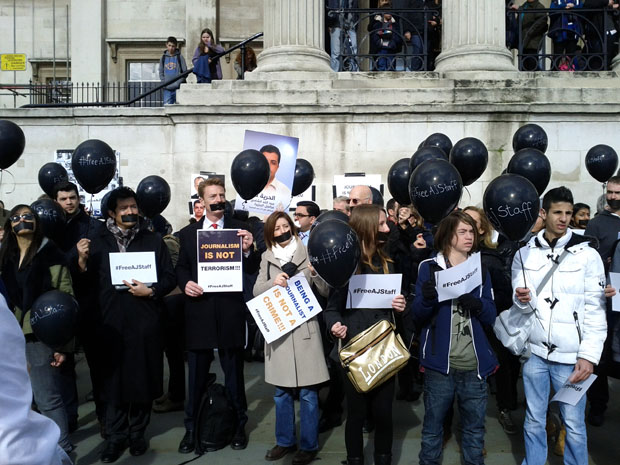
A London protest calling for the release of jailed Al Jazeera journalists in Egypt (Image: Index on Censorship)
Press freedom is at a decade low. Considering just a handful of the events of the past year — from Russian crackdowns on independent media and imprisoned journalists in Egypt, to press in Ukraine being attacked with impunity and government reactions to reporting on mass surveillance in the UK — it is not surprising that Freedom House have come to this conclusion in the latest edition of their annual press freedom report. This serves as a stark reminder that press freedom is a right we need to work continuously and tirelessly to promote, uphold and protect — both to ensure the safety of journalists and to safeguard our collective right to information and ability to hold those in power to account. On the eve of World Press Freedom day, we look back at some of the threats faced by the world’s press in the last 12 months.
1) Journalism is not terrorism…
National security has been used as an excuse to crack down on the press this year. “Freedom of information is too often sacrificed to an overly broad and abusive interpretation of national security needs, marking a disturbing retreat from democratic practices,” say Reporters Without Borders (RSF) in their recently released 2014 Press Freedom Index.
Journalists have faced terrorism and national security-related accusations in places known for their somewhat chequered relationship with press freedom, including Ethiopia and Egypt. However, the US and the UK, which have long prided themselves on respecting and protecting civil liberties, have also come under criticism for using such tactics — especially in connection to the ongoing revelations of government-sponsored mass surveillance.
American authorities have gone after former NSA contractor and whistleblower Edward Snowden, tapped the phones of Associated Press staff, and demanded that journalists, like James Risen, reveal their sources. British authorities, meanwhile, detained David Miranda under the country’s Terrorism Act. Miranda is the partner of Glenn Greenwald, the journalist who broke the mass surveillance story. Authorities also raided the offices of the Guardian — a paper heavily involved in reporting in the Snowden leaks.
2) …but governments still like putting journalists in prison
The Al Jazeera journalists detained in Egypt on terrorism-related charges was one of the biggest stories on attacks on press freedom this year. However, Mohamed Fahmy, Baher Mohamed, Peter Greste and their colleagues are far from the only journalists who will spend World Press Freedom Day behind bars. The latest prison census from the Committee to Protect Journalists (CPJ) put the number of journalists in jail for doing their job at 211 — their second highest figure on record.
In Bahrain, award-winning photographer Ahmed Humaidan was sentenced in March to ten years in prison. In Uzebekistan, Muhammad Bekjanov, editor of opposition paper Erk, is serving a 19-year sentence — which was increased from 15 in 2012, just as he was due to be released. In Turkey, after waiting seven years, Fusün Erdoğan, former general manager of radio station Özgür Radyo, was last November sentenced to life in jail. Just last Friday, Ethiopian authorities arrested prominent political journalist Tesfalem Waldyes and six bloggers and activists.
3) New media is under attack…
As more journalism is being conducted online, blogs, social and other new media are increasingly being targeted in the suppression of press freedom. Almost half of the world’s jailed journalists work for online outlets, according to the CPJ. China — with its massive censorship apparatus — has continued censoring microblogging site Sina Weibo, while also turning its attention to relative newcomer WeChat. In March, it closed down several popular accounts, including that of investigative journalist Luo Changping.
Meanwhile, Turkish Prime Minister Recep Tayyip Erdoğan has publicly all but declared war on social media, at one point calling it the “worst menace to society”. Twitter played a big role in last summer’s Gezi Park protests, used by journalists and other protesters alike. Only days ago, Turkish journalist Önder Aytaç was jailed, essentially, because of the letter “k” in a Tweet.
Meanwhile Russia has seen a big crackdown on online news outlets, while legislation recently passed in the Duma is targeting blogs and social media.
4) …and independent media continues to struggle
Only one in seven people in the world live in countries with free press. In many parts of the world, mainstream media is either under tight control by the government itself or headed up media moguls with links to those in power, with dissenting voices within news organisation often being pushed out. Brazil, for instance, has been labelled “the country of 30 Berlusconis” because regional media is “weakened by their subordination to the centres of power in the country’s individual states”. At the start of the year, RIA Novosti — known for on occasion challenging Russian authorities — was liquidated and replaced by the more Kremlin-friendly Rossiya Segodnya (Russia Today), while in Montenegro, has seen efforts by the government to cut funding to critical media. This is not even mentioning countries like North Korea and Uzbekistan, languishing near the bottom of press freedom ratings, where independent journalism is all but non-existent.
5) Attacks on journalists often go unpunished
A staggering fact about the attacks on journalists around the world, is how many happen with impunity. Since 1992, 600 journalists have been killed. Most of the perpetrators of those crimes have not been brought to justice. Attacks can be orchestrated by authorities or by non-state actors, but the lack of adequate responses by those in power “fuels the cycle of violence against news providers,” says RSF. In Mexico, a country notorious for violence against the press, three journalists were murdered in 2013. By last October, the state public prosecutor’s office had yet to announce any progress in the cases of Daniel Martínez Bazaldúa, Mario Ricardo Chávez Jorge and Alberto López Bello, or disclose whether they are linked to their work. Pakistan is also an increasingly dangerous place to work as a journalist. Twenty seven of the 28 journalists killed in the past 11 years in connection with their work have been killed with impunity. Syria, with its ongoing, devastating war, is the deadliest place in the world to be a journalist, while some of the attacks on press during the conflict in Ukraine, have also taken place without perpetrators being held accountable. That attacks in the country appear to be accelerating, CPJ say is “a direct result of the impunity with which previous attacks have taken place”.
This article was published on May 2, 2014 at indexoncensorship.org
30 Apr 2014 | Egypt, Iraq, News, Nigeria, Pakistan, Religion and Culture, Syria, Tajikistan, Turkmenistan, Vietnam
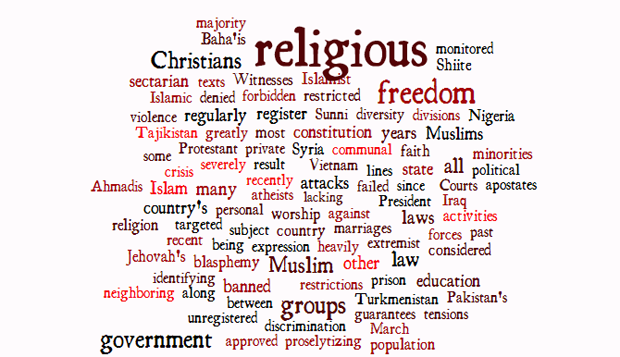
In January, Index summarised the U.S. State Department’s “Countries of Particular Concern” — those that severely violate religious freedom rights within their borders. This list has remained static since 2006 and includes Burma, China, Eritrea, Iran, North Korea, Saudi Arabia, Sudan, and Uzbekistan. These countries not only suppress religious expression, they systematically torture and detain people who cross political and social red lines around faith.
Today the U.S. Commission on International Religious Freedom (USCIRF), an independent watchdog panel created by Congress to review international religious freedom conditions, released its 15th annual report recommending that the State Department double its list of worst offenders to include Egypt, Iraq, Nigeria, Pakistan, Tajikistan, Turkmenistan, Vietnam and Syria.
Here’s a roundup of the systematic, ongoing and egregious religious freedom violations unfolding in each.
1. Egypt
The promise of religious freedom that came with a revised constitution and ousted Islamist president last year has yet to transpire. An increasing number of dissident Sunnis, Coptic Christians, Shiite Muslims, atheists and other religious minorities are being arrested for “ridiculing or insulting heavenly religions or inciting sectarian strife” under the country’s blasphemy law. Attacks against these groups are seldom investigated. Freedom of belief is theoretically “absolute” in the new constitution approved in January, but only for Muslims, Christians and Jews. Baha’is are considered apostates, denied state identity cards and banned from engaging in public religious activities, as are Jehovah’s Witnesses. Egyptian courts sentenced 529 Islamist supporters to death in March and another 683 in April, though most of the March sentences have been commuted to life in prison. Courts also recently upheld the five-year prison sentence of writer Karam Saber, who allegedly committed blasphemy in his work.
2. Iraq
Iraq’s constitution guarantees religious freedom, but the government has largely failed to prevent religiously-motivated sectarian attacks. About two-thirds of Iraqi residents identify as Shiite and one-third as Sunni. Christians, Yezidis, Sabean-Mandaeans and other faith groups are dwindling as these minorities and atheists flee the country amid discrimination, persecution and fear. Baha’is, long considered apostates, are banned, as are followers of Wahhabism. Sunni-Shia tensions have been exacerbated recently by the crisis in neighboring Syria and extremist attacks against religious pilgrims on religious holidays. A proposed personal status law favoring Shiism is expected to deepen divisions if passed and has been heavily criticized for allowing girls to marry as young as nine.
3. Nigeria
Nigeria is roughly divided north-south between Islam and Christianity with a sprinkling of indigenous faiths throughout. Sectarian tensions along these geographic lines are further complicated by ethnic, political and economic divisions. Laws in Nigeria protect religious freedom, but rule of law is severely lacking. As a result, the government has failed to stop Islamist group Boko Haram from terrorizing and methodically slaughtering Christians and Muslim critics. An estimated 16,000 people have been killed and many houses of worship destroyed in the past 15 years as a result of violence between Christians and Muslims. The vast majority of these crimes have gone unpunished. Christians in Muslim-majority northern states regularly complain of discrimination in the spheres of education, employment, land ownership and media.
4. Pakistan
Pakistan’s record on religious freedom is dismal. Harsh anti-blasphemy laws are regularly evoked to settle personal and communal scores. Although no one has been executed for blasphemy in the past 25 years, dozens charged with the crime have fallen victim to vigilantism with impunity. Violent extremists from among Pakistan’s Taliban and Sunni Muslim majority regularly target the country’s many religious minorities, which include Shiites, Sufis, Christians, Hindus, Zoroastrians, Sikhs, Buddhists and Baha’is. Ahmadis are considered heretics and are prevented from identifying as Muslim, as the case of British Ahmadi Masud Ahmad made all too clear in recent months. Ahmadis are politically disenfranchised and Hindu marriages are not state-recognized. Laws must be consistent with Islam, the state religion, and freedom of expression is constitutionally “subject to any reasonable restrictions imposed by law in the interest of the glory of Islam,” fostering a culture of self-censorship.
5. Tajikistan
Religious freedom has rapidly deteriorated since Tajikistan’s 2009 religion law severely curtailed free exercise. Muslims, who represent 90 percent of the population, are heavily monitored and restricted in terms of education, dress, pilgrimage participation, imam selection and sermon content. All religious groups must register with the government. Proselytizing and private religious education are forbidden, minors are banned from participating in most religious activities and Muslim women face many restrictions on communal worship. Jehovah’s Witnesses have been banned from the country since 2007 for their conscientious objection to military service, as have several other religious groups. Hundreds of unregistered mosques have been closed in recent years, and “inappropriate” religious texts are regularly confiscated.
6. Turkmenistan
The religious freedom situation in Turkmenistan is similar to that of Tajikistan but worse due to the country’s extraordinary political isolation and government repression. Turkmenistan’s constitution guarantees religious freedom, but many laws, most notably the 2003 religion law, contradict these provisions. All religious organizations must register with the government and remain subject to raids and harassment even if approved. Shiite Muslim groups, Protestant groups and Jehovah’s Witnesses have all had their registration applications denied in recent years. Private worship is forbidden and foreign travel for pilgrimages and religious education are greatly restricted. The government hires and fires clergy, censors religious texts, and fines and imprisons believers for their convictions.
7. Vietnam
Vietnam’s government uses vague national security laws to suppress religious freedom and freedom of expression as a means of maintaining its authority and control. A 2005 decree warns that “abuse” of religious freedom “to undermine the country’s peace, independence, and unity” is illegal and that religious activities must not “negatively affect the cultural traditions of the nation.” Religious diversity is high in Vietnam, with half the population claiming some form of Buddhism and the rest identifying as Catholic, Hoa Hao, Cao Dai, Protestant, Muslim or with other small faith and non-religious communities. Religious groups that register with the government are allowed to grow but are closely monitored by specialized police forces, who employ violence and intimidation to repress unregistered groups.
8. Syria
The ongoing Syrian crisis is now being fought along sectarian lines, greatly diminishing religious freedom in the country. President Bashar al-Assad’s forces, aligned with Hezbollah and Shabiha, have targeted Syria’s majority-Sunni Muslim population with religiously-divisive rhetoric and attacks. Extremist groups on the other side, including al-Qaeda and the Islamic State of Iraq and the Levant (ISIL), have targeted Christians and Alawites in their fight for an Islamic state devoid of religious tolerance or diversity. Many Syrians choose their allegiances based on their families’ faith in order to survive. It’s important to note that all human rights, not just religious freedom, are suffering in Syria and in neighboring refugee camps. In quieter times, proselytizing, conversion from Islam and some interfaith marriages are restricted, and all religious groups must officially register with the government.
This article was originally posted on April 30, 2014 at Religion News Service
24 Apr 2014 | Lebanon, News, Religion and Culture, Young Writers / Artists Programme
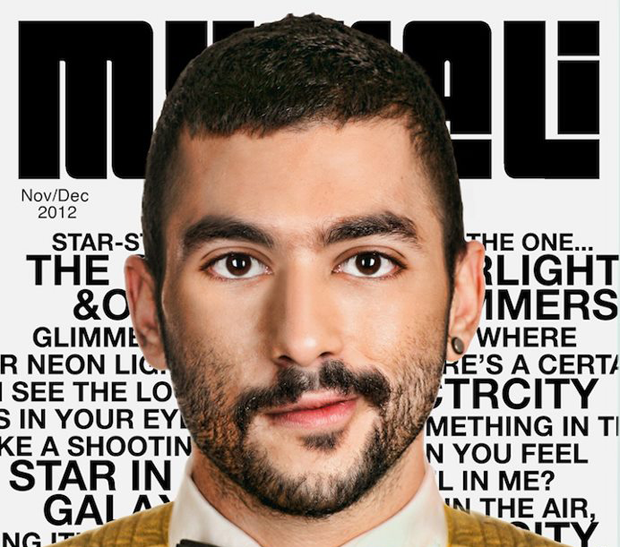
Hamed Sinno, who is openly gay, is the lead singer of Mashrou’ Leila
While walking the streets of the upscale downtown district of Beirut, or sipping cocktails in one of El-Hamra’s bustling bars, one could easily forget that Lebanon is a country where civil liberties are still in debate.
Article 534 of the Lebanese penal code states: “Any sexual intercourse contrary to the order of nature is punished by imprisonment for up to one year.” The vaguely worded article has and is still being used to crackdown on the LGBT community in Lebanon. Compared to its neighbours in the Middle East, Lebanon has long been considered one of the least conservative countries in the region. According to a poll conducted by the Pew Research Centre in 2013, 18% of the Lebanese population thinks that homosexuality should be accepted in the society, putting it way ahead of Egypt, Jordan and Tunisia where almost 97% of the population views homosexuality as deviant and unnatural.
The Lebanese Psychiatric Society issued a statement in early 2013 saying that: “The assumption that homosexuality is a result of disturbances in the family dynamic or unbalanced psychological development is based on wrong information” — making Lebanon the first Arab country to dismiss the belief that homosexuality is a mental disorder. On 28 January 2014, Judge Naji El Dahdah of Jdeideh Court in Beirut dismissed a claim against a transgender woman accused of having a same-sex relationship with a man, stating that a person’s gender should not simply be based on their personal status registry document, but also on their outward physical appearance and self-perception. The ruling relied on a 2009 landmark decision by Judge Mounir Suleimanfrom the Batroun Court that consenual relations can not be deemed unnatural. “Man is part of nature and is one of its elements, so it cannot be said that any one of his practices or any one of his behaviours goes against nature, even if it is criminal behaviour, because it is nature’s ruling,” stated Suleiman.
Despite the recent positives, being gay in Lebanon is still a taboo. In a country drenched in sectarianism, debates about homosexuality are easily dismissed in the name of religion and homosexuals are accused of promoting debauchery.
“People in Lebanon, and across the region, still act like homosexuality doesn’t exist in our society,” said Kareem, who requested that Index only use his first name. “I think it’s important that we start the conversation and get the issues out in the open, so people can start acknowledging it and then decide their stance on. The fight for our rights comes later on,” he added.
In 2013, Antoine Chakhtoura, mayor of the Beirut suburb of Dekwaneh, ordered security forces to raid and shut-down Ghost, a gay-friendly nightclub. “We fought battles and defended our land and honor, not to have people come here and engage in such practices in my municipality,” the mayor asserted.
Four people were arrested during the raid and brought back to municipal headquarters where they were subject to both physical and verbal harassment: forced to undress, enact intimate acts which included kissing, as well as being violently beaten. Marwan Cherbel, minister of interior at the time of the incident, backed the mayor’s actions, adding that: “Lebanon is opposed to homosexuality, and according to Lebanese law it is a criminal offence.”
Unfortunately, this was not an isolated incident. In a similar raid on a movie theatre in the municipality of Burj Hammoud known to cater for a gay clientele, 36 men were arrested and forced to undergo the now abolished anal probes — known as tests of shame. The raid came only a few months after Lebanese TV host Joe Maalouf dedicated an episode of his show Enta Horr (You’re Free) to exposing a porn cinema in Tripoli where it was claimed that young boys were being sexually abused by older men.
“The fact that these incidents received a lot of media coverage, some of which denounced the raids, is a sign that the public is little by little taking an interest in the issue of gay rights,” said Kareem. “Five or six years ago, this could have easily gone unnoticed. While the gay community might not be fully accepted or tolerated in Lebanon, it has been gaining a lot more visibility in recent years.”
Helem, a Beirut-based NGO, was established in 2004 to be the first organisation in the Middle East and Arab world to advocate for LGBT rights. In addition to campaigning for the repeal of Article 543, Helem offers a number of services, including legal and medical support to members of the LGBT community. Organisations like Helem and its offshoot Meem, a support group for lesbian women, had a huge impact on raising awareness and correcting misconceptions about homosexuality. Support from Lebanese public figures has also been on the rise in recent years. For example, popular TV host Paula Yacoubian and pop star Elissa have both shown support for the LGBT community in Lebanon via their Twitter accounts.
While the struggle to change the law continues, young artists have been challenging social norms through art. Mashrou’ Leila, a Beirut-based indie rock band, has sparked a lot of controversy thanks to their songs, in which they unapologetically sing about sex, politics, religion and homosexuality in Lebanon. In Shim el Yasmine, the band’s lead singer, Hamed Sinno, who is openly gay, sings about an old love, a man whom he wanted to introduce to his family and be his housewife. Director and art critic, Roy Dib, recently won the Teddy Award for best short film in 2014 at the 64th Berlinale International Film Festival with his film Mondial 2010. The film tells the story of a gay Lebanese couple on the road to a holiday weekend in Ramallah, Palestine. It tries to explore the boundaries that make it impossible for a Lebanese person to go into Palestine, as well as the challenges faced by a homosexual couple in the region.
The battle for gay rights in Lebanon is multilayered, and while change is starting to feel tangible, there is still a lot to be done.
This article was originally posted on 24 April 2014 at indexoncensorship.org
14 Apr 2014 | News, Religion and Culture, United Kingdom
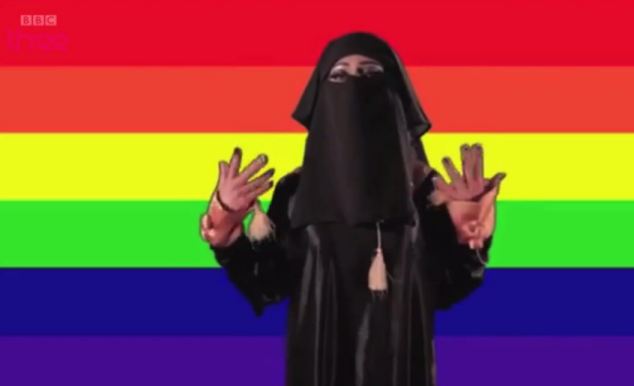
Asif Quraishi, better known as drag queen Asifa Lahore, sits unassumingly in a TV studio. “One question I’d like to ask”, he says, “is when will it be all right to be Muslim and gay?”
The programme is Twitter-powered BBC Three debate series Free Speech, whose host Rick Edwards (of Tool Academy and, unexpectedly, Cambridge) makes Nicky Campbell seem subdued, and where no thought is too complex for 140 characters. Producers, show name notwithstanding, spiked the question from a previous edition when officials at Birmingham Central Mosque, where Free Speech filmed on March 13, “expressed deep concerns” about gay Muslims being discussed. The speed at which showrunners acquiesced, postponing the segment, speaks to a wider trend.
The first guest to comment, kufi-clad Portuguese convert Abdullah al Andalusi, calls condemning gay sex “the Islamic position” with a party leader’s certainty. It’s unsurprising: al Andalusi, who defends public segregation by gender and from whose talks women have been banned, seeks a nondemocratic “modern [Islamic] Caliphate” under sharia government, free among other things of “women wearing bikinis”, “the hijab being optional” and “men and women having identical inheritance and gender roles”. Al Andalusi rails in-studio against notions of “extremism”, declaring them a means of profiling “Muslims with orthodox beliefs”. He sees himself as holding these, and so apparently do programme-makers, since he speaks much more than Asif does.
The counter-extremist whose work he attacks, Lib Dem candidate for Hampstead Maajid Nawaz, is also in the room. (“I will speak out”, he tells the drag performer, “on your right to identify however you want.”) Nawaz too has been hounded by religious would-be censors, despite being a Muslim himself. This January, following the LSE’s attempts to ban it, he tweeted an image from the atheist web strip Jesus and Mo, commenting “This is not offensive and I’m sure God is greater than to feel threatened by it.” A subsequent Change.org petition calling for his sacking gained over 20,000 signatures, some with death threats attached. Though Nick Clegg eventually stepped in to condemn them, spokespeople told the press the party “urged all candidates to be sensitive to cultural and religious feelings”, and Nawaz – presumably after internal bickering – conceded in a joint statement with Mohammed Shafiq, head of the Ramadhan Foundation and leader of the witchhunt, that “images of the spiritual leaders of all religions should be deemed to be respectful”.
In February Shazad Iqbal, a hitherto unknown British Muslim, used a similar petition to demand YouTube remove Katy Perry’s “Dark Horse” video, in which an Ancient Egyptian turns to sand whose pendant, on close inspection, reads “Allah”. “Blasphemy is clearly conveyed in the video”, Iqbal wrote. “Such acts are not condoned nor tolerated.” While the offending necklace, which had to be indicated using photoshopped freeze-frames, was barely visible, tens of thousands of signatures poured in – today, the page boasts more than 65,000 – and Perry’s producers digitally obscured it.
Iqbal, who used his petition site to share evangelistic videos, gained a platform much like Iqbal’s and al Andalusi’s. All three, and countless more religious rightists, have sold themselves as commentators, “community leaders” and de facto spokesmen for Muslims (“men” is applicable here), grabbing the spotlight neither through skilled writing nor through views polls say are actually widespread. They owe their standing to officialdom’s mounting anxiety to please the most censorious believers, its instinct that those eagerest to cleanse the public sphere of blasphemy are those who matter most.
Recycled lines about a scaremongering anti-Muslim press over-reporting extremism come easily, but demagogues of this kind are media’s darlings; far from casting them as bogeymen, it heaps meetings with politicians, TV appearances and public validation on them. Nor is this pattern unique to Islam. In a 2012 speech for the National Secular Society, Pragna Patel of Southall Black Sisters cites the case of Behzti, a play by Gurpreet Kaur Bhatti which portrayed sexual violence in a Sikh temple. “Fundamentalists, but also so-called moderates,” says Patel, “took offence, protested and had the play removed”, theatre staff bowing to their demands. Leaders on the Sikh right, she says, stated once Bhatti entered hiding that if Labour’s Racial and Religious Hatred Act had existed at the time, it would have been used to censor the play.
Authorities sided with those attacking her, as they sided with Shafiq over Nawaz, al Andalusi and Birmingham Central Mosque over Quraishi, Iqbal over every Muslim undisturbed by Katy Perry. Reformists and minorities like them, as much as a free society, are casualties of this love for religious censors. If minor faiths, still mysteries in the public eye, need representatives, far better ones exist: A media that paints puritans and fanatics as mainstream forfeits its right to condemn them.
This article was posted on 14 April 2014 at indexoncensorship.org

