20 Mar 2014 | Indonesia, News
(Photo illustration: Shutterstock)
Human rights organisations suspect a live YouTube broadcast detailing abuses by the Indonesian government may have been the real reason behind “technical difficulties” at an environmental conference in Oregon.
Two Papua tribesmen had travelled to Oregon specially for the Public Interest Environmental Law Conference in Oregon, “the world’s most important environmental law conference.”
A live broadcast of the conference mysteriously went silent when the tribesmen started telling the audience about human rights violations by the Indonesia government, perpetrated in their homeland
The pictures on the slideshow, illustrating their points, were behind them and still visible, although their commentary was not audible to anyone listening from home.
Survivor International, who also sent a delegate to the conference, told Index on Censorship that they suspect the attack was a hack, and that their organisation has been targeted by Indonesian agents in the past.
“In 2010, our website was taken offline,” said Sophie Grig, South East Asia Researcher. “We had posted a video of Indonesian soldiers torturing Papuan trible people. Other groups who also posted the video were hacked.”
The attack lasted for two days, during which all websites who had posted the video were bombarded by thousands of requests from thousands of computers worldwide, and the German police began an investigation after one of the hacked groups, based in Germany, made a complaint.
At the time, Survival’s Director Stephen Corry commented ‘This isn’t a couple of geeks in a shed, it’s an expensive and sophisticated attack amounting to cyberterrorism. The damage to Survival International may be substantial but is of course nothing compared to that inflicted on West Papuan tribes.
He added “This is a struggle for the survival of the one million oppressed tribespeople in Indonesian West Papua.”
The two Papuans who attended the conference in Oregon, are members of the Amungme tribe, whose land is home to Grasberg, a mining facility operated by 19,500 employees.
“In the area around the mine, we’ve seen forced displacements, reports of torture and illegal detention by the Indonesian military” said Grig. “We also have strong concerns about the environmental impact.”
Positioned on Papua’s highest mountain, Grasberg is home to the largest gold mine in the world, as well as the third largest copper mine in the world. It produces around
Local charities, as well as international environmental charities, are concerned about the increasing number of land slides and acidifying waste products in local water sources, although the mines operators, Freeport and Rio Tinto, insist their operations fit within international regulations.
Indonesia has occupied Papua (the western half of the island of New Guinea) since 1963, and more than 100,000 Papuans are believed to have been killed since then, many at the hands of the Indonesian military. The government hold a 10% stake in one of the companies operating the mine.
Although it is unclear which software was used to execute this hack, according to Amnesty International in Indonesia, the Papuan military have already purchased invasive internet monitoring technology from Gamma International, a UK-based company. Gamma International manufacture FinnFisher, software which is capable of monitoring all internet communications in a country. The software has been used by repressive regimes including Bahrain, UAE, Turkmenistan, Egypt (under Mubarak, although it is unclear whether the software is still in use).
Andreas Harsono, Indonesia Researcher for Amnesty International, also told Index about some of the human rights abuses he regularly observes in Papua
“I mainly deal with cases where freedom of expression is being denied, as well as impunity amongst the military, police and prison wardens,” he said, “There are also extra judicial killings,” he adds.
There are believed to be over seventy political prisoners held in brutal Indonesian prisons – some serving up to twenty years.
Sophie Grig from Survivor International warned Index
“West Papuans are no strangers to having their voices silenced. Journalists are effectively banned from the region, other than in exceptional circumstances and where they are accompanied by Indonesian government minders. People are imprisoned when their only crime is to raise the banned West Papuan flag, or to speak out against military atrocities and the Indonesian rule of West Papua.”
This article was published on 19 March 2014 at indexoncensorship.org
17 Mar 2014 | News, Religion and Culture, Young Writers / Artists Programme
A few weeks ago, 13,000 writers swarmed Seattle for the annual Association of Writers and Writing Programs conference. In the seaport city known for its ideal reading (and writing) weather — and home to poet Maged Zaher — writers filled hotel rooms and bars. On official panels they debated the state of contemporary literature, and at offsite readings and parties, they celebrated the written word.
The song of the nightingale / Is not up for sale
Ziba Karbassi, Gravequake
On the other side of the hemisphere, Ziba Karbassi doesn’t need to attend a conference to know what contemporary literature looks like. Born in 1974 in Tabriz, Iran, this rising star of Persian poetry, who also writes in her first language of Azeri Turkish, has been living in exile in London since leaving her country in 1989. Karbassi has published eight books of poetry in Persian, and with Stephen Watts, she has translated much of her work into English.
Taken from an incident close to the author’s family in the 1980s, her poem “Death by Stoning” depicts a young pregnant woman taken to prison, tortured, and stoned to death:
I am not a scaffold to be toppled
not a felled tree to be sunk in the flood
I am only a bag of bones and skin
smashed about
The heavy consonants in the nouns and adjectives and the scattered form of the poem demonstrate the mother-to-be’s “anguished, loving, and crazed” state of mind. “Death by Stoning” shows how poetry can give us a view into worlds distant from — but not entirely unlike — our own. Poetry can also play a part in shaping our world.
After the US invasion of Iraq by the Bush administration in 2003, over 13,000 poets rallied in the global movement Poets Against the War. During Occupy Wall Street in the autumn of 2011, poets from around the world contributed to the People’s Library in Zuccotti Park to form a living, breathing, inclusive anthology of the moment. At Occupy Oakland’s Port Shutdown on 2 November, 2011, there was a strong poets’ contingent, and when protestors in Cairo marched on Tahrir Square in solidarity with Occupy Oakland, the meme “Don’t Afraid” from one protestor’s sign quickly became a poetic rallying cry for Oaklanders.
But for artists as for whistleblowers — especially those working against repression, colonialism, and the destruction of the environment by big business — exercising free speech, online or off, can still lead to worst-case scenarios of exile, as in Karbassi’s case, and execution, as friends, relatives, and fans of Arab-Iranian poet Hashem Shaabani can attest to.
What! Graveyard? Fear? Are you kidding? You’re kidding, right?
Gravequake
Karbassi, however, is not afraid of expressing herself, and poets continue to organise, as manifested at the Revolution and/or Poetry conference in the San Francisco Bay Area in October 2013.
Our poetry is not exactly our politics, and our politics are not necessarily our poetry, but the line between them is blurry and easily crossed. Poetry remains a relatively free space: there are plenty of freely accessible journals on the internet; house and salon-style readings are growing in and around urban centres; anyone could submit to the Occupy Wall Street anthology, and all submitted poems were accepted. The art form remains a hopeful space for full participation in cultural and everyday life, whether we gather at conferences or in the streets — or both.
This article was posted on March 17, 2014 at indexoncensorship.org
14 Mar 2014 | Awards, Egypt, News
Rapper Mayam Mahmoud uses hip-hop to address issues such as sexual harassment and to stand up for women’s rights in Egypt.
Women played a significant role in the demonstrations that eventually toppled the regime of Hosni Mubarak in 2011. In the aftermath, however, the problem of sexual harassment has become what activists now describe as “an epidemic”.
The 18-year-old rose to prominence through her appearances on the popular TV show Arabs Got Talent. Aged 12, she was introduced to poetry by her mother. She began writing her own work, which soon turned into rap — still a male dominated music genre across the world.
“It’s got a lot of people talking about whether it’s possible for a veiled girl, or even a girl, to do this,” she says. “The girls in this field are thought to have bad morals. So it’s hard to find someone to work with her, to create a beat, to master the track.”
In order to develop her own voice, Mayam tries not to listen to western Hip hop and her songs tackle harassment and victim-blaming head-on – condemning Egyptian society for accepting harassment as part of everyday life, and for laying the blame for it on women rather than men.
“I won’t be the shamed one,” she says in one of her raps. “You flirt, you harass and you see nothing wrong with it. But even if it’s just words, these are not flirts, these are stones.”
Nominees: Advocacy | Arts | Digital Activism | Journalism
Join us 20 March 2014 at the Barbican Centre for the Freedom of Expression Awards
This article was posted on March 14, 2014 at indexoncensorship.org
27 Feb 2014 | News
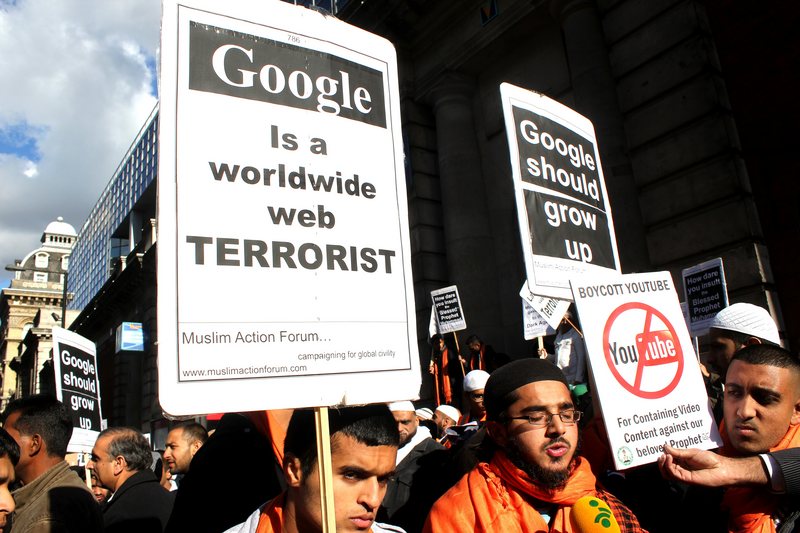
The Innocence of Muslims is truly the free speech story that keeps on giving. The crude, cheaply made anti-Islam film sparked international outrage when it first appeared on YouTube in September 2012, with even President Obama forced to weigh into the debate after the US Embassy in Cairo issued a tweet “condemning” the video. While ostensibly supporting free speech, the White House did suggest that Google should examine whether the video contravened its own terms of service.
Google eventually blocked the video of its own accord in Libya and Egypt. Meanwhile, in its move to censor the film, Pakistan simply blocked the whole of YouTube.
Now, a US court has ruled that Google should remove the video from YouTube. Not because of blasphemy, but because of copyright. The case against Google and the makers of the film was brought by actress Cindy Lee Garcia, who appears in the film for all of five seconds. Garcia claims that her single line, suggesting that Muhammad was a “child molester” was dubbed, and that she was duped into appearing in the anti-Muslim film, having been told it was a trailer for an adventure movie.
Crucially, she also says that she has a claim to the copyright of the film. The Ninth Circuit Court of Appeals agreed that she may have a claim, and on 19 February ordered Google to remove the film from its YouTube service.
The court further ordered that the ruling be kept secret until 26 February, when the 37-page opinion on the case was issued “to prevent a rush to copy and proliferate the film before Google can comply with the order.”
Google has said it will appeal the order, saying that not only could the copyright claim of a bit-part actor create havoc for filmmakers of the future, but that service providers could now also be swamped with takedown requests from people who regret appearing in works in the public domain.
Interestingly, it also suggests that the simple removal of the video could constitute a tampering with the historical record. That chimes with an argument Index has made before – we seem far more comfortable with the removal of web content than we do with, say, the pulping of books, even though the intent is the same.
As things stand, Google has complied with the order, and the Innocence of Muslims can no longer be found on YouTube.
In yet another twist, Pakistani web freedom campaigner and Index on Censorship award nominee Shahzad Ahmed has used the removal of the video to pressure his government to lift the YouTube ban.
“We think that now the government of Pakistan has been left with no excuse to continue blocking access to YouTube,” he is reported as saying. “But the ban on YouTube has got more to do with the government’s desires and efforts to impose censorship, content filtering and moral policing and we are fighting against them in court through a constitutional petition.”
This article was posted on February 27, 2014 at indexoncensorship.org
