21 Jul 2015
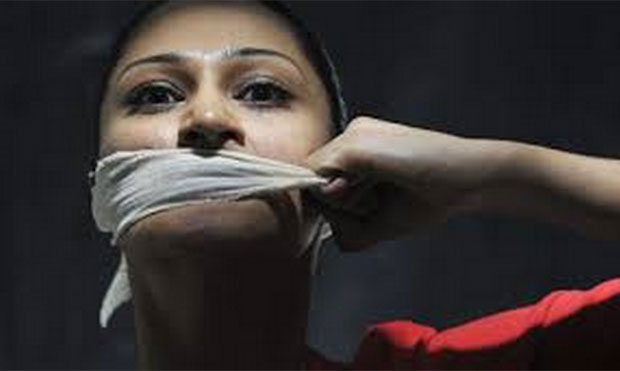
From Behud – Beyond Belief by Gurpreet Kaur Bhatti
By Julia Farrington
July 2015
In the early stages of Index on Censorship’s programme looking into art, law and offence, we wrote a case study about Coventry’s Belgrade Theatre, which premiered the production of Behud – Beyond Belief, 2010. The play is Gurpreet Kaur Bhatti’s artistic response to the experience of Behzti – Shameless, her previous play, being cancelled by Birmingham Rep in the face of protests.
Superintendent Ron Winch of Coventry Police was the officer in charge of policing the Behud premiere. Julia Farrington, associate arts producer, Index on Censorship, talked to Winch about working with the community and the theatre to ensure that Behud went ahead without incident. Winch provided interesting insights into how the police view the right to artistic freedom, particularly in comparison to the right to freely express political views.
Winch: The role of the police is to maintain law and order, to prevent crime and disorder. But the police have a wider democratic responsibility both to facilitate freedom of expression and at the same time to understand that it may cause offence to others. The community is looking to the police to prevent the play from going ahead because they believe it’s offensive. It could be blasphemous. And the theatre is saying to the police that the playwright has a right to express her views. The fact that Behud wasn’t as controversial a play as Behzti was probably due to the work that we did going into the community and reassuring people. It was successful from our perspective; there were no public safety concerns and the play went ahead.
Farrington: So you were weighing up the right of freedom of expression against other potentially conflicting calls on your time and your resources?
Winch: For me it was about understanding what policing is in a liberal democracy. We police by consent. That is not about police preventing freedom of expression, as long as it is lawful. If I didn’t believe in freedom of speech I wouldn’t be in this profession. And yet I am acutely aware of how sensitive some sections of the community are, especially when they see their faith being questioned, highlighted and in their view, blasphemed.
Farrington: Do you think that freedom of expression in this country is endangered if it requires this degree of negotiation and investment of time and resources on everybody’s part?
Winch: My professional view and my personal view are different. My personal view is that individuals have the power to press the off button. There are all sorts of things, especially in the media, with 24-hour news and the internet, that people would prefer not to see and it is hard for the state to control. And you have to ask whether censorship is something that the state should be concerned with. The state is always trying to legislate against things that it sees as harmful, either to the political establishment or the economic or social well-being of the community at large. But with diverse communities, all of whom have different views of what is acceptable, it is going to be very difficult for the state to create laws that they then expect the police to enforce.
Farrington: You could say that it is not the role of the state to legislate for people’s sensibilities – the idea that people believe that they have a right not to be offended. In a way that is what you were balancing in the case of Behud.
Winch: It might be surprising to you coming from Index on Censorship – you wouldn’t expect a police officer to be making these kind of decisions around a play.
Farrington: I would have expected them to be taken by someone in the council. But when I spoke to Clive Towndend of (Coventry City Council) Events Committee he emphasized that this was a policing issue.
Winch: As I said earlier, my decision was very clear. I faced a situation where if I didn’t do the consultation I might have had to react in an emergency – which is so much harder and more challenging than when you have had time to prepare.
Farrington: So you had police officers at the back of the theatre?
Winch: We had sufficient number of police officers on duty to manage the risk as we perceived it. But those officers were in a very low profile kind of mode.
Farrington: In the last few days before the production opened there was a communication between your colleagues in Birmingham and yourselves suggesting the threat of violence.
Winch: The threat was always there. If a group of people wanted to disrupt an event, especially a controversial event, then if they have the support they could probably do that, whether or not it was justified.
Farrington: I’d like to talk about the question of fees to cover the cost of guaranteeing the safety of the theatre. As I understand it, the bill was £10,000 a night for the cost of policing.
Winch: It wasn’t that much. In fact the theatre was not charged for the policing.
Farrington: But initially you assessed that it would cost £10,000 a night in policing and you wanted to pass that cost onto the theatre. The theatre argued that, as a not-for-profit rather than a commercial organisation, such a charge would make it impossible for the play to go ahead [and an act of de-facto censorship on financial grounds]. The fee was reduced to £5,000 and eventually as I understand it, the fee was waived altogether.
Winch: My police constable in charge of planning our operations works in other areas – for example football matches – took the view that if we were being asked to police a private event there might be costs. I think that is legitimate. Some of the community might say whilst I have got police officers enabling, or being seen to enable, a controversial play, that means that officers are not dealing with other matters. However, as things moved on, as the risks changed because of the dialogue and the meetings with the safety advisory group, I took the decision that we wouldn’t charge for policing. But what it categorically wasn’t about was the police being seen to incur costs on an organisation or theatre to prevent putting on a play.
Farrington: If you have a political protest that is planned for Saturday afternoon going through the centre of town, could you charge that political party for policing?
Winch: No, that would be very different. It is entirely fair that a profit-making private enterprise that needs to use public resources to enable their business interests to go ahead – for example in the case of a football match – be charged for the privilege. On the other hand, in the case of a political party that is not making any profit, then it is entirely appropriate that the resources of the state enable it. There is a distinction.
Farrington: But many theatres are not-for-profit charities and are perhaps more comparable to a political party. They promote and facilitate artistic expression, just as political parties promote and facilitate political expression. Both have to raise funds. Is there a category within your assessment for charitable not-for-profit arts organisations?
Winch: Ultimately it comes down to professional judgement, based on threat and risk around events. And the risk initially with this play was high, though the threat really did recede as we did the work.
Farrington: But it was a discretionary judgement.
Winch: But then so much of policing is.
Farrington: It could have gone the other way – Behud could have been pulled. Whereas in the case of a political party, even if the politics are horrible and you don’t agree with them, you don’t interfere. There seems to be an imbalance.
Winch: I don’t know about imbalance. But how would you define what type of event should be supported by the public purse? We have had enough difficulty trying to define when football clubs, multi-million pound enterprises, should pay for policing. If we open it out to all walks of public life it is just going to be too complicated. This is where we rely on discretionary judgement of professionals; society expects them to make those rational informed judgments, as I did in this situation.
Farrington: But you wouldn’t exercise the same discretionary judgment about a political party?
Winch: You could if the political party wanted to march; there is legislation around that because there are public safety considerations. If a political party wants to make a static protest there is very little you can do to prevent it from happening in terms of the law.
Farrington: But is a static protest of political expression that different from a static protest of artistic expression – in other words a play. There seems to be more structure, more acceptance and more clarity around political expression than around artistic expression, which leaves theatre vulnerable to professional discretion preventing it from going ahead.
Winch: I would not welcome legislation defining when and where we should be involved in artistic expression. I don’t think that is the right area for the state to be looking at.
Farrington: But what if it is about protecting the right to artistic expression?
Winch: But it’s about the evolution of what is considered inappropriate, and that changes. I think freedom of expression is protected – it has a natural element of protection around it and a natural censorship as well.
Farrington: And that is your consensual policing. You police by consent. You have antennae and connections tuned in.
Winch: Absolutely. My accountability in the Behud case was to the community in the widest possible sense. I had very little accountability in terms of legislation. It would just be too difficult in today’s society.
Farrington: After the G20 there was a big shift, wasn’t there, in terms of the right to protest was more thoroughly supported?
Winch: You have to look at what the law says about when and where you need to intervene. The G20 was a different set of circumstances to what we are facing locally. We live in a changing world and we have to respond to those changes.
Farrington: Nowadays we are more aware of hurt to people’s feelings and sensibilities and that’s where it becomes complicated.
Winch: It’s a very difficult area for professionals to negotiate.
Farrington: Nonetheless this play wasn’t like a football match and charging for policing would certainly have stopped the play from going ahead. The question for me is what happens when there are more constraints on resources? The decision might not go that way and the play might not go on.
Winch: I can only really speak about this specific case, because if an event like this doesn’t go well then potentially I would have to put more police officers onto the streets to maintain the security of the theatre. I think what happened with Behud was a wake up call for the theatre to recognise that actually the police are not the enemy, out to prevent freedom of speech, but very much helping to facilitate it – from a very balanced perspective. I think the wider question is: what do we want our police to do in a liberal democracy? I think policing needs to reflect the changing norms in society. Things that wouldn’t have been acceptable 20 years ago, especially around questions of morality, are now acceptable.
Case study: “The law is no less conceptual than fine art”
21 Jul 2015
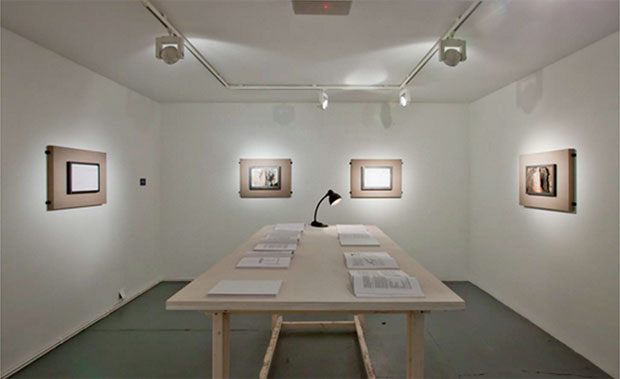
Installation image from Xenofon Kavvadias: The law is no less conceptual than fine art at 10 Vyner Street. With permission of the artist.
By Julia Farrington
July 2015
“The law is no less conceptual than fine art”
Exhibition of Illegal Books by Xenofon Kavvadias
10 Vyner Street London E8
5th May – 17th June 2011
Description of the work
In this show books that are or can be considered illegal under contemporary UK anti-terrorist legislation were displayed as an art installation. The books represented the full spectrum of ideologies and beliefs that can be considered illegal in the UK.
The books were uniformly hard-bound without titles, accompanied by text describing the content and context in which it was published. Background information, correspondence and records of interviews were displayed in the gallery.
The gallery was well lit and the viewer was encouraged to take time to read the books and accompanying information. Each week of the six-week exhibition, one book that could not exist outside the specific conditions that were created in the gallery was burned and the ashes were displayed in specially made glass vases. By the end of the exhibition, all such books were burned.
In the installation Kavvadias explicitly stated that the documents neither expressed his views nor had his endorsement.
Background
Kavvadias started the project in 2005 believing that the new anti-terrorist legislation was highly problematic and represented an erosion of civil liberties – a hypothesis that he wanted to test as an artist, from the standpoint of an individual, independent investigator who has unique access through exhibition to the public, the media, the law and the policy maker.
I am not a lawyer, in fact when I started out I wasn’t sure what I was. The choices seemed to be: journalist, activist, artist. I chose the latter.”
The legislation
As the Report of the Eminent Jurists’ Panel on Terrorism, Counter-Terrorism and Human Rights 2009 noted:
Many participants at the U.K. hearing raised concerns that the breadth and the ambiguity, of the offence of ‘glorification’ create a risk of arbitrary and discriminatory application. The risk of such abuse is exacerbated by the fact that the offence applies also to past acts of terrorism and to terrorist acts occurring in other countries. Witnesses expressed concern that such wide-ranging laws reduce legitimate political debate, particularly within immigrant or minority communities.”
Aware of the grey areas the legislation created, Kavvadias’ show was an attempt to plot the margins of legality with regard to counter terrorism legislation – what can be seen, said or thought.
The methodology
Kavvadias identified the steps he needed to take to be able to demonstrate, in court if necessary, that his motivation was as an artist. The artwork was both his presentation of texts and objects in a carefully curated space, and the evidence for his defence.
Here is a brief summary of his interactions with the police, lawyers and a member of the House of Lords, who helped him to answer the underlying questions his project raised.
The Police
Having first secured support for this project from Leeds Metropolitan University where he was studying at the time, Kavvadias approached the police and had an hour-long interview with the Counter Terrorism Special Branch in Leeds. He made a record of the interview during which he went through a list of the materials he thought he could not present. He asked the police to respond to these materials during the interview. He was asking for advice, not permission.
The police tried to advise Kavvadias on what — in their view, following available guidance — he could and couldn’t collect and discussed examples of material that had been used by the police to secure convictions.
The police always had a feeling of a line – ‘if you cross the line it will be illegal and we will have to arrest you’. This is a preventative measure from the police – they want to present a line, they don’t want to give you the grey area, so that you stay safely within the legal side. Even if later the court might say – ‘no there is no case’. The police have an interpretation of the law and this understanding is later modified by a court.”
The State Machinery
Kavvadias wrote to the Press & Broadcasting Advisory Committee (DPBAC) at the Ministry of Defence (MoD) asking if he could display restricted MoD documents that he found on Wikileaks. He received the following reply:
“I have no objections from Defense Advisory Notice standpoint to your displaying the first and second pages of the subject document as part of your project.”
With this letter to support him, Kavvadias displayed the first and second page of a document, leaked by Wikileaks, that gives an idea of the level of surveillance capabilities of the UK.
The Lawyers
The first legal opinion Kavvadias sought was from Liberty and he got a very detailed letter back, explaining how the legislation can be applied, where he needed to be extremely careful and how he should position himself. “It was very illuminating and very useful and it was one point of view,” Kavvadias said.
Kavvadias then approached Gareth Pearce, a British solicitor and human rights activist, who connected him with Alastair Lyon one of her team, and subsequently talked to Matrix Chambers’ Matthew Ryder QC in detail about his project. All the lawyers he approached supported the project and thought it was an important piece of work. While they disagreed about what was the greatest specific risk, the lawyers agreed that extreme care should be taken on how the whole show would be staged.
All agreed that at the entrance of the gallery there should be a very clear public disclaimer that the artist and gallery do not advocate violence and to distance themselves from the content. It should be made absolutely clear that the exhibits were to be seen and discussed, but not recorded — no photography, no note taking — to minimise dissemination. No part of the installation should be available on the internet.
The biggest challenge was the contradictory advice – ultimately you have to make up your mind – Liberty, MR, Lord Carlile – all liked the project. No-one took an absolute position so it was my decision. I felt I had the information – the facts were in front of me and I had to make up my mind to stick with it.”
The Law Lord
Encouraged by the support from the lawyers, Kavvadias went on to one of the highest authorities in the land – Lord Carlile of Beriew, Independent reviewer of terrorism legislation UK 2011– a Law Lord. He wrote to Carlile and received the following reply:
Thank you for your letter of February 25th.
I was interested by your MA project and am sure that there is a visual art context into which counter-terrorism legislation can be put.
Artists sometimes take risks with the Law to achieve full expression, however the Law will not be suspended for such projects. When people take a close interest in terrorism websites, or sites containing material that might prove of interest to terrorists, the authorities would be negligent if they did not take an interest in such activities, if aware of them. I am sure that you are exactly as you describe, an artist acting in good faith, but the police and others will not necessarily take that at face value and understandably so.
The authorities are under no obligation to advise whether proposals made by a citizen will lead to prosecution, and there is case law to say they need not do so. Indeed the giving of such advice would be a departure from normal practice by both the police and the Crown Prosecution Service. In the event of prosecution being considered the CPS would certainly take into account Zafar1 in assessing whether there was enough evidence or whether or prosecution was in the public interest.
The best and short answer to your question is that you are unlikely to be prosecuted and if prosecuted, not convicted, if you do not break sections 57 or 58 of the Terrorism Act 2000. The responsibility for what you do is yours: I am sure you are conscious of this, and in following your studies, document what you do and why by notes.
I am sure that your course supervisors will advise you on boundaries with the advantage of knowing your work. Central St Martins is an excellent and celebrated art school and the staff there possess well-honed judgement about the boundaries between conceptual art and politics and the Law.
I am sorry that I cannot answer your question more directly, but I am afraid that the Law is no less conceptual than fine art.
Best wishes
Yours sincerely
Signed –
Alex Carlile.
1. R v Zafar & others [2007] Imran Khan and Partners represented Aitzaz Zafar when in 2007 he, together with Irfan Raja, Awaab Iqbal, Usman Malik and Akbar Butt were jailed for between two and three years each by the Old Bailey for downloading and sharing extremist terrorism-related material, in what was one of the first cases of its kind. The prosecution alleged that they had collected extremist material for the purposes of terrorism. The men argued that they had no real terrorism links and were driven by intellectual curiosity. Four of the men were students at the University of Bradford. Following their convictions, the men appealed and on the 13/02/2008 the Court of Appeal overturned their convictions. In their ruling, the three Appeal Court judges said the trial jury should have been told to decide whether there was a connection between the extremist literature and a clear terrorist plan. http://www.ikandp.co.uk/ViewCaseStudy.asp?CaseID=76
Having managed to engage a high level politician and lawyer, Kavvadias felt that it would be extremely hard for the police to characterise him as someone who was acting recklessly.
The Gallery
10 Vyner Street gallery owner Peter Gallagher-Witham was interested in freedom of speech and felt it was worth investing in and thought it was a good work of art. He also felt that it was controversial and would attract attention. Despite the gallery owner’s belief in the work, he had a lot of reservations; he was worried that the police would come to the gallery and he would be accused of dissemination of terrorism.
He really wanted some sort of reassurance, but there is not an absolute reassurance. There are steps that can minimize risk. I never expected a public gallery to take this work because of the nature of the work being too contentious.
This was the last exhibition in 10 Vyner Street, which closed at the end of Kavvadias’s show.
The Reaction
Like most artists, Kavvadias wanted publicity for his work, but in this case, it was not just the exposure for the work that he was looking for. The press was interested because Lord Carlile, a senior law lord, had responded to an artist; this was newsworthy. The Guardian wrote an article which took the project into the public domain, opening it to scrutiny by an infinitely wider group, including the police. During the exhibition, Sir Allan George Moses, a former Court of Appeal judge, visited the gallery and left a positive comment. The police did not openly visit the gallery.
There were no legal repercussions for Kavvadias as a result of the exhibition.
New guidance for arts professionals on controversial productions
28 Jan 2015 | About Index, mobile, Press Releases
* Fear of prosecution over free speech can chill arts practitioners
* Issues triggered by Exhibit B shutdown and Muhammad images show need for guidance
A new project will offer artists, producers and curators help in negotiating controversial issues.
Experts, lawyers and arts practitioners will produce a series of information packs examining the impact of current UK laws on the arts sector’s practical freedom to present creative works. The packs will be published by new free expression advocacy organisation Vivarta, in collaboration with campaign organisation Index on Censorship and top law firms Bindmans LLP and Clifford Chance. The project is supported by Arts Council England. The new guides will be launched in May, with input from leading lights in the arts, civil liberties and legal spheres.
Covering legislation on public order, child protection, obscene publication, racial & religious hatred, and counter-terrorism, the packs will help informed decision making, contingency planning and risk assessment across the sector.
“Arts professionals rarely get any training in legal issues that impact on freedom of artistic expression,” said Julia Farrington of Vivarta. “These guides will give people across the arts more confidence in making decisions, with greater awareness of their legal rights and the role of the police.”
“The shutting down last year of performances like Exhibit B at The Barbican and Israeli hip hop opera The City in Edinburgh demonstrate that artists and venues continue to walk a delicate path when putting on challenging work,” said Index CEO Jodie Ginsberg. “Often fear of opposition or protest forces groups to self-censor. We hope clearer guidance on tackling these issues can help to reverse that trend.”
For more information contact: Julia Farrington – 07980 288 365; [email protected]
Notes for editors: Vivarta is a media production house and advocate for free expression rights. Vivarta produces and promotes new analysis and creative advocacy in support of freedom of expression rights, while developing new partnerships and resources online and off to achieve this aim.
Index on Censorship is an international organisation that promotes and defends the right to freedom of expression. The inspiration of poet Stephen Spender, Index was founded in 1972 to publish the untold stories of dissidents behind the Iron Curtain. Today, we fight for free speech around the world, challenging censorship whenever and wherever it occurs.
Art and controversy: a new project
28 Jan 2015 | About Index, Campaigns, mobile, Press Releases
Index is delighted to be launching a new project, based on its past work on art and offence, that will offer artists, producers and curators help in negotiating controversial issues and free expression.
In partnership with advocacy group Vivarta, Index will produce a series of information packs examining the impact of current UK laws on the arts sector and its freedom to present creative works.
The packs build on work initiated by Index associate arts producer Julia Farrington, who led the 2013 Taking the Offensive conference at the Southbank at which senior arts practitioners addressed questions of self-censorship and offence.
“Arts professionals rarely get any training in legal issues that impact on freedom of artistic expression,” said Farrington, who will manage the project for Index and advocacy group Vivarta. “These guides will should give people more confidence in making decisions, with greater awareness of their legal rights and the role of the police.”
The new guides will be launched in May, with input from professionals working in the arts, civil liberties and legal sectors. They are produced with support from the Arts Council.
The guides come at a time when there is renewed focus on the role of the arts community in promoting and staging challenging works. In 2014, Index led a series of workshops exploring this question with arts professionals in Wales and Northern Ireland. A final such workshop will held in Scotland later this year.
“The shutting down last year of performances like Exhibit B at The Barbican and Israeli hip hop opera The City in Edinburgh demonstrate that artists and venues continue to walk a delicate path when putting on challenging work,” said Index CEO Jodie Ginsberg. “Often fear of opposition or protest forces groups to self-censor. We hope clearer guidance on tackling these issues can help to reverse that trend.”
Additional information can be found here.