22 Dec 2025 | Europe and Central Asia, News, Serbia
On the second evening of my stay in Belgrade, I wondered if someone had been rummaging around in my Airbnb. I was pretty sure that I’d double-bolted the door, but when I came back from the restaurant the door wasn’t bolted at all. It was as if it had just been pulled shut. There was nothing missing, though I searched the high-ceiling-ed narrow studio flat just to make sure someone wasn’t hiding behind a curtain or in a cupboard. The apartment was empty. And I comforted myself with the thought that an intruder wouldn’t have found much anyway. I only had a small backpack, and I had decided to take my phone and laptop everywhere I went.
Belgrade is a city which induces paranoia. I’d spent the last couple of days listening to journalists and human rights defenders talking about the unknown sonic weapon used against student demonstrators in March, and about an activist who had been arbitrarily detained for hours while spyware was installed on his phone. Amnesty International reports this is common practice now, and human rights defenders I spoke to try to check their phones regularly for spyware.
The Serbian authorities are not very friendly to foreign journalists either. Tamara Filipović, the secretary general of the Independent Journalists Association told me that Croatian and Slovenian reporters had been turned away at the border in March because they were a “threat to the country”.
But even more worrying, from my point of view, was the sinister camp just a five-minute walk away from my apartment known locally as Ćaciland. I was staying in the very centre of Belgrade and Ćaciland was in the Pionirski (Pioneer) park in front of the National Assembly building, a large baroque revival edifice in the centre of the city. The encampment was the brainchild of Serbian President Aleksandar Vučić, who had called on the Serbian people to come and defend the parliament to protect it from student demonstrators.
The students have been up in arms for more than a year marching and blockading streets and university buildings, since the collapse of a concrete canopy in the newly rebuilt Novi Sad station which killed 16 people and injured many more in November 2024. Their initial demands: an investigation into why the station was so unsafe, and the suspected government corruption around the entire building project.
As the protests became more vociferous and attracted more members of the public, Vučić and his Serbian Progressive Party (SNS) decided to mount a counter demonstration. People – supposedly “students who wanted to study” – were recruited from round the country to come defend the parliament ahead of the March demonstrations (which were attended by more than 300,000 anti-government protesters). At one point in the recruitment drive, a phone line was set up and a local investigative journalist from the news channel N1 rang it to find out what would happen. He was told that he would be paid between 50 and 80 euros a day to sit and lie down. Women were paid the lower rate, according to one human rights defender I met.
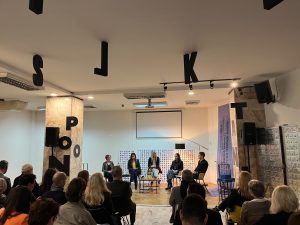
Human Rights House Serbia celebrates Human Rights Day despite threats. Photo: Sally Gimson
In reality, it wasn’t students who were attracted to the camp, but, according to various sources, petty, and even some more serious criminals. The camp now extends to the whole park and into the carpark in front of the parliament building. I saw white tents with music, portable toilets and swarms of police officers, there “to protect” the demonstrators. I also saw what seemed to be more disturbing elements, older men in masks and woollen hats, who I was told were likely Serbian veterans from the 1990s Balkans war. Even if they weren’t, they were dressed to suggest that. The whole place was fenced off with provisional metal railings, used the world round for crowd control. A few days before I arrived the top of the fencing had been greased and no one knew what the substance was.
I didn’t take any pictures on my phone and was warned not to peer too closely as I walked past. Last month, a television crew from N1, which is one of the few independent TV companies in the capital, was attacked by a man from the camp who turned out to be a convicted murderer. He was identified through footage recovered by the cameraman after his equipment was smashed. In July 2025 reporters filming Ćaciland had eggs thrown at them.
A journalist told me that the camp combined the dystopian aspects of Black Mirror mixed with the comedy of The Simpsons. It is called Ćaciland because when the students first started blockading universities and striking over the Novi Sad disaster, someone scrawled graffiti outside a local secondary school urging students in the town to go back to school. The graffitist spelled the word students as Ćaci instead of the correct spelling of Đaci. It led to a joke about their lack of education, hence Ćaciland (probably best rendered in English as Chavland).
The worst thing according to human rights defender Uroš Jovanović is that the police didn’t defend the attacked journalists but allowed them to act with impunity. Most prosecutors’ offices are dragging their feet when complaints are made to them. Students and journalists on the other hand have been detained and charged with “not following police instructions”. In August in some parts of the country – this is not just a Belgrade movement – demonstrations turned violent, with police beating protesters and some masked people throwing fireworks and stones.
The fight in Serbia is between students and a president they accuse of deep-seated corruption. Academics and schoolteachers have supported their students too. One human rights campaigner said that 100 secondary school teachers have been laid off because of their support, and some 25 headteachers and co-principals dismissed. Many ordinary members of the public have joined the protests, like the 50-year-old woman I met in a café who had been on the marches and started talking to me unprompted. She told me she had lived through five regimes in her lifetime and Vućić’s was by far the worse. She hoped the government would be overthrown soon.
Like Gen Zers around the world the students eschew politics, discuss actions through “forums” and have no leadership structure so they can’t be dismantled by the authorities. They organise primarily over social media. Those who have broken cover or have been arrested have found intimate pictures of themselves disseminated online and in government media. They’ve also been doxxed and smeared. Women have been particularly affected. Biljana Janjic, the executive director of FemPlatz, said out of 170 female activists they talked to, 87 had been assaulted and attacked by the police and pro-regime activists, and that sexual violence and rape threats had been normalised by the police. In smaller communities, women have been much more vulnerable to such attacks. The students’ ideology is unclear, except they dislike mainstream politics which they believe is so fundamentally corrupt that it resembles a big pot of shit – as one disillusioned politician described it – so that anyone who takes part becomes covered in excrement.
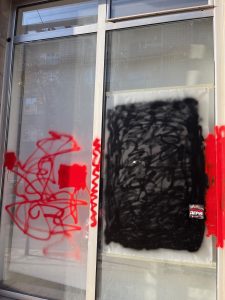
Graffiti on the HRH headquarters in Belgrade. Photo: Sally Gimson
I heard a lot about the suppression of protest and the media, not only through individual conversations, but also at the Human Rights House (HRH), just down the road from the National Assembly and the Ćaciland encampment. The front of the office has been daubed with red graffiti which covers the HRH logo: the authorities have refused to remove it for them. At least the building still rents space to the HRH Serbia team, alongside other civic society organisations.
Last week the House organised an event to celebrate Human Rights Day. The meeting was open and defiant. The leaders were mainly women. They discussed the situation in Serbia and their fears about increasing repression. Prizes were given to the director of news at N1, who HRH workers said had been vital in defending them and giving them “the courage to stay and fight”. Prizes were also given to a small group of prosecutors called Let’s Defend our Professionalism, who were praised for defending the rule of law where most of their colleagues had toed the government line. A representative from the Russian HRH in exile handed on to the director Sonja Tosković and her team the Golden Dove of Peace.
Despite their mistrust of politics and the persecution of many activists and journalists, students are organising for elections and announcing their candidates on 28 December. But there is deep tension in Serbia. Students have a history of toppling governments they don’t like. In October 2000, Slobodan Milosevic, the Serb leader in the 1990s war, was forced from power by a student-led revolution. In Belgrade’s Museum of Yugoslavia there is an celebratory exhibition about the 20th century revolutionary socialist politician Veljko Vlahović, a former student leader, and one of the leading figures in the communist government after the Second World War. In neighbouring Bulgaria, the government was overthrown by Gen Z students this December.
I’ll never know if someone really was in my apartment, but paranoia is rife in Serbia, and all have good cause to feel that way.
23 Oct 2025 | Asia and Pacific, News, North Korea, Volume 54.03 Autumn 2025
Kim Jong Un is more afraid of Korean television drama series than he is of foreign attacks
22 Oct 2025 | Europe and Central Asia, News, Scotland, United Kingdom
Banned Books Week UK was revived and celebrated across the nation recently, and it spawned an important conversation in Scotland about the conflict between inclusivity and intellectual freedom.
I headed to Scottish Parliament for an event run by CILIPS (the leading professional body for librarians in Scotland), sponsored by the SNP MSP Michelle Thomson. The discussion in question: libraries, intellectual freedom and culture wars.
How do librarians create a collection that is welcoming to their community, and balance it with books that challenge ideas or might be unpopular? There are questions to ask about intellectual freedom, but also moral obligations. What to do, for example, if someone walks into a library and wants to see a copy of Mein Kampf?
“At times of polarised views, it’s vital that we protect intellectual freedom,” said Shelagh Toonen, an award-winning school librarian and the vice president of CILIPS.
She was clear – libraries should have full control over their collections and access. They already look at the appropriateness of books for particular age groups, and the whole aim of a school library is to foster curiosity and resilience.
Sat beside Toonen was Cleo Jones, the former CILIPS president and libraries development manager for City of Edinburgh Council. She described how there’s recently been a strong push for developing knowledge around equality, including anti-racism training for staff, and she’s seen a positive impact. But there can be a tension with intellectual freedom. Staff need training around this too, she said.
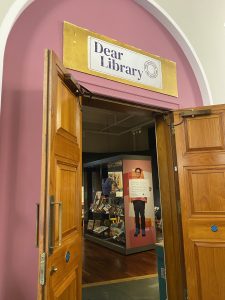
The Dear Library exhibition at the National Library of Scotland. Photo: Katie Dancey-Downs
Being a librarian was once considered a non-political role. Certainly, in the Dear Library exhibition just a short walk from Parliament in the National Library of Scotland, all the librarian stereotypes are on full display – a librarian action figure wearing glasses, a modest outfit and finger poised in the shush position, for example. But today, this role has suddenly become highly political, according to the panel. Managing sensitivities is a tough job, and is only getting tougher.
Steven Buchanan, professor of Communications, Media and Culture at the University of Stirling, put this into perspective with a discussion on book challenges in both the USA and the UK. He described how staff are being put under enormous pressure and are worried how things could escalate. Toonen and Jones have both been at the sharp end of this.
“It happened to me in my own school. A parent put in a letter of complaint because I had the book,” Toonen said of British writer Juno Dawson’s This Book is Gay, a book written for young people about the LGBTQ+ experience, and which has been one of the most banned books in the USA. Index research found that it has also been removed from some schools in the UK.
“If we remove books from our shelves how are young people going to see themselves represented?” Toonen asked, adding: “Two young people have come out to me in the school library, because it’s a safe space.”
For Jones, the event that caused a public stir was a drag queen story hour reading that her library held online during the Covid-19 pandemic. She described a staggering level of abuse directed towards staff, which mostly came from the USA.
“The number of positive comments far outweighed the negative, but three to four years later we’re still dealing with the fallout,” she said. They are still receiving letters, still instructing lawyers and some people involved in the event got major threats, she said.
Jones described how they had checked thoroughly that the drag queen was indeed a children’s entertainer. But that did not protect them from attacks. With so much time spent navigating the aftermath of a culture wars clash, Jones is concerned about the message this sends to librarians considering hosting similar events, and that they may well be put off. Her advice to fellow librarians – do all your checks (as she did), and then be completely transparent about this work, up front.
Challenges to collections have been easier to resist, she said. The more difficult and complicated fight is public spaces and displays, as the drag queen story hour lesson perfectly illustrates.
So too does an example from the National Library of Scotland, in the exhibition Dear Library. The display has been at the centre of a recent culture war clash, when the book The Women Who Wouldn’t Wheesht was not included, despite garnering enough votes – four – to be included as one of Scotland’s favourite books for the purposes of the exhibition. The book, a series of essays, is written by gender critical women detailing their political fight against the SNP leadership and the Scottish government which tried to introduce gender self ID laws (eventually blocked by Westminster). The book was still available in the library’s reading room, but deliberately left out of the exhibition due to staff concerns that it could cause harm.
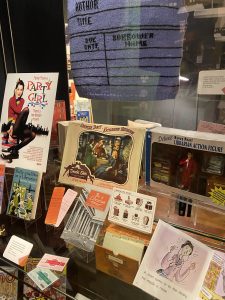
Photo: Katie Dancey-Downs
The library faced a backlash for the decision which we wrote about at Index and later added the book to the exhibition. It is now there, on a double-sided row of shelves inviting people to look at the books, beneath front-facing copies of Irvine Welsh’s Trainspotting and Maya Angelou’s I Know Why the Caged Bird Sings. The debate about sensitivities in library collections is clearly going nowhere, and the clash between trans rights and gender critical voices is a particularly polarising issue, especially in Scotland.
Challenges to free expression are nothing new. The difference now, the panel argued, is the rise of social media fuelling the culture wars. Suddenly, someone far away can learn about a decision in a library in Scotland.
“It feels heavier now,” said CILIPS president David McMenemy, and that’s because of social media.
Campaigns for books to be banned in the UK have been less organised than in the USA, where co-ordinated right-wing groups like Moms for Liberty have taken the lead. But Alastair Brian, the fact-checking lead for Scottish investigative journalism platform The Ferret, believes it is only a matter of time before that changes.
“There are certain groups in Scotland trying to put pressure on,” he said, specifically around books that the groups consider ideological. “In the US the way this has been applied is by singling people out. That definitely has a huge chilling effect.”
The question now is how libraries navigate these challenges, which are certainly not going away, and more likely will increase. Librarians need advocacy and funding, the panel said, and for MPs to oppose obvious censorship attempts.
Beyond this, McMenemy added, there is a problem with politicians finding profit in making everyone angry, and it is something he urged them to stop embracing.
Ultimately, the panel saw a strong need for open conversations where intellectual freedom, culture wars and sensitivities clash – and that means listening, as well as speaking. As Toonen told the room: “The best solution is always dialogue.”
17 Oct 2025 | News
Rebooted British spoof series Spitting Image came under fire recently from the rights owners of Paddington Bear after the character was featured in a video posted to YouTube in July titled “Spitting Image Presents: The rest is Bulls*!t”.
In the video, a parody of the popular The Rest Is… podcast series, Spitting Image’s Paddington drops his soft-spoken upper-class English accent for something more akin to his native South America whilst swapping the marmalade jam for a pile of suspicious white powder.
Dr Alberto Godionli from the University of Groningen puts forward the question, does the parody actually take aim at the idealised Britishness that Paddington represents?
The mockery looks through the facade of Paddington, described as being the “embodiment of a good immigrant archetype” by James Greig in an article for GQ following the death of Queen Elizabeth II, who famously sat down for tea with the Peruvian immigrant in a YouTube video posted by the royal family in 2022 to mark her Platinum Jubilee. Greig comments on this meeting, writing: “It’s a form of soft monarchism for people who want to buy into a cosy, benign and progressive vision of Britishness”.
Speaking to the Radio Times, Al Murray, one of the comedians behind the latest iteration of Paddington on Spitting Image, slated the legal action as “an attack on comedy” going on to say: “In my experience people find you funny taking the piss out of things, until you take the piss out of something they like. Then they don’t find you funny anymore.”
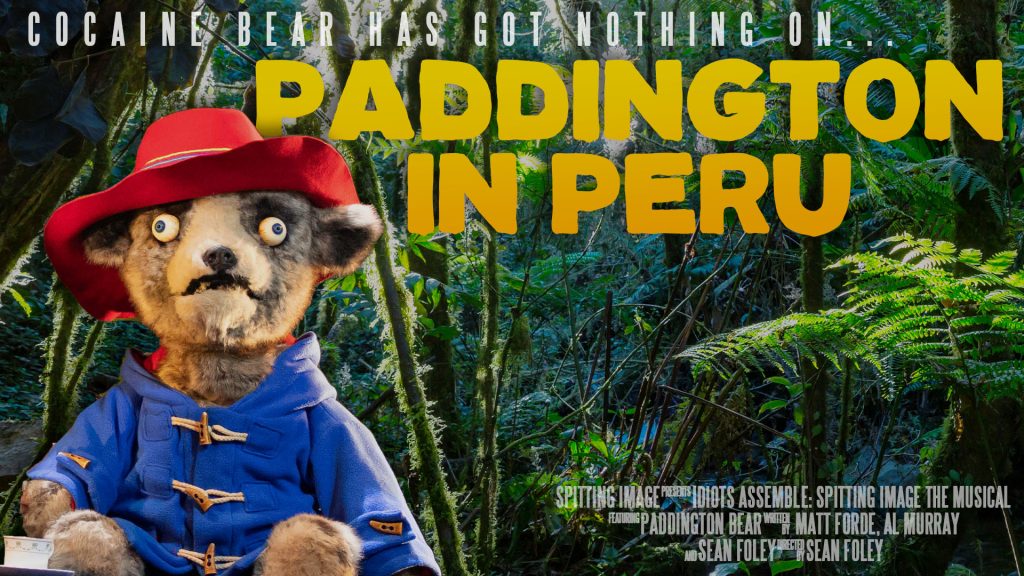
Spitting Image’s version of Paddington Bear, Photo from Spitting Image/Facebook
This legal attack on English satire that uses the image of a beloved bear harks back to the 1971 obscenity trial against counter-culture magazine OZ involving the character Rupert Bear.
Rupert Bear first appeared in Daily Express comic strips in 1920, depicted as a young bear living in the fictional countryside town of Nutwood which served as an idyllic depiction of an old-fashioned British living.
The case started after the release of OZ’s Schoolkids issue in May 1970, which was the result of an invitation to people under 18 to contribute to, and edit, an issue of the magazine.
Among the offending pieces was one submitted by 15-year-old schoolboy Vivian Berger who had modified a comic strip by American artist Robert Crumb to include Rupert Bear as the main character engaging in an explicit sexual act.
The comic drew attention from the British Obscene Publications Squad, later known for its own corruption, with OZ editors Richard Neville, Felix Dennis and Jim Anderson facing charges including “conspiracy to corrupt public morals” in what became the longest obscenity trial in British history.
Jonathan Dimbleby, reporting from the trial wrote: “It was certainly revealing; not least for the fact that the prosecution conspicuously ignored the bulk of the magazine – some 21 pages of the youthful anti-authoritarian political writing. According to the Crown, neither ‘politics’, nor what the kids thought of ‘the pigs’, were relevant in what was merely a criminal trial.”
Neville, Dennis and Anderson were found guilty and sentenced to up to 15 months’ imprisonment, however the verdict was overturned on appeal.
Rupert, like Paddington, represented a sense of Britishness that amounts to little more than a nostalgic look at a Britain still stuck between the wars, before the end of the British Empire, and before the start of the welfare state and the decline in raw global power which would mark the next 100 years.
Other examples of famous bear characters being used for political satire prove however that this is not a uniquely British phenomenon.
Yogi Bear was the subject of a 2020 Onion headline that read: Heavily Armed Fans Guard Statue Of Yogi Bear In Case It Turns Out He Supported Confederacy, mocking the reaction to the removal of a number of Confederate statues that had occurred across the United States that same year.
And again from the USA, the often-mocked Smokey Bear, with his slogan “Only YOU can prevent forest fires” was depicted in a 2022 Seattle Times cartoon saying “I hate to say it but climate change has beat me”, as part of a comment piece on that year’s wildfires.
In China images of Winnie the Pooh have been used to mock President Xi Jinping and they emerged as a symbol of dissent during protests in Hong Kong. This has led to the removal of images of the bear across Chinese social media, where users had been claiming a visual resemblance between Xi and the bear. The mockery at times included other members of government such as former Hong Kong Chief Executive Carrie Lam being compared to the character Piglet after appearing in an image with Xi.
Political artist Badiucao has used Winnie the Pooh in a series of images mocking Xi’s efforts to censor the character, with the piece “‘Xi’s going on a bear hunt” showing the President holding a rifle over the bear’s corpse.
In Russia the bear has been used to represent the country for centuries and demonstrate Russian strength, even when the bear is seen as tamed. With its sharp teeth and knife-like claws aimed towards Ukraine the bear has reared up again. Not that Russian nationalists mind – and mock-ups of Russian President Vladimir Putin riding a bear are are still shared to bolster his strong man image.
