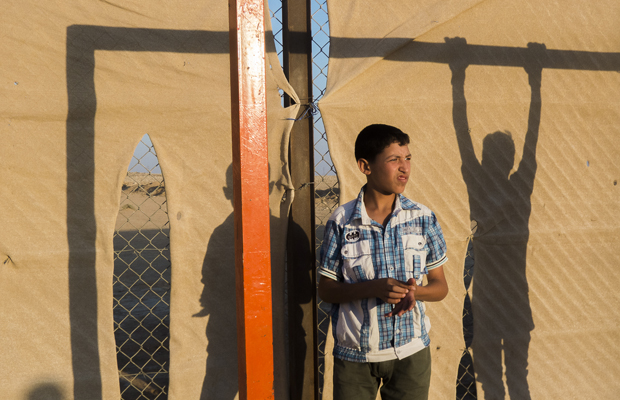
A picture from the Do You See What I See project which teaches photography skills to young refugees, Zaatari camp, Jordan (Credit: Mohamed Soleman/Do You See What I See)
In an article from the refugee voices special issue of Index on Censorship Magazine, Jason DaPonte looks at how migrants are using technology to keep in touch with distant relatives, and the security risks this can bring
“My wife changes her sim card every week,” said Omid, an Iranian refugee who hasn’t seen his wife in the seven years he has been awaiting a decision in his UK asylum case. The couple use Viber, a mobile app that allows free voice calls over the internet, but his wife remains in constant fear of surveillance. Omid is wanted by the Iranian state for political offences. He’s also a convert to Christianity and his wife fears discussing his new religion, as even members of his own family have branded him an infidel.
Refugees may be some of the most excluded people in society, but social media and new technology nevertheless play a crucial role in many of their lives. Across the globe, refugees are finding ways of using them to stay connected to families, homelands and political causes, in ways they couldn’t have a decade ago – even though it can have security implications. A number of refugees, particularly from Syria, suggested they use the free messaging mobile app, WhatsApp, because they believe the messages are secure. Whether WhatsApp messages can be hacked or intercepted is not clear, however.
Ismail Einashe, a British journalist and Africa expert, originally from Somaliland, explained another way social media is changing the refugee experience. He said how his teenage cousin, who fled Somaliland for Austria, uses Facebook for photo-sharing, to craft an image of success and happiness. But this can potentially hide the true difficulties of refugee life.
“My cousin is inspired by American hiphop. He wears baseball caps and baggy jeans – so his friends at home see the glamorous ‘other’ and they don’t see the high unemployment or poverty among refugees. It’s partly encouraging the young generation. Before, people didn’t see what life on the other side could be and now they can see it,” he told Index.
Nearly every refugee interviewed for this article said that free calls on Skype and the ability to connect with relatives for free using standard social platforms (like Facebook) is invaluable to them. But for some, sharing stories from exile goes beyond simple messaging and status updates. Some refugees use blogs and social media channels to publish content banned at home to try to fight the repression they escaped.
Moses Walusimbi fled Uganda’s anti-gay laws for The Netherlands and now runs Uganda Gay On Move – a blog, Facebook and Twitter movement that helps gay Ugandans and Africans who have fled persecution, as well as providing information for those who are left behind and remain under threat.
“When I came to Holland, I realised the more you keep quiet the more you suffer,” Walusimbi told Index. “I was very eager to know if there were any other Ugandans who are in Holland who are like me, in the same situation. And when I started these social media things, many Ugandans responded.”
His movement now has almost 9,000 followers on Facebook, which he says is the most popular platform for his content. He also has followers on Twitter and his blog. Uganda Gay On Move is providing a support network that goes beyond publishing, with many photos of meetings between its members for social and political reasons.
“Uganda Gay On Move is like a family to us now. It’s like a family because we come together, we discuss, we find solutions,” said Walusimbi. These solutions have included the group petitioning and lobbying the Dutch parliament to raise awareness about the denial of the human rights of gay Ugandans and other Africans. It also publishes information that helps asylum-seekers manage their cases and gather evidence. But Walusimbi still worries about those in Uganda who could face jail sentences simply for reading it.
“Ugandan LGBTI people – unless well-known human rights defenders – tend to use false names on Facebook. There is also a danger when people attend internet cafes and do not securely log off. There is also a danger – and I have had several direct reports of family or friends seeing the Facebook pages left open on computers in homes. Some people have been exposed this way,” Melanie Nathan, an LGBTI activist and publisher who has worked closely with African LGBTI movements, told Index. “Using Facebook could result in meetings or revealing real names through trust and then in entrapment.” Walusimbi corroborated that there are real cases where this has happened.
Blogs by and for refugees from various conflict zones are building audiences. The Medeshi Somaliland blog is one example. It was founded with a desire to keep in touch with a dispersed family and diaspora in 2007 by Mo Ali, who left Somaliland to seek asylum in the UK in 2004. His work of aggregating and creating new content quickly became more political.
“There are many websites about Somaliland and those who are publishing there have been harassed by the police. They’ve been ordered to shut down because of being critical of the government on freedom of speech and press,” Ali told Index, saying he knows of at least three websites that have been shut down and explaining why he has to publish from abroad.
Even publishing from the UK, he doesn’t feel totally safe, “I’ve received death threats via email but I published the threat online and nothing happened. I’m still alive. It was just intimidation.”
Like Uganda Gay On Move, Ali has used the blog’s following to campaign, and in 2010 and 2012 rallied more than 1,000 of his followers to lobby outside London’s Parliament for official recognition of Somaliland.
Refugees are working on their own and with professional content and software creators to find bespoke ways to tell their stories. Dadaab Stories and the related Refugee News are two of the most elegant projects that have used the power of free social media tools (particularly Tumblr and YouTube) to help refugees publish stories. In these cases, professional filmmakers and refugees worked together to create ongoing social media coverage of the refugee camp for Somalians in Kenya.
Globally available and free technology platforms are helpful, but tools, platforms and projects are now emerging that are specifically aimed at refugees to allow them to self-organise and connect digitally.
Refunite is a social network designed to connect dispersed families that have low access to technology following displacement. It allows refugees to remain anonymous to everyone other than their family members, which aids those who may not be able to register with formal institutions because they are awaiting asylum decisions or are stateless. The platform currently reaches more than 500,000 refugees and is aiming to connect 1 million during 2015. It is geared towards low-end mobile technology to ensure that nearly anyone can use it. It can even be accessed using an interactive voice response system or text-messaging for those who are illiterate or don’t have internet access.
Low-cost and low-barrier-to-entry technologies such as these are proving to be a key part of connecting refugees in crisis. The UNHCR is telling the world the story of Jordan’s Zaatari camp via Twitter (which has claimed to be the first refugee camp with an official Twitter account). Nasreddine Touaibia, a UNHCR communications associate at the camp described how WhatsApp, a free or low-cost mobile messaging system, is being used by Syrian refugees to self-organise. “Urgent messages are sent to these groups and they are reflected in the Facebook group later. It’s their own emergency broadcast network,” he told Index, describing how WhatsApp had been used to give warnings when flooding occurred at the camp.
South African technology startup Vumi is now trying to build on this trend of using low-cost messaging services to create technical products that can empower refugees to self-organise at scale. Its platform uses mass mobile messaging and low-fi browsing to enable access to civic information.
Building on its success in Libya of technically enabling Wikipedia Zero (a Wikipedia Foundation project which gives access to Wikipedia without data charges in 35 countries) and distributing voter information, the company is now in the planning stages for a project focussed on empowering refugees, in partnership with South Africa’s Lawyers for Human Rights, an NGO that deals largely with refugees in South Africa.
Various NGOs and other services are also using social media to provide platforms that help refugees re-settle. These are largely regionally based and aim to help refugees understand the legal and social contexts they are in. In the UK, the Refugee Council and Bail for Immigration Detainees provide online resources and tools that help refugees build and understand their legal cases. Migrant Voice, another UK-based organisation, provides training and tools to allow migrants (including refugees) to publish and communicate their stories.
Refugees and migrants certainly benefit from the uses of social media that everyone with internet access does; but the emerging platforms in the space are where the traditional model of solitary, isolated migrants can be disrupted. Tools specifically tailored to the needs of the excluded have the potential to create the most significant change in a networked world.
To read other articles from the issue, subscribe to the magazine in print, iPad, or phone find out more here or on iTunes, search for “Index on Censorship”.
A Kenyan woman speaking out for women in one of the world’s most dangerous regions and a female journalist who exposed an unreported uprising in Saudi Arabia are among the winners of this year’s Index on Censorship Freedom of Expression Awards.
“Our shortlisted nominees are all tackling direct and serious threats to stifle free speech,” said Index on Censorship CEO Jodie Ginsberg. “We were humbled and inspired by their stories, and their dedication to ensuring we can all speak freely.”
Index on Censorship 2015 Freedom of Expression award winners: Rafael Marques de Morais (journalism), Safa Al Ahmad (journalism), Amran Abdundi (campaigning), Mouad “El Haqed” Belghouat (arts) and Tamas Bodoky (digital activism) (Photo: Alex Brenner for Index on Censorship)
Awards are presented in four categories: journalism, arts, campaigning and digital activism. The winners were Saudi journalist Safa Al Ahmad and Angolan reporter Rafael Marques de Morais (journalism – jointly awarded); Moroccan rapper “El Haqed” (arts); Kenyan women’s rights campaigner Amran Abdundi (campaigning); and Hungarian freedom of information website Atlatszo (digital activism).
The crime of free expression
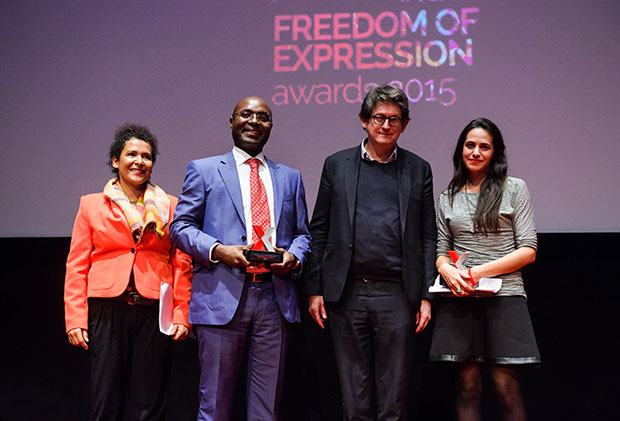
Journalist and campaigner Mariane Pearl, journalism award recipient Rafael Marques de Morais, Guardian editor Alan Rusbridger and journalism award recipient Safa Al Ahmad (Photo: Alex Brenner for Index on Censorship)
Al Ahmad was recognised for her documentary Saudi’s Secret Uprising, which exposed details of an unreported mass demonstration in Saudi Arabia. “Safa Al Ahmad dared to go into places that are difficult for women and for reporters, to bring that information back and share it with the world,” said Turkish author Elif Shafak, one of the five judges. Saudi Arabia is a mystery, even to its own people, said Al Ahmad in her acceptance speech: “Parts of our history is deliberately concealed, the present is muddled with rumours and half-truths. The government-owned and controlled media play a major role in the dissemination of those false realities of ourselves and others. This makes facts a precious commodity in Saudi Arabia.”
Angolan investigative reporter Marques de Morais has been repeatedly prosecuted for his work exposing government and industry corruption and will go on trial on 24 March charged with defamation. “Rafael is a very important individual doing very important work in a very, very difficult environment,” said judge Sir Keir Starmer QC. Marques de Morais dedicated his speech to the Zone 9 group of Ethiopian bloggers currently in jail “for the crime of exercising their right to freedom of expression”.
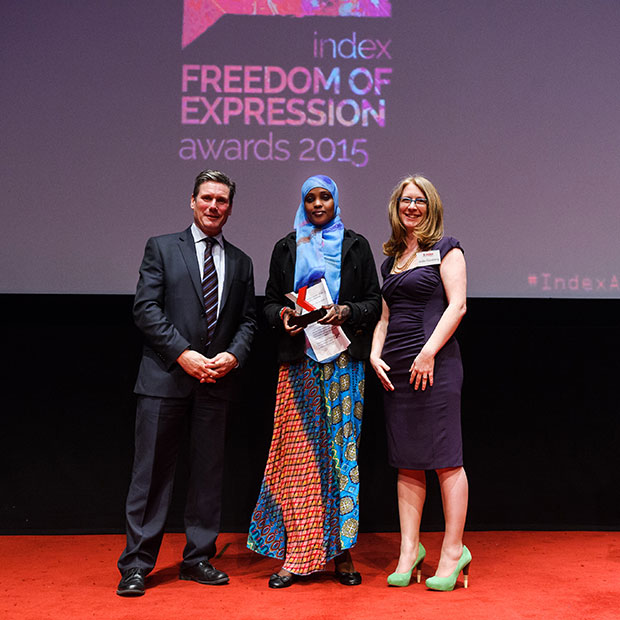
Doughty Street barrister Keir Starmer, campaigning award recipient Amran Abdundi and Index on Censorship CEO Jodie Ginsberg (Photo: Alex Brenner for Index on Censorship)
The winner in the campaigning category, Amran Abdundi, is a women’s rights activist based in north-eastern Kenya and runs a group helping women along the dangerous border with Somalia, where terrorism and extremist violence dominate. Judge Martha Lane Fox said: “Amran Abdundi was a standout candidate for me. She is doing something incredibly powerful in an unbelievably complicated and dangerous situation.” Abdundi dedicated her award to the “marginalised women of northern Kenya… who will now know that their struggles and their efforts to fight for their rights are being recognised internationally”.
Help us let the world know the truth
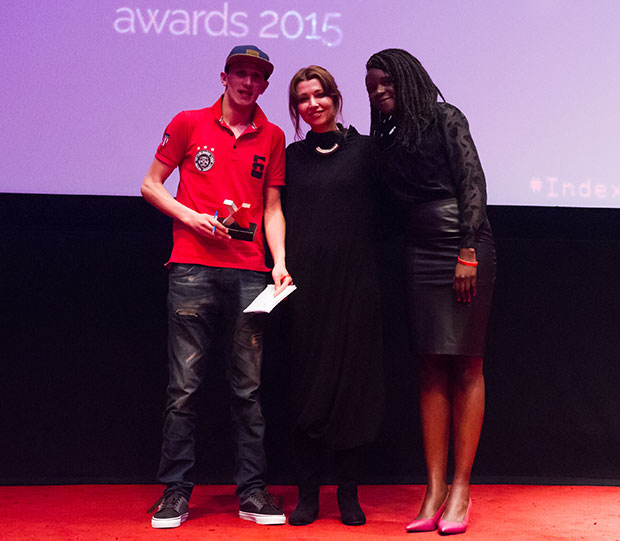
Arts category winner Mouad “El Haqed” Belghouat, novelist Elif Shafak and actor Stella Odunlami (Photo: Alex Brenner for Index on Censorship)
Arts category winner Mouad “El Haqed” Belghouat is a Moroccan rapper and human rights activist whose music highlights widespread poverty and endemic government corruption in Morocco. He has been imprisoned on spurious charges three times in as many years, most recently in 2014. Belghouat said in his acceptance speech: “I have been through difficult times: I was jailed, fired from my work, rejected by many friends. I am still forbidden to sing in my own country. But after all that I am still determined that I will never change my position. I will fight for freedom, equality and human rights for ever.” Lane Fox said Belghouat had taken his music and “translated it into a kind of online activism, but then, crucially, mobilised people in the street”.
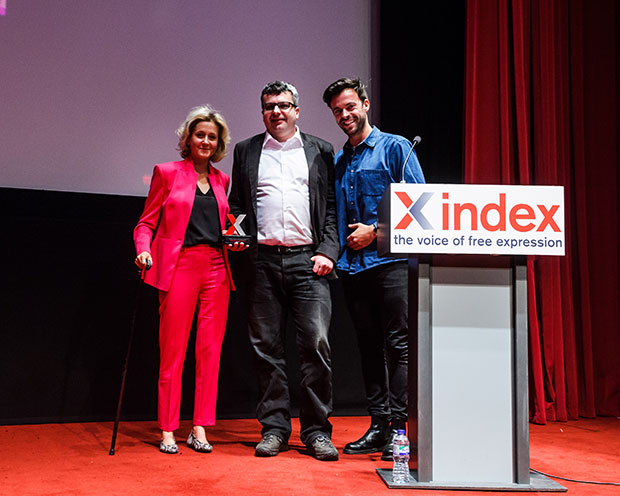
The digital award, decided by public vote, went to Hungarian investigative news outlet Atlatszo.hu managed by Tamás Bodoky. The website acts as watchdog to a Hungarian government which has increasingly tightened its grip on press freedom in the country. Editor-in-chief Bodoky said Atlatszo.hu called on all those who believe that independent journalism in Hungary is under threat. “All those who agree that politics and business interests have sunk their claws into everyday life. All those who know that taxpayer money is vanishing. We are calling on you to help us let the world know the truth.”
Entrepreneur Martha Lane Fox, digital activism award recipient Tamas Bodoky and actor Jolyon Rubinstein (Photo: Alex Brenner for Index on Censorship)
The awards were presented by the judges along with special guests including Guardian editor Alan Rusbridger.
A special award was also given on the evening to honour the many Azerbaijani journalists and activists jailed or forced into exile or hiding following a recent crackdown by the government. Former award winner and journalist Idrak Abbasov, who was forced to flee Azerbaijan last year, accepted the award on behalf of all those facing persecution in the country. “I call upon the world community to help Azerbaijan… so that our colleagues might be released and that our country might become a normal state in which we and others might live freely,” Abbasov told the audience in a video speech.
The evening featured an exhibition of specially commissioned cartoons by international cartoonists, reflecting on the past 12 months for free expression. Most of the artists had direct experience of persecution over their work, including Syrian political cartoonist Ali Ferzat – a former Index award winner – and Malaysia’s Zunar. “In the wake of the attacks on Charlie Hebdo, we wanted to pay homage to the work of cartoonists who are so often the first to face censorship in any move to stifle free expression,” said Index’s Jodie Ginsberg.
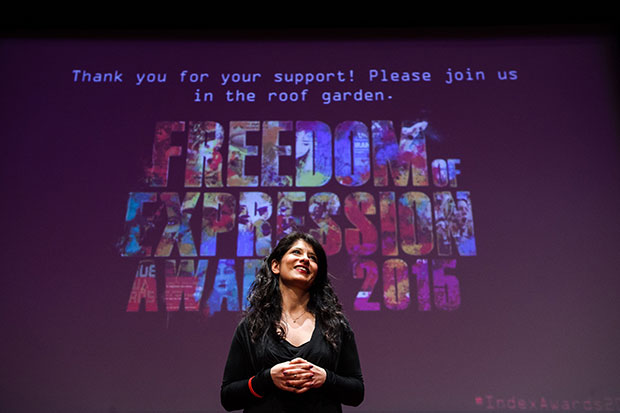
Comedian Shappi Khorsandi, the host of this year’s Index on Censorship Freedom of Expression Awards, understands the effects of censorship first hand.
Her father, Iranian writer and comic Hadi Khorsandi, was forced to flee to Britain in 1979 with his family, including a young Shappi, following the Iranian revolution and his criticism of the new regime. Even in the UK, Khorsandi continued to receive death threats.
“During the 1979 revolution against the Shah, there were crowds calling for my father’s execution because of his satirical writings. The only way to stay in Iran was to toe the party line. He chose exile, a profound experience for a writer,” Khorsandi says.
Khorsandi speaks movingly of the effects of exile on writers, saying: “They have to leave their home country to be able to express themselves freely in their native language. Censorship was a huge thing in my family.”
Once in Britain, Hadi Khorsandi continued writing and also published a satirical newspaper: “Because of this there was a plot to assassinate him in 1984,” says his daughter.
Many of those shortlisted for this year’s freedom of expression awards have experienced similar attempts to silence them. Lirio Abbate, an Italian journalist who faces constant threat of attack because of his investigations into the mafia, has 24-hour police protection. Others, like Angolan journalist Rafael Marques de Morais, Moroccan rapper El Haqed, or Ecuadorian cartoonist Bonil, are repeatedly threatened with jail for challenging powerful government and business interests.
Index on Censorship magazine featured Hadi Khorsandi’s work in two of its 1986 issues, describing his humour as “aimed at the follies and absurdities of the present Iranian regime and giving the reader a vivid picture of life in a country where ideology and zeal have been allowed to reign unchecked.” The October issue in which Hadi Khorsandi’s work features also includes an essay by Nobel Prize-winning author Gabriel Garcia Marquez.
“I’ve known about Index on Censorship for years – there were always Index logos in our house because of my father’s work,” says Khorsandi. “It’s quite an honour to have been asked to host the awards, one I accept on my father’s behalf.”
The 15th Index on Censorship Freedom of Expression Awards were held on March 18 at the Barbican, London.
There is, I am told, a war going on in feminism. A war between “intersectionalists” (I think) and TERFs (Trans-Exclusionary Radical Feminists, as far as I can tell).
I am not about to stick my oar into this particular boating lake, for two reasons:
Reason 1. Self-awareness. I am a white middle class western European media professional, north-London dwelling male, born in a time when there is little chance of conscription. I am practically the most privileged thing that ever existed, and the last thing people struggling for equality need is me, turning up, cheerily shouting “Only me!!!” like Harry Enfield’s Mr-You-Don’t-want-to-do-it-like-that, and telling people how to do a real feminism. That is not to say I do not have a right to have an opinion, but…
Reason 2: lurking in that apparently placid boating lake are piranhas, reading to chew up and spit out any oarsman (or woman) who does not know every ebb and eddie of the lake.
It’s a horrible sight to see. Every so often some poor naive jumps in their little pleasure boat, having been assured by the man that it’s perfectly safe, and rows happily to the middle of the lake. You watch from the shore. They wave back. What’s that sound? They’re singing Sister Suffragette from Mary Poppins, their rowing keeping a brisk beat with the jaunty marching tune. “Shoulder-to-shoulder” and-stroke-and-stroke.
Unbeknownst to them, the piranhas have smelled blood. They row on. Gleefully, they reach the crescendo: “Our daughters’ daughters’ will adore us…”. They raise their hands to punch the air. An unattended oar slips into the water. The piranhas stir. Daughters? That sounds like determinism. The water begins to froth. The poor unsuspecting oarsman (or woman) is still singing. Eventually they catch the commotion in the corner of one eye: they hear it grow louder, under the boat, which now seems irresponsibly flimsy.
They sing still, but now in trepidation: “No more the meek and mild subservients we!”.
The frenzy grows stronger, at what was certainly a slight on members of the BDSM community (well, the Ms anyway). Stronger and stronger. Our rower tries to resist, we can see, but the boat is now falling apart, as if rotten, under their feet. Our previously carefree rower feels first a nip, and then a rush. They are simultaneously drowning and being eaten alive.
A final defiant shriek from a the near-eviscerated pleasure seeker, and then there is nothing. The waters are calm once more.
We tut, from the shore. Such a shame, such a loss. Did you see the cowbell dog?
That’s one version, but then try to see it from the fishes’ point of view. Fish have got to live. Piranhas have been, for years, maligned as a generality by the mainstream. The very word “piranha” is thrown around as an insult. Piranhas are irrational, illogical, even abominations against nature. And of course, there is more than one type of piranha, and not every piranha has the same experience of what it’s like being a piranha. Piranha identity is complex, to say the least. But that doesn’t mean piranhas shouldn’t bond together and work together. What outsiders view as a “feeding frenzy” is actually the best – only – way piranhas can continue to exist safely.
Besides, the piranhas grew up in this lake. They know it like the back of their fins – how to navigate, how to communicate. If anyone’s in a wrong place in the boating lake, it’s not the piranhas.
This is not an unreasonable case. The question then (and here’s where the horrendous tortured boating lake analogy comes to an end, you’ll be pleased to know) is: Was George Bush right? Can the human beings and the fish coexist peacefully?
The issue emerged again recently with a terse exchange of letters in the Observer newspaper, which followed the cancellation of a show by comic Kate Smurthwaite at Goldsmith’s college. Smurthwaite said she’d been banned because some university feminists who are pro sex work were threatening to protests against her anti sex work views, and the college security didn’t want the hassle.
A letter was put together, as letters are, decrying campus censorship and the narrowing of debate (with specific mention of the National Union of Students’ policy of “no-platforming” feminist Julie Bindel for statements on trans people). There was a response, disputing the facts of the first letter and suggesting that there are bigger campus free speech issues – around student protest for example – than whether certain already powerful people can take part in a panel debate or a comedy show.
The problem here is the commodification of free speech: who is allowed it and who isn’t, and, in hierarchical societies (i.e. pretty much every society we’ve come up with so far) who grabs it as theirs and who should be granted more in order to even things out, and who can “use” free speech against whom.
This is to treat free speech as a weapon rather than a space. There is not a limited amount of free speech to go round: rather, there is a (hopefully) ever-expanding free speech arena in which we can argue. The signatories of both letters have actually identified the same problem, the narrowing of the space, particularly in education. Perhaps it would be beneficial for them to defend the space in which to argue rather than trying to push the other side overboard.