24 May 2011 | minipost, News
Iran’s state-run English language channel Press TV could face a hefty fine from UK TV regulators after it broadcast a prison interview with jailed journalist Maziar Bahari.
Ofcom found that the station had breached Bahari’s rights by broadcasting an interview in which he was forced to make a “televised statement about the role of the western media in the post-presidential election demonstrations”. Bahari was detained the summer of 2009, in the aftermath of that year’s Green Revolution. He was released in October after a global campaign.
11 May 2011 | Iran, Middle East and North Africa
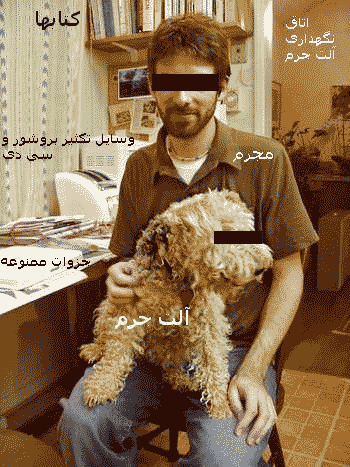
 I’ve just finished reading a piece on Global Voices about the controversial issue of owning a dog in Iran. With so many more fundamental freedoms curbed, you’d be forgiven for laughing this off. Last year an Iranian cleric issued a fatwa against keeping dogs as pets, claiming that it was only a “blind imitation of the vulgar Western culture…There are lots of people in the West who love their dogs more than their wives and children.”
Last summer, there were reports of a spate of arrests in Tehran parks, particularly of young people carrying small dogs — an opportunity for restricted youth to socialise when out with their pooches. One year on, and parliament is currently considering passing a bill banning the ownership of dogs.
This would give Iran’s morality police and other authorities free reign for further crackdown. “This bill will outlaw people living in apartments from owning dogs, and prevent all people from exercising these animals outside”, a spokesman for supporters of the bill said. “These types of behaviours are unacceptable in this nation and we will not allow these decadent attitudes to overtake our great nation. We begin and end these actions today, with this bill, for now and forever.”
But where do the dogs go? In the past the pets have been kept in “temporary prisons”. Now the government has ordered several hundred special “train cars” for the transport of the confiscated dogs. With the regime’s record of treatment of its incarcerated people, one can only imagine how these animals, deemed “unclean” and props of the enemy culture, will be treated.
For the love of dog blog and many others have responded but Hamid Tehrani presents the most interesting and humourous take from bloggers within Iran.
3 May 2011 | Uncategorized
Freedom House’s annual Freedom of the Press Index, released Monday at World Press Freedom Day events in Washington, show that press freedoms are on the decline throughout the world as authoritarian regimes tighten their control over new media forms of communication and as worsening violence in countries like Mexico has pushed more journalists into self-censorship. (more…)
29 Apr 2011 | Uncategorized
UNESCO will convene its annual World Press Freedom Day conference this weekend in Washington against the backdrop of rapidly evolving revolutions throughout much of the Middle East and North Africa that are changing long-held views of who’s in the media, how it uses technology and what access to information means.
The United States is hosting the conference — which Index on Censorship will attend and cover — for the first time, in conjunction with more than a hundred events internationally celebrating press freedom and focusing attention on the corners of the world where it does not yet exist.
“Until recently, when we were talking about freedom of expression and the media, we were talking also about monopolies and the concentration of ownership of some media,” UNESCO Director-General Irina Bokova said in a conference call with attending media this week. “Now with new technology we have an entirely different picture.”
Even in the few months since UNESCO first unveiled plans for this year’s events, news around the world has dramatically altered the range of issues at stake. Bloggers are now jailed alongside professional journalists. New-media tools that have helped connect dissidents are now just as likely to be used to track and crack down on them by repressive regimes. Technology has made possible both more sophisticated firewalls and circumvention tools that can be funded and developed from afar. And social media sites have become a live source for worldwide news – but in a world where access to digital information can be blocked with the pull of a plug.
Millions of people around the world who possess neither television, nor computer, nor newspaper subscription are also now accessing information in the palm of their hands.
“In Africa, it’s well-known for a fact that they may not have electricity as widely as they have mobile phones,” Bokova said. “New technologies are not only changing the media landscape, they’re changing the way we look at teaching and all of our access to knowledge in general.”
The conference in Washington — focusing on “21st Century Media: New Frontiers, New Barriers” — will also examine censorship in the digital age and global access to the Internet. Imprisoned Iranian journalist Ahmad Zeidabadi will also be honored with the UNESCO Guillermo Cano World Press Freedom Prize. Zeidabadi has been in jail since mass protests following Iran’s 2009 disputed election first presaged the uprisings now sweeping the region.
“What we saw was the fact that one single person can make history with a kind of very direct impact on political developments,” Bokova said of events over the last three months that give this year’s World Press Freedom Day additional urgency. “Who would have thought some months ago that one single young unemployed Tunisian in the market in a small town, that his reaction would have such an enormous wave of revolutions and repercussions. It was exactly because of these of social media, these new technologies.”
Index will blog here throughout the discussion, but you can also follow along with Twitter hashtag #WPFD.