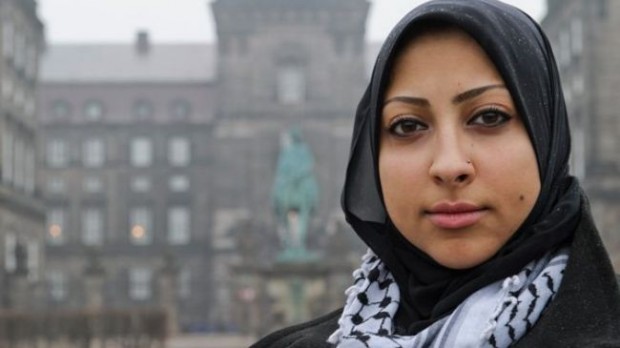
As a human rights defender, I, Maryam Al-Khawaja, Director of Advocacy at the Gulf Center for Human Rights, have decided to boycott my court hearing on the 1 December 2014. During this hearing I am due to be sentenced on trumped up charges of assaulting two policewomen at the Bahrain International Airport. (Update: Al-Khawaja was sentenced to one year imprisonment on 1 December)
The decision to boycott the court was reached based on several grounds:
The lack of independence and due process in the Bahrain judiciary system:
It has become evidently clear that it is not possible to have a fair and independent trial in Bahraini courts as they stand. The judicial system in Bahrain is highly flawed, and is overrun with egregious human rights violations which usually start during the arrest, and continue throughout what is supposed to be a legal process. I was personally subjected to numerous human rights violations since the moment of arriving in Bahrain and until I was able to leave the country as can be read in my testimony here.
There are medical reports about the injuries I sustained during the assault I was subjected to, for which I continue to need physiotherapy. My case was sped up, and quickly turned for sentencing with complete disregard to legal procedures.
The lack of independency and neutrality of the judge himself:
The presiding judge, Mohammed Ali Alkhalifa, in the case brought against me is a member of the ruling family, and has been himself, as well as members of his family, identified previously during my advocacy campaigns as implicated in human rights violations. This makes his presiding over the case a clear case of conflict of interest given the personal grievances he may have against me. This judge in particular, it is important to note, has been involved in the sentencing of numerous human rights defenders including Nabeel Rajab and Naji Fateel in unfair trials.
The cooperation of the Special Investigations Unit (SIU) with the Ministry of Interior:
During my imprisonment I met with the SIU, headed by Nawaf Hamza, to submit a complaint against the three policewomen and the first lieutenant who assaulted me at the airport. The prosecutor, Mohammed Al-Hazaa, rewrote my statement in his own words, attempting to implicate me in violations, and refused to correct what he had misquoted. This resulted in my refusal to sign the papers and filing of a complaint against the prosecutor. One day before the sentencing, namely on the 30th of November 2014, and due to almost daily follow up by my lawyer, the public prosecution notified him that the complaint case had been revoked. Despite my complaint about the assault since the beginning of my arrest, it was only one day before the sentencing that my lawyer was finally able to get a statement from the public prosecution that my complaint case had been revoked, at a time when the trumped up assault charges against myself were speedily processed and turned for sentencing.
The violation of my rights by the public prosecution:
During the interrogation I was subjected to, I was refused access to my lawyer by the prosecutor dealing with my case. During my imprisonment my lawyer was not given any visits, nor was the Danish embassy. The way that the public prosecution deals with politically motivated cases is it uses all aspects of the government to provide impunity for the perpetrators of violations.
Based on the reasons stated above, I find any and all cooperation with the court or attendance of the hearings by myself as a problematic legitimisation of an unfair and biased court. Therefore I have decided to boycott the hearings, and have asked my lawyer to do the same.
It is important to note here, if I, as a human rights defender, whose case receives international media and diplomatic attention is handled in this way; it is gravely concerning how cases not receiving attention are handled by the authorities in Bahrain.
Maryam Al-Khawaja
Director of Advocacy
Gulf Center for Human Rights
30th November 2014
Nine human rights organisations called on the British government on Friday to speak out publicly in the case of activists currently being detained in Bahrain. Prominent human rights defenders Nabeel Rajab, Zainab Al-Khawaja and Ghada Jamsheer have all been arrested and face lengthy prison sentences in Bahrain for cases of peaceful expression.
This echoes the message from Maryam Al-Khawaja, a prominent Bahraini activist and co-director of the Gulf Centre for Human Rights, earlier this week.
You can imprison a human rights defender, but you can’t stop the human rights cause, Al-Khawaja told a packed press conference in London on Wednesday, organised by Index on Censorship and the Bahrain Institute for Rights and Democracy (BIRD).
She urged UK authorities to speak out about rights abuses in her country, which she said is being run like a business by the ruling Al-Khalifa family. This comes after the arrest of her colleague, 2012 Index advocacy award-winner Bahrain Centre for Human Rights (BCHR) president Nabeel Rajab. He is facing charges of insulting government institutions on Twitter. His trail opens on 19 October.
Also on Wednesday, her sister Zainab Al-Khawaja, who is 8 months pregnant, was sentenced to seven days’ detention for publicly insulting King Hamad bin Isa Al-Khalifa by ripping up a picture of him in court. She was in court over charges connected to her previous human rights campaigning.
Al-Khawaja, a dual Danish and Bahraini citizen, was herself recently released on bail after being arrested at Bahrain International Airport when trying to enter the country to see her father. She said: “I was stopped at the airport where I was told falsely that my citizenship had been revoked.”
She was then assaulted by police at the airport, and is still recovering from a torn muscle in her shoulder as a result. The police officer who assaulted her later filled charges against Al-Khawaja, presenting a scratched finger as medical evidence.
Al-Khawaja spoke of her time in Isa Town women’s prison, where she spent 19 days; she described poor sanitation and said there were no nurses or doctors available at night and it took 45 minutes for ambulances to reach the facility.
Al-Khawaja’s father, Abdulhadi Al-Khawaja, the founder of 2012 Index award winner BCHR, is serving a life sentence after playing a prominent role in the country’s 2011 pro-democracy protests.
Al Khawaja described how changes could be implemented in Bahrain, saying there is a need for pressure from countries such as the UK and US, who have the capability to make sure the government respect human rights.
“Reform can be implemented and enforced by accountability,” she said.
Nominations are now open for the Index Freedom of Expression Awards 2015. Put forward your free expression heroes here.
Nabeel Rajab Arbitrarily Detained
Please ask your MP to support the campaign by writing to the Foreign and Commonwealth Office. (This web app will take you to the website of the Bahrain Institute of Rights and Democracy)
Maryam Al-Khawaja spoke about her arrest, Nabeel Rajab’s case and more in her opening statement
She also described conditions inside Isa Town Prison, where she was held for 19 days
Britain is to send the Royal Air Force Red Arrows display team to perform Bahrain, just weeks after negotiations opened on the sale of BAE Eurofighter jets to the tiny Gulf Kingdom.
Bahrain’s ruling family has been engaged in brutal repression of protesters since a democratic uprising began i n February 2011. Britain has been repeatedly criticised for selling weapons and other military hardware to the regime while the crackdown continues.
Earlier today, Index reported the awarding of yet another international prize to the Bahrain Center for Human Rights, which has been battling peacefully for democracy in Bahrain under increasing repression since the uprising. The campaign group won the Norwegian Rafto Human Rights Prize.
Center leader Nabeel Rajab was imprisoned not long after accepting an Index on Censorship Free Expression Award in 2012, and remains in jail.
There have been dozens of violent deaths in Bahrain since the beginning of the uprising, many put down to the regime forces’ indiscriminate use of tear gas, which it is reported to be stockpiling.
A press release published on the Bahrain News Agency Portal today says:
One of the world’s premier aerobatic teams, Britain’s famous Red Arrows, is to display in Bahrain as part of a Middle East tour.
The team, with its nine distinctive red jets, will perform a series of precision formations and dynamic loops and rolls when it visits on Sunday, November 10.
[…]
The Team’s visit to the region has come about after accepting an invitation to the Dubai Air Show, where the Red Arrows will perform each day between November 17 and 21.
It is an opportunity being used by the Team to visit other nations in an important region, with which the United Kingdom has strong links to.
Indeed, Britain’s armed forces have a deep historical tie with Bahrain dating back over 200 years.
As ambassadors for the UK, the Red Arrows showcase the excellence of the Royal Air Force.
The team, which currently fly BAE Systems Hawk aircraft, consists of nine display pilots, all of whom are from frontline squadrons. Each has previously operated other Royal Air Force fast jets, such as the Tornado or the Typhoon multi-role combat aircraft
Bahrain has a great interest in the excellence of British hardware and expertise. As well as looking to buy an “unspecified number of Eurofighter Typhoon fighter jets”, Bahrain already imports hardware including weapons from Britain. Meanwhile, former senior Metropolitan police officer John Yates was engaged to advise the government on policing and dealing with civil unrest.
In the last week, Bahrain’s treatment of its citizens and their right to free expression has been repeatedly in the news. Sara Yasin reports on a spate of developments that raise questions about the Bahraini government’s commitment to free speech.
Blogger and activist Ali Abdulemam has been granted asylum in the United Kingdom. Abdulemam’s two years in hiding began shortly after the start of Bahrain’s political unrest in February 2011. He was sentenced in absentia to fifteen years in prison on charges of attempting to overthrow the monarchy.
Abdulemam is the prominent founder of Bahrain Online, a site that created an online space to criticise and discuss the country’s regime in 1998. Initially, he wrote anonymously, but he began to write in his own name in 2001. Public dissent in Bahrain comes at a price: the blogger was first arrested in 2005 and then once more in 2010.
News of Abdulemam’s heroic escape did not amuse Bahrain’s government:
Ali Abdulemam was not tried in court for exercising his right to express his opinions. Rather, he was tried for inciting and encouraging continuous violent attacks against police officers. Abdulemam is the founder of Bahrain Online, a website that has repeatedly been used to incite hatred, including through the spreading of false and inflammatory rumors.
The statement goes on to say that the country “respects the right of its citizens to express their opinion”, but makes a distinction between expressing an opinion and “engaging in and encouraging violence.”
Back in 2010, Abdulemam was jailed, tortured, and accused of being a part of a “terrorist network.” The real threat he posed to the state, as fellow activist Ala’a Shehabi put it last year, was that “his forum offered dissidents a voice.”
So what does “incitement” look like in Bahrain? For documenting a protest on Twitter last December, Bahrain Center for Human Rights (BCHR) member Said Yousif, was jailed and charged with “spreading false news.” According to the country’s laws, “the dissemination of the false news must amount to incitement to violence.” As Human Rights Watch’s Middle East director, Sarah Lea Witson put it:
If Bahraini officials believe that an activist is inciting violence by tweeting a picture of an injured demonstrator, then it’s clear that all the human rights sessions they’ve attended have been wasted.
The jailed head of the organisation, Nabeel Rajab, is currently serving a two year sentence for organising “illegal protests.” BCHR released a statement today expressing concerns that Rajab has been transferred to solitary confinement. He has been unreachable since relaying to his wife an account of young political prisoners being tortured earlier this week. Rajab was requesting a visit from the International Committee of the Red Cross, to document the case.
Still, Bahrain insists that freedom of expression is something that it upholds — in fact, it has gone so far as prosecuting individuals for supposedly abusing it. Just yesterday, year-long sentences were handed to six Twitter users for making posts insulting Bahrain’s King Hamad. For hanging a Bahraini flag from his truck during protests in 2011, a man was handed a three-month jail sentence today.
Looks like it might be time for Bahrain to reevaluate how it understands freedom of expression.