Tyrant of the year 2025: Vladimir Putin
No one is safe it seems from the self-proclaimed Father of the Nation

No one is safe it seems from the self-proclaimed Father of the Nation
The conference, the Battle for the Soul of Europe, opens in the Belgian capital on Wednesday (3 December). Below is an interview with Frank Furedi, director of the Mathias Corvinus Collegium (MCC) in Brussels, which has organised the event.
Furedi, one time professor of sociology at the University of Kent (and still an emeritus professor), has lined up a list of mostly conservative and right-wing figures to speak. A central theme of the conference is free speech, including one panel entitled Against the language police: Why we must reclaim speech.
Speakers include British journalist Melanie Phillips and political scientist Matt Goodwin; US author Patrick Deneen and right-wing figures in Europe including Giorgia Meloni ally, Francesco Giubilei, and the French right-wing feminist Alice Cordier.
The MCC is a Hungarian think-tank and educational institute based in Budapest (with a Brussels outpost run by Furedi). Its board chairman is Balázs Orbán, who is also the political director for Hungary’s Prime Minister, Viktor Orbán (no relative).
We talked to Furedi about free speech, his relationship with the leader of Europe’s biggest “illiberal democracy”, Viktor Orbán, and being funded by MOL, Hungary’s largest oil company through which Hungary imports its oil from Russia with an EU exemption.
Index: How would you define your politics?
Furedi: I cannot put a clear label on it. I think in many ways, political labels at the moment are fairly confusing, given the shift that has occurred. I would say that when it comes to certain issues to do with history, tradition, families, I would call myself fairly on the conservative side. When it comes to individual matters to do with free speech, tolerance, autonomy, I would see myself as fairly liberal, classical liberal. But when it comes to issues to do with economics welfare, I would say that I’m fairly sympathetic to redistributionist approaches, or what I would call classical left-wing approaches in terms of provision of health and education.
So it’s three, where it’s kind of mixed together. And, yes, that’s how I would describe myself. But if anybody asked me, you know, where are you? I would never use a label just because it wouldn’t capture it. The sort of labels that comes closest to us is what they used to call, in the old days, democratic republicans, sort of republican, not in the party-political sense, but republican in the way that it was classically understood. We’re basically seen … and are probably, on the right spectrum. I suppose the main reason why I came here, I set the whole thing up, was to act as a counterpoint to the dominant political culture. We see ourselves as being like Gramsci in reverse, where we’re challenging the cultural norms that are promoted by the European Commission, and that are fairly hegemonic in most of Western Europe.
Index: I think that’s quite intriguing, because in a sense, you’re using the language of the kind of classical left-wing tradition against the European liberal tradition. Would that be a fair?
Furedi: Yes, which is why I’m very sympathetic. We have some people that work with us that I would call old-school left, as opposed to identity-politics left, who I’m fairly sympathetic to, in terms of my own origins and my own instincts. So, yes, that’s the way I would say it.
Index: You have this quite dramatic-sounding conference… looking at some of the invitees, you might describe them as pretty classically right-wing. The term that is sometimes used is National Conservative (NatCon). What do you feel about that term?
Furedi: Yes, I can see why people would characterise some of the speakers as NatCon… I cannot really help that… We had a meeting the other week… and we had a person like that, and then we had a left-wing speaker from Germany, so I do try to mix it all up. At the moment, it’s quite difficult to get people from different traditions who are roughly interested in the kind of themes that I want to pursue. So that’s why you get the balance that you do. And so, yes, I think I would say that probably the majority of the people there, not all of them, would be conservative… They are, amongst themselves, fairly heterogeneous.
Index: Where do your loyalties lie? Are they to Hungary? Are they to the opposition to the Brussels elite? Are you hostile to Britain? Where do you put yourselves? It’s quite hard to work out.
Furedi: Yes. it is hard to work out, but that’s because you’re lucky, because you grew up in a place where you were born. You probably see yourself as having a very clear identity rooted in a particular cultural milieu. I was born in Hungary, I grew up in North America, I lived almost all my adult life in Britain, and now I’m here involved in creating a kind of a cultural political opposition to the [European] Commission. My loyalty is… I don’t know. I mean, I love Britain… All my close friends and my family are, I suppose, English or they live in Britain. I’ve got a very strong kind of affection, even though I don’t feel British, I don’t feel English. So, the way that I explain, if England is playing Hungary in a football match, I would probably support Hungary because of the underdog status. If England plays against any other team in the world, I would support England in a football match,
Index: A sort of football version of the cricket test.
Furedi: Exactly. And that’s not because I’m disloyal or whatever. It’s just, I always think of English as being my intellectual language and Hungarian, my emotional language. I don’t know if that makes any sense. When I get angry, I swear in Hungarian when I think it’s in English. I don’t feel any affinity to what’s happening here in Brussels, or I have no commitment to any abstract Europeanism, except for the fact that I would like to see a stronger, more cohesive, all-European intellectual alternative to the dominant paradigm.
Index: Clearly there are concerns about Viktor Orbán and Orbán’s government. You have been a vocal champion of free speech and free expression. This would seem somewhat contradictory to some of the things that Orbán’s been doing in terms of attacks on free media.
Furedi: I don’t have a selective approach towards free speech, that it’s good in some places, not good in others. I do think the attacks on Orbán’s government and Hungary over the free media are misconceived… You have a situation where there are TV channels in Hungary that are anti-government and have a very large viewership [Editor’s note: the RSF describes Viktor Orbán as a predator of press freedom with 80% of the media controlled through Orbán’s Fidesz party and their supporters]. You have a situation where the opposition has got a far greater presence on the social media, in social media platforms, than the government has. You go to Budapest, and you go to newspaper shops, you’ll find that there are plenty of newspapers, not one, two or three, but a lot of newspapers hostile and critical to government, so I don’t see it the way it’s represented. I don’t think is unusual… You look at Germany and the way that free speech is being encroached upon fairly systematically, the kind of laws that they have there. You look at France, you look at even Britain, just the way in which people get done for their social media posts. So unfortunately, I don’t think there’s any government, there’s any European country that I can think of that comes out as white knights in relation to the whole area of free speech. I don’t think Hungary is any worse than many of the other countries, but it gets criticised as unique in that respect, a kind of a double standard, which I think misses the point about what’s going on there.
Index: I don’t speak Hungarian. But you know, in the reports that I read Orbán himself does describe himself in semi-authoritarian terms.
Furedi: Illiberal democracy.
Index: Now, obviously part of that is teasing liberals, right? But again, please help me understand what you understand by that, because it sounds quite sinister to me.
Furedi: Well, if you actually look at the speech where he used the term “illiberal democracy”, what he is really saying is that he, he sees democracy as being logically prior to liberalism. As you know, there’s always a big debate between freedom and democracy in all kinds of different environments… He basically argues that his illiberal thing is part of his critique of what he sees liberalism as being. But he doesn’t mean that that freedoms are taken away, or freedoms are encroached in a way that you might imagine. It’s his attempt to be provocative, very successfully, as it happens, in relation to the kind of prevailing consensus. Hungary, and Orbán, is invariably accused of democratic backsliding time and again – I just don’t see that. If there was democratic backsliding, then the opposition wouldn’t win the election in Budapest last time we had local elections…
Index: You are largely funded by the Hungarian government?
Furedi: We are funded by two companies, the oil company, MOL, and Gedeon Richter, the pharmaceutical company. Now you could argue that MCC Hungary has got a close association with the government and it empathises with the government’s politics. Our particular organisation is entirely autonomous. That was the condition on which I took the job or set it up… We decide what issues are important and what issues are not important… Obviously, on many issues, we are very sympathetic to what they’re doing. But we don’t just simply, like in the Soviet Union or in any kind of dictatorial system, tick the boxes. We’re not asked to tick the boxes, but even if we were, [we] wouldn’t tick the boxes unless we agree with it.
Index: So why is it in the interest of the oil company and the pharmaceutical company to back you?
Furedi: Well, that’s an interesting question. I think that these companies, like anywhere else, when you have funders, either for philanthropic or for political reasons, do it for our idea. I think it’s their way of demonstrating their social connection or responsibility. I’ve never met anybody from either one of these two companies, so I don’t really know. But I would imagine it’s because they think that what MCC is doing is really important, because we do a lot of educational work. Part of our job is to, is to raise the intellectual game that Hungary plays. And I think that what we also do through hopefully the interesting and inspirational work that we do, we give Hungary a good name, even though we’re not a Hungarian thinktank. Because most people that work for MCC Brussels are not Hungarian. They come from Europe. But that’s probably the reason why. But you’d have to ask them. I’ve never actually met any of them.
Index: That would seem strange to me, but that’s, I don’t know whether you made a conscious decision not to meet them. But if I were in your position, I would want to meet them and find out what their motivations were.
Furedi: Why? The point is that you’re assuming that he who pays the piper… that we’re somehow kind of internally corrupt, and if somebody sort of gives us money, then we just simply sing from their song sheet. But that’s never happened. If it did, I think not only me, but almost all the key people here would leave, because the whole buzz about doing what we’re doing is we got this real capacity to be independent, and we’re not accountable. We don’t have to play somebody else’s game.
Index: There have been suggestions of a Russian connection. What do you say to the allegations that you are Russian funded?
Furedi: It’s not true. But also, if anybody cared to read a book I wrote a few years ago on the Ukraine War, which has been published by a legitimate Western publisher, I’m totally critical of Russia, and I support Ukraine’s struggle for national independence 120 percent. I stood up at the time against pro-Russian speakers, and I debated them. So I think it’s a weird fantasy to suggest that there is anything to do with a Russian connection. Plus, given my family’s background in ‘56, we are not exactly going to the defense of Russia, given our historical connections.
The interview was conducted by our editor at large Martin Bright
Battle for the Soul of Europe is taking place on 3 and 4 December. Click here for more information
This article first appeared in Volume 54, Issue 3 of our print edition of Index on Censorship, titled Truth, trust and tricksters: Free expression in the age of AI, published on 30 September 2025. Read more about the issue here.
In his book What is Free Speech? The History of a Dangerous Idea the historian Fara Dabhoiwala aims to show how free speech, once viewed as both hazardous and unnatural, was reinvented as an unalloyed good, with enormous consequences for our society today. Its origins and evolution, he argues, have less to do with the high-minded pursuit of liberty and truth, than with the self-interest of the wealthy, the greedy, and the powerful. Free speech as we know it, he writes, is a product of the pursuit of profit, of technological disruption, of racial and imperial hypocrisy, and of the contradictions involved in maintaining openness while suppressing falsehood.
I was rather sceptical about taking such a bleak view. Growing up behind the Iron Curtain, with unrelenting state and party propaganda, a right to speak and think freely has always been, to me, a foundation of free society – a vaccine against tyranny. Just like journalism, I have always viewed free speech as a way to speak truth to power, rather than the other way around; to see a variety of perspectives, develop empathy and understanding of different viewpoints, disagree civilly and thus reduce polarisation, ultimately leading to healthy societal development.
After more than 20 years in the West, and observing recent cultural trends, I have to admit that my original view was somewhat idealistic. First, as Dabhoiwala rightly points out in his book – the right to free speech has never been available to all or distributed equally. It is not possible to do justice to the free speech discussion without seeing it through the lens of power, who has a voice and who doesn’t? The fact that free speech is such a polarising issue today ultimately goes back to a single question – who controls the narrative? When Elon Musk claims to be “a free speech absolutist” defending the right to speak truth to power, he seems to forget that he himself is the power: a billionaire owner of a platform which controls the algorithms of what content its users see, and what gets prioritised. This is less about the “right to free speech” but more about rejecting any regulations that exist in the real world. Meta, which controls Facebook, Instagram and Threads, is no different.
In the current climate of cancel culture and cultural boycotts, it would be good to focus on concepts such as institutional responsibility and their duty. When cultural institutions, film and literature festivals choose to steer on the side of caution for fear of attracting protests, or courting controversy, they fail not only themselves and the artists who trust them, but the public too.
Take two Canadian film festivals which last year cancelled controversial documentaries about the wars in Ukraine and Gaza. Organisers opted to pull the films for the fear of attracting protests. They resorted to censorship, instead of prioritising the right of the public to see different perspectives and practise their own critical thinking. Institutions need to have a backbone to stand up for their programming and curatorial independence and autonomy. Films, literature, music and art are there to spark debate and conversations, not simply to follow any particular political agenda.
In 2017 in Zurich, where I live, one of the leading theatres announced an interesting and provocative experiment – The New Avant-Garde. It was supposed to be a discussion between right-wing nationalists, libertarian activists and members of the liberal democratic movement.
According to Jörg Scheller, an art historian who teaches at Zurich University of the Arts (Zhdk) and who was supposed to take part in the discussion, the idea was to discuss the meaning of terms such as “liberal,” “right”, “conservative”, and “progressive” from the perspective of the panel’s participants. Public debate is a necessity, the organisers argued, as everything else just leaves those rightly or wrongly excluded to radicalise themselves in their own filter bubbles. However, as the pressure on the institution grew from its own peers opposed to platforming right-wing voices, the theatre gave way and cancelled the discussion.
When public institutions and academia cede territory, market forces move in – sometimes with questionable motives and results. Californian start-up Jubilee Media went viral for hosting heated debates with subjects like Flat Earthers vs Scientists, with Mehdi Hasan recently featuring in one titled 1 Progressive vs 20 Far-Right Conservatives which racked up 10 million views within a month of being posted on YouTube.
The format is deeply flawed. Instead of intellectual honesty and stimulation, it is a lot of fast-paced shouting over each other with participants so entrenched in their own views that they seem to perform them for their own audiences, rather than genuinely engaging with the opponent. There is no shortage of controversial views on offer, with Hasan saying blankly at one point that he doesn’t debate fascists. Jubilee Media’s CEO Jason Y Lee, meanwhile, has argued that his vision of this civil discourse is “Disney for empathy”.
But should it really be left to market forces to provoke understanding and foster human connection?
“People hardly ever make use of freedom of thought,” Danish philosopher Søren Kierkegaard wrote in his journals. “Instead, they demand freedom of speech as a compensation for the freedom of thought which they seldom use.” Can one truly exist without the other? Free speech as an end principle in itself is a concept with little value when not accompanied by a genuine need for truth-seeking and free thinking.
It is true that tolerance of opposing views is a virtue and a necessity in any democratic society. Only by trying our ideas on each other can we figure out what to believe, what to criticise and how to progress towards the truth – both individually and collectively. Maybe instead of talking of “the right to free speech” and “censorship” as the two default settings, we should be asking ourselves how, by exercising our right to free speech, are we contributing to the societal good?
Ultimately, everyone’s intellectual freedom is society’s immune system. As Soviet dissident physicist and human rights defender Andrei Sakharov said beautifully back in 1968: “Human society needs intellectual freedom – freedom to receive and disseminate information, freedom of unbiased and fearless discussion, and freedom from the pressure of authority and prejudices.”
Such triple freedom of thought is the only guarantee against the infection of the people with mass myths which, in the hands of cunning hypocrites and demagogues, easily turns into a bloody dictatorship. This is the only guarantee that a scientific and democratic approach to politics, economics and culture will work.”
This article first appeared in Volume 54, Issue 3 of our print edition of Index on Censorship, titled Truth, trust and tricksters: Free expression in the age of AI, published on 30 September 2025. Read more about the issue here.
At the end of June, Belarusians witnessed something close to a miracle. After meeting with US Special Envoy for Ukraine Keith Kellogg, Belarusian dictator Alyaksandr Lukashenka “pardoned” and deported to Lithuania a group of political prisoners: five Belarusians and nine foreign nationals.
Among them were former Radio Free Europe/Radio Liberty journalist Ihar Karnei and Minsk State Linguistic University associate linguistics professor Natallia Dulina. Most unexpectedly, they also included Siarhei Tsikhanouski, blogger and activist, the first to challenge Lukashenka in the 2020 election. He is the husband of Sviatlana Tsikhanouskaya, who stepped into her husband’s political shoes when he was jailed and who many consider Belarus’s president-elect.
Index went to Lithuania and Poland to speak with these three.
Tsikhanouski was arrested in May 2020 shortly after he announced his plans to run for the presidency in opposition to Lukashenka. He was eventually charged with organising mass unrest and fuelling social hatred, and sentenced to 18 years in prison, with an extra one and a half years added during his sentence for supposedly breaking prison rules. He spent more than two years incommunicado before his unexpected release this summer.
In October 2022, Dulina was put behind bars for public order offences and promoting extremist activities, after she took part in peaceful protests. She was sentenced to three and a half years in a penal colony.
Karnei, a journalist, was arrested in July 2023 and charged with participating in an extremist group. After being sentenced to three years in prison, he was transferred to a penal colony, where he was placed in a punitive isolation cell.
In June, the three with 11 others went through a forced exile and were delivered to the Lithuanian border with bags on their heads, absolutely uninformed. The next thing they heard was: “It’s all right guys, you are under the protection of American diplomacy – you are free.”
Below, Tsikhanouski, Dulina and Karnei share, in their own words, a glimpse of what it means to be a political prisoner in Belarus. And while 14 were released in June, there are nearly 1,300 political prisoners still being held in penal colonies in Belarus.
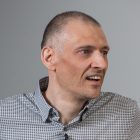 My arrest and criminal case clearly show that I was persecuted solely for my words. I was prosecuted for defending freedom of speech and the right to share information. The charges they invented had no evidence whatsoever – nothing was presented in court. The regime doesn’t even understand what a real court is. What they have has nothing to do with justice.
When you’re tried, Stalin-style, inside the prison itself, behind closed doors, your lawyers can’t defend you. Meanwhile, on state TV, they broadcast false and defamatory claims, but neither I nor my lawyers can respond. Sitting in prison “with my mouth shut,” I couldn’t even make a final statement. People couldn’t hear my evidence of innocence or my arguments – nothing. The regime throws out baseless accusations and hands down long sentences. My trial lasted about six months.
It’s absurd. The UN Working Group on Arbitrary Detention had already ruled that my detention was arbitrary and therefore illegal. But the regime didn’t care.
This is how the justice system works in Belarus: when the dictator appoints the head of the Investigative Committee, the prosecutor general, the head of the KGB and the ministers, he appoints everyone. He also appoints judges by his own decree. Our constitution states there is a separation of powers, three branches
of government, but in reality this does not exist. He appoints everyone by his decrees, and they carry out his will.
And it turns out that it is impossible to fight this within the framework of the law. Impossible. We suffered not because we fought in some way outside the law, but because we spoke up, exposed and showed it. Accordingly, they engaged their instruments of force and simply put everyone who did not stay silent and spoke out into prison.
 From the very start, a segregation process begins in prisons. Those convicted under so-called “extremist” articles – which cover a wide range of charges, from participating in public gatherings to posting comments allegedly insulting the honour and dignity of officials and the president – are stripped of nearly all rights.
Such prisoners are immediately labelled “malicious violators of prison rules”. Often, there is no real basis for this, but it’s simply the procedure: a person is automatically considered to be breaking internal regulations in detention facilities.
On this basis, they are placed on a preventive register, meaning they are under heightened scrutiny from their first day in a penal institution. Usually, they are subjected to all possible punishments: disciplinary cells, denial of parcels and packages from relatives, and bans on any visits.
Political prisoners – marked with yellow tags – are even denied the right to visit the library, use the sports yard or attend church, despite small chapels existing in all colonies. Torture by solitary confinement is common. I spent almost six months in a medium-security colony in Shklou. In total, I spent 160 days in solitary confinement there.
 After a long period in prison, people often feel disoriented when they are released. Reactions vary. Some initially experience euphoria and joy at being reunited with loved ones, but may struggle to adjust to the changed reality. At first, they might feel okay, but many have told me that after a while, psychological problems begin. The original traumas don’t disappear – they’re deeply buried but eventually resurface.
I have personally experienced this in two ways. During short administrative arrests, the first time I was released, I felt very bad – scared, as if they were about to come for me again. I went through that fear, processed it, let it out and felt relief. Later, after subsequent short arrests, I was able to resume life as if nothing had happened. But those were very brief detentions.
Now, I have been released outside Belarus. I think if I had returned home, I would feel better – because being in exile brings its own challenges. My case is unusual, as my release was forced. I was taken out of the country without my knowledge, blindfolded, with no explanation of where I was being moved. In the first days, the anger and despair over still having no control over my life overshadowed everything else.
Thanks to the support I received in exile – practical, financial, and from friends – it became much easier for me. And perhaps one of the important things were the words of my loved ones. Now, they too have breathed a sigh of relief, and for their peace of mind, I am ready to face personal difficulties.