8 Jan 2014 | News, Volume 42.04 Winter 2013
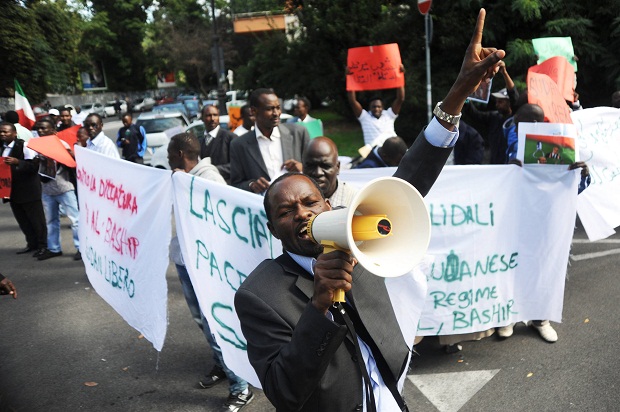
Dozens of protesters in front of the Sudanese Embassy in Rome October 2013 to protest of the alleged human rights abuses in Sudan (Image Marco Zeppetella/Demotix)
In the latest magazine issue of Index on Censorship the Bishop of Bradford Nick Baines reflects on his first visit to Sudan, a country whose leader strongly believes in one religion and one language for all.
Freedom of expression is of universal importance, but its absence is sometimes more easily seen through the lens of a different culture. The familiar landscape of “home” can sometimes hinder a proper appreciation of the absence of freedoms, being outside of one’s comfort zone can heighten awareness of reality. In this article I want to approach the matter from the outside in.
Early in 2013 I visited Sudan for the first time. The diocese of Bradford has had a partnership with Sudan for 30 years, and I was linked for a decade with Anglican dioceses in Zimbabwe (in my previous post as Bishop of Croydon). I thought I could easily switch attention from one African country to another. The reality was different.
Zimbabwe is ruled by Robert Mugabe, a man so corrupt that even his own demise will not clear the path to a golden new age – there are too many people who need to be protected by power well into the future. Sudan is governed by Omar al Bashir, a man committed to the project of creating a single nation (Sudan) with a single ethnicity (Arab), a single language (Arabic) and a single religion (Islam). There is a degree of shameful incompetence about Mugabe’s manipulation of power and the consequent destruction of the Zimbabwean economy and the country’s political culture. But al Bashir knows exactly what he is doing. And he does it in the face of a serious indictment by the International Criminal Court (ICC) for genocide in Darfur: he feels untouchable
Since 99 per cent of southerners voted in 2011 for the division of Sudan into two independent states, Sudan and South Sudan, al Bashir has chosen to make the secessionists take responsibility for their choice – to some extent understandably. If they are so keen on having their own country, then they can go there… and then apply for visas to come to Sudan as foreigners. Harsh? Yes, but he could be seen to be compelling the South Sudanese to live with the consequences of their actions. Democratic choices bring consequences.
However, the real experience of this is the expulsion from Sudan of anyone deemed to originate in the south – even several generations ago. Those who remain – often because they are married to Sudanese – are prohibited from working. Apart from the human cost of this policy, the effect on the Anglican church (the Episcopal Church of Sudan, which has not divided along with the states) is an exodus of leaders, an increased dependency of those who remain on the goodwill and generosity of other Sudanese Christians. And this is happening alongside the ongoing genocide in Darfur, government violence in South Kordofan and Blue Nile state. Khartoum has had to absorb destitute migrants on an unimaginable scale.
Those displaced are almost exclusively African. They speak African languages (derogatorily referred to as “twittering” by the Arabs). They are mostly (but not exclusively) Christian.
My visit to Khartoum earlier this year ended when my wife and I left a Christian-owned guesthouse at 1am in order to get to the airport for the flight back to Manchester. Within an hour the guesthouse had been raided by the security services, all property confiscated, and all residents and guests taken in for questioning. Foreign guests were deported and the family that ran the guesthouse was removed; the father of the family is now prohibited from working. This might not sound too dramatic – especially in the light of reports from parts of the Middle East and South Asia where Christians are being targeted for violence or forced to convert to Islam – but it comes as part of a deliberate policy on the part of government to exclude Christians and force them to leave for the South. This necessarily puts pressure on Christians to keep quiet, but the bishops (in particular) continue to be unafraid to engage courageously with “the powers”.
It seems that al Bashir blames the international community for refusing to welcome him back into the fold by removing the ICC indictment after the peaceful transition to two states. Foreigners are to be removed, even when they provide essential services that cannot be provided locally. We met European medical personnel who had spent their working lives developing medical facilities in local communities, and who now found themselves thrown out, leaving medical provision severely weakened.
Why destroy social, educational and medical infrastructure simply in order to save face? Riots in September 2013 in Khartoum (initially about the removal of fuel subsidies) demonstrated that economic matters do not always serve the interests of the government of the day.
But there is a bigger question relevant beyond Sudan. How do we understand and clearly define the categories in which and through which we see political, religious and cultural phenomena? Getting the category wrong leads inevitably to miscomprehension, to a potentially dangerous misapplication of rhetoric/language… and this has political consequences.
My own diocese of Bradford has a high percentage of Muslims from south Asia. Immigration began in the mid-20th century in order to staff the textile mills of West Yorkshire. Many of Bradford’s Muslims originate from the region of Kashmiri Mirpur in Pakistan. This concentration necessarily affects how the community lives and organises in Bradford, how it is influenced by (and, in turn, influences) events back in Pakistan, and how it is understood by the non-Pakistani population in the city.
One of the first lessons I had to learn when I came to Bradford nearly three years ago was not to confuse ethnicity with religion. What might appear to be a phenomenon rooted in religious identity (certain modes of dress, for example) might actually be more appropriately understood as a cultural phenomenon that coincidentally becomes associated with religious identity. To confuse the two can be dangerous. What I have in mind here is where violence (in particular) is attributed to religion, when religious tagging is clearly a tribal badging designed to hide more cultural (or other) identity.
Examples of this can be seen in the Northern Ireland of the Troubles or the sectarian destructiveness of Lebanon. Although the categories cannot easily be extricated from one another, at least those who observe or comment on such events should have the intelligence to dig a little deeper into the categorisation of such phenomena before simplistically eliding culture and religion as if they were synonymous.
The point is that there are two dangers here: (a)that category errors lead to poor communication and confusion, and (b)that people might be reluctant to speak out on serious matters simply because they fear being accused of racism or simply getting it wrong. This doesn’t help anyone where honest and frank conversation is needed and mutual critique is essential to good relationships.
This takes us back to Sudan. It is not a simple matter – capable of easy explication or distinction – to work out what can be attributed to which category. Al Bashir’s policy seems clearly to create a political, ethnic, religious and cultural identity in which there is no place for diversity. One can assume that he is aiming at a myth of solidarity – that if everyone claims the same identity, they will buy into the same projects, have the same friends and enemies, defend the same categories and communicate in the same way. Of course, this fails to take into account the complex reality of human identity construction and how complex and diverse people interrelate and self-identify.
In one sense all this should not need to be articulated. If Muslim is blowing up Muslim in Pakistan or Afghanistan, then there is clearly more going on than mere “religion” or religious identity. Simply reporting atrocities as if they were political or cultural events (without reference to religious allegiance) is as naïve as to report on religion without reference to the ethnic, political, economic, social or cultural identities that shape religious expression.
This is not a plea for obfuscation or mitigation of religiously motivated violence. On the contrary, it is a plea for the sort of literacy that seeks to comprehend in order to know how to think about and respond to phenomena that might all-too-easily be capable of simplistic categorisation.
Language goes to the heart of this. Not only the language of explanation or reportage, but the ways in which language is (or particular languages are) seen to be totems of identities that are deemed to be inconvenient. In Zimbabwe identity is tied up inextricably with language: the Shonaspeaking government has demonstrated in past violence what it thinks of the Ndebelespeaking Matabele. In Sudan African languages – mostly spoken by Christians of African (rather than Arabic) origin – are being derided and squeezed out. This is one reason why some churches in Sudan put such high value on keeping their own languages alive, teaching them to both children and adults, working hard (with pitiful resources) to reserve their means of communication as an integral element of cultural and religious identity. Language is as much part of individual and common identity as is skin colour, and nobody should be compelled to lose their native tongue.
One of the most penetrating verses of the Old Testament is found in the book of Proverbs. Seized upon by opponents of Hitler during the 1930s and 1940s in Germany, it demands that we “open our mouths for the dumb” – that is, that those who have a voice must keep alive the songs and language of people whose voice is silenced by the exercise of corrupt power. The moral demands of this are clear here also. But, for that voice to be heard and understood, it is essential that intelligent consideration is given to ensuring that the categories of speech and identification are kept as accurate as possible.
Responding to religious phenomena as if they were merely “cultural” is as dangerous and misplaced as eliding all cultural phenomena as merely “religious” – and runs the risk of stopping people speaking truthfully and accurately when religion is the root of violence or cultural violence seeks to hide behind a religious facade. The world is more complex than that. We can and must do better.
2 May 2013 | religion & culture
An arm of the US government named 15 nations as the “worst violators of religious freedom”.
The Commission on International Religious Freedom (USCIRF), an independent advisory body created by the International Religious Freedom Act to monitor religious freedom abuses internationally, released its 2013 report, which idenitifes “governments that are the most egregious violators.”
The 15 countries are Burma, China, Eritrea, Iran, North Korea, Saudi Arabia, Sudan, Uzbekistan, Egypt, Iraq, Nigeria, Pakistan, Tajikistan, Turkmenistan and Vietnam, all of which severely restrict independent religious activity and harass individuals and groups for religious activity or beliefs. These nations are classified as Tier 1 “countries of particular concern” (CPCs) in the report.
Despite its recent opening and political reforms, change in Burma have “yet to significantly improve the situation for freedom of religion and belief.” The report states that most violations occurred against minority Christian and Muslim adherents. China’s government is also cited for its ongoing severe abuses against its citizens’ freedom of thought.
The report said that Egypt’s transitional and elected governments have made progress toward religious freedom, it further highlighted the attacks that Coptic Christians have sustained in the period after the Arab Spring that brought down the Mubarak regime. “In many cases, the government failed or was slow to protect religious minorities from violence.”
The former Soviet states of Tajikistan, Turkmenistan and Uzbekistan were included for pursuing state control over religion, targeting Muslims and minorities alike. Iraq was cited for, among other things, tolerating “violent religiously motivated attacks” and Iran for “prolonged detention, torture, and executions based primarily or entirely on the religion of the accused.”
Saudi Arabia continues to suppress religious practices outside of the officially-sanctioned Wahhabi interpretation of Islam, interferes with the faith of guest workers and prosecutes individuals for “apostasy, blasphemy and sorcery”, according to the report. Pakistan has a strict blasphemy law and failure to prosecute acts of religious violence, the report said.
The situation in Sudan has deteriorated since South Sudan gained its independence. Criminalization of apostasy, the imposition of the government’s strict interpretation of Shari’ah on both Muslims and non-Muslims and attacks against Christians, were cited in the report for the decline.
The report also identified Nigeria for continuing religious violence between Muslims and Christians compounded by the government’s toleration of the sectarian attacks. North Korea’s totalitarian regime was also included for its ongoing harassment and torture of citizens based on religious beliefs.
A second tier includes Afghanistan, Azerbaijan, Cuba, India, Indonesia, Kazakhstan, Laos and Russia, where abuses of religious freedom are tolerated by the government and meet the threshold for CPC designation by the US Department of State, but don’t meet all of the standards for “systemic, ongoing, egregious” measurements.
Other countries regions being monitored included Bahrain, Bangladesh, Belarus, Ethiopia, Turkey, Venezuela and Western Europe.
1 Mar 2013 | News, Religion and Culture
[vc_row][vc_column][vc_column_text]While they exist harmoniously on paper, free expression and religion often conflict in practice, and free speech is often trampled in the name of protecting religious sensibilities — whether through self-censorship or legislation that censors.
History offers many examples of religious freedom being repressed too. Both free expression and religious freedom need protection from those who would meddle with them. And they are not necessarily incompatible.
Over 200 years ago, the United States’ founding fathers grouped together freedom of worship and freedom of speech. The US Constitution’s First Amendment, adopted in 1791, made sure that the Congress couldn’t pass laws establishing religions or prohibiting their free exercise, or abridging freedom of speech, press and assembly.
More recently, both religion and free expression were offered protection by The United Nations Declaration of Human Rights (UNDHR) drafted in 1949. It outlines the ways in which both free expression and religious freedom should be protected in Articles 18 and 19. Article 18 protects an individual’s right to “freedom of thought, conscience, and religion” and the freedom to change religion or beliefs. Article 19 states: “Everyone has the right to freedom of opinion and expression; this right includes freedom to hold opinions without interference and to seek, receive and impart information and ideas through any media and regardless of frontiers.”
Why is it, then, that for centuries — from the Spanish Inquisition to the Satanic Verses — free speech and religion have been cast as opponents? Index on Censorship has explored, and will continue to explore, this crucial question.
Offence
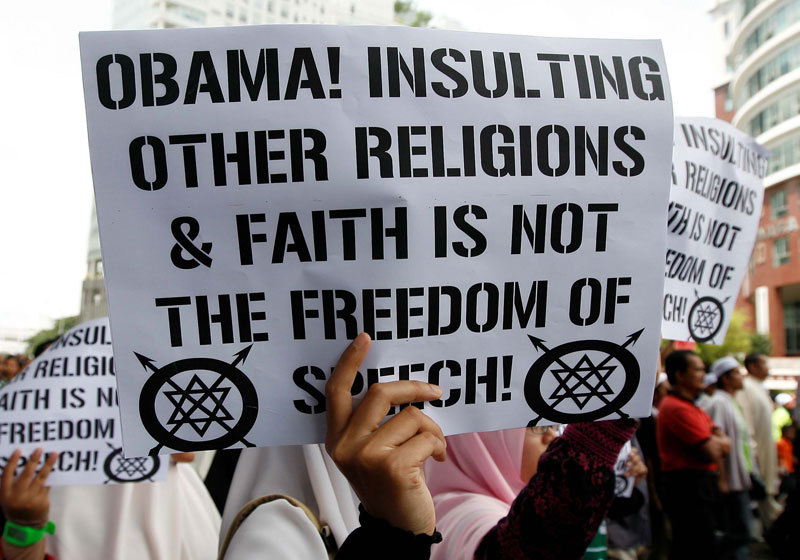
Muslims gathered in Malaysia’s capital to protest against the controversial Innocence of Muslims film (Demotix)
Sporadically explosive conflicts arrise when words or images offensive to believers spark a violent response, the most recent example being the reaction to the controversial Innocence of Muslims film. Index has stated before that the majority of states restrain by law distinct and direct incitements to violence; however, causing offence doesn’t constitute an incitement to violence, much less a good excuse to react with violence. Yet violent protests sparked by the YouTube film led many countries to push for the video to be taken down. As the controversy unfolded, digital platforms took centre stage in an age-old debate on where the line is drawn on free speech.
The kind of connectivity provided by the web means a video uploaded in California can lead to riots in Cairo. Real-time transmission, real-time unrest. It presents a serious challenge for hosts of user-generated content like YouTube and Facebook.
Before the web, British-Indian writer Salman Rushdie’s “blasphemous” 1988 novel — The Satanic Verses — sparked protests and earned its author a death sentence from Iran’s Ayatollah Khomeini, who called upon Muslims to assassinate the novelist, his publishers, and anyone else associated with the book. The Japanese translator of the Satanic Verses was killed, and Rushdie’s Norwegian publisher was shot and wounded, leading some to think twice about publishing works potentially “offensive to Islam”.
These fears were renewed after the 2005 decision of Danish newspaper Jyllands Posten to publish caricatures of the Prophet Muhammad, which were protested about in riots worldwide, largely initiated as a result of agitation by Danish clerics.
The Jewel of Medina, a historical novel about the life of Muhammad’s wife Aisha was due to be published by Random House in the US in 2008, but it was pulled when an academic warned the publishers of a possible violent backlash to the novel. After the UK-based publisher Gibson Square decided to take on the novel, Islamic extremists attempted to firebomb the home of the company’s chief executive. More recently, ex-Muslim and author of The Young Atheist’s Handbook Alom Shaha wrote that initially, staff at Biteback publishing had reservations about releasing his book in the UK. Upon being presented with the book, one staff member’s reaction was, “we can’t publish this, we’ll get firebombed”.
Article continues below[/vc_column_text][/vc_column][/vc_row][vc_row][vc_column][vc_custom_heading text=”Join the Index mailing list and get an exclusive gift” font_container=”tag:p|font_size:28|text_align:left” use_theme_fonts=”yes”][vc_separator color=”black”][/vc_column][/vc_row][vc_row][vc_column width=”1/2″][vc_column_text]
Index on Censorship’s summer magazine 2016
We’ll send you our weekly emails and periodic updates on our events. We won’t share your personal information with anyone outside Index.
You’ll also get access to an exclusive collection of articles from our landmark 250th issue of Index on Censorship magazine exploring journalists under fire and under pressure. Your downloadable PDF will include reports from Lindsey Hilsum, Laura Silvia Battaglia and Hazza Al-Adnan.[/vc_column_text][/vc_column][vc_column width=”1/2″][gravityform id=”20″ title=”false” description=”false” ajax=”false”][/vc_column][/vc_row][vc_row][vc_column][vc_separator color=”black”][/vc_column][/vc_row][vc_row][vc_column][vc_column_text]Protecting religious sensitivities at price of free expression
Many countries have legislation designed to quell religious tensions and any ensuing violence.
India, for example, has a Penal Code with provisions to protect “religious feelings”, making “acts” or “words” that could disturb religious sensitivities punishable by law. However, while such laws exist to address prevent sectarian violence their vagueness means that they can also be used by groups to shut down free expression. This opens up a question, which is when do states have the right to censor for public order reasons even if the actual piece of writing, art or public display is not a direct incitement to violence.
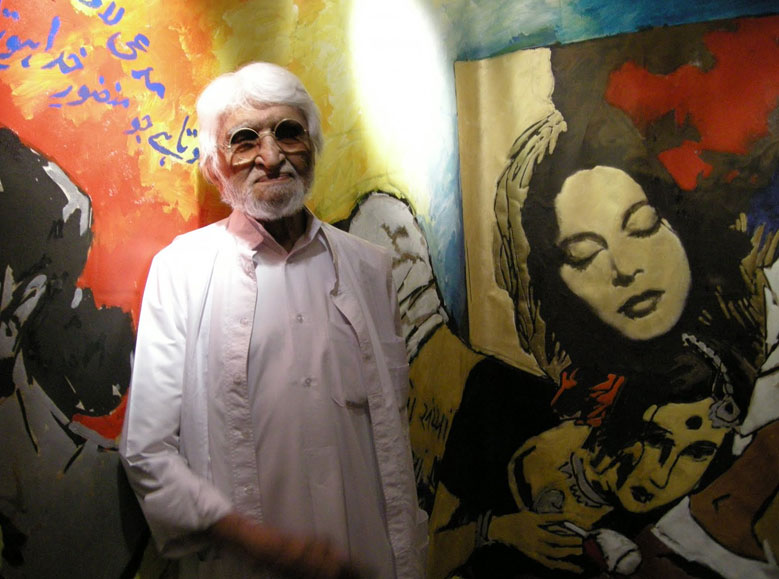
Indian artist and Index award winner was forced to leave his native India in the 1990s after being threatened for his work
In the 1990s, Indian artist and Index award winner MF Husain was the subject of a violent intimidation campaign after painting Hindu gods and goddesses naked. He received death threats and had his work vandalised. Hundreds of complaints were brought against the artist, leading to his prosecution under sections 295 and 153A of India’s Penal Code, which outlaw insulting religions, as well as promoting animosity between religious groups. Locally these laws are justified as an effort to control sectarian violence. While the cases against Husain were eventually thrown out, the spectre of new legal battles combined with violent threats and harassment pushed Husain to flee his home country. He never returned, and died in exile last year.
Across the world restrictions on free expression are imposed using laws designed to protect religious sensitivities.
Pakistan’s blasphemy laws are notorious for being abused to silence and persecute the country’s religious minorities. Although the country’s Penal Code has always had a section on religious offence, clauses added in the 1980s set a high price for blasphemy or membership of the Ahmadi sect of Islam — an Islamic reformist movement. These laws, including a possible death sentence for insulting the Muslim prophet Muhammad, have been slammed by civil society inside and outside of Pakistan.
A report issued in September by the Special Rapporteur on the promotion and protection of the right to freedom of opinion and expression, Frank La Rue, says that blasphemy laws should be repealed. Controls on free speech in order to protect religious sensibility seem to run parallel to controls on religion.
Globally, restrictions on religious expression have increased according to a report released last month by the Pew Research Center. In 2010, the study found that 75 per cent of the world’s population lived in countries where restrictions placed on religious practice were rated as either “high” or “very high”. The study found that the greatest restrictions on religion take place in the world’s most heavily populated countries — India, Egypt, Indonesia, Iran, and Russia stood out on the list.
Outrage and incitement to religious hatred
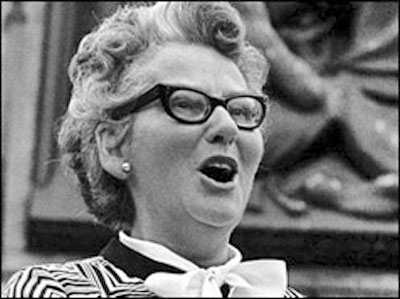
In 1977 Christian campaigner Mary Whitehouse successfully brought charges against the publishers of a magazine that printed a graphic sexual poem about Jesus Christ
In 2007, the UK introduced the offence of “incitement to religious hatred”, which some feared was merely a replacement for the scrapped blasphemy law, made more wide-ranging by covering not just Christianity but all religions. The last conviction under that law was the infamous 1977 Gay News case, where Christian campaigner Mary Whitehouse brought a successful private prosecution against the publishers of Gay News magazine for publishing a poem describing a Roman soldier’s fantasy of sex with Jesus Christ.
In the UK, one of the most pernicious means by which restrictions on free speech have grown tighter has been through the use of incitement laws, both incitement to hatred and incitement to violence and murder. In some cases, as in the outlawing of incitement to religious hatred through the Racial and Religious Hatred Act, the law is being used to censor genuine debate. In other cases, incitement law is being used to shut down protest, as in the convictions of Muslim protestors Mizanur Rahman and Umran Javed for inciting racial hatred and ‘soliciting murder’ during a rally in London against the publications of the Danish Muhammed cartoons. Over the past decade, the government has used the law both to expand the notion of ‘hatred’ and broaden the meaning of ‘incitement’. Much of what is deemed ‘hatred’ today is in fact the giving of offence. And should’t the giving of offence be viewed as a normal and acceptable part of plural society?
In 2009, Ireland created for the first time a specific blasphemy offence. This law states a person is guilty of blasphemy if
“he or she publishes or utters matter that is grossly abusive or insulting in relation to matters held sacred by any religion, thereby causing outrage among a substantial number of the adherents of that religion, and
(b) he or she intends, by the publication or utterance of the matter concerned, to cause such outrage.”
This wording was later used as a template for attempts to introduce the idea of “defamation of religion” as an offence at the United Nations. The attempt to introduce this concept failed, but the UN Human Rights Council did pass a resolution condemning “intolerance, negative stereotyping, stigmatisation, discrimination, incitement to violence, and violence against, persons based on religion or belief”.
On the other hand, according to Frank La Rue, quoted by Journalism & Intolerance said: “blasphemy is a horrible cultural phenomenon but, again, should not be censored or limited by criminal law. I would like to oppose blasphemy in general by being respectful, but that’s something you build in the culture and the traditions and the habits of the people, but not something you put in the criminal code. Then it becomes censorship.”
Crushing religious freedom
Other European countries have had their own free speech versus religion battle when a push towards bans on the veil or niqab began, infringing on choices of Muslim women. France’s controversial ban on the niqab went into effect last year. Offenders must pay a 150 € fine or take French citizenship classes. There have been similar discussions in the Netherlands, Denmark, the United Kingdom, and Belgium. Such bans are not restricted to Europe — in 2010 Syria banned face veils from university campuses. From 1998 – 2010, Turkey banned headscarves from university campuses. In fact, Turkey has a much wider ban on headscarves in public buildings, a ban the government faces difficulties overturning though it would like to. Just as troubling — countries like Iran and Saudi Arabia have strict dress codes for women that visitors must comply with as well.
Both enforced secularism and enforced religiosity constitute a form of censorship; the key word being “enforced” as opposed to “free”. Whether it is tackling enforced religion, religious offence, hatred and incitement to violence, or enforced secularism, only a constructive approach to free speech can genuinely guarantee freedom of conscience and belief, whether in one god, many or none.[/vc_column_text][/vc_column][/vc_row][vc_row][vc_column][vc_basic_grid post_type=”post” max_items=”12″ style=”load-more” items_per_page=”4″ element_width=”6″ grid_id=”vc_gid:1493908381135-56de588f-391f-0″ taxonomies=”78, 4880″][/vc_column][/vc_row]
4 Feb 2013 | Uncategorized
Chinese communist party newspaper The People’s Daily has today denied allegations that China hacked into the computer systems of various US media outlets. The state-run newspaper denied that officials had hacked The New York Times and The Wall Street Journal, also refuting claims from The Washington Post that it had been targeted. The People’s Daily said that the national security allegations from the US were a cover-up for imposing economic sanctions on China. The Obama administration will reportedly address the attacks as an economic threat in a National Intelligence Estimate report, meaning the US can impose sanctions in China in response. Concern has been mounting in America that China has been responsible for a series of sustained cyber attacks on government agencies, US companies and media outlets — a US congressional report last year named China “the most threatening actor in cyberspace”.
A french journalist researching prostitution and human trafficking in Cambodia has had a seven year jail sentence in absentia upheld under prostitution charges. Daniel Lainé was charged by Phnom Penh City Court on 29 January for soliciting prostitutes and issued with a “red notice” by Interpol following a request from the court, banning him from reporting anywhere outside of France. Lainé had originally been sentenced in 2010 after being caught secretly filming a prostitute without permission, a charge the journalist denies. The charges are thought to be linked to Lainé’s 2003 documentary exposing sex tourism in Cambodia and are allegedly supported by a written witness statement from someone who never appeared in court during the case. Lainé is a filmmaker for Tony Comiti Productions and was winner of a World Press Photo award in 1991.

These crisps have caused offence amongst the Catholic community
On 1 February, a film maker accused the Italian government of censorship for calling off the screening of his film for being too political. Bill Emmott, former editor of the Economist, was due to show his documentary Girlfriend in a Coma on 13 February at the National Museum of the 21st Century Arts, but the organisers were contacted on 1 February to say that the ministry of culture had ordered the event to be postponed ahead of the parliamentary elections on 24 February. Emmott, who’s film takes a critical look at Italy and the problems it faces, said there is a culture of denial in the country. The film has already been screened in several European countries and the US and is expected to remain postponed until the elections are over.
An appeals court in the Philippines has upheld a decision to pursue a libel case and issue of arrest warrants against a minor and five other people for online defamation charges made on 13 March 2012. A teenage blogger was accused of posting defamatory comments on Celine Quanico’s blog on 6 April 2008, along with Justine Dimaano, Francesa Vanessa Fugen, Anthony Jay Foronda, Roberto Armando Hidalgo and Danielle Vicaldo. Quanico said that Dimaano had posted a Yahoo messenger conversation titled “meet my backstabber friend”, but had changed the alleged victim’s name — who was 16 at the time of the alleged offence. Other insults posted on the site included “bitch”, “ugly”, “loser” and “liar”. The Cyber Crime Prevention Act went into effect on 3 October in the Philippines, after it was suspended following calls to remove the law from constitution.
Chain sandwich store Pret A Manger has withdrawn a new “Virgin Mary” brand of crisps from shelves following religious complaints. The bloody mary cocktail flavoured crisps had been introduced last week, but prompted complaints, including from Catholic groups that the brand was offensive to Jesus’ mother. The company said it removed the product to avoid further offence after noting the “strength of feeling” behind the few complaints they received. The unsold crisps will be donated to homeless charities across the country. Among the complainants was The Reverend Nick Donnelly, deacon of the Diocese of Lancaster, who said after Pret removed the product that the incident taught the Catholic community how to defend their faith in the future.
