This column was originally submitted to Today’s Zaman, but was rejected by the new management. Doğu Ergil is a Turkish sociologist, political scientist and academic, and was a columnist for Today’s Zaman.
The numerical figures of the reality of Syrian refugees in Turkey is as follows: 2.2 million of the 4.3 million displaced Syrians who have been registered as persons of concern by the Office of the United Nations High Commissioner for Refugees (UNHCR) currently reside in Turkey. There is an estimated 0.4 million who have settled in various parts of Turkey relying on their own financial resources. The total number of Syrian refugees in Turkey is higher than the entire population of six of the EU’s 28 member states.
What truly scares Europe in terms a massive influx of “others” who can neither be assimilated nor accommodated is not sufficiently evaluated in Turkey. This is due to two factors. First the incumbent government wanted to win the hearts and minds of the Syrian asylum seekers fleeing from a tyrant who they believed would quickly wither away.
The return of the displaced people with gratitude and love for Turkey and its leadership would boost Ankara’s desire to shape the future of Syria and the Levant. Hence their warm welcome was accompanied by thoughts of temporary duress with large dividends to follow.
Secondly, the people of Turkey were influenced by the rekindled ideological rhetoric of Islamic brotherhood/solidarity and reclaiming the old territories of the Ottoman past. However, as years passed and the calculations over Syria changed, the permanence of Syrian refugees became apparent just as the realisation of the magnitude of humanitarian, social, economic and security challenges.
The big question is whether Turkey alone can bear the burden of hosting more than 2.5 million refugees without outside/international aid and support. Here comes the EU threatened by an unprecedented influx that it can neither accommodate nor assimilate. Neither Turkey’s capabilities nor Europe’s political stance have been amenable to a sustainable management of the current refugee crisis.
Consequently, this week necessity brought Turkish and EU leaderships to work out a sustainable process whereby Turkey will build the capacity to host most of the Syrian refugees and Europe will take in a limited number of them through a gradual filtering system. In return, the EU will help Turkey to carry the burden of hosting millions of refugees.
Another matter of bargaining was the lifting of visa requirement for Turkish citizens in the Schengen area. Indeed the Turkish leadership feel discriminated against on this issue when compared with other EU applicant countries (i.e., Western Balkan countries) or with third countries concerning the restrictive EU visa policy. They have concrete expectations from Brussels in this respect.
In fact, a political deal was reached in 2012 for the readmission into Turkey of third-country irregular migrants who enter the EU via Turkey in return for visa liberalisation for Turks traveling to the EU. This agreement is of great sentimentality in the overall EU-Turkey relationship given the fact that the latter’s membership seems to be farfetched.
These issues were the issues discussed by the Turkish prime minister and accompanying officials with EU representatives in Brussels this week. So far information obtained indicates that any passage of refugees further west from the Balkan countries they have reached will be obstructed. This means the so called “the Balkan corridor” will be closed.
Already a series of countries on the route have prevented the entry of migrants of Middle Eastern origin. Brussels does not want individual initiative by member states. Otherwise the crisis cannot be handled effectively. For example Macedonia allows only a limited number of refugees from Greece each day. This leads to a swelling of the number of refugees on the border towns of Greece like Idomeni, where nearly 10,000 wait on. The EU promised 700 million euros to Greece in relief.
What the EU wants is for Turkey to readmit those refugees who are not given legal rights of entry. As German Chancellor Angela Merkel has said, the 3 billion euros earmarked for Turkey can be used to build schools for refugee children and development of employment opportunities for the adults. But these piecemeal and incomplete initiatives are no panacea for either Turkey or the humanitarian crisis born out of the dismal conditions of the Middle East.
First of all given the conditions in the Middle East, namely Syria and Iraq, the return of the displaced people is not a possibility in the short term or even the medium term. Secondly, without peace and stability in the home countries, more asylum seekers will be knocking on the doors of Turkey and Europe.
So it is the mutual responsibility of mankind to end the root causes of the ongoing conflicts and stop the misery of their fellow men and women. We will see if humanity, especially “civilised countries,” will show this acumen and conscientious behavior.
Turkish President Recep Tayyip Erdogan speaks at a rally in Istanbul, 20 September 2015. Credit: Orlok / Shutterstock
Turkey’s government and courts have demonstrated their unwillingness to adhere to basic values on press freedom and media pluralism. From judicial harassment and seizing media companies to silencing Kurdish and critical media, Turkey’s government has been used by President Recep Tayyip Erdogan to silence critical voices in the country.
The European Charter on Freedom of the Press is a non-binding guideline on press freedom, signed on 25 May 2009 in Hamburg by 48 editors-in-chief and leading journalists from 19 European countries. It consists of 10 articles on media freedom, and if we take it as an ideal for which countries should operate, we see no country in the EU is perfect. However, Turkey finds itself in a unique position of being consistently in breach of every single one on an almost weekly basis.
Article 1 Freedom of the press is essential to a democratic society. To uphold and protect it, and to respect its diversity and its political, social and cultural missions, is the mandate of all governments.
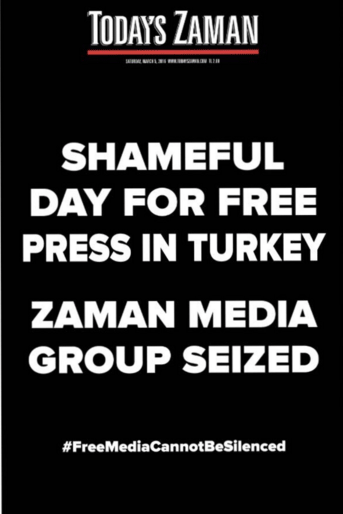
Index on Censorship’s Mapping Media Freedom has verified over 200 violations of media freedom in Turkey since the project began in May 2014. The seizure of the Zaman Media Group, which owns Zaman and Today’s Zaman, on 4 March was just the latest in a long line of assaults against media diversity in the country. Any respect for diversity seemed to be dispersed like the crowds of supporters who gathered at Zaman’s headquarters, who were then set upon by police with water cannons and tear gas.
Article 2 Censorship is impermissible. Independent journalism in all media is free of persecution and repression, without a guarantee of political or regulatory interference by government. Press and online media shall not be subject to state licensing.
A day after the takeover of Zaman, trustees were appointed by the authorities to Cihan News Agency in another bid to silence criticism of Erdogan. Cihan said on its website late on Monday 7 March that an Istanbul court would appoint an administrator to run the agency on a request from a state prosecutor. Interference by the government is now systemic in the Turkish media.
Article 3 The right of journalists and media to gather and disseminate information and opinions must not be threatened, restricted or made subject to punishment.
Opposition journalists are routinely punished in Turkey. Barış İnce, a former editor of Birgün who still writes for the leftist daily, was sentenced on 8 March to 21 months in prison for “insulting” Turkish President Recep Tayyip Erdoğan. A week previously, on 2 March, journalist Arzu Yıldız attended a hearing at Ankara criminal court for “insulting” Erdogan, former Justice Minister Kenan İpek and Justice Minister Undersecretary Basri Bağcı. Yıldız explained that she is being tried for a retweet, and not for something that she personally wrote.
Article 4 The protection of journalistic sources shall be strictly upheld. Surveillance of, electronic eavesdropping on or searches of newsrooms, private rooms or journalists’ computers with the aim of identifying sources of information or infringing on editorial confidentiality are unacceptable.
On 9 February, Claus Blok Thomsen, a Danish journalist working for daily newspaper Politiken, was detained by Turkish authorities at the Istanbul airport and then barred from entering Turkey. He was travelling to the country to report on refugees at the Turkish-Syrian border. At the airport, Thomsen allegedly identified himself as a journalist and then the police forced him to open his phone and computer, undermining the confidentiality of his sources.
Article 5 All states must ensure that the media have the full protection of the law and the authorities while carrying out their role. This applies in particular to defending journalists and their employees from harassment and/or physical attack. Threats to or violations of these rights must be carefully investigated and punished by the judiciary.
Rather than having the full protection of the law, Turkish journalists often find themselves at its mercy. Nineteen journalists have so far been arrested or detained in the country this year alone, many of them on terror-related charges. This includes Nazım Daştan, a reporter for Dicle News Agency (DİHA), which reports in Kurdish, who was charged with spreading terrorist propaganda on Facebook in February.
Article 6 The economic livelihood of the media must not be endangered by the state or by state-controlled institutions. The threat of economic sanctions is also unacceptable. Private-sector companies must respect the journalistic freedom of the media. They shall neither exert pressure on journalistic content nor attempt to mix commercial content with journalistic content.
Threats to the economic livelihood of the media are commonplace in Turkey. On 3 November 2015, 58 journalists were dismissed from İpek Media Group when it was unlawfully seized in a government-led police operation in late October. Sound familiar? When Zaman was taken over, editor-in-chief Abdülhamit Bilici was fired without remuneration by the new trustees. Many other members of staff were let go also.
Article 7 State or state-controlled institutions shall not hinder the freedom of access of the media and journalists to information. They have a duty to support them in their mandate to provide information.
Article 8 Media and journalists have a right to unimpeded access to all news and information sources, including those from abroad. For their reporting, foreign journalists should be provided with visas, accreditation and other required documents without delay.
Turkish authorities rejected a permanent press accreditation application filed by Norwegian daily Aftenposten’s correspondent Silje Rønning Kampesæter, on 9 February 2016. Turkish authorities have not issued any written statement on the reason for the rejection. The application also affects her residence permit in Turkey.
Article 9 The public of any state shall be granted free access to all national and foreign media and sources of information.
Over the past two decades, right to know laws have become commonplace in the European Union. In Turkey, the principle has yet to catch on. In the wake of the bomb that ripped through Ankara killing 37 people on Monday, Erdogan’s government moved to block Facebook and Twitter as part of a media ban. Domestically, blanket media bans are becoming more common in Turkish media. On 17 February, the government rushed out a temporary broadcast ban after another deadly blast in Ankara. Similar measures were taken the month previously as well.
Article 10 The government shall not restrict entry into the profession of journalism.
This week, Erdogan has claimed the definition of a terrorist should be changed to include terrorist “supporters”. It was clear who the president had in mind: “Their titles as an MP, an academic, an author, a journalist do not change the fact they are actually terrorists.” By treating critical journalists like terrorists, Erdogan is effectively redefining their profession.
This column was originally submitted to Today’s Zaman but was rejected by the new management. Yaşar Yakış is a Turkish politician. He is a former foreign minister, and a former ambassador to the UN Office in Vienna, Egypt and Saudi Arabia, and was a columnist for Today’s Zaman.
An important step has been taken in Turkey’s painful negotiations with the EU. Turkey submitted to the Turkey-EU summit, held in Brussels on 7 March, several proposals, including the following:
-Move to 1 June 2016 the implementation of the readmission agreement, which will make Turkey contractually obligated to readmit any person who travelled to an EU country from Turkey if he or she was not admitted by that EU country;
-For every citizen of a third country readmitted by Turkey, the EU should promise that it will admit one refugee from Turkey, and the readmission expenses will be covered by the EU. This will protect Greece from the uncontrollable flow of refugees arriving in the Greek islands from Turkey’s coastal towns. However, difficulties may arise in finding an EU country that will fulfill this commitment, and Turkey’s refugee problem may continue to increase since the arrival of refugees from Syria may not stop before Syria is stabilised.
-If the readmission agreement enters into force by 1 June 2016, visa-free travel will be possible for Turkish citizens wishing to visit the Schengen countries.
-Turkey asked for an additional 3 billion euros, to be spent for refugee-related projects.
-Turkey’s EU accession process will be reactivated by opening new negotiation chapters that were blocked for political reasons, either by the EU Council or by individual countries, such as France and the Greek Cypriot administration. This positive commitment may not guarantee that Turkey will become a member of the EU but may lead to the resumption of the reforms that Turkey has to comply with under the Copenhagen criteria and the Maastricht economic criteria.
The deal will be discussed once again with Turkey before the EU Council meeting on 18 March.
Turkey’s refugee problem may thus be slightly alleviated if the genuine efforts by Chancellor Angela Merkel of Germany succeed. The bulk of the burden, however, will still remain on Turkey’s shoulders. Turkey will have to accommodate the refugees, mainly from Syria, until the EU countries select among them the eligible ones. The EU does not want to assume the moral responsibility for the solution of a problem that stems basically from Turkey’s open door policy for Syrian refugees.
The good side of the deal for Turkey is that the EU is giving Turkey a helping hand. If Chancellor Merkel hadn’t taken the lead to alleviate Turkey’s refugee burden, Turkey would have been left alone to solve it. If the deal is implemented properly, Turkey will receive not only an easing of its refugee burden but will make progress in other areas: One of them is the grinding to a halt of Turkey’s EU accession process. Both Turkey and the EU had lost their appetite for the continuation of the process. Not only the refugee problem but also the entire Syrian crisis, and beyond it the other crises in various Middle Eastern countries, may have demonstrated to certain EU countries that cooperation with Turkey could facilitate the solution of the problems that the EU may face in the Middle East. Therefore, certain EU countries may have decided to revisit the question of the reactivation of Turkey’s EU accession process.
This column was originally submitted to Today’s Zaman, but was rejected by the new management. Suat Kınıklıoğlu is a Turkish politician, writer and analyst.
Ernest David Klein was a Romanian-born Canadian linguist, author and rabbi. His theory for the origins of the word “Europe” was that it derives from the ancient Sumerian and Semitic root “Ereb,” which carries the meaning of “darkness” or “descent,” a reference to the region’s western location in relation to Mesopotamia, the Levantine coast, Anatolia and the Bosporus. Thus, the term would have meant the “land of the setting of the sun,” or more generically, “Western land.” His theory has not been widely accepted, but these days there seems to be some truth to it.
In view of the “extremely pragmatic” EU-Turkey Council, which primarily wants Turkey to stem the flow of refugees from Europe at any price, the dark side of European pragmatism can be imagined. Only a few days before the summit convened, Turkey’s largest newspaper was confiscated in the latest step in the government’s efforts since 2013 to suppress the media. Turkey’s extremely fraught relationship with freedom of expression, freedom of assembly and democratic pluralism is very well known in European capitals. Of course, we understand the need to strike a deal with Ankara, but should that be associated with such a heavy price tag? What if — as many argue — visa liberalisation cannot be delivered by June 2016? Would we not have an even more serious issue vis-à-vis European credibility at hand? Is linking Syrian refugee resettlement to Turkish accession talks a wise policy? These will surely be discussed this week in Brussels, but what we have seen so far has been alarming. Perhaps there will be some revision to the position adopted in Brussels. However, the whole summit affair was bizarre.
Turks who are putting up a brave fight confronting the authoritarianism in this country every day are simply aghast at the show put on in Brussels. Turkey’s democrats have been thoroughly exposed to the crude pragmatism of the EU. What credibility can the EU have after such a summit, which is obviously designed to stem the flow of refugees at any cost? How is it possible for the EU to deal with a government that so blatantly crushes every single voice in favor of democracy, pluralism and free speech? As a recent New York Times editorial titled “Democracy’s Disintegration in Turkey” recalled, the recent crackdown on newspapers “is merely the latest of Mr. Erdoğan’s increasingly authoritarian moves, which have included imprisoning critics, sidelining the military and reigniting war on Kurdish separatists. He now controls much of the media and has made Turkey a leader among countries that jail journalists. Along with his campaign to wipe out a free press, his government’s prosecutors have opened nearly 2,000 cases against Turks in the last 18 months for insulting Mr. Erdogan, which is a crime”.
Worse, the deal produced in Brussels is not good for Turkey, either. Turkey is already overwhelmed by a large number of refugees. The Turkish commitment to accept all refugees entering Europe illegally is likely to make Turkey the world’s largest refugee camp. The security risks associated with that are obvious, and I am writing as someone whose hometown has been bombed twice in the last five months. The social and economic burden is self-explanatory.
We all know Turkey currently does not meet the Copenhagen criteria. Despite all these facts, the European Union put up a great show in Brussels as if everything was normal in the country with which the EU was holding a summit. Needless to say, Turkey’s democrats found this display of double-dealing profoundly distasteful and a betrayal of the values the union is supposed to be built upon.
Rest assured, the next time a European person attempts to lecture me on values, I will have a word or two in response.