Morocco moves for dignity
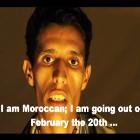
Moroccan youth organised protests through YouTube, Twitter and Facebook, just like activists across the Arab world. But are their aims the same? Jillian C York reports
(more…)

Moroccan youth organised protests through YouTube, Twitter and Facebook, just like activists across the Arab world. But are their aims the same? Jillian C York reports
(more…)
The US Department of Homeland Security last Friday accidentally shut down 84,000 websites — most of them the domains of private individuals and small businesses — during a mangled operation to seize several child pornography outlets. The gaffe took several days to fix, during which time the affected pages were redirected to a menacing warning that their domains had been seized as part of a Homeland Security investigation.
“Advertisement, distribution, transportation, receipt, and possession of child pornography constitute federal crimes that carry penalties for first time offenders of up to 30 years in federal prison, a $250,000 fine, forfeiture and restitution,” the banner broadcast, wrongly associating thousands of law-abiding web users with child pornography.

Their sites are all back up now, and Homeland Security has gone on to announce and celebrate the seizure of the 10 pornography domains it meant to target in the first place. But the error suggests how easily — and accidentally –– innocent Internet users can get caught up in the hunt for actual cyber criminals.
The incident has also alarmed civil liberties groups already wary of proposed Internet “kill switch” legislation in the US Senate, and the collateral damage that could come from giving government too much control over cyber space. Homeland Security, meanwhile, has been conspicuously silent about the mistake.
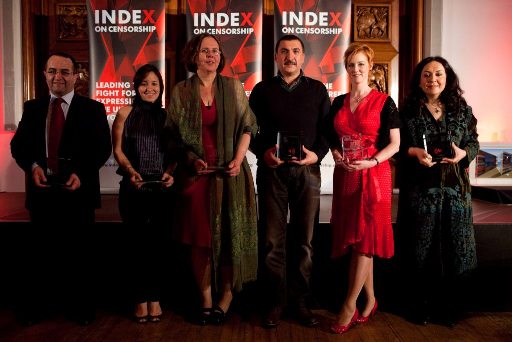
Index on Censorship Free Expression Award 2010 winners
The 11th annual Index on Censorship Freedom of Expression Awards honour those who, often at great personal risk, have given voice to issues and stories from around the globe that would otherwise have passed unnoticed.
This year’s event will be hosted by Jonathan Dimbleby at the Royal Institution in Mayfair on 24 March. It promises to be a truly inspiring evening, with a keynote address from Booker prize-winning novelist Howard Jacobson and a special address from celebrated playwright Sir Tom Stoppard.
Over four decades Index has worked for victims of oppression and censorship, championing their right to free expression. In December, when Natalia Koliada of the world-renowned Belarus Free Theatre was arrested and bundled into a police van, her first call for help on a smuggled mobile phone was to Index on Censorship. In Tunisia we’ve been working on the ground with civil society activists for five years. In addition to our international work, we lead the campaign to reform English libel law.
The awards, kindly sponsored by SAGE, gives you the opportunity to support our vital work. We expect over 300 prominent guests this year, and your attendance will fund our ongoing campaign for free expression in the UK and abroad. The event will begin at 7pm with a champagne reception and grand canapés. After the awards ceremony we will ask you to bid high in our celebrated auction.

Help us aid the courageous efforts of people who campaign for freedom of expression even in the most hostile environments by purchasing tickets below. Each ticket comes with a FREE SUBSCRIPTION to Index on Censorship’s award-winning magazine!
Gaddafi’s tight rein on journalists means that protests in Libya are particularly difficult to monitor, as violence escalates. Libya is placed 160th out of 178 countries in Reporters Without Borders’ press freedom index 2010.
Sarah Leah Whitson from Human Rights Watch explained the difficulties of counting the number of demonstrators on America’s NPR:
“[It’s] extremely hard to say because we are only relying on eyewitnesses in the ground and estimating numbers of crowds is the most inaccurate information that people ever give. But we have reports of thousands and tens of thousands people demonstrating in various cities.”
CNN is claiming that the channel’s correspondent Ben Wedeman, who entered eastern Libya from Egypt, is the “first Western television correspondent to enter and report from Libya during the current crisis”.
Meanwhile, Nazanine Moshiri has filed Al Jazeera’s first report from the border with Libya. Details are scant, however. On Tuesday morning eyewitness in Tripoli reported extreme violence, with “fighter jets bombarding and heavily armed mercenaries using high-caliber, perhaps even anti-aircraft guns on protesters”. But, as Al Jazeera reports: “So far, though, almost no images or videos have emerged of the attacks.”
Libyans are unlikely to be able to access Al Jazeera’s coverage: its website is blocked in Libya, and the country’s intelligence agency is behind a “powerful jamming” that has disrupted its television signal in the Middle East and North Africa, according to a report on Reuters Africa.
“The source of (the) signal blockage has been pinpointed to a Libyan intelligence agency building… south of the capital Tripoli,” said Al Jazeera, whose coverage of a regional political unrest has been watched across the Arab world.”
At the time of writing, death count estimates vary. The International Federation for Human Rights says that protests have resulted in 300 to 400 deaths, with thousands injured. On 20 February, Human Rights Watch reported the death toll was up to 233 over four days.