30 Sep 2011 | Index Index, minipost
A Tajik journalist is facing 16 years in prison, following charges of defamation. Makhmadyusuf Ismoilov, a reporter for the independent weekly paper Nuri Zindagi, was arrested for defamation, insult, and incitement following an article in which he criticised government and law enforcement officials in the Asht district in the northern Sogd region of Tajikistan. During his hearing yesterday, prosecutors asked the court to sentence the journalist to 16 years imprisonment, while Ismiolov’s lawyer claimed investigators had failed to prove he was guilty, and called for his release. The next court hearing in the case is scheduled for 3 October.
30 Sep 2011 | Index Index, Middle East and North Africa, minipost
Egyptian police raided the offices of Al Jazeera yesterday, for the second time in a month. Around 25 plain clothed police officers stormed the affiliate office, detaining journalist Mohamed Suleiman and roughing up other members of staff. The officers broke down the front door of the office, claiming they had a warrant, which they later failed to present. They also seized staff identification cards and confiscated office equipment. Suleiman was released a few hours after the raid. Police also raided the channel’s former office on 11 September, when they detained an engineer and shut down live broadcasts on the channel.
30 Sep 2011 | Uncategorized
The need to maintain freedom of expression while we work to restore faith in the press was emphasised by one of the journalists who uncovered the Watergate scandal at an event in London organised by The Guardian last night.
Carl Bernstein said he was “struck by the parallels” between the News of the World phone-hacking scandal and the saga that brought down US President Richard Nixon in the 1970s. He added that the two events were “shattering cultural moments of huge consequence that are going to be with us for generations”, and that both were “about corruption at the highest levels, about the corruption of the process of a free society”.
Chaired by Channel 4 News anchor Krishnan Guru-Murthy, the event, titled After Hacking: How Can The Press Restore Trust?, brought together a panel consisting of Bernstein alongside George Eustice, David Cameron’s former press secretary; Sylvie Kauffmann, editorial director of French newspaper Le Monde; and The Guardian’s editor-in-chief, Alan Rusbridger.
Regulation of the press was high on the agenda. Eustice, while disagreeing with Ivan Lewis’s suggestion of “striking-off” journalists guilty of malpractice, claimed there was “not much wrong” with the existing Press Complaints Commission (PCC) code, besides that it needed to be better enforced. He argued that the British press needed stiffer regulation in order to prevent a repeat of the phone-hacking scandal and raise journalistic standards.
Bernstein was at odds with Eustice, arguing that “any kind of prior restraint on what we publish would be a slippery slope inhibiting free speech.” He said the press must be regulated in the same way as our speech is, through general law rather than a specific code. Otherwise, we would be “heading towards a truth commission”.
Kauffmann also agreed that regulation was unfeasible, as “journalism is not an exact science.” Rusbridger, meanwhile, was in favour of continuing the UK’s current model of having two systems of regulation for press and broadcasting, though noted the complications that may lie ahead as papers continue to develop their web strategies. Where regulation of journalism ends and regulation of blogging begins, an issue also raised at last week’s Law Society debate, was flagged as a stumbling block of tighter controls.
Yet any possible solutions to restore faith in the press go beyond mere regulation, it was argued. Kauffmann noted that the scandal that has rocked Rupert Murdoch’s News Corporation empire has brought into focus the fundamentals of journalism: “Why do journalists do what they do? What is right and what is wrong? We need to ask these questions.”
The thorny conflict between privacy and the public’s right to know, Bernstein opined, would also help to define who we are and deciding what is news. The latter, he said, was the “most important task of journalism”.
He also emphasised that the scandal is part of a “cultural breakdown” that goes beyond Rupert Murdoch, involving politicians and consumers alike. “We’ve not heard much about the consumers of trash,” he said. “They also have a responsibility for culture.” He later asked: “Why are people seeking information to reinforce already held beliefs? That’s where journalism is going.”
He noted we are experiencing a global loss of trust in our institutions, from the press to politicians. Giving them more secrecy would be “awful”, he said, adding that we need to be “more aggressive” in breaking this down.
With the fear of a potential backlash on the press, Rusbridger noted that the next few years will be “uncomfortable” for journalists. But he reminded the audience that it was “an act of outstanding journalism that exposed an act of bad journalism.”
“Without reporters,” he concluded, “we’re all fucked.”
Marta Cooper is an editorial assistant at Index on Censorship
30 Sep 2011 | Middle East and North Africa, News
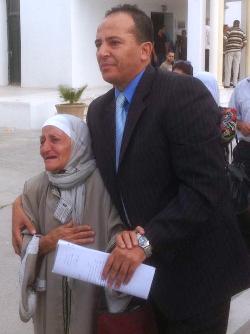
Police commissioner Samir Feriani has been acquitted of “harming security of state” after criticising continued role of Ben Ali-era security officials. Index on Censorship reports
(more…)
