31 Mar 2014 | Digital Freedom, News, United States

(Illustration: Shutterstock)
Reforms can be a deceptive thing. They can be particularly deceptive when covering the intelligence community, which is notoriously resistant to legislative meddling it tends to find intrusive.
Last week, Congress and the White House were a flurry with proposals to alter the nature of bulk collecting of calls and communications of American citizens under the Patriot Act. In a statement released through the American Civil Liberties Union, Snowden went so far as to see this as “turning point”. “I believed that if the NSA’s unconstitutional mass surveillance of Americans was known, it would not survive the scrutiny of the courts, the Congress, and the people.”
Three plans are on the table – the USA Freedom Act (otherwise known as the Leahy-Sensenbrenner bill), the more conservative House Intelligence Committee Bill (the Ruppersberger-Rogers bill), and the President’s own proposal. The latter has yet to mutate into the language of legislation, but is by the far the most important one to date. For that reason, it deserves greatest scrutiny.
All the proposals, in some measure, deal with the operation of Section 215 of the Patriot Act. The provision facilitates current bulk collection and remains a creature of the post-September 11 2001 era, when the Bush administration extended the surveillance state with knee-jerk enthusiasm. Defenders of the provision argue that metadata gathered under the program remains vital in identifying links between terrorist cells inside the United States. Privacy advocates remain unconvinced by the inefficiency of a program that has been affirmed.
President Obama’s proposal involves allowing phone companies to retain their databases of records in standardised, interoperable format. The reason behind this is to allow government officials quick and easy access to the material when required. The focus on storage will shift from government agencies – a main bone of contention for privacy advocates – to telephony companies. There is an additional oversight measure – the NSA would, in obtaining access, have to seek an order from the Foreign Intelligence Surveillance Court. In turn, the FISC would have to be satisfied that the records pertained to a person connected with a terrorist organisation.
The enthusiasm for the changes last week was certainly evident, suggesting the administration had struck a delicate balance between privacy and security. In Obama’s own words, “I am confident that this approach can provide our intelligence and law enforcement professionals the information that they need to keep us safe while addressing the legitimate privacy concerns that have been raised.”
Reuters stated that the Obama administration had “announced details of its plan to end the government’s vast bulk collection of data about phone calls made in the United States”. Even more cautious observers, such as Jameel Jafeer, suggested that this was “an acknowledgment that a program that was endorsed in secret by all three branches of government, and that was in place for about a decade, has not survived public scrutiny.”
For all that enthusiasm, Jafeer would also suggest that various operational matters needed clearing up. What would, for instance, be the governing standard of suspicion the FISC would use in its judicial deliberations? There is every suggestion that the reforms are driving down the standard of suspicion required in various cases – from “probable cause” to “reasonable suspicion”. For that reason, it would be difficult to see refusals to government petitions except on rare occasions. The FISC will continue being a formalised rubber stamp.
A looming question here is what constitutes a “phone record” for the purposes of Obama’s reforms. Phone records obtained by national security letter statutes and the pen register would need to be incorporated into the reforms – to not do so would render any changes futile..
There is a striking addition to the NSA’s powers that will take place if Obama’s current proposals go through in their current form. The NSA would only be losing authority to collect and hold telephone calling records for up to five years from landlines. Telephony companies will be expected to hold records for up to 18 months. More than adequate compensation is being offered to the NSA’s apparent trimming of data access. The compromise has come in the form of collecting cell phone data, a considerable expansion of power given that the NSA claims that only 30 per cent of all call data of the country is being tapped into.
This in itself is a curious suggestion, given that the NSA is already gathering up to 5 billion records a day on the location of cell phones around the globe. Presumably, local coverage in the US of cell phone data has been skimpy, at least relative to land lines.
It should come as little surprise that the agency’s chief, the retiring Gen. Keith Alexander, was enthusiastic for a solution that would, in effect, enhance NSA coverage while having metadata from landlines restricted. His lobbying of Congress has been particularly frenetic, given that the collection authority of the agency will expire in 18 months. The drafters have been busy, and Obama has been dismissive of suggestions by such NSA critics as Democratic Senate Judiciary Committee Chairman Patrick Leahy to let the program lapse into oblivion. In that, the President has the support of the House Intelligence Committee members, Republican Mike Rogers and Democrat Dutch Ruppersberger, whose “End Bulk Collection Act” replicates the spirit of Obama’s proposals.
For that reason, privacy advocates can only count the latest measures, notably those of the Obama administration, as refined efforts to enhance surveillance rather than roll back metadata collection. The principle remains only the practice is being tweaked and effectively granted a legal varnish.
31 Mar 2014 | News, Russia
Punitive psychiatric treatment is returning to Russia. This is a throw back to Soviet times, with opposition activists condemned by a kangaroo court to bogus psychiatric treatment courses, with no chance of release until a doctor says so.
Mikhail Kosenko, 39, last week became the highest profile case when he lost his appeal case against enforced psychiatric treatment. As such he will be interned immediately at a state-owned medical facility in Moscow. At worst, his sentence could be for life, with no chance of parole, as his release depends on vaguely described criteria. His assessment will also be made by doctors whose political neutrality is not guaranteed.
In 2012, Kosenko was arrested by Moscow police after taking part in a peaceful protest against Putin in Bolotnoya Square. Charged with rioting, he spent much of the next twenty two months behind bars. When his sentence was read out in court last October, his sister Kseniya, told the BBC : “I have an awful feeling. There are really frightening stories about what goes on in these places.”
Kseniya describes her brother as “a very quiet, homely type of guy.” She confirms various inspecting doctors reporting that he’s very shy – “shunning any kind of violence.”
Kosenko did have a pre-existing psychiatric condition when he was arrested – slow on-set schizophrenia diagnosed in 2001. But after medication and good advice, the condition was very much under control. Kosenko had never shown any tendency to be violent, according to his doctors.
Tanya Lokshina, Russia Program Director and Senior Researcher at Human Rights Watch, opposes the ruling.
“Mikhail’s case simply reminds me of the Soviet Union,” Lokshina warns. She tells how punitive psychiatry was a tool that was rarely used, but always with devastating effect. “Back then the medications used were really heavy, they were designed to slow down movements and just keep you out of the way.”
It’s impossible know exactly what treatments are now in store for Kosenko. But whatever is to come, it will only end if Kosenko dies, renounces his politics, or wins a final case of appeal at the Supreme Court. This is his last chance, but it could be some time. Lokshina remembers that when Pussy Riot took an appeal case to the Supreme Court, they had to wait a year before their case was heard. In the meantime, Kosenko’s treatment will continue.
The only medical evaluation the court heard was conducted by the Serbsky Institute in Moscow. Their crebility was disputed by medical experts, including the head of Russia’s Independent Psychiatric Association, when they noted that the assessment had completely omitted any reference to Kosenko’s successful ten years of self-medication, with no history of violence. Serbsky Insitute is also owned and operated by the state. The judge threw out a petition to have a second medical assessment.
Lokshina tells me there have been a few cases recently – but this is by far the worst. Amnesty International call it “an abhorrent return to Soviet-era practices.” The weeping sister of Kosenko told the BBC she felt “physically sick” when she heard that her brother had been found guilty.
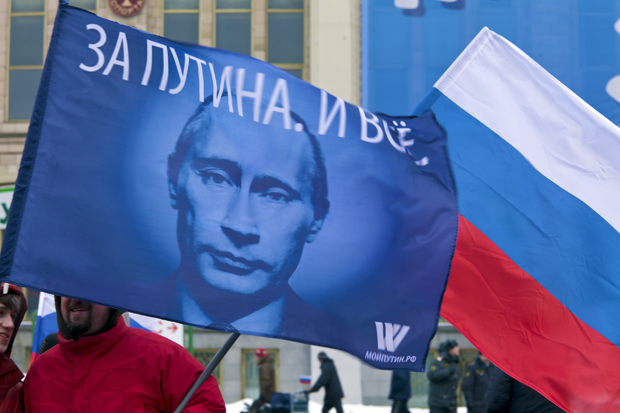
Putin is turning to medieval, desperate measures as he balances himself on a rattling economy, a tonne of debt and a country that is too big to govern. Those with the bitterest memories, like Ukraine, Poland and the Baltic states, fear a renewed bid to expand borders permanently, especially looking at adventures into Crimea.
But Putin is smarter. He must distract the population from a certain amount of oligarch asset-stripping and poor management, which has become epidemic under his reign. But he also must not overstretch or overspend. Enter the Roman strategy of “bread and circuses,” minus the bread.
Putin’s inaugural circus took place during the Georgia invasion in 2008, and according to Mark Adomanis remembering the war in Forbes magazine “bathed Russia in a warm patriotic glow.” Putin’s ratings took a generous bump as a result.
But Admonanis predicted, just two months ago, that Putin’s ratings would have dipped by the end of this year. The economy was weak and Sochi had been a slightly uncomfortable experience for anyone even remotely Russian.
Sadly Adomanis, nor anyone outside Putin’s inner circle, could not reasonably have predicted Putin’s subsequent gamble in Crimea.
The incursion has seen approval ratings leap from sixty five to eighty percent almost over-night. That is an extraordinary success.
Yet while Crimea has been a successful though highly irritating move, Putin’s political future is still at risk. The balance of world media commentary has been unapproving. The lies he is telling about dangerous neo-Nazi gangs have been proved as untruths, journalists have exposed the role of vicious nationalist thugs (on the Russian side), and Putin’s cheeky disregard for international law condemned. His domestic woes also go on regardless – senior officials within the Kremlin admit that the capital outflows and fall in the stockmarket are far greater than they had forecast. There certainly isn’t any capacity for “bread.”
Facing criticism at home and abroad – Putin turns to censorship and propaganda to secure himself domestically and reap political reward out of Crimea. Any oppositionist media has been bloodily censored. Reports of self-censorship are leaking out from the remaining clutch of titles.
There are three varieties of public criticism which particularly irk Putin. First, a human rights group can get hold of and successfully publicise a story (Kosenko). Second, a one-off event focuses the world on Russia (Sochi). The third is that Russian activists go out onto the streets (again Kosenko’s case, see also Pussy Riot).
In each scenario, Putin potentially loses. But he’s developed mitigation strategies. The first is to denounce foreign criticism as biased and baseless. The second is to claim it’s-a-great-big-Western-plot-we’re-the-victims-don’t-worry-Putin-here-will-rescue-you. The third is to allow some freedom of speech, but only as an opposition release valve. The fourth is to treat protesters like animals.
Street-marches are targeted by violent thugs, who act with suspicious impunity. But it’s the judiciary, and their shoddy self-discipline, who play the more important role. There were serious judicial errors in Kosenko’s case. Other victims have seen key witnesses prevented from giving testimony. Or biased “expert opinions.” Or paid goons threatening the families of the accused.
Putin’s actions abroad might bring back memories of Communist Russia, but Putin probably doesn’t see it this way. Putin needs the circuses of Georgia and Crimea, even if he can’t afford bread back home. He has also applied a blanket of censorship on the media.
Now Putin is turning to psychiatric institutions in a bid to remain in power.
This article was published on March 31, 2014 at indexoncensorship.org
28 Mar 2014 | Bahrain Statements, Campaigns
Every year, the Bahraini government hopes the roar of Formula One cars will drown out criticism for the regime’s human rights violations. This year, the Committee to Protect Journalists (CPJ) and Reporters Without Borders (RSF) asks you to ensure that does not happen.
How to Show Your Support
1. Join the #F1 Thunderclap action and support the campaign with Twitter, Facebook, or both.
2. Tell all of your friends and followers to join the campaign.
3. On April 6, watch as everyone’s messages are simultaneously shared at the start of the F1 race.
4. Continue speaking out for press freedom in Bahrain using the #F1 hashtag.
Background
CPJ and RSF have documented a consistent attempt by the Bahraini government to censor the press since the launch of a mass protest movement on February 14, 2011. In that time, at least three news providers have been killed for their work and many more have been subject to arrestand even torture. Many news providers remain imprisoned today. Several journalists have been forced into exile in fear for their safety.
The government has also limited access to international journalists and human rights organizations seeking to cover the ongoing unrest and repression in the country, including the imprisoned IFEX member, Nabeel Rajab, president of the Bahrain Center for Human Rights. Meanwhile, some protesters on the street have assaulted journalists considered sympathetic to the government.
Help put the brakes on press censorship in Bahrain by joining this campaign.
For more information on press freedom in Bahrain, please visit:
http://www.cpj.org/mideast/bahrain/
http://en.rsf.org/bahrain.html
28 Mar 2014 | News, Politics and Society, Religion and Culture, United Kingdom, Young Writers / Artists Programme
(Illustration: Shutterstock)
“The media tells you what to think!”
That’s a basic criticism of Western journalism, whether it’s of the “CNN controls your mind” or “Left Liberal Elites have monopolised the agenda” variety. Most people reject this, rightly, as a straw-man. We pride ourselves on our ability to sift information, reject weak arguments and come to our own points of view.
A more worrying criticism is that the news directs what you think about. Decisions to give Story X prominence and headlines, and to bury or spike Story Y, mean most of us can only encounter X. Newsworthy stories become obscure if drowned out by others or omitted entirely. We’re denied investigation or campaigning on vital issues because nobody knows they exist.
In Britain this is not what we typically mean by ‘censorship’, not the recourse of despots or prudes. Nevertheless, self-censorship with market and readership in mind denies all but the most devout news-addict important stories. And without the news we can’t have comment pieces, columns, Twitter debates and opinion blogs.
Consider the EuroMaidan protests in Kiev through spring. Coverage gave the impression of a pro-EU crowd led by a heavyweight champion, with a worrying fringe of violent nationalists – Svoboda and Right Sector. This followed the ‘mainstream-extremist’ simplification presented in Egypt, Syria and Libya. Other crucial groups were ignored: LGBT activists set up the protest’s hotlines, feminists ran the makeshift hospitals, Afghan war veterans defended them.
The world’s focus on Kiev and Crimea drove other issues from the spotlight. The Syrian civil war has hardly featured recently, but that conflict has far more casualties, worse upheaval and more immediate consequences for Britain. Refugees are currently en route to claim asylum – this is the last we heard. Similarly, the Philippines dominated the winter’s news after Typhoon Haiyan. Now it’s forgotten in favour of flight MH370 despite the catastrophic ongoing humanitarian crisis, again with more lives at stake.
The Arab Spring is itself a good example of one narrative deafening public consciousness. How many of us knew that at the same time as protests ignited Yemen and Syria in July 2011, Malaysia’s government gassed peaceful crowds and arrested 1,400 protesters after tens of thousands marched for electoral reform? It’s tempting to wonder whether greater coverage, and greater international pressure, could have supported the democratic reforms demanded.
Closer to home, consider the brief uproar caused by the 2013 UK policing bill, drafted to outlaw ‘annoyance and nuisance’ and give police arbitrary powers to ban groups from protest areas. Although the drafts were publicly available, and campaign groups voiced outrage swiftly, left-wing papers took notice only after the bill had passed the Commons. The bill was softened, not by popular pressure or national debate, but by a few conscientious Lords.
Readers could forgive the media for prioritising other stories if they are more pressing. When headlines are crowded by non-events, however, this seems a poor excuse. The British news spectrum was recently obsessed with Labour politicians Harriet Harman and Patricia Hewitt, who worked for the National Council for Civil Liberties (now ‘Liberty’) in the 1970s. That council granted affiliate status to the now-banned Paedophile Information Exchange (PIE). The Daily Mail made a huge splash about its PIE investigation in February, despite uncovering no new information. That paper alone had reported the same story in 1983, 2009, 2012 and 2013. Eventually the BBC, online world and print media all covered the controversy, meaning more worthy issues lost precedence.
Madeleine McCann has dominated countless front pages, reporters chewing over the barest scraps of Portuguese police leaks. No real progress has been made for years. Pundits admit the story retains prominence largely because the McCanns are photogenic, and similar stories would have fallen off the agenda. There are hundreds of similar unsolved child disappearances, just from the UK. Drug scares, MMR vaccine hysteria, celeb gossip and royal gaffes (not to mention Diana conspiracies) complete the non-story roster.
If this seems regrettable but harmless, consider sexual violence. Teacher-child abuse, violent assaults and gang attacks deserve coverage, but their sheer news monopoly perpetuates the public’s false idea of ‘real rape’. Most sexual abuse is between couples or acquaintances: campaigners have shown the myth that ‘real rape’ must involve a violent stranger impedes both prosecution and victim support.
There is no silver bullet, just as no one news organisation can really be blamed for censorship by omission. Few people want or need constant updates on upheaval in South Sudan or Somalia – but we could be reminded they’re happening at all. Editors will always reflect on what is vogue, what will sell, and a diverse free press ensures a broad range of stories. Perhaps the rise of online citizen-reporting can bridge the gap. Nevertheless, the danger of noteworthy events falling into obscurity should niggle at the back of the mind – for those who know enough to think about it.
This article was posted on March 28, 2014 at indexoncensorship.org