26 Mar 2014 | Digital Freedom, Gambia, News
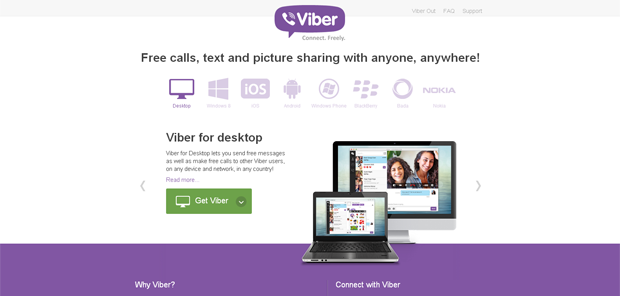
The increasingly authoritarian regime of Gambia is suspected of blocking the popular social media app Viber following weeks of speculation on the government’s intentions. The government said it has not been banned and blames service providers for the outage.
Threatened by the growing popularity of free internet phone services using voice over internet protocol (VOIP), the government of Gambia is said to believe the use of such services is helping online Gambian media in the diaspora to deliver information to the public through whistle blowers.
The regime in Banjul is also looking into the possibility of extending the block to other calling apps like Skype, according to press reports.
“The government has decided to block Viber. We cannot communicate with our love ones in the diaspora”, an insider at GAMCEL, the national cellular company, confirmed to index. The source said that a new app called Hitalk can be downloaded to get the Viber-like services.
Asked what prompted the decision “it is government order and we as mere employees we have no other option to obey instructions given to us by our bosses,” the source said.
In an interview with the Standard, a local newspaper, Lamin Camara deputy permanent secretary at the ministry of information and technology denied that government blocked the app.
Camara blamed what he described as erratic network of service providers. He said patchy service is affecting the quality of calls that subscribers can make through Viber and other social media services.
Sidi Sanneh, a former Gambian civil servant and a political activist, posted an opinion piece on this blog saying that this is not the first time the regime tried to censor the internet. Sanneh described the Gambian regime as a desperate one.
“We managed to place calls to Banjul using Viber and discovered that there are some who are indeed experienced interruption of service for the past couple of days,” he stated. Sanneh went on to say that there are a few who have already resolved the problem by simply downloading other apps to get around what appears to be a nuisance.
He advised users to download a VPN client, which allows the user to be assigned a random IP address that changes every time Viber is used.
“We were told that the persons engaged by the regime to interfere with the internet are ‘amateurs who will only succeed in damaging their servers’”, Sanneh concluded
Sam Phatey, a Gambian intelligence analyst and American Street News contributor told ASN, an online Gambian newspaper, that the decision of the Gambia government is illogical.
Phatey observed that the government feels insecure and scared because exiled dissenters are using the service to plan and communicate with Gambian.
In April last year the Gambian regime ordered the Public Utility Regulatory Authority to ban the use of phone services using VOIP, the regime also imposed stiff charges on internet cafes to register for use of VoIP.
This article was published on March 26, 2014 at indexoncensorship.org
25 Mar 2014 | Digital Freedom, Events

(Image: Shutterstock)
Index on Censorship, in association with Doughty Street Chambers, invites you to attend our high-level panel discussion asking who runs the internet?
At a moment when the revelations on NSA and GCHQ mass surveillance are opening up a wide debate about our digital freedoms, our panel will discuss how free the net is today, and the main challenges that lie ahead. In the next couple of years, major international summits will debate new rules on internet governance, and whether to adopt a top-down approach as favoured by China and Russia, or maintain a more open, multistakeholder networked approach. Meanwhile, from the EU to Brazil, reactions to the Snowden’s revelations of mass snooping suggest there is a growing risk of fragmentation of the internet, with calls for forced local hosting of data.
We are delighted to be hosting speakers:
Bill Echikson – Head of Free Expression EMEA, Google
Richard Allan – Head of Europe, Middle East and Africa, Facebook
Tusha Mittal – formerly a correspondent for Tehelka and currently a Fellow at the Reuters Institute, Oxford University
Kirsty Hughes – CEO, Index on Censorship
The panel will make short introductory remarks ensuring plenty of time for a lively Q&A session.
The event will be held at Doughty Street Chambers (53-54 Doughty St, London WC1N 2LS) on Wednesday 2nd April 6-7.30pm, followed by a drinks reception. To RSVP please fill in your details here. If you have any questions please contact Fiona Bradley ([email protected]).
25 Mar 2014 | Americas, Europe and Central Asia, Events, United Kingdom, United States
Over a year after the Leveson report came out, regulation of the British press is still a question of intense debate. Meanwhile, the NSA/Snowden revelations – and the related detention of David Miranda (supported recently by British courts) – open up core questions of how investigative and public interest journalism can function in a world of mass surveillance. In the US, while Guardian editor-in-chief Alan Rusbridger rightly praises the first amendments, Obama himself has a growing reputation as a president who has pursued sources and journalists through the courts.
Join us on a Google Hangout with Guardian Digital journalist, James Ball (now based in New York) and LA Times London correspondent, Henry Chu, hosted by our Editor, Online and News, Sean Gallagher for a lively debate around the media freedom on either side of the Atlantic.
The recording will be broadcast live via Index’s Google+ and YouTube accounts from 10am (EST)/ 2pm (GMT) on Wednesday 26th March. Get involved in the discussion on our Twitter feed and website. Visit the Google+ page here and the YouTube page here.
25 Mar 2014 | Events
(Image: Mahmoud Illean/Demotix)
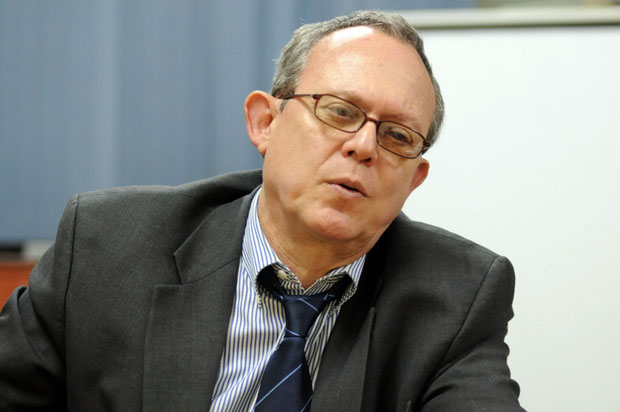
Frank La Rue, UN Special Rapporteur on the promotion and protection of the right to freedom of opinion and expression, will be interviewed by Index on Censorship’s CEO Kirsty Hughes, on his experience surrounding digital freedom while in office.
Frank La Rue is a lawyer and current Director of the Centro-American Institute for Social Democracy Studies (DEMOS) in Guatemala. He holds a degree in law from the University of San Carlos, Guatemala, and a postgraduate degree in U.S. foreign policy from Johns Hopkins University. He was also a professor of human rights at the University of Rafael Lavinder de Guatemala. La Rue has worked extensively on human rights issues, and as founding member and Director of the Centre for Legal Human Rights Action (CALDH), he was involved in presenting the first Guatemalan human rights case before the Inter-American Court for Human Rights. Mr. La Rue also brought the first case of genocide against the military dictatorship in Guatemala. As a human rights activist, he was nominated for the Nobel Peace Prize in 2004. La Rue has been serving as the United Nations Special Rapporteur on the promotion and protection of the right to freedom of opinion and expression since August 2008.
Join us for this exciting insight into digital freedom between leaders in the field from 4pm (GMT) on Wednesday 26 March. The event will be live streamed on Google+ here as well as via Index’s YouTube account here. Get involved with your questions prior to the event via Twitter or during the live stream on Google+.
