18 Apr 2018 | Egypt, News
[vc_row][vc_column][vc_column_text]
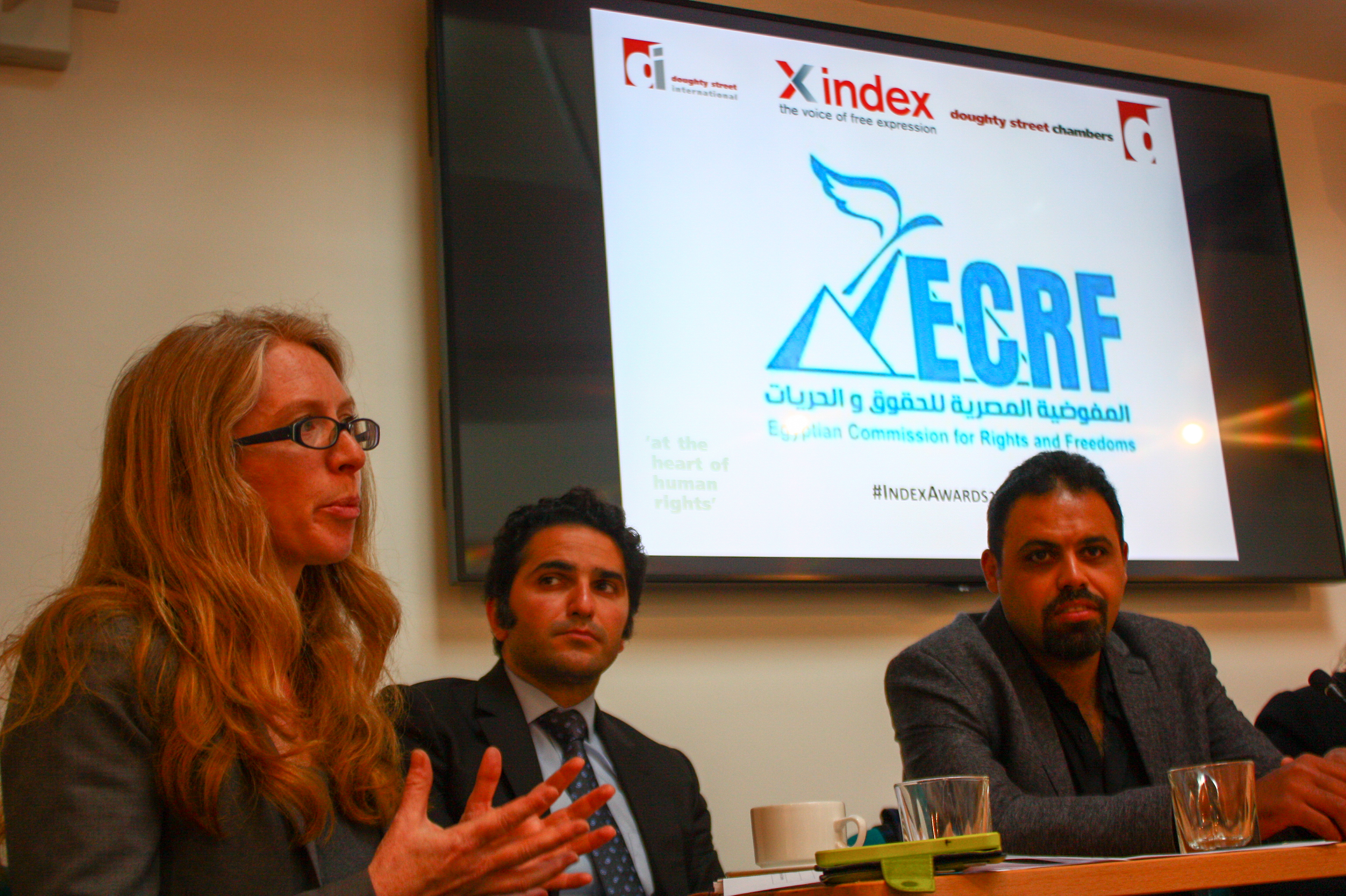
Index on Censorship’s CEO Jodie Ginsberg discusses change in Egypt with activists Mohamed Sameh and Ahmad Abdullah (Photo credit: Alessio Perrone)
The opening line of Rousseau’s treatise The Social Contract reads: “Man is born free, and he is everywhere in chains. Those who think themselves masters of others are indeed greater slaves than they.”
This was one of several books to feature in a book club started by Ahmad Abdallah during his four and a half months spent in prison. The co-founder of the Index on Censorship Freedom of Expression Award nominee Egyptian Commission for Rights and Freedoms (ECRF) was arrested without a warrant on 25 April 2016 for alleged terrorist activity.
Awoken by masked members of the special forces prodding him with a machine gun he first thought it was a prank, he recalled at an event discussing human rights in Egypt on 17 April 2018 at Doughty Street Chambers.
The worst of the worst
“I thought it was someone joking, maybe my mum, maybe my father,” he said. “But I got up and then I was afraid for my family. I was pushed by the machine gun once again and my parents were at the side of the door. Then I ask the chief of this group: ‘do you have a warrant for me?’ They showed me nothing, they searched my house and then I was detained.” They said, “what will you do if we don’t have one?”
Index on Censorship CEO Jodie Ginsberg condemned the Egyptian authorities for the misuse of terror legislation to persecute peaceful critics like Abdallah and his colleague Mohamed Sameh.
Speaking to the room, Abdallah told of his continued attempts to challenge repressive ideas and the Egyptian government even while in prison.
He was shocked to be branded a terrorist. “I had nothing to do with these groups. I was jailed with some of our brotherhood and even some of ISIS. I was very afraid at this time. They are the worst of the worst,” he said.
His answer to this fear was books. “I started a book club because I was afraid of the ISIS guys,” he said.
“I was really afraid so I said: ‘OK, why don’t we start a reading club. We have plenty of time, we are in jail! You can bring your books and I can bring my books, maybe we can be more enlightened. I got them books: Rousseau’s Social Contract, literature books, Kafka, philosophy books, Orwell’s 1984 and Animal Farm and as one month elapsed, the ISIS guy was isolated. Everyone was against his ideas and my ideas were spreading amongst other prisoners,” the human rights defender continued.
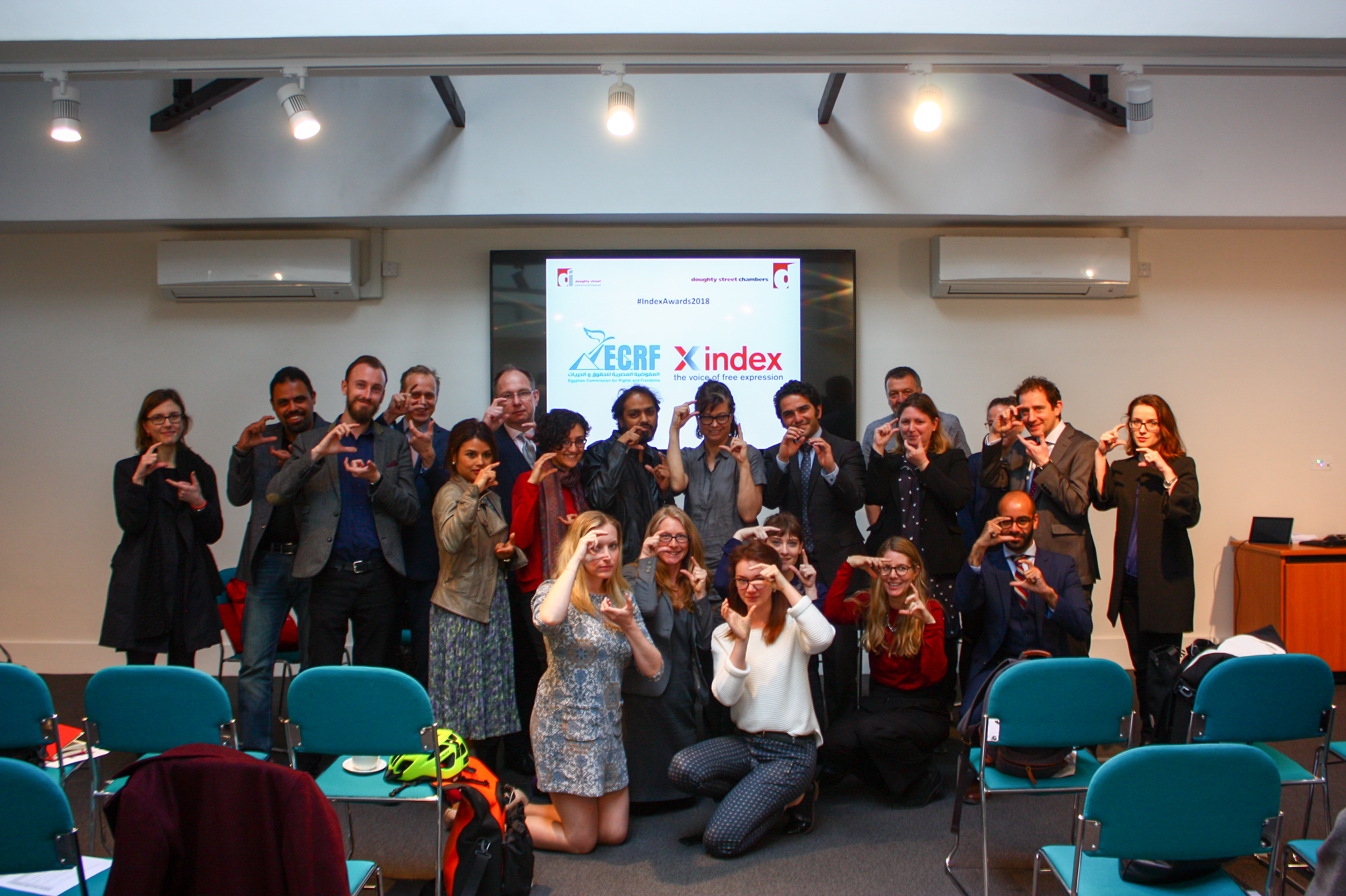
Attendees of the seminar in group solidarity for Egypt and Shawkan, the persecuted photojournalist #mypicforshawkan (photo credit: Alessio Perrone)
As a result, Abdallah was put in solitary confinement where he was in complete darkness and without food for two days.
“Egyptians are not low rank humans. We need our fundamental rights like everyone else”
Human rights activists and journalists are systematically targeted in Egypt and, like Ahmad Abdallah, called terrorists. Jeremy Dear, representing the International Federation of Journalists at the event, informed attendees 21 journalists have been killed in the country since 2011. More than 20 have been imprisoned, half of which without charge.
Forced disappearances and media harassment
The precise numbers of those targeted are unknown, even to the ECRF. The organisation was set up in 2013 after someone came to Abdallah and Mohamed Lotfy (executive director and co-founder of ECRF) saying his friend had gone missing. This led them to question whether the disappearance was “a single event or a pattern.”
The organisation, nominated for an Index on Censorship Freedom of Expression Award, has since worked on cases involving forced disappearance and the prevention of censorship. The government has made it increasingly difficult for them to conduct their work and their offices were raided twice last year. Their website was also blocked.
The group continues to work towards improved human rights despite the dangers. Ahmad said it is their passion and desire for change that keeps them going. “Egyptians are not low rank humans. We need our fundamental rights like everyone else,” he added.
Sameh continued: “Why do we continue? Much sacrifice has already been done. We really do love Egyptians, we really love humans, we really love our families and we think there is a better way of living, of respecting each other. The reason we keep going is because we think we can change that. I think there is serious hope that we can achieve something. We are showing these people are not left behind, that they are not forgotten.”
Peter Greste, an Al Jhazeera journalist who was imprisoned in Egypt, sent a video message of support Abdallah and Sameh. He told of how in 2014 they had been convicted under terrorist charges. Greste said: “The charges were related to the work we had been doing for Al Jhazeera English… At the time, I struggled to make sense of what they were going through, the gap which was between what they were accused of doing, joining a terrorist group, and what they were actually doing… I couldn’t understand how anyone could draw the conclusions that the prosecution… came to.”
The seminar, “Freedom of Expression and the Protection of Human Rights in Egypt,” concluded hopefully. Ginsberg from Index on Censorship posited several ways those in the room could help. This included a suggestion that media organisations each take a case and closely follow it.
She said: “I know sometimes we think we are sitting here talking and nobody’s paying attention, but actually these kind of public solidarity actions do matter. They matter to the individuals who are in detention and they also matter and bother the authorities.”
Jeremy Dear agreed, emphasising the importance of support from societies with media freedom. He said: “There’s no doubt that in the past few years the space for dissenting and independent voices has shrunk in Egypt. We have a duty to ensure that we are doing everything that we can to create the space for them and help them create their own space to raise their own voices.”[/vc_column_text][/vc_column][/vc_row][vc_row][vc_column][vc_basic_grid post_type=”post” max_items=”4″ style=”load-more” items_per_page=”4″ element_width=”6″ btn_shape=”square” btn_align=”center” grid_id=”vc_gid:1524045621403-609ab883-1e90-3″][/vc_column][/vc_row]
18 Apr 2018 | Honduras, Media Freedom, News
[vc_row][vc_column][vc_single_image image=”99730″ img_size=”full” alignment=”center”][vc_column_text]
“The noose is tightening around the Honduran people more than ever,” says Dana Frank, professor at UC Santa Cruz, specialising in human rights and US policy in post-coup Honduras, adding that with this comes increased repression of the media.
With political turmoil and protests following the 2017 re-election of president Juan Orlando Hernández, repression of information has become commonplace in Honduras. According to Amnesty International, at least 31 people were killed in the aftermath of the election, with hundreds more arrested or detained. Reporters Without Borders ranked Honduras 140th in the 2017 World Press Freedom Index.
Journalists reporting on corruption and violence in Honduras regularly deal with violence and the risk of death for their work — including investigative journalist Wendy Funes, a nominee for Index on Censorship’s 2018 Freedom of Expression Award for Journalism — while perpetrators often go unpunished.
“What’s amazing is that corruption is highly documented. For example, the government itself and the attorney general have confirmed the evidence that as much $90 million was stolen by the ruling party and the Juan Orlando campaign in 2013 from the national health service. They siphoned it into their campaigns,” says Frank. “The evidence of corruption is out there. The problem is that the attorney general and the government don’t act on the evidence.”
According to Honduras National Commission for Human Rights, over 70 journalists and other media workers were killed in Honduras between 2001 and August of 2017. PEN International reports that violence against journalists continued despite the Honduran government’s pledge at the United Nations in May 2015 to improve its human rights record. Journalists have begun to silence themselves out of fear for their lives.
“Over the years, the situation has been deteriorating and getting worse in regards to freedom of expression,” Honduran journalist Dina Meza told Index on Censorship in February 2018. “Therefore, what journalists and social communicators have started to do is self-censor.”
As recently as 13 February 2018, one Honduran television reporter, César Omar Silva, was the victim of an attempted on-air stabbing. According to the Committee to Protect Journalists, Silva said that a nearby police officer and hospital worker told the man to stop but did not try to detain him or take his weapon. The attacker escaped.
This wasn’t the first time Silva was attacked for his work. He was kidnapped and tortured after he covered human rights violations around the 2009 coup.
Censorship by the government goes beyond attempting to silence journalists; it also restricts the information government agencies are allowed to release to the media and the public. A 2014 law assigned responsibility for releasing information to individual government agencies, instead of the more independent Institute for Public Access to Information. As a result, government transparency and the public’s right to information suffered.
“It really is a reign of terror. The government used live bullets against a labour strike on 9 March, and that’s new,” says Frank. “What’s amazing is that people are reclaiming democracy and going to the streets even though they know they could get killed.”
Frank echoed sentiments written by Dina Meza in a September 2013 article for Index on Censorship magazine. “In a democracy, criminal investigations would be the appropriate means to bring these culprits to justice,” said Meza, “but in what is an essentially failed state with a collapsed infrastructure, anyone who is determined to speak out risks their life.”
As journalists in Honduras face harsh censorship, those who continue to work and speak out must be supported and defended. Without this the corruption and repression in post-coup Honduras would go undocumented. [/vc_column_text][/vc_column][/vc_row][vc_row][vc_column][vc_basic_grid post_type=”post” max_items=”12″ style=”load-more” items_per_page=”4″ element_width=”6″ grid_id=”vc_gid:1524040544190-383fec9d-ea6d-2″ taxonomies=”8996″][/vc_column][/vc_row]
