16 Apr 2018 | Campaigns -- Featured, Media Freedom, media freedom featured, Statements
[vc_row][vc_column][vc_column_text]
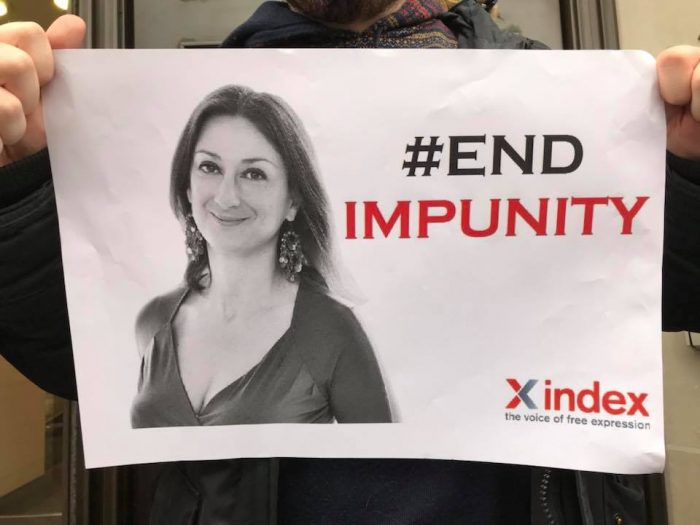
Daphne Caruana Galizia, the Maltese investigative journalist who was assassinated in October 2017, had numerous lawsuits pending at the time of her murder.
Around the world, big business and corrupt politicians are using threats of legal action to silence journalists and other critics — including NGOs and activists.
Usually this starts with a letter threatening expensive proceedings unless online articles are rewritten or removed altogether, and demanding an agreement not to publish anything similar in the future. The letters often tell the recipient that they cannot even report the fact that they have received the letter.
This process is known as a SLAPP (Strategic Lawsuit Against Public Participation). SLAPPs are designed to intimidate and silence critics by burdening defendants with huge legal costs. The purpose of SLAPPs is not to win the case. They are vexatious and are designed to eat up time and resources. They are a way to harass and intimidate journalists and others and dissuade them from reporting.
SLAPP suits are a particular problem for independent media outlets and other small organisations. They are financially draining and can take years to process. Faced with the threat of a lengthy litigation battle and expensive legal fees, many who receive SLAPPs are simply forced into silence.
Don’t let them silence you
Index believes that by encouraging journalists and media outlets to talk more openly about these threats, we can begin to put an end to the use of these vexatious lawsuits that threaten democracy.
We support an initiative by members of the European Parliament for a new directive to tackle SLAPPs.
We also know that getting such changes takes time. But it can be done. In the United States, 34 states have enacted laws to combat SLAPPs. California, which adopted its anti-SLAPP legislation in 2009, enables defendants to sue the original plaintiff for malicious prosecution or abuse of process.
In 2015 Canada passed the Protection of Public Participation Act, which aimed to implement a fast-track review process to identify and end vexatious lawsuits.
In the meantime, there are some steps that all journalists can take to help put an end to this practice.
1. Know you are not alone
Journalists from Albania to Japan have received such letters. In Malta, for example, The Shift News website received a letter late last year from law firm Henley and Partners demanding an article be removed. Henley and Partners also stated that the letter was not to be made public.
Daphne Caruana Galizia, the Maltese investigative journalist who was assassinated in October 2017, had numerous lawsuits pending at the time of her murder. She was being sued by Pilatus Bank, a Maltese-based financial institution she frequently criticised. The lawsuit was filed in the USA and dropped following the killing.
Other Maltese media groups, faced with legal threats, have complied with Pilatus Bank’s requests, and deleted and amended articles in their online archives. Pilatus denies any wrongdoing.
In the UK, Appleby, the firm associated with the Paradise Papers, is threatening legal action against the Guardian and the BBC, demanding they disclose any of the six million Appleby documents that informed their reporting and seeking damages for the disclosure of what it says are confidential legal documents.
2. Tell others if you receive a letter
Speak to someone you trust. This could be a colleague at your place of work, your local union or a representative from a nonprofit organisation working in your country or region. Nonprofit organisations and others working in the field of journalist safety include:
Article 19
Committee to Protect Journalists
European Centre for Press and Media Freedom
European Federation of Journalists
International Press Institute
Index on Censorship
Reporters Without Borders
SEEMO
A major fear when receiving a SLAPP letter from a large law firm can be a sinking feeling that you might indeed have something wrong with your story. This casts a long shadow of self-doubt and can prevent journalists even from discussing the letters with each other within the same newsroom.
If you receive these legal threats, discuss them with journalists from other publications who are working on similar stories. This is often the only way to find out that the subject of your investigations is trying to shut down the public discussion systematically. “Discovering that pattern is not only a story in itself, but critically important in helping journalists work together to defend themselves,” says investigative reporter Matthew Caruana Galizia.
3. Report it
If you work in one of the countries covered by the project, you should report such threats to the Index on Censorship Mapping Media Freedom platform, which documents threats to media freedom. Index works with other organisations to raise the worst cases with the Council of Europe so that the council can raise cases directly with the governments concerned.
When you document these threats on Mapping Media Freedom, you help to show that they exist and are a problem for journalists and the public, who are robbed of their right to know. Once we have that documentary evidence, we can push harder for a change in legislation. We believe that the number of threats would speak for themselves, if everyone in the countries we cover reported them.
4. Know your rights
Get expert legal advice but remember that not all lawyers are the same. There are lawyers who are experienced in dealing with SLAPPs. For example, the European Centre for Press and Media Freedom has a legal team that can advise on SLAPP lawsuits and Doughty Street Chambers has an International Media Defence Panel who regularly assist journalists and NGOs faced with these kinds of threats.
Have you received a SLAPP letter? Let us know. Spreading the word about this cases is important in tackling the problem. The more we can document the extent of this issue, the easier it will be to address it. Please let us know by contacting Joy Hyvarinen, Head of Advocacy, at [email protected]. [/vc_column_text][/vc_column][/vc_row][vc_row][vc_column][vc_basic_grid post_type=”post” max_items=”12″ style=”load-more” items_per_page=”4″ element_width=”6″ grid_id=”vc_gid:1523875014232-cb75410f-355e-4″ taxonomies=”8996″][/vc_column][/vc_row]
16 Apr 2018 | News, Turkey, Turkey Uncensored
[vc_row][vc_column][vc_column_text]For Turkish academics, signing a dissenting petition can mean expulsion from their job, the country or even jail time. In Noémi Lévy-Aksu’s case, signing the Academics for Peace petition, “We will not be a party to this crime!” meant losing her teaching position at Boğaziçi University.
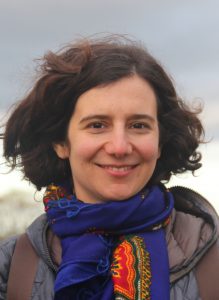 In March 2017, Lévy-Aksu had flown from London to Turkey to take an exam to become an associate professor. After the exam, she flew back to London to continue her fellowship at the British Academy with an affiliation with Birkbeck College. However, two days later she received an email saying she had been dismissed from her teaching position at Boğaziçi. Following the news of her work and residence permit cancellation, she was notified that she had passed her associate professor exam. In April, she became a Turkish citizen after applying for citizenship in January 2016.
The confusing whirlwind of events left Lévy-Aksu jobless with Turkish citizenship and associate professor credentials. Her story is far from unique as President Recep Tayyip Erdoğan has increased his government’s squeeze on dissenting voices — whether journalistic, legal or academic.
While best known for the January 2016 “We will not be a party to this crime!” petition, Academics for Peace advocates for peace between Kurds and Turks and condemns government violations of its own and international laws. The organisation, which formed in 2012, is an amalgamation of academics from over 50 universities.
With over 2,000 signatures, the petition hurtled Turkish academics into the dissenting spotlight, prompting Erdoğan to arrest and dismiss academics through emergency decrees. The purges only escalated after the unsuccessful coup in July 2016. Since last November, many signatories have been held on criminal charges and accused of terror propaganda. Ostensible “terrorists” in Turkey, professors and other intellectuals like Lévy-Aksu have been persecuted, which has led to job loss, passport revocation and prison.
In Lévy-Aksu’s case, she has been one of the luckier academics. With her dual French and Turkish citizenship, Lévy-Aksu is able to easily enter and leave the country where she attends hearings of her fellow colleagues and offers her continued solidarity. She is currently finishing up her fellowship in London and recently began studying law at BPP University Law School.
Lévy-Aksu spoke with Sarah Wu of Index on Censorship about the current situation for Turkish academics. Below is an edited version of their conversation:
Index: What role did your participation in Academics for Peace play in your dismissal?
Lévy-Aksu: That was that exact reason why I was fired. It was openly stated. I had been involved in Academics for Peace while I was in Turkey, and when I came to London, I became involved in its UK branch. The Council of Higher Education gave no reason when they revoked my work permit at my university, which was the same case for another foreign academic in the sociology department. When I decided to sue the Council of Higher Education, my lawyer first asked what the reason for dismissal was, and they then said the petition was the main reason. This is the core issue in the ongoing administrative lawsuit I opened against the Higher Education Council and Boğaziçi.
Index: Were your reasons for signing the petition personal or professional?
Lévy-Aksu: I think it was a reaction motivated by anger and the need to say something against what was going on, not only as an academic but as a citizen. Although I was not a Turkish citizen at the time, as a human being I have this duty to speak up and not to stay silent. It was a way to morally and politically react to what was going on and doing it collectively made sense at the time.
Since the beginning of the Turkish Republic, the Kurdish region and Kurdish populations have been consistently targeted by state oppression. Seeing this happening again and again, [signing this petition] was just a way to say, ‘Not again’. The petition was a way, especially for Turkish academics not in the Kurdish region, to say that they were concerned, aware of what was going on, and eager to voice their disagreement.
Index: Do you have any anxiety while traveling to and from Turkey?
Lévy-Aksu: Being a foreigner at the time worked in my favor. My main concern, besides being dismissed, was being expelled from the country, which is quite common for foreign troublemakers. So I applied and surprisingly got the citizenship after being dismissed from the university. It’s funny because I lost my job and then became Turkish. I am therefore lucky enough to travel and I go to Turkey as often as I can as it is still the place I feel I belong to.
Every time I go to Turkey, I hear a lot of criticisms in private by people who are not just political, but by people who want this oppression to stop. Even if they are not leftist or Kurdish, more or less everyone has been affected by the purges or repression. But it’s different when it comes to public discontent. People are now arrested for a tweet or a social media post. A line can send you to prison. So you have to be really brave. The space for opposition has dramatically shrunk.
I still think it’s remarkable that people are still ready to protest despite risking arrest, and if you think about western societies, I’m not sure there would be more resistance in the same context. Who is ready to sacrifice his career, to lose his job, but also his liberty? I think this is a problem that not only concerns Turkey. You need to be really brave to continue speaking up.
There are so many examples of academics and non academics who are, despite all risks, resisting in Turkey. Showing solidarity is the least we can do.
Index: How did the rest of your colleagues fare?
Lévy-Aksu: It depends. My university has been spared of the purges besides me and my other colleague, Prof. Abbas Vali. But in comparison to other universities, I have been much luckier than many others. A great number of friends are stuck in Turkey because their passports have been revoked and are having difficulties finding a job outside of academia. Colleagues in London and other parts of Europe are also in difficult situations. For them, sometimes their passports are revoked after they come here, so now they are stuck and visa renewals are difficult. If they go back, they know they won’t be able to leave Turkey again. It’s a very complex situation, not to mention the financial and job search difficulties. In addition, several signatories of the petition have already been sentenced to 15 months imprisonment (with possibility of a suspensive appeal) for terror propaganda and hundreds of other cases are going on.
Index: Erdoğan was arrested for reading a poem and now he’s doing the same thing with academics. Do you think he is thin-skinned and fearful for his reputation, or is there a deeper meaning behind the academic purges?
Lévy-Aksu: He is relying on the lack of sound democratic tradition, which is what all the previous leaders of the Turkey have done in the past. But of course, the level of control on the institution he has is probably unparalleled in Turkish history.
He has established a system that attempts to control all of society, which attempts to reduce all opposition. It is done now complicitly by many decision makers. These people in institutions are, either by ideological conviction or by fear, doing what is expected of them so that the power can maintain itself. The system, which is bigger than Erdoğan himself, is frightening. It extends to the justice institution, the education system and police. Even more worrying are the mechanisms of denunciation, the use of society and encouragement to denounce your neighbors, your colleagues.
We see it in the universities. Colleagues are denounced by students. Students are denounced by students. You have all these mechanisms that contribute to the polarisation of society and increase fear and potential violence. On both sides, you feel this palpable tension. Even if Erdoğan left, it would not be easy to solve.
Index: Where do you think Erdoğan is taking the university system?
Lévy-Aksu: There’s a push to make religious values the core of education, and it’s something we’ve already felt even before the coup. This increasingly conservative, religious and nationalistic discourse means certain topics can’t be discussed, which means academics can be denounced for expressing critical opinions.
This is the case at my former university. There have been many arrests of students and police are on campus. There was an incident between pro-government and leftist students after the Afrin operation and Erdoğan called for the arrest of those students and a ‘cleaning of the university,’ calling them terrorists, communists and treacherous students and saying they should not be given the right to education. Police are on campus, they are arresting students from the dormitories, and they check IDs in the library – this is what’s happening.
They’re establishing fear not only for politically engaged students but all the academic community, who expect university to be a place of knowledge, not a place of control and repression. Unfortunately, every kind of institution and place of social life is transforming into a place of surveillance and control, and this is the case for universities all over Turkey. Most of them have been extensively purged and most are controlled by the police and administration and by the collaboration of state representatives.
I think it’s a very dark picture. It’s getting darker and darker especially with the beginning of the Turkish military operation in Syria, which again gave a new reason for emphasising nationalist, religious values and arresting people who protested against this military intervention.
Index: Do you think the best form of support for the academics in Turkey is to show solidarity, is it enough?
Lévy-Aksu: This is an ongoing debate among the academics who are still in Turkey and those who are abroad. Of course solidarity is important. It can be financial solidarity with the academics dismissed, it can be helping an academic pursue their research and networking, or giving them access to online classes if they cannot move. Academics for Peace networks in Europe and the US are lobbying to encourage organisations such as Scholars at Risk or CARA, state or regional institutions and foundations to create positions for dismissed academics. In the UK, we have just established the Centre for Democracy and Peace Research to develop projects and partnership to support dismissed academics and, beyond this, critical research and production of knowledge.
Another possible form is one that started last year by the Academics for Peace. The call to freeze all cooperation with complicit universities. It’s a call that has been made by the Academics for Peace networks in the UK, France, Germany and the US. It established a list of complicit universities and calls for academics not to cooperate formally with them. It means not participating in conferences organised by complicit universities and not inviting directors of the universities. As an institutional boycott, it targets the institutions that are persecuting the ideas and opinions of academics.
Until now, it’s had some limited impact. One of the reasons is that it’s not easy for academics to understand the situation in Turkey. Colleagues in Turkey too are divided on this. For some, they think it’s important to keep strong relations with foreign institutions, including bringing colleagues to the university even if it witnessed some arbitrary dismissal. For the ones that have been dismissed, they are expecting this kind of reaction.
I understand there can be reluctance against boycotting, but I think the bare minimum is for people who go to Turkey is to be aware of what is going on. Foreign academics should be able to raise criticisms or questions if they choose to visit these institutions. Otherwise, you become complicit in a way through your silence and not seeing what’s going on. Academics who visit these complicit universities are strongly resented by colleagues who are in Turkey and feel invisible and unable to travel. I think awareness of what’s going on in different countries and global solidarity is important.
I understand that colleagues who have worked with Turkish colleagues for a long time enjoy going to Turkey because it relates to their fieldwork and they have developed fruitful academic collaborations there. Yet knowing these institutions that have persecuted other academics for their opinions should raise moral questions before you visit. [/vc_column_text][/vc_column][/vc_row][vc_row][vc_column][vc_basic_grid post_type=”post” max_items=”12″ style=”load-more” items_per_page=”4″ element_width=”6″ grid_id=”vc_gid:1523868900741-6ff5bed6-c05b-7″ taxonomies=”8607″][/vc_column][/vc_row]
