10 Apr 2018 | Bahrain, Bahrain News, News
[vc_row][vc_column][vc_column_text]By Ciaran Willis, Lauren Brown and Samantha Chambers
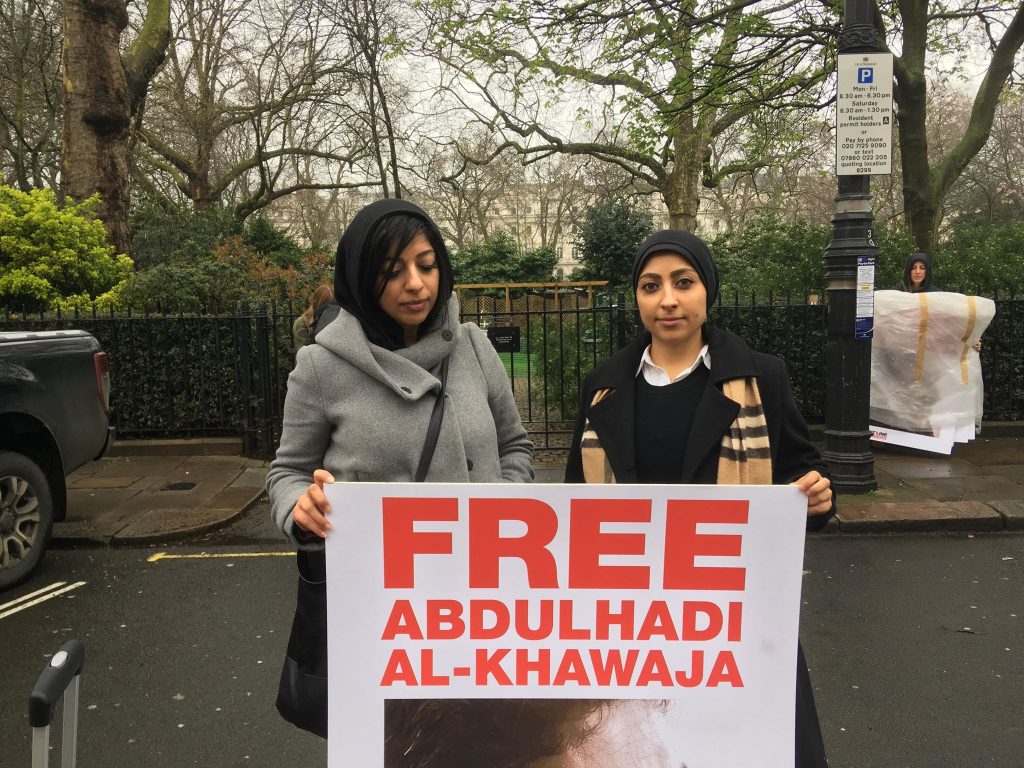
Zainab and Maryam al-Khawaja
The daughters of Abdulhadi al-Khawaja, the co-founder of Bahrain Centre for Human Rights, participated in a demonstration on Monday 9 April outside the Bahrain Embassy in London calling for his release on the seventh anniversary of his arrest.
Maryam and Zainab al-Khawaja joined NGOs and fellow supporters, as they chanted “free free Abdulhadi” and held placards with a picture of the Bahraini human rights activist.
It marked seven years since Abdulhadi al-Khawaja, founder of the 2012 Index on Censorship Freedom of Expression Award-winning Bahrain Centre for Human Rights, was imprisoned for his involvement in peaceful pro-democracy protests that swept the country during the Arab Spring. On 9 April 2011 twenty masked men broke into his house, dragged him down the stairs and arrested him in front of his family.
Bahrain has a poor track record on human rights, with many reports of torture and human rights defenders in jail. Al- Khawaja was part of the Bahrain 13, a group of journalists and activists who faced unfair trials following the unrest.
During his time in prison, Al-Khawaja has been tortured, sexually abused and admitted to hospital requiring surgery on a broken jaw.
His daughter Maryam al-Khawaja was imprisoned in Bahrain for a year before leaving the country in 2014. She faces prosecution on charges including insulting the king and defamation. She told Index: “For me, this isn’t just about my dad, it’s a reminder that we have thousands of prisoners in Bahrain, and we need to remember all of them, and we need to be fighting on behalf of all of them. These are all prisoners of conscience.”
A number of prominent Bahraini campaigners took part in the demonstration.
Jawad Fairooz, a former Bahrain MP and president of SALAM for Democracy and Human Rights, said: “We’re here to support Abdulhadi as a symbol of the demand of the people of Bahrain who want to live in the country with dignity and freedom.”
Sayed Ahmed Alwadaei, director of advocacy at the Bahrain Institute for Rights and Democracy and an activist who fled the country following torture, said: “I’m proud to belong to a nation that Abdulhadi is a part of. Abdulhadi to me is one of the most inspirational individuals.”
Cat Lucas, programme manager at English Pen’s Writers at Risk initiative, said that the government could be doing a lot more to challenge what is going on in Bahrain. She hopes the Bahraini Embassy will finally act, not just in the case of al-Khawaja, “but in the case of lots of writers and activists who are imprisoned for their peaceful human rights activities”.
Protesters have gathered outside the Embassy once a month since January 2018 to highlight the dire human rights situation and ask the UK government to take action.
Al- Khawaja’s daughter Zainab called on the UK to hold the Bahraini regime accountable: “Major governments are still supporting the Bahraini regime with weapons and political training. They’re the people behind them. I can feel as angry here as I would protesting in Bahrain, because I know what the government here is responsible for. I know one of the reasons people are being killed and tortured in Bahrain, including my father, is the support from the British and American governments.”
A group of NGOs, including Index on Censorship and Pen International, signed a letter last week calling on Bahrain to cease its abuse of fundamental human rights.They asked the authorities to immediately and unconditionally free Abdulhadi, provide proper access to medical care and allow international NGOs and journalists access to Bahrain.[/vc_column_text][vc_video link=”https://www.youtube.com/watch?v=8lkS7Fsyqso”][/vc_column][/vc_row][vc_row][vc_column][vc_basic_grid post_type=”post” max_items=”12″ style=”load-more” items_per_page=”4″ element_width=”6″ grid_id=”vc_gid:1523361455279-ef10ef07-647f-1″ taxonomies=”716″][/vc_column][/vc_row]
10 Apr 2018 | Bahrain, Bahrain News, Uncategorized
[vc_row][vc_column][vc_column_text]
In 2011 Bahraini human rights defenders were arrested for pro-democratic activism. Seven years on, monthly protests are reminders of ongoing injustice.
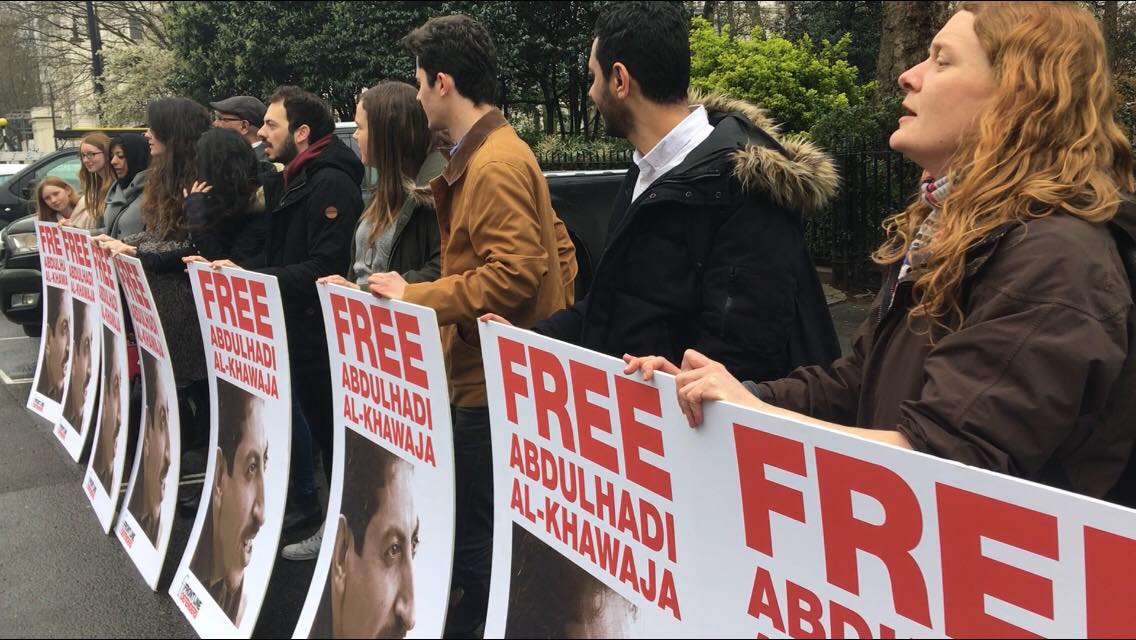
Protesters gathered outside the Bahrain Embassy shouting “free free Abdulhadi” as activists continue to be targeted
NGO’s gathered yesterday at the Bahrain embassy in London to call for the release of Abdulhadi al-Khawaja, a human rights defender imprisoned for life seven years ago for organising peaceful protests against Bahrain’s government during the country’s Arab Spring uprising.
Al-Khawaja founded the Bahrain Centre for Human Rights in 2002 and is a founding director of the Gulf Centre for Human Rights, established in 2011. He was one of 13 human rights defenders to be arrested during the 2011 demonstrations.
Index on Censorship and other human rights organisations have called for his immediate release and for all human rights defenders jailed in Bahrain to be freed.
Monday’s protest not only signalled the ongoing persecution of al-Khawaja, but with repeated calls for his release, highlight Bahrain’s systematic imprisonment and targeting of human rights activists since the Arab Spring.
Front Line Defenders recently reported that all human rights defenders in Bahrain have been exiled, imprisoned or prevented from freely working or travelling. Here, we profile some of those targeted:
Nabeel Rajab
This human rights defender was imprisoned for five years in February 2018 for tweets and retweets perceived as inflammatory by the Bahraini authorities. The posts, from 2015, relate to torture in Bahrain’s Jau prison and the killing of civilians. He has been in and out of prison for peaceful human rights activism since 2012, with charges ranging from “incitement to non-compliance with the law” and “spreading false news” to “incitement to hatred against the regime”.
Nedal Al-Salman
Head of women and children’s rights advocacy for the Bahrain Centre for Human Rights, Al-Salman was stopped at Bahrain International Airport in December 2017. She was prevented from travelling and has since been banned from leaving the country. The same happened in 2016 when she was barred from exiting on her way to attend the United Nations Human Rights Council in Geneva. In April 2017 Sharaf Al-Mousawi was also stopped on her way to a development meeting in Lebanon.
Ebtisam Al-Saegh
Al-Saegh, who works for Salam for Human Rights and Democracy, was one of 22 human rights defenders who were interrogated by the Bahraini authorities in April 2017. They had all supposedly attended an illegal meeting. Most were informed they were banned from travelling. Al-Saegh has been repeatedly targeted by the authorities, sexually assaulted and threatened with rape for her human rights advocacy.
Saeed Al-Samahiji
Saeed Al-Samahiji, an opthamologist, used his medical expertise to help protesters injured in the 2011 Bahraini Arab Spring. In 2012 he was sentenced to 10 years in prison for his involvement but was released in 2013 following an appeal. He has since been repeatedly targeted, serving a year in prison in 2014 for insulting the king and being charged for tweets written in 2016. Charges included “threatening a neighbouring country (Saudi Arabia) for the purpose of threatening national security” and “publicly calling for participation in unlicensed demonstrations and marches”.
Duaa Alwadaei
In March 2018 London-based Duaa Alwadaei was sentenced to two months in jail for insulting a police officer. Her trial was conducted without her present. The charge came after Alwadaei told of her mistreatment by security at Bahrain International airport in 2016. Her husband is Sayed Ahmed Alwadaei, Director of the UK-based Bahrain Institute for Rights and Democracy. He attended Monday’s protests at the Bahraini Embassy in London, calling for an end to the persecution of the country’s human rights defenders. [/vc_column_text][vc_video link=”https://www.youtube.com/watch?v=8lkS7Fsyqso&feature=youtu.be” align=”center”][/vc_column][/vc_row][vc_row][vc_column][vc_basic_grid post_type=”post” max_items=”12″ style=”load-more” items_per_page=”4″ element_width=”6″ grid_id=”vc_gid:1523361407755-9197b56c-e77e-6″ taxonomies=”716″][/vc_column][/vc_row]
10 Apr 2018 | News, Turkey, Turkey Uncensored
[vc_row][vc_column][vc_single_image image=”99469″ img_size=”full” add_caption=”yes” alignment=”center”][vc_column_text]Since Turkey launched a military operation in Afrin, northern Syria, in January, state repression against critical voices has escalated once more. Hundreds of Turkish citizens who expressed their opposition to war, massacres and the displacement of Kurdish civilians have been arrested.
As with two years ago, when a petition by academics against the ongoing war in the Kurdish region was released, demanding peace has been deemed as supporting terror by the government and the pro-governmental media.
On 26 February 2018 a statement from the Ministry of Interior confirmed that 845 people were detained for criticising Turkey’s Afrin operation — code-named Operation Olive Branch — on social media and taking part in protests. Each week now brings new arrests on similar grounds, with students and academics caught up in the wave of repression.
In early February two academics, Onur Hamzaoğlu and Serdar Başçetin, were arrested. Hamzaoğlu is a doctor well known for his research into the correlation between industrial pollution and cancer in Kocaeli Province. He was dismissed from Kocaeli University, along with other signatories of the petition, by an emergency-decree after the attempted coup in July 2016. Hamzaoğlu is a co-founder of the Kocaeli Solidarity Academy and a co-spokesperson of the People’s Democratic Congress (HDK), a union left-wing parties and civil society organisations, formed in 2011 with the aim of recreating politics and promoting a democratic society against social, ethnic, religious and gender discrimination. He was arrested on 9 February before the HDP Congress and is still detained, together with dozens of party members.
Serdar Başçetin was a research assistant who was fired from Erzincan University by emergency decree. He was arrested in Antalya on 13 February for his support to Nuriye Gülmen and Semih Özakça during their hunger strikes and his posts on Afrin on social media. On 29 March he was acquitted of all charges at the first hearing.
Students at Boğaziçi University, one of the leading higher education institutions in the country, known for its autonomy and liberal traditions, have also come under attack. The so-called “Afrin delight” incident started on 19 March when pro-governmental students opened a stand on campus to distribute Turkish delights in honour of the Afrin expedition and the Turkish soldiers who lost their lives there. Tension raised when students carrying a banner reading “No delight for occupation and massacre” protested against the stand and both groups started to fight. What could have remained an incident indicative of the political tensions that exist between students turned into a pretext for a wide police operation on campus. Arrests began on 22 March when five students were rounded-up in the early morning in the dormitories and homes. A press statement organised on the North Campus condemning these arrests gave way to a violent police intervention and further arrests.
In the days that followed president Erdogan himself condemned the “no delight” students, calling them terrorists and adding that these “communists” and “traitors” would not be given right to education. Academics were warned by the president that there would be consequences if they co-operated with these students.
Some students reported being kept for long hours in a police van, severely beaten, insulted and, for some of them, sexually assaulted before being released. Since then, police have been patrolling the campus, leading to fresh arrests. Some of those arrested weren’t even involved in the initial incident. On 3 April, when 15 Boğaziçi students were brought before Çağlayan courthouse, ten were sentenced to pre-trial detention. For their anti-war slogans, they were accused of spreading terrorist propaganda. They remain in prison.
This repression came as no surprise. On 7 January, while speaking at the university on the invitation of a conservative alumni association, Erdogan had criticised the university in the presence of the rector for not being “local and national” enough. Yet Boğaziçi’s loss of autonomy had actually started much earlier. In November 2016, showing no consideration for the summer elections that had seen the previous rector re-elected with more than 80% of votes, Erdogan appointed professor Mehmed Özkan, a Boğaziçi academic who hadn’t even been a candidate in the election. Despite protests by a small group of academics and students, Özkan’s election was greeted with relief by the majority of academics, trusting his promise to protect the liberal tradition of the university and its academic staff. Academic freedom and freedom of expression have come under joint attack from the government and the university administration.
In March 2017 I was dismissed from Boğaziçi, along with professor Abbas Vali, for signing the petition for peace. The Higher Education Council revoked our work permit and the university cancelled our contracts. We were singled out as the two foreign signatories of the petition. Before us, Murat Sevinç, an academic dismissed by emergency-decree from Ankara University, had already been compelled to stop his part-time teaching at Boğaziçi. The rector’s justification for our dismissal was the duty to obey orders – the universal excuse of civil servants trying to escape their responsibilities – and the need to protect the institution against further attacks. Fortunately, this view was challenged by some supportive colleagues and an extraordinary mobilisation of students from the history department who set up a tent throughout the Spring term on the North Campus, where they attempted to raise awareness of our dismissal by inviting academics to participate in outdoor lectures and workshops.
Yet it was already clear by then that the attacks against critical academics across the country and the appointment of a pro-governmental rector had dramatically shrunk the space for critique and opposition on campus. As with elsewhere in Turkey, fear of repression and a disillusionment with the possibility for change grew, and with it, self-censorship spread among academics and students.
Since then, things have only worsened for critical academics and students across the country. In October 2017 the Ministry of Justice made public that more than 36,000 students were detained in Turkey, raising to nearly 70,000 when open university students are included. While the number of students currently detained is likely to be even higher, these figures reflect the heavy price paid by critical students, deprived of their liberty and their right to education for expressing their opposition to state policy. Meanwhile, the trial against the Academics for Peace is ongoing in Istanbul and several academics have already been sentenced to a 15-months suspended prison sentence for spreading terrorist propaganda because they signed the 2016 petition. On 4 April, professır Füsun Üstel, from Galatasaray University, another academic was given a 15-month prison sentence, with the right to appeal the decision.
Aside from the purges, the state authorities encourage a culture of denunciation through dedicated online platforms, where complaints can lead to a police or administrative investigation. The Education Council relentlessly fights against the remaining spaces of academic freedom, relying on the active complicity of most universities’ administrative boards. Both academics’ right to critique and students’ right to education are under threat. After the Boğaziçi incident, the Higher Education Council announced that they considered adopting new disciplinary procedures against students. The same day, in a statement published on Boğaziçi University website, the rectorate denounced terror, welcomed police intervention on campus and announced disciplinary procedure for students who protested against the Afrin expedition, cynically referring to the university’s commitment to “freedom of expression” of the other camp.
While an international petition now calls for solidarity with Boğaziçi students, academics and students must find ways to stand together for a free and diverse university, despite the threats, arrests and intimidation.[/vc_column_text][/vc_column][/vc_row][vc_row][vc_column][vc_basic_grid post_type=”post” max_items=”12″ style=”load-more” items_per_page=”4″ element_width=”6″ grid_id=”vc_gid:1523355691217-4bb55336-d4a1-10″ taxonomies=”8607″][/vc_column][/vc_row]
10 Apr 2018 | Index in the Press
NCAC joins PEN America and 31 other prominent arts organizations to jointly file a friend of the court brief in the case of State of Hawaii v. Trump, urging the Supreme Court to strike down the third version of the Trump travel ban issued on September 27, 2017. Executive Order (EO) 13780bans all immigration from six majority Muslim countries, placing additional visa restrictions on nationals of Syria, Iran, Libya, Yemen, and Chad, and includes token restrictions on North Korea and Venezuela. Read the full article.
