The line between fact and fiction often overlaps in Jafar Panahi’s films.
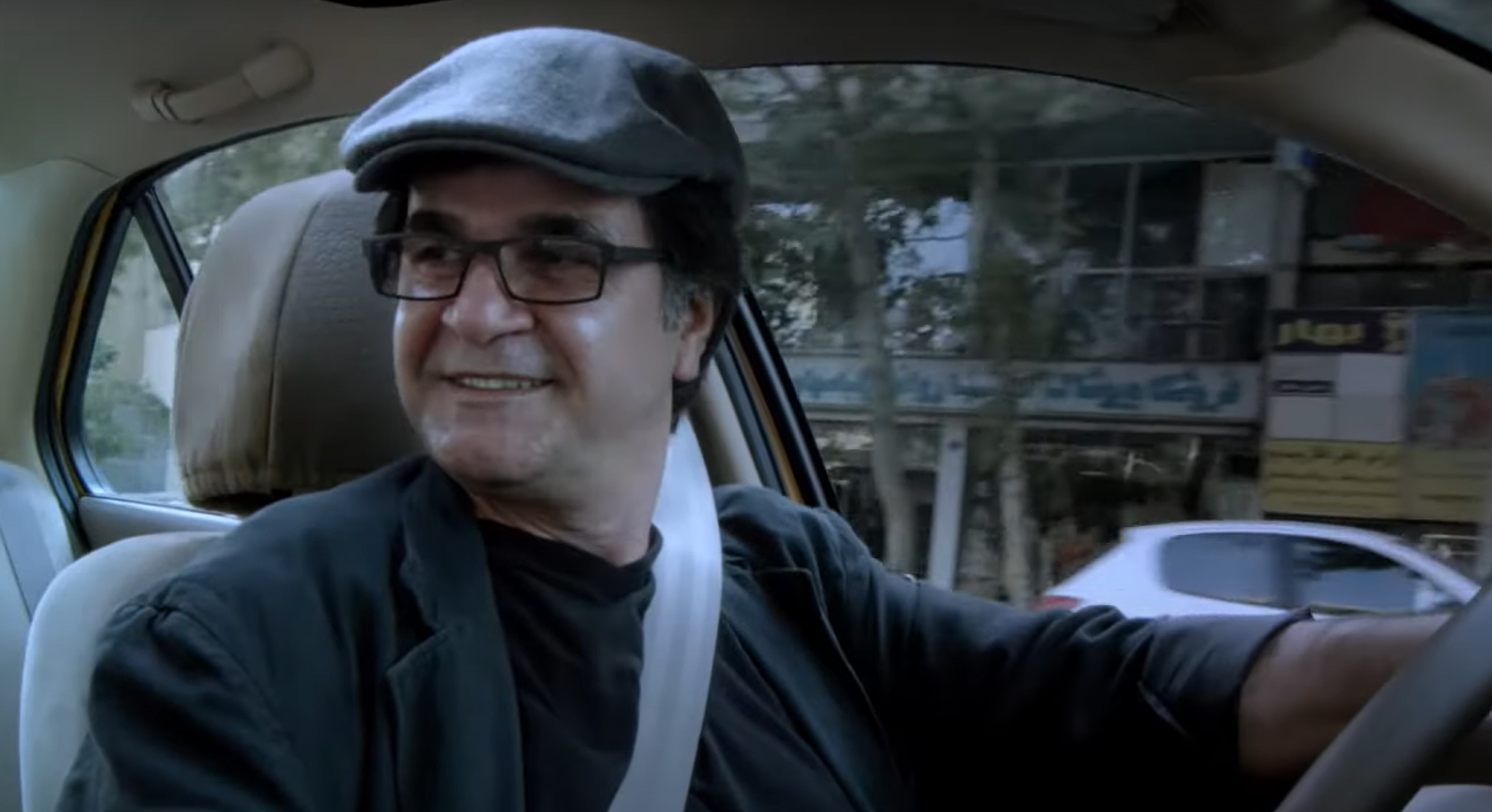
Take Taxi Tehran from 2015 for instance. The film takes place inside a cab with three hidden cameras. Panahi, an internationally acclaimed award-winning Iranian director, plays himself. He just so happens to be driving a taxi around the Iranian capital. What initially seems like an improv documentary eventually turns out to be a satirical conceit. Namely: the director is using the safe space of a private car to freely discuss what would ordinarily be off limits to discuss publicly in the Islamic Republic of Iran.
Among the passengers that Panahi picks up is the Iranian human rights lawyer, Nasrin Sotoudeh. Over the last 15 years she has been imprisoned twice in her native country. Her last stint was for defending women prosecuted for appearing in public without a hijab. Sotoudeh’s husband, Reza Khandan, is also now serving a three-and-a-half year prison sentence for voicing public opposition to Iran’s compulsory hijab laws. In Taxi Tehran, Sotoudeh speaks about defending human rights and free speech in a theocratic-totalitarian-police state. “First they mount a political case,” Sotoudeh explains. “They beef it up with a morality charge, then they make your life hell.”
In that same scene, Sotoudeh notices the director looking at his back window.
“Looking for someone?” she asks.
“I heard a voice … I thought I recognised my interrogator,” Panahi replies.
Sotoudeh mentions how her clients often say this. “They want to identify people by their voices,” she says. “Advantage of blindfolds.”
“This reference in Taxi [Tehran] to prisoners hearing sounds is a communal experience shared by all prisoners of conscience,” Panahi told Index from Los Angeles, via a Farsi translator. “In my current film I wanted to talk about a [similar] experience. This time, however, the sound is coming from a disabled [prosthetic] leg, which becomes the moving engine of the film.”
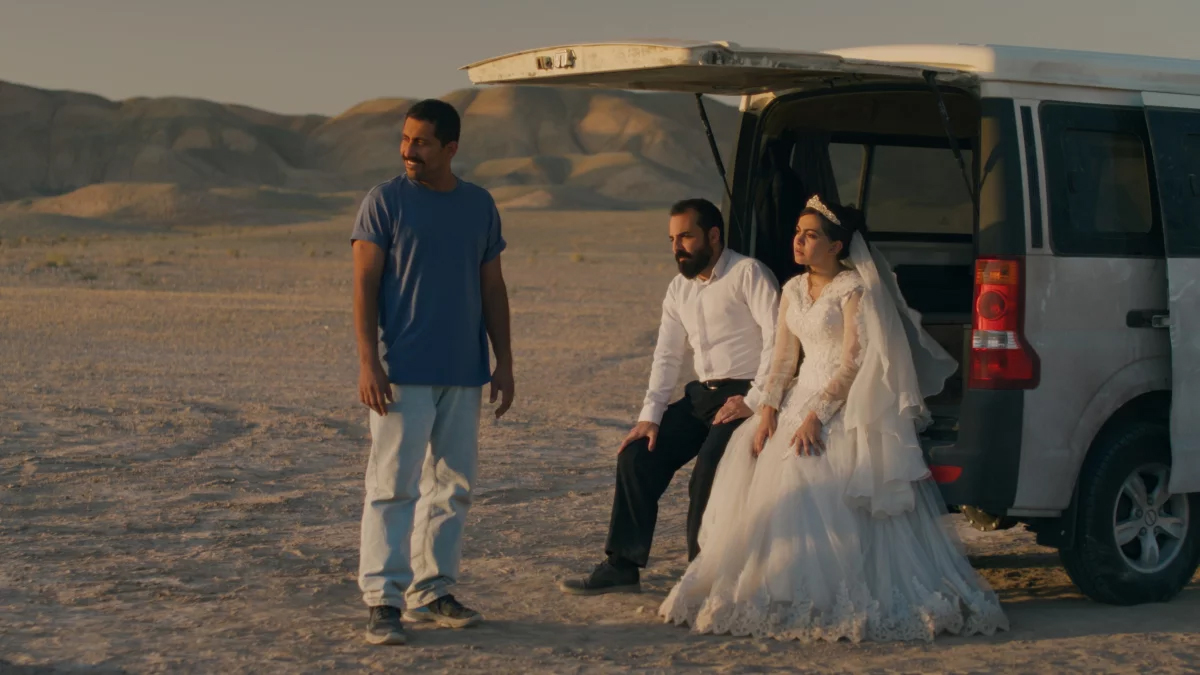
Panahi’s latest movie, It was Just an Accident, won the Palme d’Or at this year’s Cannes Film Festival and opens in UK cinemas this coming Friday, 5 December. The story begins in a mechanics’ workshop, where a man named Vahid is convinced he has just encountered Eghbal – a prison inspector who once caused him great pain and suffering. Vahid hears Eghbal before he sees him. He can never forget the eerie squeaking sound Eghbal’s prosthetic leg makes in motion. He remembers it from prison, where “Peg Leg” was known as a sadistic torturer. The traumatised Iranian mechanic later kidnaps Eghbal and even considers killing him. But has he got the right man? To tease out his doubts, Vahid rounds up a group of former prisoners to seek their advice.
What follows is a brilliant farcical black comedy-road trip movie. Despite the light-hearted banter, the film poses two serious ethical questions. One, how far will an individual – or a group – go to seek revenge on former enemy? Two, at what point does revenge violence make the victim the victimiser?
It was Just an Accident has been selected by France as its official nomination for the Academy Awards this coming March. It may be Panahi’s most overtly political film to date. But the 65-year-old Iranian moviemaker disagrees.
“I don’t make political films, which typically tend to divide people into good and bad,” he insists. “I make social films, where everyone is a human being.”
The film’s script was inspired from several conversations Panahi had with inmates he befriended while serving time in Tehran’s notorious Evin Prison. In March 2010, Panahi was convicted by a Revolutionary Court in Iran of propaganda for his film-making and political activism. He subsequently spent 86 days behind bars, he explained: “For the first 15 to 20 days I was in a small cell in solitary confinement, where I was interrogated.”
That same year, the Iranian regime handed Panahi a 20-year ban that forbade him from directing films or writing screenplays. “This [censorship] I experience presents many challenges to keep making films, but a social filmmaker is inspired by the circumstances in which they live,” said Panahi. “If I lived in a freer society what would inspire me? I don’t know.”
Despite the ban, Panahi is a prolific filmmaker who never stops creating. Many of his films have focused on the complications of making films with a state-imposed censorship hanging over his head. They include the ironically titled, This Is Not a Film (2011), which was smuggled out of Iran on a USB stick concealed inside a birthday cake, and No Bears (2022).
No Bears has two stories in it. The first is about migrants heading off to Europe and the second is about Panahi, who is stuck back in Iran, as his film crew attempt to complete the film they are shooting just across the border in Turkey. The film won the Special Jury Prize at the 2022 Venice Film Festival. Panahi was unable to collect the prize. He was then back in Evin prison, after a Tehran court ruled he must serve the six-year sentence he was handed more than a decade before for supporting anti-government demonstrations.
“According to the law [in Iran] if a sentence is issued but not gone into effect for ten years, it should not be executed,” said Panahi. “However, [the regime] said that this is not true about political prisoners. They were lying though.”
During this second prison term Panahi was in a public ward with 300 or so prisoners, of whom roughly 40 were prisoners of conscience, he said: “On that occasion I did not face interrogations or solitary confinement, which meant I could speak and listen to the prisoners’ stories.”
Panahi remained in prison until the following February. After his release, he noticed many changes in Iranian society. The previous September, a 22-year-old Kurdish woman, Mahsa Jîna Amini, was beaten to death in Tehran by Iran’s so-called morality police after being accused of defying the country’s hijab rule. The state sanctioned homicide inspired the Woman Life Freedom uprising, which saw an estimated two million take to the streets across Iran. Many ripped and burnt posters of their political leaders, while others openly chanted, “Death to the Islamic Republic!” Iranian security forces, meanwhile, responded by killing hundreds of protesters.
“The history of the Islamic Republic [will eventually] be divided into before and after the timeline of this movement,” said Panahi. “The impact has been enormous and even made its way into cinema.”
Specifically, Panahi was referring to the fact that many women who appear in It Was Just an Accident – including actors and extras – are not wearing the hijab. “Much of what you see in the background of the film is people being filmed as they are in daily life in Iran today,” said Panahi. “For example, one woman who agreed to be in the film as an extra said to me: ‘If you are going to force me to wear the hijab, I am not going to do that.’ I told her: ‘You appear as you wish’.”
It’s not a view the authorities in the Islamic Republic endorse. Just days after Index spoke to the Iranian director, he was sentenced in absentia to one year in prison and a travel ban over “propaganda activities” against Iran. The news was broken via the French news agency, Agence France Presse (AFP), who cited Panahi’s lawyer, Mostafa Nili, as a source.
At the time of writing, Panahi remains outside Iran. Prior to news of his new prison sentence being issued, Panahi told Index he could not imagine living somewhere in which he has only a touristy outlook and superficial understanding of the people and culture: “I have lived in Iran for 65 years and I make films about Iranians. I don’t want to stop making films because life without cinema has no meaning to me.”
“[In Iran] when you work you will have problems as a filmmaker there and anywhere in the world the Iranian authorities can get their hands on you,” Panahi concluded. “But you accept this is the price to be paid, and you get through what you have to in order to make the film you want to make.”