NEWS

Banning social media is a kneejerk reaction that should be resisted
While Spain is yet another country considering social media bans, we should remember the dissidents who rely on platforms to organise or let others know what’s happening on the ground
14 Feb 2026

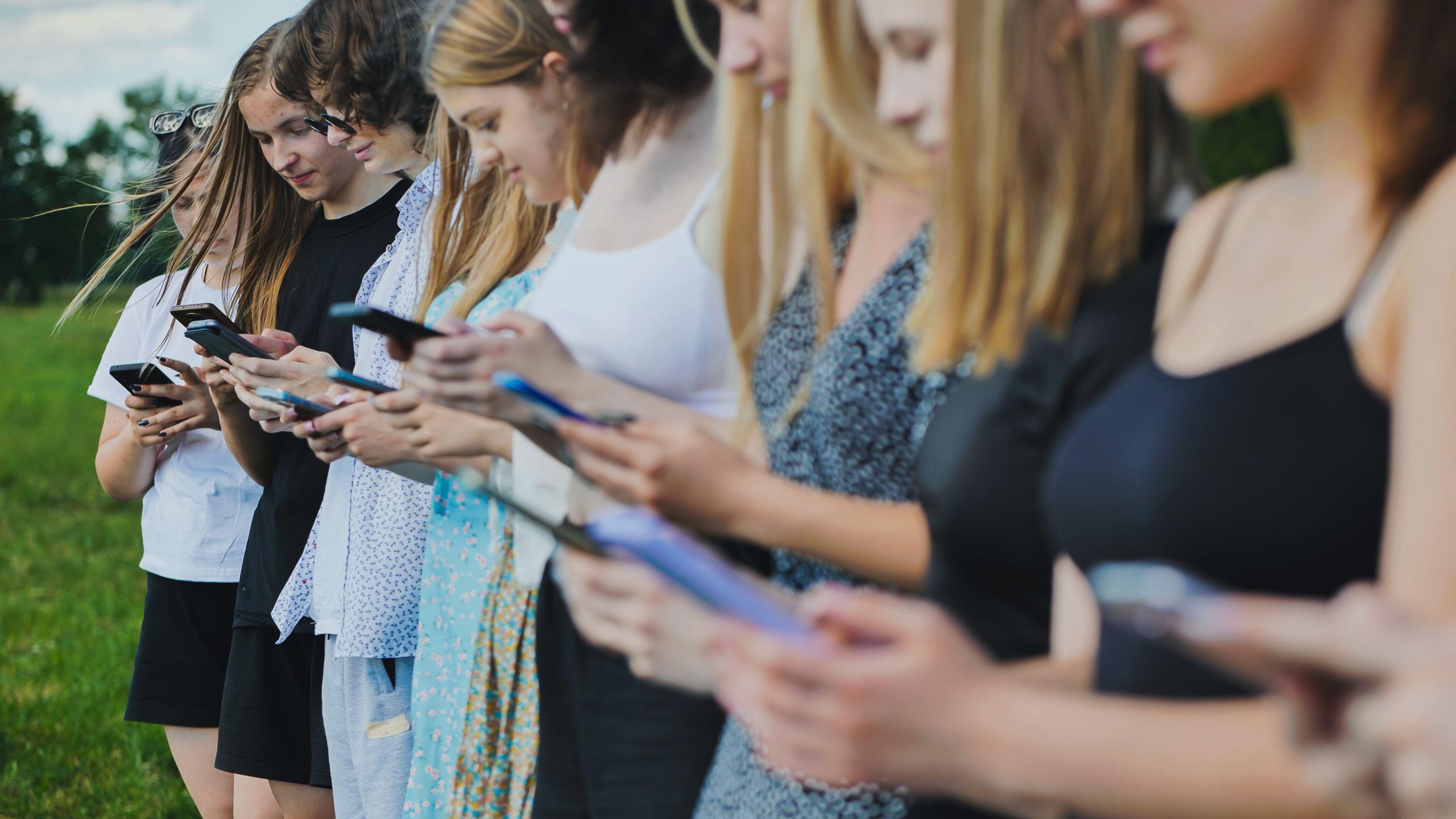
Group of teenage students using smartphones. Credit: Davidovich Mikhail/Alamy

Banning social media for the under-16s appears to be contagious. Australia set the trend in December and now other countries are considering doing the same. There is growing momentum in Britain in favour of a ban (with the House of Lords having voted in favour of one last month). Spain is the first European country to propose legislation and Greece is said to be following suit.

The Spanish prime minister, Pedro Sánchez, has spoken candidly about the abuse he has experienced online, saying it has “crossed many red lines” and nearly caused him to resign in 2024. He’s pushing through laws not only to ban access to major platforms for under-16s, but to hold social media executives criminally responsible if they do not take down illegal or hateful content. The country might even go one step further: Sira Rego, the youth minister, has suggested X should be prohibited altogether, because of the “flagrant violations of fundamental rights” taking place on the platform. She listed various issues, including the sexual deepfake images generated by Grok, and called the broader social media landscape “undemocratic” and controlled by “a few digital strongmen”. Elon Musk, of course, hit back, first posting on X: “Dirty Sánchez is a tyrant and a traitor to the people of Spain”, and an hour and a half later posting “Sánchez is the true fascist totalitarian.”

I am not going cheerlead for Musk here. On X specifically, I find the culture now often unpleasant, somewhere I visit out of habit and seldom linger. And while X seems to be a microcosm of the worst trends of social media today, the other major platforms have flaws too. Do read this excellent piece we recently published from Brazilian writer Nina Auras on Meta banning left-wing political accounts in her country.

But for those of us who work in defence of freedom of expression, the question is not whether platforms are flawed. The question is whether restricting access to them will strengthen our speech rights or weaken them.

At Index, we’re not neuroscientists studying the cognitive effects of scrolling and the impact of social media on the young (as a sidenote a landmark trial has just started in Los Angeles on the mental health effects of Instagram and YouTube, the outcome of which will be very insightful). Rather we’re advocates for people whose speech is curtailed, be it journalists, activists or others. From that vantage point, social media remains incredibly important. For the isolated and the marginalised, it can be a lifeline: a source of learning, solidarity and visibility. The platforms continue to help expose state violence, mobilise protest movements and even unseat autocrats. Our recent magazine issue on Generation Z explored exactly that, and for those of us paying close attention to events in Iran, social media provided some of the best access to on-the-ground information. It is for these reasons that, until recently, the governments most eager to ban social media have typically been the least tolerant of dissent. Yes, the calls from Australia, Spain, Greece, the UK and other countries are rooted in different, more admirable reasons. It’s just bans will still have the same impact.

None of the above excuses the abuse, the disinformation, the addictive design of algorithms and democratic interference. Those harms demand attention. But when solutions jump straight to prohibition without reckoning with what might be lost, they begin to resemble moral panics of the past – video games, rock ’n’ roll, the printing press, each once cast as existential threats to society that should be controlled no matter what the cost.

Support free expression for all


At Index on Censorship, we believe everyone deserves the right to speak freely, challenge power and share ideas without fear. In a world where governments tighten control and algorithms distort the truth, defending those rights is more urgent than ever.

But free speech is not free. Instead we rely on readers like you to keep our journalism independent, our advocacy sharp and our support for writers, artists and dissidents strong.

If you believe in a future where voices aren’t silenced, help us protect it.

Make a £10 monthly donation

At Index on Censorship, we believe everyone deserves the right to speak freely, challenge power and share ideas without fear. In a world where governments tighten control and algorithms distort the truth, defending those rights is more urgent than ever.

But free speech is not free. Instead we rely on readers like you to keep our journalism independent, our advocacy sharp and our support for writers, artists and dissidents strong.

If you believe in a future where voices aren’t silenced, help us protect it.

Make a £20 monthly donation

At Index on Censorship, we believe everyone deserves the right to speak freely, challenge power and share ideas without fear. In a world where governments tighten control and algorithms distort the truth, defending those rights is more urgent than ever.

But free speech is not free. Instead we rely on readers like you to keep our journalism independent, our advocacy sharp and our support for writers, artists and dissidents strong.

If you believe in a future where voices aren’t silenced, help us protect it.

Make a £10 one-off donation

At Index on Censorship, we believe everyone deserves the right to speak freely, challenge power and share ideas without fear. In a world where governments tighten control and algorithms distort the truth, defending those rights is more urgent than ever.

But free speech is not free. Instead we rely on readers like you to keep our journalism independent, our advocacy sharp and our support for writers, artists and dissidents strong.

If you believe in a future where voices aren’t silenced, help us protect it.

Make a £20 one-off donation

At Index on Censorship, we believe everyone deserves the right to speak freely, challenge power and share ideas without fear. In a world where governments tighten control and algorithms distort the truth, defending those rights is more urgent than ever.

But free speech is not free. Instead we rely on readers like you to keep our journalism independent, our advocacy sharp and our support for writers, artists and dissidents strong.

If you believe in a future where voices aren’t silenced, help us protect it.

Donate a different amount

Jemimah Steinfeld

Jemimah Steinfeld has lived and worked in both Shanghai and Beijing where she has written on a wide range of topics, with a particular focus on youth culture, gender and censorship. She is the author of the book Little Emperors and Material Girls: Sex and Youth in Modern China, which was described by the FT as "meticulously researched and highly readable". Jemimah has freelanced for a variety of publications, including The Guardian, The Telegraph, The Independent, Vice, CNN, Time Out and the Huffington Post. She has a degree in history from Bristol University and went on to study an MA in Chinese Studies at SOAS.

READ MORE

CAMPAIGNS

SUBSCRIBE

SUPPORT INDEX'S WORK