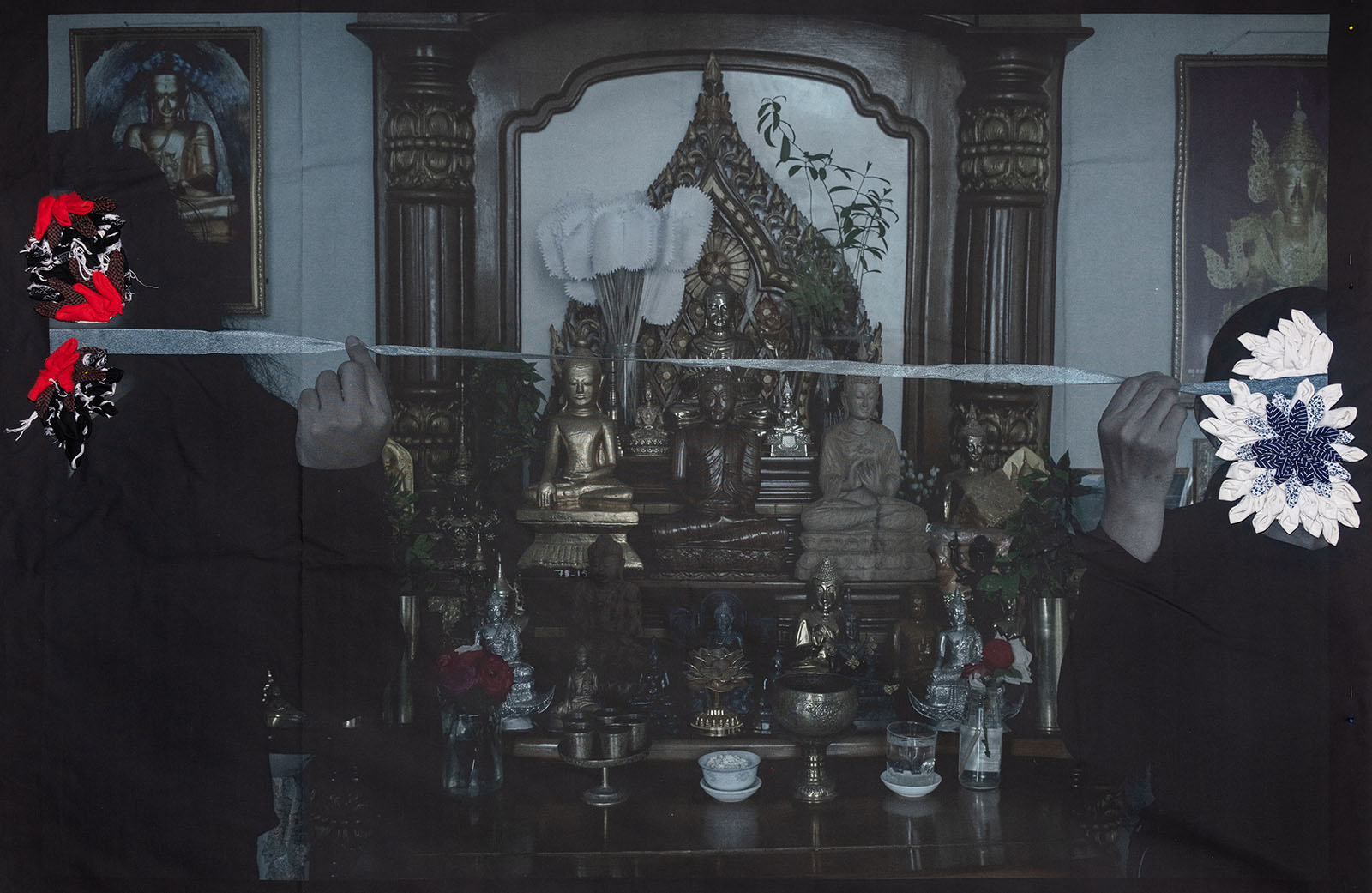
Two months ago, Burmese artist Sai finally received the news he had been waiting for: his application for refugee status in the UK had been approved. He and his wife had been living in turmoil since the morning of 1 February 2021, when the Myanmar military staged a coup d’état against the country’s democratically elected government and established a military junta, arresting thousands of protesters and politicians – including Sai’s father – in the process.
Having spent the last five years fleeing from persecution and attempting to attain justice for his father and his country, Sai, who was nominated for the Index on Censorship Freedom of Expression Award in the Arts category, spoke to Index about the astonishing journey that led him to this point.
Sai came from humble beginnings, hailing from a remote town around 200 miles from the Chinese border. He admitted that his childhood home, which has since been destroyed by an airstrike, was an unlikely place for a future artist to grow up.
“Throughout my childhood we didn’t really have too much electricity or a proper public library,” he told Index. “You can see the lightbulb and it just looked like a tomato, so we used to call lightbulbs tomatoes!
“There was no art, there was not much of a culture.”
Although Sai was an only child with two working parents, money was difficult to come by. The family struggled financially because of what Sai describes as “structural institutional violence by the state”. As a result, his parents were reluctant to see their son being drawn into the arts world.
“They didn’t want me to be an artist,” he said. “When you’re broke, you don’t want your only child to have the least sustainable lifestyle! Whenever I tried to learn music or languages or drawing, my father would initially encourage me but would never support me for the long term.”
Despite their objections, Sai was instantly hooked when at seven years old he got hold of his uncle’s instant camera.
“I can remember when I looked through the viewfinder I felt a sense of liberation,” he said. “Of course, as a kid you don’t know what liberation is, but your heart feels really open.”
His passion was put on hold as his family could not afford a camera growing up, but Sai reacquainted himself with photography in his early twenties while he was training to become a civic educator at the American Center in Myanmar. From there, his love for art grew.
“I transitioned from photography enthusiast to deep into the rabbit hole,” he said. “I found myself experimenting with different forms and concepts, using different media, exploring discrimination and identity.”
This artistic development was suddenly cut short by the military coup in February 2021. His father, Linn Htut was arrested.
Htut was a prominent political figure. Soon after his graduation from dental school and after a foray into political comedy, Htut had become involved in the 1988 Myanmar uprisings, a predominately student movement which led to the emergence of Aung San Suu Kyi.
He remained politically active in opposition and when Suu Kyi’s National League of Democracy party came to power in 2015 he was appointed Chief Minister of Shan state, the largest state in Myanmar which covers almost a quarter of the country.
Like thousands of other political prisoners, Htut was taken by the military to be interrogated and tortured.
“In the first three days [of the coup] he was taken to the military compound, then he was released into house arrest for seven days,” he explained. “During that time I suggested to my father to get out, but he didn’t listen to me; he was eager to show solidarity against the military coup.”
Ten days after the coup started Sai’s father was taken away for good.
Sai’s uncle was arrested on the same day as his father, and his mother was placed in detention. Forced to relocate after his address was made public and unable to help his parents, Sai found other ways to protest against the coup and the oppressive junta.
“I used my small network of artists to create infographics, because during that time of really high stress information got lost really easily,” he said. “[I was] researching fundamental things like what tear gas is, how you treat it.
“Immediately after the coup, when people were not really preparing for the worst, I was already trying to research gunshot wounds, shields and strategies against police brutality.”
At that point, Sai explained that his focus had moved away from making art and into whatever he could do to help the protest movement.
“I never wanted to create art during that time, it was just ‘how can I be useful?’,” he said. “It would be too egotistical just to create art in the time where you can play a role and serve the people in any way you can.”
During this time, Sai was “hiding in plain sight”, living in a building above a police interrogation centre where arrested protesters were taken, before deciding to break into the military compound where his mother was being held, bringing his camera with him.
“The only thing I can do is to document and I was very adamant to bring a camera inside the compound,” said Sai. “That was a death wish because [you go] through many checkpoints and if you are found with a phone or a camera you will be immediately shot or killed, or taken into an interrogation centre to get tortured or imprisoned.”
Thankfully, he was able to get the camera through undetected by hiding it in his wife’s skirt. The resulting photographs of Sai and his mother demonstrate why he was willing to take such a risk.
“I always wanted to take a family photograph, even before the coup,” he explained. “We didn’t have much of a family portrait together because we didn’t have access to a camera.
“My father is absent due to abduction, but I wanted to materialise that idea anyway, so we left a space for him to encapsulate his presence in the absence.”
After collecting everything he needed, he uploaded the photographs, deleted them off his camera and exited the compound the way he came in. Despite having by his own admission risked his life to perform this act of resistance, Sai was quick to downplay his own courage.
“Maybe it’s being ADHD?” he laughed. “For me I don’t have many choices, it’s not out of courage or bravery. When hundreds and hundreds of people get killed every day, dying becomes the new normal.
“I tried to visualise it many times. Would I be okay to die right now, at this moment? I think it helps in a way, I already accept it.
“It’s not a unique situation for me. It’s a new normal that Myanmar people as a collective have to go through.”
Fearing persecution, Sai and his wife left Myanmar and have spent several moving from place to place, reaching out to humanitarian organisations and attempting to spread the word about what was happening at home. His father continues to be in prison and his mother is under house arrest.
In 2023 Sai and his wife relocated to Thailand, where last year one of his exhibitions was censored after Chinese embassy officials demanded that it be shut down. Feeling unsafe in their new home and worried about being deported back to Myanmar, the couple now reside in the UK under refugee status which was granted earlier this year.
With so much distance between him and his home country, Sai said he was able to feel more confident in fighting for his father publicly, even dropping the mask that he had previously used to shield his identity. He credits those who have stood in solidarity against oppressive authoritative networks for helping him to publicly advocate for his father and the tens of thousands of political prisoners held in Myanmar.
“I have managed to meet a lot of individuals like Index on Censorship, Hong Kong activists, artists, researchers, who have been very supportive and shown solidarity,” said Sai.
“People may think that it doesn’t matter, but it does matter a lot.”