NEWS

Killing the joke – the assassination of a Russian cartoonist
Semyon Skrepetsky's murder shows that satirists are (literally) in the Kremlin's firing line
22 Jun 2026

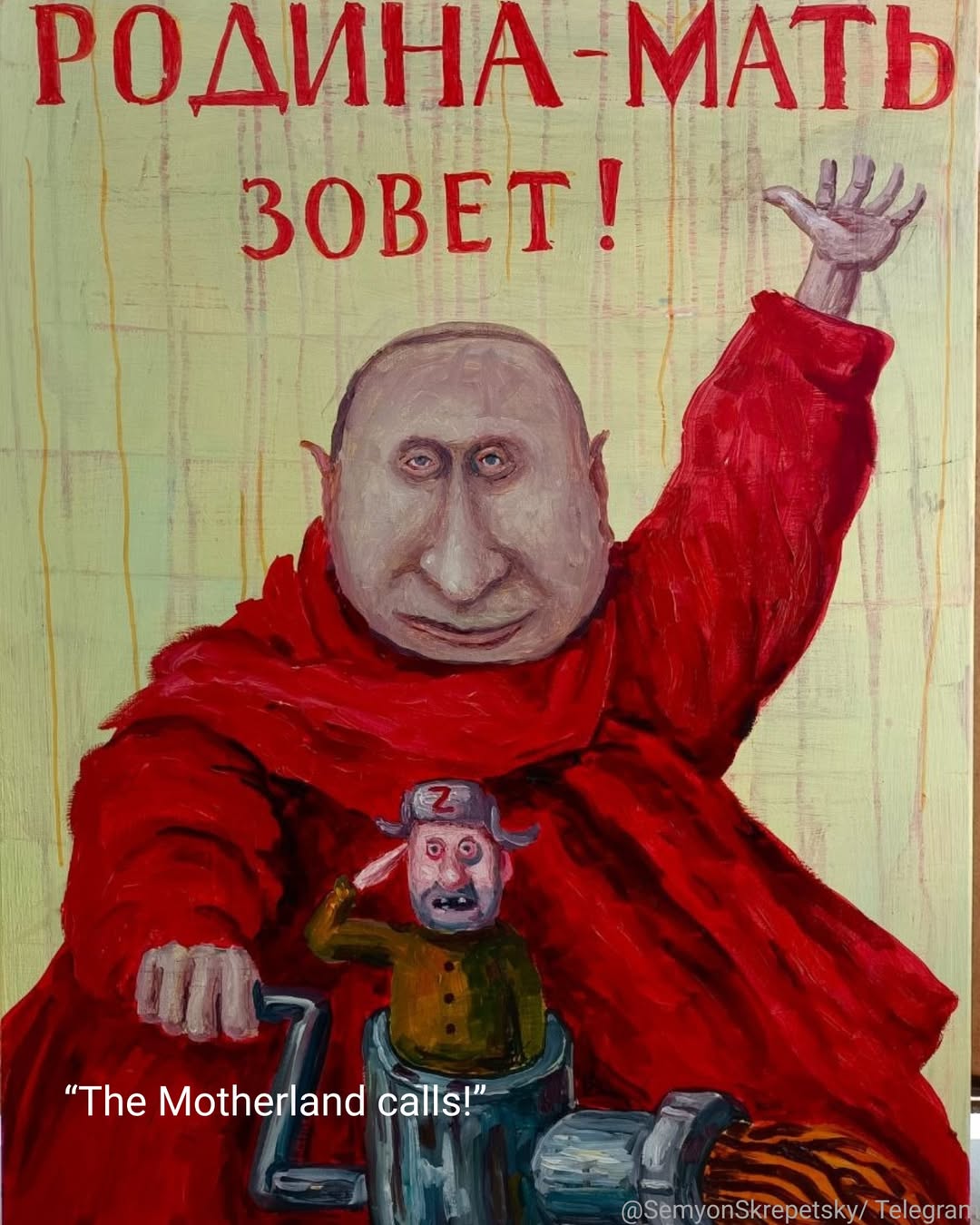
(An illustration by Semyon Skrepetsky) Semyon Skrepetsky/Telegram

Russian artist Semyon Skrepetsky may have achieved exactly the wrong level of fame. He was prominent enough to be known to the Kremlin – and to annoy them – but not so renowned that his murder would trigger a major diplomatic outcry. That, at least, is what one Russian artist I spoke to this week believed about his killing on Monday.

Skrepetsky, whose real name was Robert Kuzovkov, was known for his political caricatures. He drew satirical portraits of Vladimir Putin, Alexander Lukashenka, Chechen leader Ramzan Kadyrov and even Alexei Navalny. He fled Russia in 2021, fearing arrest and moved to the small Polish town of Biała Podlaska near the border with Belarus.

Contrarian by nature, Skrepetsky was initially seen as being pro-Ukrainian and publicly burnt his Russian passport following Russia’s full-scale invasion of  the country in 2022. Later he grew publicly critical of the Ukrainian leadership, which led to him being listed in Ukraine’s Myrotvorets database, a tracker of individuals accused of activities deemed harmful to Ukrainian national security.

But it was Putin who was the focus of most of his criticism. Three days before he was shot dead, Skrepetsky travelled to Berlin to stage a one-man protest outside the Russian embassy, featuring a caricature of Joseph Stalin and Putin. As part of the protest, he filmed himself putting Russia’s flag in a rubbish bin.

It remains unclear who killed him, although a couple of Belarusian men were detained and then released in connection with his murder.

Polish Prime Minister Donald Tusk said the killing has the hallmarks of a political assassination. This, Tusk added, would be “an extremely serious matter internationally. It would constitute state terrorism.” Except Tusk also said justice can be hard in such cases, perhaps already suggesting there is little appetite for a bolder response.

Is Skrepetsky’s murder a sign of an increasingly nervous Moscow? Russia assassinating overseas critics is hardly new. Still, this is the same week that an unmarked Russian warship fired warning shots towards a small British yacht in the English Channel. It also comes at a time of deepening repression in Russia itself. Internet shutdowns are becoming more common. Apps are being routinely blocked. All likely triggered by the war in Ukraine not going as well as planned and worries about public opinion on the home front.

A quiet transfer of power within the Russian state has apparently been taking place. The FSB, successor to the Soviet-era KGB, is increasingly in charge. Their primary focus are threats to Putin, be it from external adversaries or internal dissenters.

Whether Skrepetsky’s death was part of this pattern remains unproven, but what is certain is the Kremlin appears more reactive than ever and more willing to take risks. When regimes are worried about maintaining order, they hit out at the people who make fun of them – and satirists are (literally) in the firing line.

Support free expression for all

At Index on Censorship, we believe everyone deserves the right to speak freely, challenge power and share ideas without fear. In a world where governments tighten control and algorithms distort the truth, defending those rights is more urgent than ever.

But free speech is not free. Instead we rely on readers like you to keep our journalism independent, our advocacy sharp and our support for writers, artists and dissidents strong.

If you believe in a future where voices aren’t silenced, help us protect it.

Make a £10 monthly donation

At Index on Censorship, we believe everyone deserves the right to speak freely, challenge power and share ideas without fear. In a world where governments tighten control and algorithms distort the truth, defending those rights is more urgent than ever.

But free speech is not free. Instead we rely on readers like you to keep our journalism independent, our advocacy sharp and our support for writers, artists and dissidents strong.

If you believe in a future where voices aren’t silenced, help us protect it.

Make a £20 monthly donation

At Index on Censorship, we believe everyone deserves the right to speak freely, challenge power and share ideas without fear. In a world where governments tighten control and algorithms distort the truth, defending those rights is more urgent than ever.

But free speech is not free. Instead we rely on readers like you to keep our journalism independent, our advocacy sharp and our support for writers, artists and dissidents strong.

If you believe in a future where voices aren’t silenced, help us protect it.

Make a £10 one-off donation

At Index on Censorship, we believe everyone deserves the right to speak freely, challenge power and share ideas without fear. In a world where governments tighten control and algorithms distort the truth, defending those rights is more urgent than ever.

But free speech is not free. Instead we rely on readers like you to keep our journalism independent, our advocacy sharp and our support for writers, artists and dissidents strong.

If you believe in a future where voices aren’t silenced, help us protect it.

Make a £20 one-off donation

At Index on Censorship, we believe everyone deserves the right to speak freely, challenge power and share ideas without fear. In a world where governments tighten control and algorithms distort the truth, defending those rights is more urgent than ever.

But free speech is not free. Instead we rely on readers like you to keep our journalism independent, our advocacy sharp and our support for writers, artists and dissidents strong.

If you believe in a future where voices aren’t silenced, help us protect it.

Donate a different amount

Jemimah Steinfeld

Jemimah Steinfeld has lived and worked in both Shanghai and Beijing where she has written on a wide range of topics, with a particular focus on youth culture, gender and censorship. She is the author of the book Little Emperors and Material Girls: Sex and Youth in Modern China, which was described by the FT as "meticulously researched and highly readable". Jemimah has freelanced for a variety of publications, including The Guardian, The Telegraph, The Independent, Vice, CNN, Time Out and the Huffington Post. She has a degree in history from Bristol University and went on to study an MA in Chinese Studies at SOAS.

READ MORE

CAMPAIGNS

SUBSCRIBE

SUPPORT INDEX'S WORK