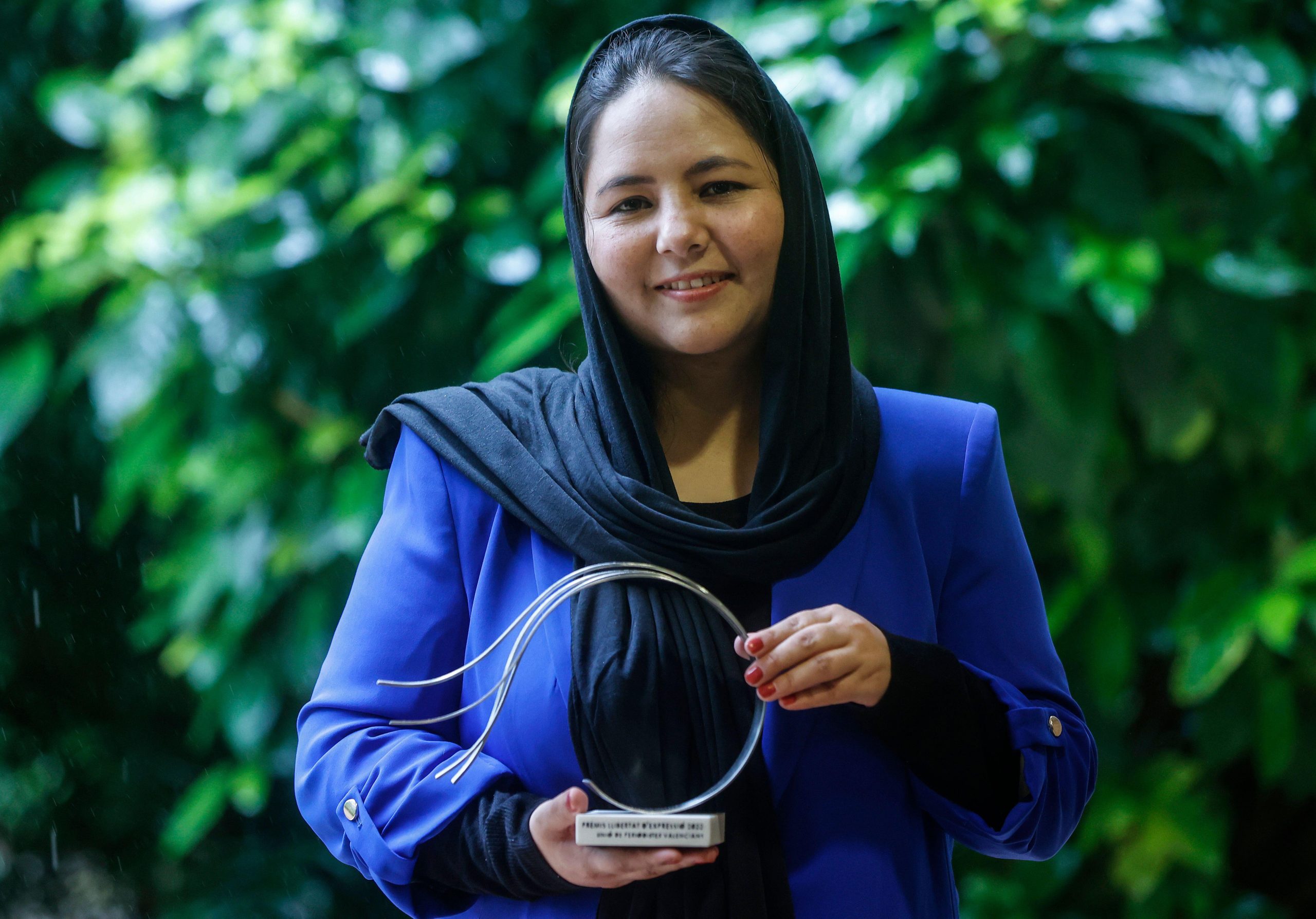
Nearly five years after the Taliban took control of her country and she fled Kabul, Afghan journalist Zahra Joya is telling her story. Her book The Vanishing Girl of Kabul, written with British-American journalist Amie Ferris-Rotman, is a mirror not just for Joya’s life, but for millions of other Afghan women and girls, who she describes as currently living in “home prisons”.
The book tells the story of the Taliban’s brutal silencing of women and Joya’s own life of resistance. How she pretended to be a boy in the 1990s so she could go to school. How her family quickly packed up her grandfather’s handwritten Persian epic while the Taliban raided local villages for banned books. And how she feared for her life when the Taliban returned five years ago. Being a Hazara woman – Hazaras are a persecuted minority in Afghanistan – she grew up with extreme violence levelled at her people.
“It was important for me to record it, for people to understand, for the next generation and the history of Afghanistan,” Joya told Index.
The day before the Taliban returned, she recounts in her book, she had the freedom to go the beauty salon. The next day offered a stark contrast.
“Everything collapsed, including my own freedom,” she said.
As the Taliban drew further into Kabul, she and her colleagues at the women-led publication which she had founded, Rukhshana Media, continued reporting. As Joya saw it, she was standing up for her rights and for freedom of expression, and was making sure the world knew about what was unfolding.
“We never imagined that the Taliban would come to power so quickly, and everything would vanish very soon. We never thought that one day journalism would be a huge risk for the whole team,” she said.
Joya had set up Rukhshana Media only a year before, and even then she was doing something courageous. In Afghanistan’s patriarchal society, the media space was dominated by men, who often held leadership positions.
Now, Joya continues to run Rukhshana Media from London. Her journalists across Afghanistan work underground, protecting their identities by remaining anonymous and never meeting each other. Joya feels she has a heavy responsibility on her shoulders.
Just before she spoke with Index, she received a voice message from one of her journalists describing how she wakes up every morning afraid of what she is going to lose on that particular day. Women and girls are banned from secondary and university education, and most jobs are closed to them. They must cover their bodies completely and even visiting a doctor requires a male chaperone.
“The reality of Afghanistan under the Taliban regime is a complete gender apartheid system,” Joya said.
Since she’s been in the UK, Joya has received a vast number of direct messages on social media from Taliban supporters, threatening her directly for her work and sending her videos of sexual abuse.
But she has received supportive messages too. Now, she hopes readers of her book will reflect on the story, perhaps even take a photo of themselves with it and send her a message.
Writing about her own life has been a difficult experience, and she has had to be careful around details of her relatives who are still in Afghanistan. But Joya said that remaining silent is not a solution.
“It is part of my struggle against the misogyny, discrimination and injustice that is ongoing in Afghanistan,” she said. “The Vanishing Girl of Kabul. Maybe it’s me because I have had to disappear many times and find myself again, but I feel like she could just as easily be the millions of women of Afghanistan.”
The Vanishing Girl of Kabul was published by Robinson on 23 July 2026