NEWS

Dissidents have started challenging Saudi Arabia and Bahrain through the UK courts
Victims of unlawful state surveillance are refusing to back down
01 Dec 25

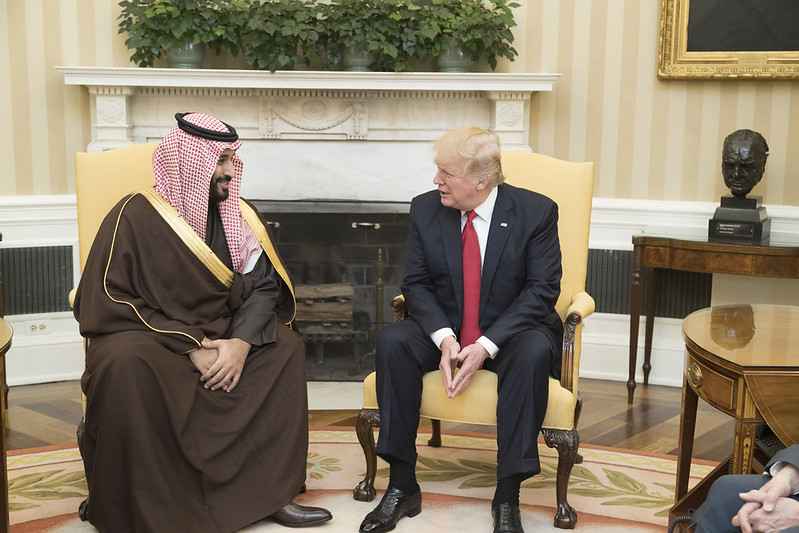
Mohammed Bin Salman and Donald Trump. Photo by Trump White House Archived, Public Domain

While Donald Trump might dismiss the most egregious actions of Gulf States as “things happen”, dissidents are taking justice into their own hands. The Saudi comedian and activist Ghanem Al-Masarir, for instance, has sued the Kingdom of Saudi Arabia for psychological damage resulting from the misuse of private information, harassment and assault after he was attacked in London in 2018. A core part of Al-Masarir’s case rested on Pegasus spyware, which was found on his phone. Such spyware is difficult to definitively trace back, but in this case the court stated that there was “good evidence” Saudi Arabia was responsible. The High Court also ruled that Saudi Arabia did not have immunity under the State Immunity Act 1978, a point the Saudi government appealed in an effort to get the case struck out. They didn’t succeed. The case continues.

A similar case is being heard in the UK’s Supreme Court this week. Saeed Shehabi, a leading Bahraini opposition figure, and Moosa Mohammed, a pro-democracy activist and photojournalist, allege the Bahraini government used FinSpy software back in 2011 to infiltrate their computers while they were living in London, also resulting in psychological harm. Like Pegasus, FinSpy can collect vast amounts of data from infected devices. The hacks occurred months after anti-government protests began in Bahrain. Shehabi and Mohammed were in touch with other activists, journalists and political prisoners.

Bahrain denies being behind the hack and is also claiming state immunity. They’ve lost twice on these grounds in both the High Court and Court of Appeal. Now they’ve taken their case to the Supreme Court, saying prior judges have misinterpreted section 5 of the State Immunity Act 1978 and unduly broadened the scope of its exception to immunity. Judges have argued to the contrary – that under Section 5 a state does not have immunity from claims for personal injury caused by an act or omission which happened in the UK. The Supreme Court can now clarify this point once and for all.

It’s an important moment. If the Supreme Court rules against Bahrain, it sends a clear message about accountability and rule of law on UK shores. For too long the UK has been a playground for the world’s autocrats, who’ve targeted their overseas dissidents here through a variety of means. It would also be a moment of victory for the victims themselves. The psychological impact of surveillance is real. We’ve seen this in action, with Al-Masarir, a contributor of ours. He was due to perform at an Index comedy event two years ago and had to pull out because of poor mental health. The damage caused to these individuals can’t be undone, but at least it can be acknowledged. That’s something.


Support free expression for all


At Index on Censorship, we believe everyone deserves the right to speak freely, challenge power and share ideas without fear. In a world where governments tighten control and algorithms distort the truth, defending those rights is more urgent than ever.

But free speech is not free. Instead we rely on readers like you to keep our journalism independent, our advocacy sharp and our support for writers, artists and dissidents strong.

If you believe in a future where voices aren’t silenced, help us protect it.

Make a £10 monthly donation

At Index on Censorship, we believe everyone deserves the right to speak freely, challenge power and share ideas without fear. In a world where governments tighten control and algorithms distort the truth, defending those rights is more urgent than ever.

But free speech is not free. Instead we rely on readers like you to keep our journalism independent, our advocacy sharp and our support for writers, artists and dissidents strong.

If you believe in a future where voices aren’t silenced, help us protect it.

Make a £20 monthly donation

At Index on Censorship, we believe everyone deserves the right to speak freely, challenge power and share ideas without fear. In a world where governments tighten control and algorithms distort the truth, defending those rights is more urgent than ever.

But free speech is not free. Instead we rely on readers like you to keep our journalism independent, our advocacy sharp and our support for writers, artists and dissidents strong.

If you believe in a future where voices aren’t silenced, help us protect it.

Make a £10 one-off donation

At Index on Censorship, we believe everyone deserves the right to speak freely, challenge power and share ideas without fear. In a world where governments tighten control and algorithms distort the truth, defending those rights is more urgent than ever.

But free speech is not free. Instead we rely on readers like you to keep our journalism independent, our advocacy sharp and our support for writers, artists and dissidents strong.

If you believe in a future where voices aren’t silenced, help us protect it.

Make a £20 one-off donation

At Index on Censorship, we believe everyone deserves the right to speak freely, challenge power and share ideas without fear. In a world where governments tighten control and algorithms distort the truth, defending those rights is more urgent than ever.

But free speech is not free. Instead we rely on readers like you to keep our journalism independent, our advocacy sharp and our support for writers, artists and dissidents strong.

If you believe in a future where voices aren’t silenced, help us protect it.

Donate a different amount

By Jemimah Steinfeld

Jemimah Steinfeld has lived and worked in both Shanghai and Beijing where she has written on a wide range of topics, with a particular focus on youth culture, gender and censorship. She is the author of the book Little Emperors and Material Girls: Sex and Youth in Modern China, which was described by the FT as "meticulously researched and highly readable". Jemimah has freelanced for a variety of publications, including The Guardian, The Telegraph, The Independent, Vice, CNN, Time Out and the Huffington Post. She has a degree in history from Bristol University and went on to study an MA in Chinese Studies at SOAS.

READ MORE

CAMPAIGNS

SUBSCRIBE

SUPPORT INDEX'S WORK